Building an accounts payable system for the MSME 45-day payment rule and 43B(h)/37(2)(g) compliance
Accounts Payable Automation for MSME Vendor Payments India
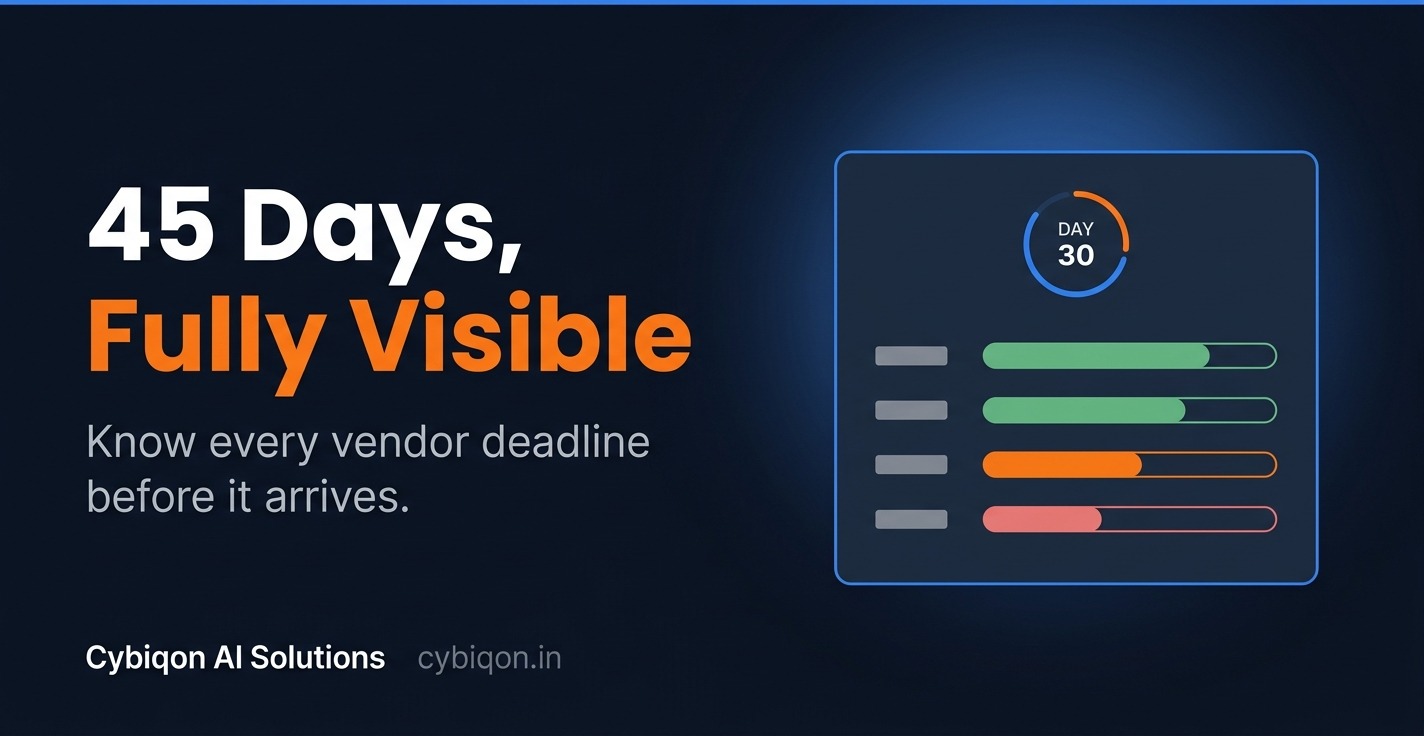
Accounts Payable Automation for MSME Vendor Payments India
If you buy from small suppliers, the most expensive line in your next tax computation may not be a cost at all — it may be a disallowance. Accounts payable automation for MSME vendor payments in India has quietly stopped being a finance nice-to-have and become a dated, auditable obligation. The next hard date is close: the FY 2025-26 tax audit (Forms 3CA/3CB with 3CD) is due 30 September 2026, with ITR filing on 31 October 2026.
The pressure is real. The Economic Survey 2025-26, tabled on 29 January 2026, estimated that around ₹8.1 lakh crore is stuck in delayed payments to MSMEs. On 21 July 2026, MoS Finance Pankaj Chaudhary told the Rajya Sabha the government stands by Section 43B(h) — no relaxation is coming. And on 3 August 2026 the Rajya Sabha passed the MSME Development (Amendment) Bill 2026, tightening enforcement further.
This post is written for the buyer, not the seller: what the law says, where the 45-day clock actually starts (almost every article gets this wrong), and what a working system needs.
The MSME 45 day payment rule: 45 days, 15 days, and who is covered
Section 15 of the MSMED Act, 2006 sets two periods, and mixing them up is the most common mistake in Indian payables:
- 45 days — where there is a written agreement with the supplier.
- 15 days — where there is no written agreement. No PO terms, no signed contract, no agreed credit period? You're on 15 days.
The rule protects micro and small enterprises only — medium enterprises are outside it. And a Udyam certificate alone proves nothing: under the MSME Office Memorandum dated 2 July 2021, traders and wholesalers are excluded from delayed-payment rights, holding Udyam registration for Priority Sector Lending purposes only.
Two things widen the net quietly:
- Revised classification from 1 April 2025 (S.O. 1364(E), 21 March 2025): micro is now ₹2.5 crore investment / ₹10 crore turnover, small ₹25 crore / ₹100 crore, medium ₹125 crore / ₹500 crore. Vendors comfortably "medium" last year may now be small — and newly inside the rule.
- As on 30 June 2026, 8.84 crore enterprises had registered across the Udyam Registration Portal and Udyam Assist Platform (MoS MSME Shobha Karandlaje, Rajya Sabha reply, 20 July 2026). That's cumulative registrations rather than a live headcount — but more of your vendor list falls in scope every quarter.
The 45-day clock starts at acceptance, not the invoice date
This is the most misunderstood line in the subject, and the reason most ageing reports are wrong.
Section 15 does not count from the invoice date. It counts from the day of acceptance of the goods or services, or the day of deemed acceptance — which applies where the buyer received the goods and raised no written objection within 15 days of delivery.
Read literally, that means:
- Inspected and accepted on delivery? The clock starts that day.
- Said nothing in writing? Acceptance is deemed fifteen days after delivery — so with a written 45-day agreement, the outer date can sit up to 60 days after physical delivery.
- Raised a written objection? The period runs from when it was resolved and the goods accepted.
Here's the operational problem: your books do not store an acceptance date. Tally stores an invoice date and a party credit period. Your GRN sits in a register or an email. Your quality rejection sits on WhatsApp. The one field the statute turns on is the field nobody captures.
So any tracker worth building must record, per invoice: delivery date, acceptance date (or deemed acceptance), whether an objection was raised, and whether a written agreement exists. Without those four fields, you're guessing which day of the 45 you're on.
Section 43B(h) compliance now, Section 37(2)(g) from Tax Year 2026-27
Section 43B(h) was inserted by the Finance Act 2023, effective AY 2024-25. The mechanism is simple and brutal: any amount payable to a micro or small enterprise beyond the Section 15 limit is deductible only in the year you actually pay it. Unpaid on 31 March, past the window? It's added back to taxable income.
| Period | Governing provision |
|---|---|
| FY 2025-26 (audit due 30 Sept 2026) | Section 43B(h), Income-tax Act 1961, via the Section 536 saving clause |
| Tax Year 2026-27 onward | Section 37(2)(g), Income-tax Act 2025 (in force 1 April 2026) |
Now the detail almost nobody reports. Clause (g) is expressly carved out of the Section 37(3) proviso — the one that lets other Section 37(2) items be deducted if paid before the return due date. So unlike PF or bank interest, paying the vendor in July does not rescue the previous year's deduction.
Who this binds — read twice. MCA's MSME Form 1 applies to companies only. But 43B(h) and its successor 37(2)(g) apply to every assessee — proprietorships, partnerships and LLPs included. If you're unincorporated and never file MSME Form 1, you are still fully inside the tax provision.
Nor has it been softened. A traders' body challenged the rule in the Supreme Court in 2024; the Court declined to entertain the writ and sent them to the High Court. The rule has never been stayed, and Budget 2026 did not relax it.
A 43B(h) disallowance calculation example — and the Section 16 interest
An illustrative example, not a real client. A ₹40-crore-turnover auto-components maker in Ludhiana with about 220 vendors — job-work shops, a powder-coater, a packaging unit, two logistics providers, an IT AMC firm. Purchases sit in Tally, approvals happen on WhatsApp, payments go out on a Friday when there's cash. Nobody can name which of the 220 are Udyam micro or small; the ledgers carry no Udyam number, no enterprise type, no acceptance date.
Say ₹1.8 crore of micro and small invoices are unpaid past the window on 31 March. That's added back to taxable income. For a domestic company at the 22% concessional rate (roughly 25.17% effective with surcharge and cess), that's about ₹45 lakh of tax pulled forward into a year it was never budgeted for — plus advance-tax interest exposure under Sections 234B and 234C.
To be fair: this is a timing hit, not a permanent loss. The deduction comes back in the year you pay the vendor. But the cash shock is immediate, and one part never comes back — interest under MSMED Act Section 16, at three times the RBI Bank Rate, compounded monthly. With the Bank Rate at 5.50% after the 5 August 2026 MPC, that's 16.5% a year, compounded monthly. It's the Bank Rate, not the repo rate; and it is not deductible under Section 23 and cannot be waived by contract, even if your vendor signs a letter saying otherwise.
Vendor master Udyam verification: how to verify a vendor's Udyam number
All of it depends on one dataset you probably don't have: a vendor master that knows, per vendor, whether they're micro, small, medium or out of scope.
The official route is udyamregistration.gov.in/Udyam_Verify.aspx — one 19-digit URN at a time, behind a case-sensitive captcha, and only if the vendor gave you the number. There is no free official API and no official bulk route; bulk verification exists only through commercial providers such as AuthBridge, Deepvue, Gridlines and Decentro.
That friction is why vendor masters rot. Four traps to design around:
- The trader exclusion. A valid Udyam certificate for a trading firm creates no delayed-payment rights. Store activity type, not just the URN.
- Mid-year registration. A vendor registering in November is in scope for invoices after that date. You need an effective-from date, not a yes/no flag.
- Reclassification churn. Classification moves with investment and turnover, and the 1 April 2025 thresholds reshuffled thousands of vendors. Re-verify yearly.
- Udyam Assist Platform certificates. Whether a UAP certificate carries the same delayed-payment protection is genuinely unsettled — the 2023 gazette equates them expressly only for Priority Sector Lending. Our line: treat a UAP holder as in scope and pay on time.
The fix is a one-time declaration drive collecting URN, enterprise type, activity type and registration date, then automated verification and an annual refresh — the same discipline you apply when you reconcile GST credits against the portal instead of trusting what a vendor typed on an invoice.
Does TallyPrime or Zoho Books already do this? Honestly, partly
We're not going to pretend this is a greenfield gap. It isn't. TallyPrime has shipped MSME features since release 4.1 — an Outstanding MSME Bills report and an MSME Form 1 Annexure with micro/small segregation. Zoho Books ships an "MSME Vendor Bills Unpaid for 40+ Days" dashboard tile. If you're on either, switch them on today; you'll get most of the visibility for free.
Here's where both stop:
| What you need | What Tally / Zoho do today |
|---|---|
| Verified Udyam status per vendor | Udyam number is manually typed input, never verified against the portal |
| Due date from acceptance date | Computed from credit days set on the party, not the MSMED acceptance date |
| Alerts at day 30 and day 40 | No push alerting — a report someone must remember to open |
| Trader exclusion, mid-year registration, reclassification | Not handled |
| Expanded MCA V3 MSME Form-1 fields | Not produced |
That doesn't make them bad software — it makes them accounting systems asked to do compliance workflow. If you're weighing up a Tally alternative for your small business, the answer is usually not replacing the ledger; it's adding a thin layer on top of it.
One dataset, three outputs: ageing report, Clause 22, MSME Form 1
Build this properly and one dataset answers three separate obligations.
1. A payables ageing report at 45 days. Not a 30/60/90 report — one bucketed against the statutory clock, per invoice, from acceptance date, filtered to verified micro and small vendors, with alerts at day 30 and day 40 so payments get made, not just measured. This is where AI-assisted financial workflows earn their keep: the nudge on day 30 beats any report on day 46.
2. Form 3CD Clause 22. Amended by CBDT Notification 23/2025 dated 28 March 2025, for reports signed on or after 1 April 2025. Your auditor must report the total payable to micro and small enterprises under Section 15, the interest inadmissible under Section 23 even if unpaid, and the split between timely and delayed payments — a per-invoice dataset, due with the audit on 30 September 2026. (From Tax Year 2026-27, Form 3CD is replaced by Form 26.)
3. MCA MSME Form 1. For companies only; the April–September 2026 half-year is due 31 October 2026. Penalty under Companies Act Section 405(4) is ₹20,000 plus ₹1,000 per day, capped at ₹3 lakh, on the company and every officer in default. The expanded V3 form (MCA notification, 15 July 2024) asks for PAN, ageing buckets and a structured reason for delay — and the rule that catches people out: if even one payment to a supplier crossed 45 days in the half-year, all payments to that supplier must be disclosed.
What the Amendment Bill 2026 changes — and what it doesn't
Passed by the Rajya Sabha on 3 August 2026 and pending in the Lok Sabha, the MSME Development (Amendment) Bill 2026 adds mediation within 90 days, arbitration referral within 30 days and an award within 90; a new Section 15A making TReDS settlement mandatory for CPSEs; graded penalties of ₹10,000 to ₹1,00,000 for repeat contraventions of Section 22, the buyer's disclosure duty; and a rule that where a dispute drags past six months, the court must order at least 50% payment pending resolution.
What it does not change: the 45-day period under Section 15 or the interest under Section 16. The core obligation is untouched — it just got faster and more expensive to ignore. If you sell to larger buyers too, the same tightening makes it more realistic to recover delayed payments owed to your own business.
FAQs
Is the MSME payment rule 15 days or 45 days?
Both, depending on your paperwork. Under MSMED Act Section 15 it's 45 days where there is a written agreement and 15 days where there isn't — so informal terms with no signed contract put you on the 15-day clock.
When does the 45-day clock start — the invoice date or the delivery date?
Neither, strictly. It starts from the day of acceptance, or the day of deemed acceptance — 15 days after delivery if you raised no written objection. Because acceptance dates aren't stored in most accounting systems, this is the field you most need to start capturing.
Does Section 43B(h) apply to medium enterprises and traders?
No. It protects micro and small enterprises only. Traders and wholesalers are also excluded from delayed-payment rights under the MSME Office Memorandum dated 2 July 2021, even with valid Udyam registration.
If I pay the vendor before filing my return, can I still claim the deduction?
No — the detail that surprises most finance teams. Section 37(2)(g) is expressly carved out of the Section 37(3) proviso that rescues other items paid before the return due date. Unpaid past the limit on 31 March means the deduction shifts to the year of actual payment.
How do I verify a vendor's Udyam registration number?
Use the official checker at udyamregistration.gov.in/Udyam_Verify.aspx — one 19-digit URN at a time, behind a case-sensitive captcha, and you must already have the number. There is no free official API or bulk lookup; bulk verification is only available through commercial providers.
Where Cybiqon fits in
We're a small Indian team building websites, apps and automation for MSMEs, and this is exactly the kind of problem we like — boring, dated, and expensive to get wrong. What Cybiqon builds sits on top of your existing books, not instead of them: a vendor master that captures and verifies Udyam status (handling the trader exclusion and mid-year registrations), a payables dashboard counting the 45 days from the acceptance date per invoice, and WhatsApp or email alerts at day 30 and day 40 — the same dataset exporting straight into Form 3CD Clause 22 and MCA MSME Form 1.
Tell us how many vendors are in your books and we'll show you what a 45-day payables tracker would look like for you. Write to [email protected], call +91 9250711473, or visit cybiqon.in.
The takeaway
The MSME payment rule isn't really a money problem — it's an identity and time problem. Which of your vendors is micro or small right now, and for each unpaid invoice, what day of the 45 are you on? Neither is answerable from a normal ledger, which is why the exposure stays invisible until a CA reconstructs it in late March. Accounts payable automation for MSME vendor payments in India fixes that with three fields and two alerts — verified Udyam status, acceptance date, and a nudge on day 30. Start before 30 September, not after.
Want this set up for your business?
Book a free call — no tech jargon, no sales pressure. Just honest answers.
What we build for this: AI agents & automation