How Indian MSME merchants get their bank accounts frozen by cyber crime complaints and how to get them released
Bank Account Frozen Cyber Crime India: How Merchants Unfreeze
Bank Account Frozen Cyber Crime India: How Merchants Unfreeze
You sold something. The customer paid on your QR code. Weeks later your current account is dead — salaries bounce, the GST challan fails, the supplier's NACH mandate returns, and your branch manager can only say "cyber cell, some other state."
If you searched bank account frozen cyber crime India, almost every page on the first screen is written for one of two people: the fraud victim trying to get money back, or the accused mule trying to stay out of jail. Nobody writes for the third person — the honest shop, clinic, D2C seller, kirana, workshop or small exporter whose only act was accepting a UPI payment from a walk-in buyer they had never met. This guide is for that third person.
The scale is not small. In Punjab alone, 63,749 accounts were frozen in a single year against ₹540.34 crore of fraudulent transactions, with ₹64 crore recovered — figures given by DGP Punjab Gaurav Yadav (The Tribune, 26 June 2026). Many of those accounts belong to businesses that did nothing wrong.
Below: why merchants get caught, the lien-versus-freeze distinction that decides your case, six 2026 High Court rulings you can quote at the branch, the exact grievance route you cannot file yourself, an itemised evidence pack, and honest timelines.
Why an honest merchant gets a bank account frozen for someone else's cyber crime
Person-to-merchant payments are now 63% of UPI volume, and NPCI recorded 23.2 billion UPI transactions in May 2026. Read that as a security fact: every shop QR is an open, unscreened inbound channel. You cannot ask a walk-in buyer where his money came from.
When a fraud victim files on the National Cybercrime Reporting Portal, the money is traced through the accounts it passed into. The first account to receive tainted funds is "Layer 1" — the mule. I4C's Suspect Registry had 32.08 lakh Layer 1 mule accounts shared as on 30 June 2026. But the trail rarely stops there. If a mule spends the money at your shop, you become a downstream receiver, and a freeze instruction can land on your account too.
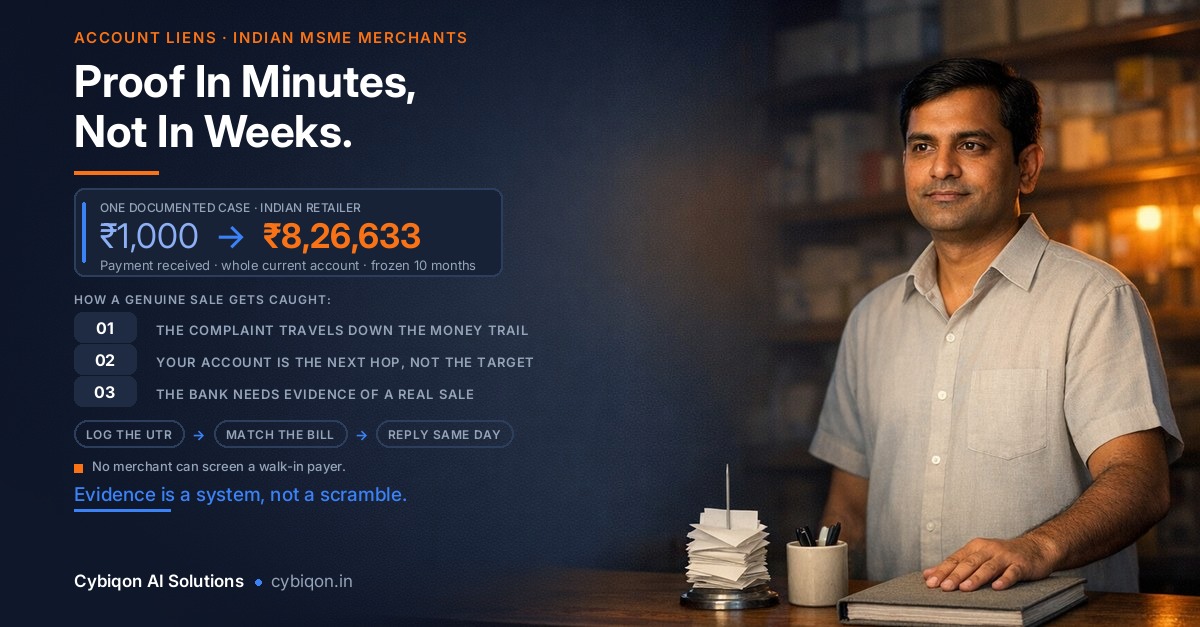
The clearest documented example is a licensed wine trader in Andhra Pradesh. He sold ₹1,000 of liquor to a walk-in customer who paid by UPI. That customer was later accused in a cheating case in Patna, Bihar. On 19 August 2025 the Cyber Cell, Patna directed SBI's Mangalagiri branch to freeze the trader's entire account — ₹8,26,633, with no notice. That is 826 times the disputed sum, and it stayed frozen for roughly ten months until the Andhra Pradesh High Court struck it down in June 2026, holding that a seller "cannot verify the credentials" of every UPI buyer (Sri Sai Wines v. Union of India, WP No. 969 of 2026).
One caution, because other pages overstate it: being a Layer 3 or Layer 4 receiver helps your argument but confers no automatic protection. There is no codified de-minimis rule and no rule that downstream merchants are treated leniently by default. You still have to make the case.
Lien vs debit freeze: the distinction that decides your entire case
This is the single most useful thing to understand, and most merchants never learn it.
- A lien holds a specific sum — say the ₹4,500 that is actually disputed. The rest of your balance should remain operable. Payroll runs. GST gets paid.
- A debit freeze blocks the whole account. Nothing moves.
Banks routinely apply the second when the police order only justified the first. The Bombay High Court at Nagpur addressed this head-on in Kartik Yogeshwar Chatur v. Union of India (20 November 2025): Section 106 BNSS confers a power of seizure only; a debit freeze amounts to attachment, which requires Section 107 BNSS and a Magistrate's order. Banks and intermediaries, the Court held, "are empowered only to place the disputed amount under lien and are not authorised to impose a debit freeze on accounts."
That is the sentence that gets a branch manager to act. Ask, politely and in writing, on what authority the whole balance is blocked when the communication names only a sum.
The Karnataka High Court made the same point with numbers. In Sri Madhu v. IndusInd Bank Ltd. (15 June 2026), the bank had police communications for ₹15,000 and ₹10,000 and froze the entire account "precautionarily". The Court restricted the freeze to ₹25,000 and the balance was released within four days, observing that "a possibility or apprehension of a future event cannot be equated with a lawful order."
The Rajasthan High Court, deciding 105 connected freeze petitions in one batch, used a ₹500-versus-₹5-lakh illustration to explain proportionality. In several of those petitions the disputed transaction was under ₹100, ₹1,000, ₹5,000 or ₹10,000 while entire accounts holding far more were made inoperative — and in some, the disputed amount had not even been crystallised.
The six 2026 rulings every frozen merchant should know
| Court | Case | Date | What it held |
|---|---|---|---|
| Bombay HC (Nagpur) | Kartik Yogeshwar Chatur v. Union of India, 2025 SCC OnLine Bom 4778 | 20 Nov 2025 | S.106 BNSS is seizure only. A debit freeze is attachment, needing S.107 and a Magistrate's order. Banks may lien the disputed amount, not freeze the account. |
| Karnataka HC | Sri Madhu v. IndusInd Bank Ltd., WP 38362/2025, 2026 LiveLaw (Kar) 207 | 15 Jun 2026 | Freeze restricted to the ₹25,000 actually named; balance released in four days. Apprehension is not a lawful order. |
| Andhra Pradesh HC | Sri Sai Wines v. Union of India, WP 969/2026, 2026 LiveLaw (AP) 115 | 22 Jun 2026 | UPI is "a routine mode of payment in petty businesses"; a seller "cannot verify the credentials" of every buyer. |
| Madhya Pradesh HC | Archana v. State of Madhya Pradesh, 2026 LiveLaw (MP) 299 | Late Jul 2026 | Guidelines: bank uploads the grievance in 7 days, IO decides in 15, release implemented preferably within 48 hours, general 90-day release with 15 days' notice to the agency. |
| Allahabad HC | Ritesh Yadav v. Reserve Bank of India, 2026 LiveLaw (AB) 578 | 14 Aug 2026 | "A lien cannot extend beyond that amount in the absence of material showing that the remaining funds are also connected with the alleged offence." Banks must display MHA grievance information at branches and on websites. |
| Rajasthan HC | Shree Balaji Enterprises v. RBI and batch (105 petitions), 2026 LiveLaw (Raj) 348 | 20 Aug 2026 | Twelve directions on proportionality; DGP circular in 4 weeks, compliance report in 8; RBI to issue a general circular to all scheduled banks. |
You cannot file the grievance yourself — your bank must (GRM vs MRM)
This is the most actionable fact on the topic, and virtually no page states it plainly.
The MHA's grievance architecture for frozen accounts runs on the CFCFRMS Grievance Redressal Module (GRM) at ncrp-grievanceredressal.mha.gov.in. It is not self-service for the account holder. Your bank has to register the grievance for you. Walking in and asking the branch manager to do it is not optional politeness; it is the only door.
Do not confuse it with the MRM (Money Restoration Module), which is self-service — but it is for fraud victims reclaiming their money using a 14-digit NCRP acknowledgement number. Merchants routinely apply on the wrong portal and lose weeks. Mainstream news headlines confuse the two as well.
Both sit under the SOP notified in January 2026, with the grievance and restoration modules operational from April 2026.
Your seven steps, in order:
- Get the freeze coordinates from the bank in writing — exact amount held, date marked, whether it is a lien on a sum or a full debit freeze, the name and state of the ordering authority, and the NCRP acknowledgement number or FIR number.
- Establish lien vs debit freeze. If the whole account is blocked but the order named only a sum, you are in the Karnataka and Allahabad situation. Cite it.
- Trigger the GRM through your bank. Carry KYC documents, a passport photo and the transaction statement. The bank must upload within 7 calendar days; you get a trackable Grievance ID.
- The investigating officer must decide within 15 calendar days, examining the transaction trail. Your statement can be taken by video conference — you do not have to travel to Patna or Jaipur. Non-response escalates automatically.
- Escalate on rejection: District Grievance Redressal Officer (Addl./Dy. SP rank) → State-level officer (DG/IG rank) → the jurisdictional Magistrate or High Court. Courts now expect the GRM to be exhausted first.
- In parallel, send a bona-fide-receiver representation by email and registered post to the investigating cyber cell, asking for a dated acknowledgement and offering to appear.
- Do not contact the payer. Do not privately refund the complainant. Anything that looks like coordination with a flagged account damages your position. Route everything through the officer or the court.
The evidence pack that shortens the officer's decision
An IO deciding your case in fifteen days is asking one question: can this business show the transaction was a genuine sale? Give them a pack, not a story. For each disputed credit:
- Bank statement page showing the flagged credit — date, amount, sender VPA or name, UTR
- Tax invoice or cash memo with matching amount, date and serial number
- The order record — POS or billing entry, order ID, or a timestamped WhatsApp or phone order
- Delivery or service-completion proof — signed challan, e-way bill, courier POD, job card
- Customer record — name, phone, any KYC held; GSTIN for B2B
- GSTR-1 and 3B for the period showing the sale reported, plus the e-invoice IRN where applicable
- Your own KYC, shop or trade licence, GST certificate and Udyam registration
- A one-page signed declaration of the transaction particulars and of no knowledge of the payer's other dealings
- A reconciliation sheet mapping every disputed UTR to its invoice number. This one document is what shortens the officer's decision more than anything else.
Be honest with yourself about what this achieves. Good records do not prevent a lien. They shorten the reply. No merchant can screen a walk-in payer — that is the Andhra Pradesh High Court's own holding, not a marketing line.
The merchants who get unfrozen in weeks rather than months are simply the ones who can produce, on demand, one linked record tying each inbound UPI credit to invoice, UTR, order, delivery proof, customer record and GST return. If your sales sit in a notebook and your payments sit in a phone app, that reconstruction takes a fortnight you do not have. Modern billing software for a small business that stores the UTR against the invoice turns the evidence pack into a two-minute export. The same discipline that lets you read your own UPI transaction data is what makes you defensible when a cyber cell asks.
The "90-day rule", explained honestly
Nearly every competing page states this wrongly, so read carefully.
Under the MHA SOP, the 90-day release is tied to disputed sums below ₹50,000 — the same threshold below which refunds can be processed without a court order. Above ₹50,000 the SOP prescribes no timeline at all. LiveLaw lists this as one of five structural gaps in the framework.
There is one exception you can rely on: in Madhya Pradesh, the High Court in Archana has made a 90-day release a general rule, with 15 days' notice to the agency, and directs that release be implemented preferably within 48 hours once granted.
The other honest number is the refund rate. MHA data tabled in the Rajya Sabha on 30 July 2025 showed ₹8,690 crore frozen through CFCFRMS against ₹167 crore refunded — under 2%. A later parliamentary figure shows ₹9,079 crore under lien against ₹206 crore refunded, or 2.27%. As on 30 June 2026, ₹11,158 crore had been "saved" across 32.80 lakh complaints. Every rupee "saved" is sitting in somebody's account, and a large share of those somebodies are ordinary businesses.
What is changing right now — and the accountability gap
There is no dedicated RBI circular governing police-directed account freezes as of 8 September 2026. That is precisely why, on 4 August 2026, the Supreme Court in In Re: Victims of Digital Arrest (SMW (Crl.) No. 3/2025, CJI Surya Kant with Justices Joymalya Bagchi and V. Mohana) directed the RBI to adopt and circulate a nationwide SOP on mule accounts and temporary debit holds within four weeks. That deadline lapsed around 1 September and the next hearing falls this month. For the first time, the protection of the innocent account holder — not only the fraud victim — is being written into national banking procedure.
The gap it has to close is stark. The Ministry of Finance told the Lok Sabha (Unstarred Question No. 2460, 3 August 2026) that the RBI "does not maintain details of amounts frozen, recovered and refunded to victims." Nobody at the central bank is counting how many honest businesses are locked out of their own money.
Two practical notes. The RBI Ombudsman can address your bank's deficiency of service — the failure to inform you, or freezing beyond the sum named — but not the police order itself. Under RB-IOS the Ombudsman may award consequential loss up to ₹20 lakh plus a separate amount for time lost, expenses and harassment, raised to ₹3 lakh under RB-IOS 2026 effective 1 July 2026. Check current terms at rbi.org.in. And practically: a frozen current account is a cash-flow emergency like any other, so the same habits that help you recover delayed payments as an MSME — a second banking relationship, written records, early escalation — are what keep the shutters open while the GRM runs. If your collections depend on a single rail, read up on choosing a payment gateway for a small business before you need the backup, not after.
FAQs
How do I unfreeze a bank account frozen for cyber crime in India?
Get written freeze details from your branch, establish whether it is a lien or a full debit freeze, and ask the bank to register your grievance on the MHA CFCFRMS Grievance Redressal Module — you cannot file it yourself. The bank must upload within 7 days and the investigating officer must decide within 15. Escalate to the District Grievance Redressal Officer, then the State-level officer, then the Magistrate or High Court.
Can a bank freeze my entire account for a small disputed amount?
Courts in 2026 have repeatedly said no. The Bombay High Court held that Section 106 BNSS permits seizure, while a debit freeze is attachment requiring Section 107 and a Magistrate's order. The Karnataka High Court restricted a freeze to the ₹25,000 actually named, and the Allahabad High Court held a lien "cannot extend beyond that amount" without material linking the remaining funds to the offence.
What is the 90-day rule for a frozen bank account?
It is not a universal entitlement. Under the MHA SOP the 90-day release applies to disputed sums below ₹50,000; above ₹50,000 the SOP sets no timeline at all. In Madhya Pradesh alone, the High Court has made a 90-day release a general rule with 15 days' notice to the investigating agency.
What is the difference between the GRM and the MRM portal?
The GRM (Grievance Redressal Module) is for you — the frozen or lien-marked account holder — and must be filed by your bank. The MRM (Money Restoration Module) is self-service, but it is for fraud victims reclaiming money using a 14-digit NCRP acknowledgement number. Both run under the SOP notified in January 2026, with the modules operational from April 2026.
How long does it take to get a frozen account released?
By design, 7 days for the bank upload plus 15 days for the officer's decision — about three weeks. In practice, a documented bona fide receiver typically sees 15–30 days; clear mistaken identity can resolve in 7–15 days; alleged identity theft runs 30–60 days. Multi-state cases are slowest. The Andhra Pradesh wine trader's case took roughly ten months because it went the writ route.
Where Cybiqon fits
Cybiqon AI Solutions LLP builds websites, apps and AI automation for Indian MSMEs — shopkeepers, clinics, manufacturers, D2C brands and small exporters. On this problem specifically, we build the connected billing-and-records layer that ties every inbound UPI credit to its invoice, UTR, order, delivery proof, customer record and GST return, so an evidence pack is a two-minute export instead of a two-week reconstruction. To be clear, that will not stop a cyber cell from marking a lien. It will make your reply faster, cleaner and far harder to reject. If you want your sales, payments and compliance records to actually talk to each other, reach us at cybiqon.in, +91 9250711473 or [email protected].
Conclusion
A bank account frozen over cyber crime in India is not proof that you did anything wrong — it is usually proof that money you legitimately earned once touched somebody else's fraud. Know the difference between a lien and a debit freeze, make your bank file the GRM because you cannot, quote the 2026 High Court rulings at the branch, and keep an evidence pack that ties every UTR to an invoice. The law is finally moving in the honest merchant's favour. Your records decide how fast you benefit from it. Cybiqon can help you build them.
Want this set up for your business?
Book a free call — no tech jargon, no sales pressure. Just honest answers.