End-of-day cash and UPI reconciliation for multi-staff counter shops
Daily Cash Reconciliation App: Why Your Galla Is Short Tonight
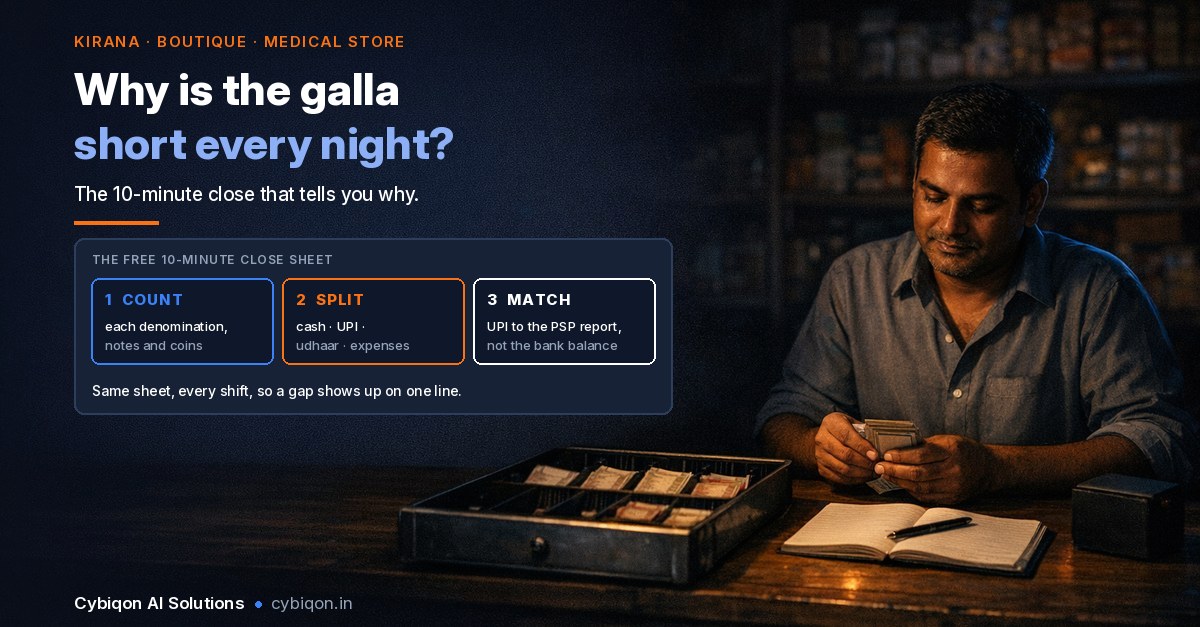
Daily Cash Reconciliation App: Why Your Galla Is Short Tonight
It is 10:40 pm, the shutter is half down, and the galla is ₹2,300 short again. Three people worked the counter today. Somebody took UPI and maybe wrote it as cash. Somebody gave udhaar to a regular. Somebody paid the tempo driver from the drawer. You have one combined total for the day, so you can't tell which of these it was, and the guess ends up landing on a staff member.
A daily cash reconciliation app is meant to answer exactly that question, but most of what ranks for the term is a generic form builder made for American retail. An Indian counter shop has a different problem. According to a Department of Financial Services study reported by ANI on 16 Feb 2026, 94% of small merchants have adopted UPI. So every night you are closing three ledgers at once: cash, UPI and udhaar.
This post gives you a free close sheet you can copy tonight. It also explains why your bank balance never matches today's UPI, how to check a fake payment screenshot, what the MDR deferred until after Diwali means for you, and when an app is worth having instead of paper.
Why does my cash drawer come up short at the end of the day?
Most cash drawer short at end of day problems are recording problems, not theft. Accountune's cash book guide (15 Jul 2026) gives an illustrative example, a composite of real customers with the names changed. A Kota hardware shop's steel cash box came up ₹2,000 short one week, ₹3,500 the next, and nearly ₹6,000 one Saturday. The owner suspected his staff.
None of it was theft. The gap came from three things:
- ₹1,200 in loading and tempo charges paid from the box and never written down
- Three UPI payments counted as cash in the day's sales
- A ₹5,000 advance to his helper that he was keeping in his head
The fix was simple and took about a week: every rupee was written down, with its mode, at the moment it moved.
At your counter the usual suspects are the same, plus two more:
- A miscount at opening or closing, usually from skipping a denomination count
- UPI written as cash, or cash written as UPI
- An unrecorded galla expense, such as chai, courier, tempo or a small repair
- An unrecorded staff advance
- Udhaar given but not noted, so the "sale" has no cash behind it
- A fake UPI screenshot, which shows up as a UPI sale with no credit
- Actual theft, which is the least common explanation and the one you should rule in last
No published study we could find says how often Indian shop drawers come up short, or by how much. What we can say is that a single day total makes all seven causes look the same.
End of day cash closing shop routine with more than one staff member
When three people share one galla, end of day cash closing for the shop has to happen per person or per shift. Otherwise there's no way to know whose shortfall it is. The routine:
- Opening float. Count the drawer by denomination when each shift starts, and have the staff member sign or initial it.
- Every entry carries a mode and a name. Cash, UPI, card, udhaar. "Sale ₹850" isn't enough. "₹850 UPI, Ramesh" is.
- Expenses and advances leave the galla only with a slip. Even a ₹40 chai.
- Handover count. When a shift ends, the outgoing person counts by denomination before the next person touches the drawer.
- Over or short is written with a reason, even when the reason is "not known". Over time those reasons are your data.
For a medical store in Indore with a morning and an evening pharmacist, this means two closes a day, not one. For a boutique in Jaipur where the owner's son and two salespeople all ring up sales, it means one line per person.
Free daily cash reconciliation template (copy this shop cash book format)
Most of the daily cash reconciliation template Excel files that rank are either built for restaurants or locked behind an email form. Here is a shop cash book format you can copy into a notebook or a sheet, with no sign-up. Do one column per staff member or shift.
| Line | Shift 1 (name) | Shift 2 (name) | Notes |
|---|---|---|---|
| Opening float (counted) | Signed by staff | ||
| ₹500 notes × count | |||
| ₹200 notes × count | |||
| ₹100 notes × count | |||
| ₹50 / ₹20 / ₹10 notes | |||
| Coins | |||
| Closing cash counted | Sum of denominations | ||
| Cash sales (as written) | |||
| UPI sales (as written) | Match to app history, not screenshots | ||
| Card sales | Match to POS slip | ||
| Udhaar given | Customer name each | ||
| Udhaar collected in cash | Customer name each | ||
| Galla expenses | Slip for each | ||
| Staff advances | Name each | ||
| Expected cash | Float + cash sales + udhaar collected in cash − expenses − advances | ||
| Over / short | Counted − expected | ||
| Reason | Even "not known" |
Two rules make this sheet work. First, Accountune's guidance is that a credit sale goes into the cash book only when the money actually comes in, and outstanding udhaar is tracked separately in a customer ledger. Second, and this is our own practical advice rather than a standard: write udhaar down at the counter when it's given, with the staff member's name next to it.
UPI payment reconciliation for shop: why the bank never matches tonight
This is where most owners give up. You add up today's UPI, open the bank app, and the numbers don't match. UPI payment reconciliation for a shop fails because your bank balance isn't tonight's UPI. Your payment provider (PSP) settles on its own schedule:
| Provider | What their help docs say |
|---|---|
| PhonePe Business | History > Settlements > Download Settlement Report. The report is available the next day and covers successful payments only. Menu labels may differ in the India app. |
| Paytm for Business | Settlement and Ledger reports showing Settlement Amount, Total payments and Total Deductions, going back up to 24 months, from the app, the dashboard, email or SFTP. |
| Google Pay for Business | Instant (per payment, but payments after 8 pm are credited by 7 am the next day), Daily (a lump sum after midnight that appears the next day), or a Scheduled cut-off. Delays of up to 3 business days. We couldn't confirm a downloadable report. |
A daily settlement can therefore include part of yesterday's collections, a point Munim's reconciliation guide (updated 9 Oct 2026) also makes. So match today's counter UPI entries against the PSP's transaction history, and match the settlement report against the bank separately, a day later.
If your counter uses a QR code linked to a personal savings account, there may be no settlement report at all. In that case your UPI app's transaction history is the record to match against.
A soundbox doesn't solve this either. Paytm's Q1 FY27 results (25 Aug 2026) say about 1.57 crore merchants pay for Paytm devices such as the Soundbox. A voice alert tells you a payment arrived. It doesn't tell you which staff member's sale it was, or whether the sheet says the same.
Fake UPI payment screenshot: how a shopkeeper checks it is genuine
A fake UPI payment screenshot looks like a UPI sale with no credit behind it, and it's a real, current risk. On 20 Aug 2026 Delhi Police (Cyber North) arrested a man linked to 8 cases and over ₹30.81 lakh, who used fake or edited "payment successful" screenshots at small shops in Delhi and Mumbai, according to The Patriot (26 Aug 2026). When the credit didn't show up, he offered to "help resolve" the problem, then took or snatched the shopkeeper's phone. One case was ₹1 lakh at a Sadar Bazar clothes shop.
The check:
- Never accept a screenshot as proof. Pine Labs' 2026 guide advises matching the transaction ID in your own app.
- Open your own business app or bank app and find the credit before the goods leave the counter.
- Never hand your phone to a customer who wants to "help" fix a failed payment.
- Train every staff member on this, because the counter is wherever the busiest person is standing.
On the close sheet, any UPI entry that has no match in your app history is a red flag for that shift.
The UPI MDR after Diwali: UPI collected vs UPI credited
NPCI had planned a 0.4% MDR, capped at ₹300 (the cap is reached at ₹75,000), on P2M UPI payments above ₹2,000 from 15 Oct 2026. On 13 Oct it deferred this to "immediately post Diwali", with the date still to be notified (Business Standard, ANI). Diwali falls on Sunday 8 Nov 2026.
What we know so far:
- Payments of ₹2,000 or less and P2P transfers stay free.
- Small merchants receiving up to ₹1 lakh a month through existing QR codes are reported as exempt, although press reports don't fully agree on where that boundary sits.
- Merchants can't pass the MDR on to customers.
- The Finance Ministry estimates it touches about 4% of merchant transactions.
Merchants aren't happy about it. A LocalCircles survey (16 Sep 2026, 32,796 responses across 242 districts) found only 17% would bear a 0.4% MDR above ₹2,000, and 41% would bear none.
If the MDR does apply to you, UPI collected and UPI credited will stop being the same number. Your close sheet needs a deductions line, and you'll need to read the "Total Deductions" figure on the settlement report.
Khatabook, OkCredit, Vyapar vs a daily cash reconciliation app
These apps are good at what they were built for. Here's what their own docs describe:
- Vyapar has six predefined roles (Secondary Admin, Salesman, Viewer, Biller, Accountant, Stock Keeper) through Sync & Share, and a Day Book with cash in hand.
- OkCredit is a free udhaar ledger with automatic and WhatsApp reminders that carry a payment link. Multi-device use is a premium feature.
- Khatabook listings describe multi-business, multi-device cashbooks. We didn't find staff roles in them.
What we didn't find in any of their docs is a per-staff or per-shift cash close with over/short, voids and discounts logged with a reason, or UPI entries matched against the PSP report. If you mainly need invoices, a guide to billing software covers that ground. For food counters, restaurant billing software is its own category.
Does a shop need a cash book under the Income-tax Act 2025?
It may. Under the Income-tax Act 2025, which came into force on 1 Apr 2026, books of account are required by Section 62 (formerly 44AA). The ₹25,000 penalty for failing to keep, maintain or retain them is Section 441 (formerly 271A).
This only applies above certain thresholds. Secondary sources put them at income above ₹2.5 lakh or receipts above ₹25 lakh for individuals and HUFs, and ₹1.2 lakh or ₹10 lakh for others. Taxpayers on the presumptive scheme (Section 58, formerly 44AD) generally don't have to keep detailed books. Not every shop faces the ₹25,000 penalty, so check with your CA. Either way, a dated daily close is the easiest record to hand them.
When a daily cash reconciliation app makes sense (and when paper is enough)
Paper is enough if you run the counter yourself, or with one trusted person, the drawer balances most nights, and you take UPI on a single QR.
An owned daily cash reconciliation app makes sense when:
- Three or more people take money at the same counter, or you run two shifts
- The drawer is short more than once a week and you can't say why
- You take UPI on more than one QR or PSP, so matching takes longer than counting
- You give regular udhaar and staff hand it out
- You're running more than one counter or branch from the same notebook
These are the same signs we describe in the signs your business has outgrown Excel, applied to the galla. If staff advances are part of your shortfall, they also belong in attendance and payroll so they come off salary automatically.
FAQs
Is there a free daily cash reconciliation template?
Yes. The close sheet in this post is free and ungated. Copy it into a notebook or a spreadsheet, with one column per staff member or shift.
How can a shopkeeper check a UPI screenshot is genuine?
Don't trust the screenshot. Find the transaction in your own business or bank app, matching the amount and transaction ID, before the goods leave the counter. Never hand your phone to the customer.
Should udhaar go in the cash book?
Only when it's paid back. Accountune's guidance is that a credit sale enters the cash book when the money is received, and outstanding udhaar stays in a separate customer ledger. Our practical advice: note it at the counter with the staff member's name when it's given.
Will the new UPI MDR after Diwali apply to my shop?
Only to P2M payments above ₹2,000, and only from a date NPCI hasn't notified yet. Small merchants receiving up to ₹1 lakh a month through existing QR codes are reported as exempt, but check your PSP's notice.
What Cybiqon would build for your counter
For a shop like yours, Cybiqon would build an Android day-close app around your own close sheet, not a template. Each staff member opens and closes their shift with a denomination count. Every UPI entry is matched to your PhonePe, Paytm or Google Pay transaction or settlement report rather than a screenshot. Udhaar, voids and discounts are logged with a name and a reason when they happen, and you get a WhatsApp summary of each shift's over/short when the shutter comes down. You own the code. See how we approach Android apps.
No pressure: WhatsApp +91 9250711473 a photo of your night-close notebook page (blur the numbers) and we'll show you what the app screen for it would look like. Or book a 30-minute call, or email [email protected].
Conclusion
A short galla is rarely a mystery once every rupee carries a mode, a name and a shift. Start tonight with the free close sheet. Match UPI against your app history instead of screenshots, and against the settlement report a day later. Add a deductions line before the MDR arrives after Diwali. When three people, two QR codes and regular udhaar make the notebook take longer than the count itself, a daily cash reconciliation app built around your own sheet is worth a conversation. Send us that notebook page on WhatsApp.
Want this set up for your business?
Book a free call — no tech jargon, no sales pressure. Just honest answers.
What we build for this: Android apps