Dealer locator for a manufacturer's website
Dealer Locator for Website: What Indian Brands Should Build
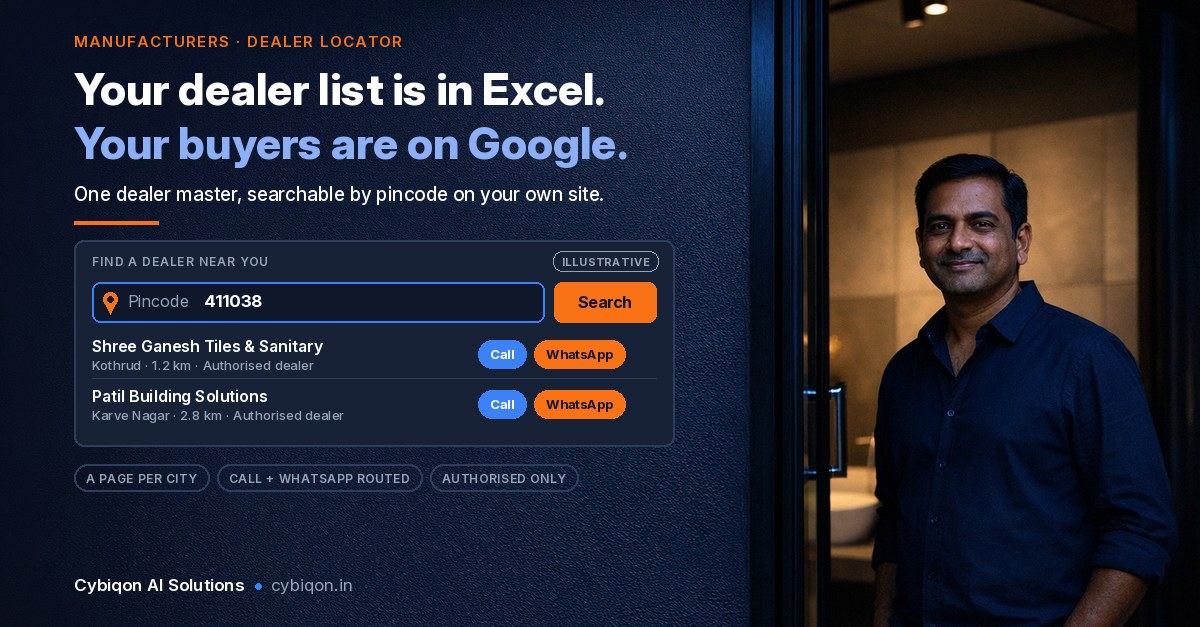
A customer in Sangli wants your submersible pump. She searches your brand name, lands on your website, and finds a "Dealer List 2023" PDF with 400 rows, half of them in towns she has never heard of. So she calls the number in your footer. Your head-office receptionist looks up the Excel the sales team keeps, reads out a dealer's number, and the call ends. Nobody knows whether she bought the pump, from whom, or from a competitor down the road.
A dealer locator for website visitors fixes that moment: type a pincode or city, see the nearest authorised dealers, tap to call or WhatsApp. With 958 million active internet users in India in 2025, 548 million of them rural (IAMAI–Kantar, Internet in India 2025), the buyer looking for your dealer in a tier-3 town is already online.
This guide covers what Google will and won't do for you, when a free Google My Maps embed or a plugin is honestly enough, what the Maps API costs, how to structure city pages without tripping Google's spam rules, and why a published, authorised dealer list is your best defence against fake dealership websites.
Why the dealer Excel and the PDF fail the buyer
In most Indian manufacturers selling paints, tiles, sanitaryware, pumps, inverter batteries, farm equipment or two-wheeler parts, the dealer list has no single owner. It usually looks like this:
- Sales keeps the Excel. Each regional manager has a version. New dealers are added there first, closed dealers are rarely removed.
- The website shows a PDF someone uploaded when the site was built. It has no search, no map, and no way to tell a buyer which dealer is nearest.
- Head office answers "where can I buy this in my city?" calls and passes on a number, with no record of whether the enquiry reached the dealer or turned into a sale.
Kajaria Ceramics, for example, had 1,800+ operative dealers and was adding roughly 200 a year, according to an ICICI Securities report from July 2024. Asian Paints reports about 1.7 lakh retail touchpoints (ICICI Direct, Q2 FY26) and runs a city/pincode store locator on its own site. You don't need that scale for the PDF to break: at 150 dealers it is stale, at 600 it is unusable on a phone.
Meanwhile buyers search "dealer near me" and find directories, aggregators and, sometimes, lookalike websites using your brand name. If your own where to buy page can't answer the question, someone else's page will. That is also a large part of why your competitor shows up on Google when you don't — local search rewards whoever answers the location question clearly.
Can you add your dealers to your brand's Google Business Profile?
The honest answer is: mostly no. Bulk verification of Business Profiles is for 10 or more locations of the same business, and only the owner or an authorised representative of that business may verify. Agencies managing several different businesses can't bulk verify, and service-area businesses are excluded.
An independent dealer is a separate business. Under Google's Business Profile guidelines, a reseller or multi-brand dealer lists its own name — "Sharma Sanitary Stores", not your brand. Only an "authorized and fully dedicated seller" may use the brand name (Google's example is "U-Haul Neighborhood Dealer").
Google doesn't literally say "a brand cannot list its dealers", but it follows from those rules: the dealer owns its listing, and you can't verify a shop you don't own. In practice:
- Your exclusive, brand-only showrooms can carry the brand name on their own profiles.
- Multi-brand dealers keep their own profiles under their own names. You can encourage them to keep those accurate, but you don't control them.
- The one place you fully control the list of where to buy your product is your own website.
Dealer locator for website, plugin or free My Maps: when the free option is enough
Not every brand needs a custom build. Here is the honest comparison.
Google My Maps (free). You can import a spreadsheet straight from your Excel — CSV, XLSX or a Google Sheet, up to 2,000 rows per import and 40 MB. A map can hold 2,000 places per layer and 10,000 places in total. You then paste the Google My Maps embed code on your website. It is the simplest way to add multiple locations to Google Maps on a website, and it costs nothing.
What it can't do: there is no "nearest dealer to my pincode" search. A buyer has to pan and zoom. Someone has to re-import the sheet whenever the list changes, and the dealers live inside an iframe Google's crawler doesn't treat as your page content.
A plugin or SaaS store locator. A store locator plugin for WordPress (or an app on Shopify) gives you search by address, a map and a list. Third-party pricing comparisons (as of August 2026) put Stockist at about $10 a month with a 2,000-location ceiling, and Storepoint at about $25 a month.
| Google My Maps embed | Plugin / SaaS locator | Custom dealer locator | |
|---|---|---|---|
| Cost | Free | Monthly subscription | One-time build, plus Maps usage |
| Dealer limit | 2,000 per layer, 10,000 per map | Plan-dependent (e.g. 2,000 on Stockist) | Your own database |
| Pincode / nearest-dealer search | No | Usually address search | Yes, built around pincodes |
| Call / WhatsApp per dealer | Only as text in the pin | Varies | Yes, as buttons |
| Enquiry logged for head office | No | Rarely | Yes |
| Indexable city and dealer pages | No | Some | Yes |
| Who owns it | Google account | The vendor | You own the code |
My Maps is enough if you have under a few hundred dealers, the list changes a few times a year, and you mainly want buyers to see that dealers exist in their district. A plugin is enough if you're already on WordPress or Shopify, buyers search by city name, and you don't need to know what happened after they found a dealer.
You need something more when the list changes weekly, buyers search by pincode, and sales wants to know which enquiries went where.
Do you need the Google Maps API for a dealer locator, and what does it cost?
Only if you want an interactive map with search. Since 1 March 2025 Google replaced the old $200 monthly credit with free monthly usage per product (SKU). Current list pricing:
- Maps Embed API: free and unlimited. Good for a simple map on each dealer's page.
- Dynamic Maps: 10,000 loads a month free, then $7 per 1,000.
- Geocoding (turning an address or pincode into coordinates): 10,000 free, then $5 per 1,000.
- Places Autocomplete: 10,000 free, then $2.83 per 1,000.
- Text Search Pro: 5,000 free, then $32 per 1,000.
The lesson: geocode each dealer once, when the dealer is added, and store the latitude and longitude in your own database. Then the "nearest dealer" search is your own maths on your own data, not a paid API call for every visitor. Don't wire the search box to Text Search, the expensive SKU; a pincode lookup doesn't need it.
For most Indian brands, a well-built dealer locator for website use stays inside the free tiers, because the map loads only when someone asks for it and the heavy work is done once per dealer.
What a dealer locator for website buyers in India actually needs
Most guides to dealer locator software assume a US buyer who types a zip code and sends an email. Yours is different.
- Pincode first. Indian buyers know their pincode better than their coordinates. A "dealer near me" pincode search should accept pincode, city or district, and fall back to the nearest district when a pincode has no dealer.
- WhatsApp, not a contact form. Each dealer gets a call button and a click-to-chat button using the standard
wa.me/<number>?text=format, with the product pre-filled: "Hi, I found you on [brand] website, I want a 1.5 HP pump." - Built for a mid-range phone on patchy data. A list of dealers should load before any map does. The map is optional.
- One dealer master. Sales edits one list — add, close, change number — and the website updates. No PDF, no re-import.
- Enquiry routing and a log. Each tap is recorded: which pincode, which product, which dealer. If a pincode has no dealer, the enquiry goes to the regional manager instead of vanishing.
That last point is what turns a find a dealer page from a directory into a sales tool. One US manufacturer, Newmar (motor coaches sold through independent RV dealers), had its agency Element Three build a lead portal that routed each enquiry by zip code and product to a nearby stocking dealer, with a fallback dealer. The agency reports $4.5 million in additional retail sales in the first year. That is a vendor-reported figure from one company in a very different market, not a benchmark. But the mechanism — route the enquiry, then check it was handled — is the same one an Indian brand needs.
Should every city or dealer have its own page for SEO?
Yes, where real dealers exist, and only there.
A map widget or search box is invisible to search engines: the crawler can't type a pincode. So a locator that lives entirely inside a search box gives Google nothing to rank. The structure that works is crawlable:
- Hub page — "Find a dealer", listing states.
- City page — "[Brand] dealers in Nashik", listing every real dealer there with address, phone and hours.
- Dealer page — one per dealer, with a map, buttons and directions.
On dealer pages, add LocalBusiness structured data (Google's documentation was updated 8 Sep 2026). Name and address are required; geo coordinates, telephone, a location-specific URL and opening hours are recommended. Use the most specific type, such as Store.
Now the warning. Google's spam policies (updated 28 Aug 2026) list doorway abuse, including "pages targeted at specific regions or cities that funnel users to one page". Generating "Pumps dealer in [every city in India]" pages with no dealer behind them is exactly that. Build a city page only when there is a real dealer in it, and let the page grow as the network grows.
Why an authorised dealer list website protects your brand
In September 2021 Delhi Police arrested four men for running fake dealership websites of Amul, Patanjali and Haldiram, promoted with Google Ads. The Tribune and Hindustan Times reported 126 frauds across 16 states, totalling over ₹1.1 crore. Amul had already put out a press note in August 2020 warning that victims paid between ₹25,000 and ₹10 lakh for fake dealerships.
The pattern hasn't gone away. Hyundai Motor India's dealership page currently cautions about a fake HMIL website, fake email IDs and forged Letters of Intent, and says no agency is appointed to select dealers. Maruti Suzuki's genuine-parts FAQ currently warns that marutisuzukiparts.co.in uses its name and logos without authorisation. A report on The420.in (updated 27 Jan 2026) describes a Ghaziabad man who lost ₹23.53 lakh applying for a distributorship with a "well-known brand" through a lookalike domain.
For context, I4C data shows ₹19,813 crore lost to cheating-related cyber fraud in India in 2025 (all cyber fraud, not only dealership scams).
An authorised dealer list website page gives buyers and would-be dealers one place to check: if a shop or a "dealership offer" isn't on your official list, it isn't you. Pair it with a clear line on how you appoint dealers, and with the steps in our guide to stopping fake domains that use your company name. The same list also helps when you're chasing unauthorised sellers on Amazon and Flipkart, because you can show exactly who is authorised.
With Dhanteras on 6 Nov 2026 and Diwali on 8 Nov 2026, the weeks before both festivals are when most "where can I buy" searches for paints, batteries and two-wheeler parts happen — and when a fake page does the most damage.
FAQs
How do I add a dealer locator to my website?
Start from your dealer Excel: clean it so every row has name, full address, pincode, phone and WhatsApp. For a small, stable list, import it into Google My Maps and paste the embed code on a "Find a dealer" page. For WordPress or Shopify, a store locator plugin can import the same sheet. For pincode search, WhatsApp buttons, city pages and enquiry logging, you need a custom locator that reads from one dealer master.
Is Google My Maps free to embed and how many locations can it hold?
Yes, it's free. You can import up to 2,000 rows at a time, hold 2,000 places per layer and 10,000 places per map. It has no nearest-dealer or pincode search, so buyers must find their area by zooming.
Difference between a store locator and a dealer locator?
A store locator for website visitors usually lists a brand's own shops. A dealer locator lists independent businesses authorised to sell your product, which means you also need to manage who is authorised, route enquiries to them, and keep the list current as dealers join and leave.
How can customers check whether a dealer or website is authorised by the brand?
Check the brand's official website — the domain the brand itself advertises — for a published dealer list, and call the dealer from that list. Be wary of any site asking for a fee to grant a dealership. Several brands, including Hyundai Motor India, currently state on their sites how they appoint dealers and warn against fake websites.
What Cybiqon would build for your dealer network
If your dealer list lives in an Excel sheet and head office takes the "where can I buy" calls, here is what Cybiqon would build: a dealer locator on your site, fed by one dealer master your sales team edits; pincode and city search; a crawlable page for every city where you have real dealers, with LocalBusiness schema; and call and WhatsApp buttons that route each enquiry to the right dealer and log it, so you can see whether it was followed up. It is written for your network and your buyers, not configured from a template, and you own the code. See our custom website development page for how we work.
Email your dealer Excel to [email protected]. We'll tell you honestly whether a free Google My Maps embed is enough for your network or a custom locator is worth building. Or book a 30-minute call, or ring +91 9250711473.
Conclusion
Your dealers own their Google listings; you own your website. A dealer locator for website visitors is the one place you control the answer to "where can I buy this in my city?" — and the one place buyers can check a dealer is genuine. If your list is small and stable, a free My Maps embed may be all you need. If it is large, changes weekly and the calls still land at head office, a pincode search with WhatsApp routing and enquiry logs pays for itself in calls you no longer take. Send Cybiqon the Excel and we'll tell you which.
Want this set up for your business?
Book a free call — no tech jargon, no sales pressure. Just honest answers.
What we build for this: Custom websites