Choosing field service management software in India: complaint-to-closure, cost per technician, and proof of service
Field Service Management Software India: Cost & Proof Guide
Field Service Management Software India: Cost & Proof Guide
Here is the question that actually keeps a service business owner awake, and it is not "should I buy software?" It is: can I prove that complaint was closed?
Not to the customer. To a government portal, inside a deadline, with a dated record.
That is the new reality behind every search for field service management software India in 2026. On 22 June 2026, the Ministry of New and Renewable Energy notified an SOP under PM Surya Ghar that lets a registering agency temporarily deactivate a rooftop solar vendor from the national portal — publicly, by name — for unresolved consumer complaints or "delayed or non-responsive comprehensive maintenance contract (CMC) services." With 40,07,355 rooftop systems installed as of 24 July 2026 (MNRE's written reply to the Lok Sabha), and every one of them carrying a five-year maintenance obligation on the installing vendor, that is a very large number of service jobs that now need evidence attached.
This guide does what the vendor product pages won't: real rupee cost per technician over three and five years, a straight comparison of custom build versus subscription, and an honest section on when renting SaaS is genuinely the smarter call.
What Field Service Management Software Actually Does, Day to Day
Strip away the marketing and a field service system does five unglamorous things.
- Takes the complaint in one place. WhatsApp, a phone call, a DISCOM forward, a web form — all of it becomes one ticket with a number and a timestamp, instead of three messages in a group nobody scrolls back through.
- Assigns the right technician. By area, by skill, by who is actually free. One assignment, one calendar — so two people cannot book the same technician for the same morning.
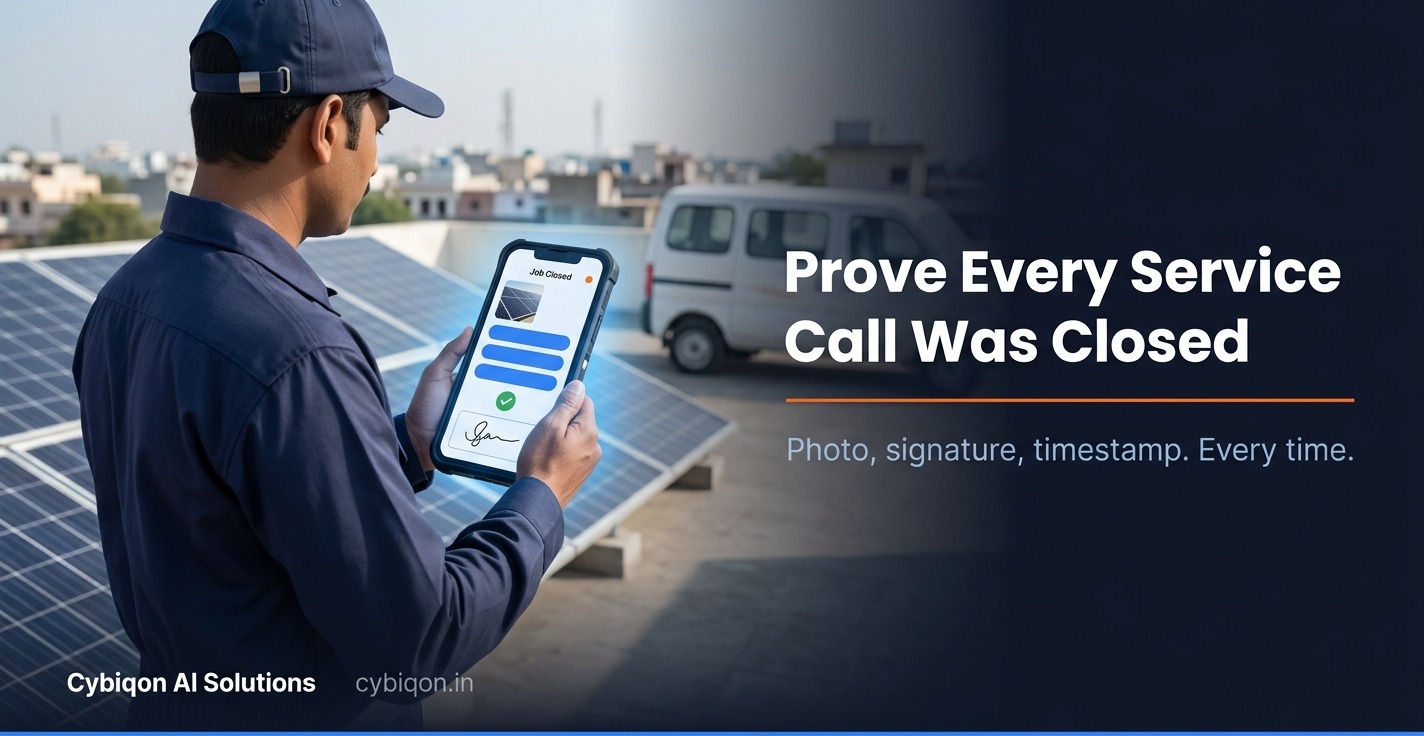
- Carries a job card to the site. The technician opens the job on his phone, sees the customer's history, the machine, the warranty status, the spare parts likely needed. He closes it with photos and a customer e-signature.
- Links the job to the contract. Is this system inside its free maintenance window or out of it? The app answers at the doorstep, not after a two-day argument.
- Tells you when you are about to breach. An SLA clock that shouts before the deadline passes, not after.
That last point is where most Indian service MSMEs are exposed. The 2026 Aquant Field Service Benchmark — built from around 30 million service events across 161 service organisations — puts the industry first-time-fix rate at 77%, with top performers at 88% and the bottom at 60%. That 28-point gap is almost never about technician skill. It is about whether the person who drove 22 km knew which part to carry.
The 22 June 2026 MNRE SOP: Why "Proof of Closure" Became a Compliance Problem
The escalation ladder in the MNRE Office Memorandum is worth understanding precisely, because it runs on dates.
A vendor gets roughly a week to respond to a registered complaint. Then an automated reminder. Then a formal Show-Cause Notice around day 15, with 15 more days to reply. If the response is inadequate, the registering agency deactivates the vendor's national-portal account for one month. There is an appeal window of 30 days, and it requires supporting evidence. MNRE also directed that the names of deactivated vendors be displayed publicly on the portal.
The enumerated violations go well beyond bad installs: substandard installations, missing warranties or certifications, incomplete installations despite payment, project delays after advance payment, obstructing third-party inspection — and delayed or non-responsive CMC services.
This is not theoretical. UPNEDA blacklisted a registered Prayagraj rooftop solar vendor in March 2026 and forfeited its ₹2.5 lakh bank guarantee. In Jammu & Kashmir, 55 clients who had taken J&K Bank loans in 2025 complained against one vendor; KPDCL recommended national-portal suspension and wrote to the SSP Crime Branch, Kashmir.
Now picture the defence. A registered EPC in a tier-2 city with around 600 residential installations — a composite, representative picture rather than any one client — gets a portal complaint. Complaints have been arriving on the owner's personal WhatsApp, a shared "Service Team" group, and sometimes the DISCOM. There is one diary. A technician did attend that rooftop in March. Nobody can prove it. Memory is not evidence, and a WhatsApp group is not a record. The response window and the Show-Cause window both pass while the owner tries to reconstruct a date.
The regulatory direction of travel is the same everywhere else, too. Complaints to the National Consumer Helpline rose from 37,062 a month in 2017 to 1,70,585 in 2025 — 4.6x in a decade — with WhatsApp-based grievance registration jumping from 3% (March 2023) to 20% (March 2025), per the Department of Consumer Affairs. The Consumer Protection (E-Commerce) Rules 2020 already demand acknowledgement within 48 hours and redress within one month. Timestamped acknowledgement and time-bound closure are becoming the default expectation.
And customers feel the gap. A LocalCircles survey in July 2026 — 15,000+ responses across 312 districts — found 66% of Indian consumers with a major service deficiency could not get the provider to help at all. 36% were outright refused, only 27% got resolution, 18% escalated on social media, and 5% had to win in consumer court.
How Much Does Field Service Management Software Cost Per Technician in India?
Here is the arithmetic nobody puts on a pricing page. Take a modest, realistic Indian service MSME: 10 technicians.
| Option | Listed price | 10 technicians / year | Over 3 years | Over 5 years |
|---|---|---|---|---|
| AntMyERP (official India pricing) | ₹1,200/user/month, min 10 users + GST | ₹1,44,000 | ₹4,32,000 | ₹7,20,000 |
| Zoho FSM Standard (partner-quoted) | ₹1,000/user/month excl GST | ₹1,20,000 | ₹3,60,000 | ₹6,00,000 |
| Zoho FSM Professional (partner-quoted) | ₹1,800/user/month excl GST | ₹2,16,000 | ₹6,48,000 | ₹10,80,000 |
| Salesforce Field Service Enterprise | $175/user/month + mandatory Service Cloud (~$165) | ~₹18,00,000+ | ~₹54,00,000+ | ~₹90,00,000+ |
Three honest caveats. The Zoho India figures above are partner-quoted (by PrecisionTech), not Zoho's official list — Zoho's own page runs an appointment-volume calculator with a free tier capped at 30 appointments a month for up to 20 users, which is genuinely useful if your job volume is tiny. Salesforce Field Service cannot be bought standalone: every org must also hold Service Cloud, which is why the effective cost lands near ₹15,000 per technician per month at roughly ₹88/USD. And all of these figures are before GST.
The pattern to notice: the bill grows every time you hire. Twenty technicians doubles it. That is fine when growth funds it — and painful when it doesn't.
Meanwhile the messaging side of a complaint-to-closure system costs almost nothing. WhatsApp utility template messages in India run roughly ₹0.145–₹0.30 each, and service messages inside the 24-hour customer window are free. Automated ETA and closure-proof messages for an entire month of jobs typically cost less than a single technician's software seat.
For context on why this market is heating up: MarketsandMarkets sizes India's field service management software market at USD 339.6M in 2025 growing to USD 726.4M by 2030 — a 16.4% CAGR against 12.5% globally.
Custom Build vs SaaS Subscription: The Honest Comparison
The real objection from most owners isn't the monthly number. It's "why does this get more expensive the more I grow, and why don't I own it?"
Look at that 5-year column again. ₹6–7 lakh for ten technicians, forever, escalating with headcount. Against that, a one-time custom build is an asset that sits on your side of the table. Ask any builder — Cybiqon included — for a fixed one-time quote and put it next to the 5-year number. If the build costs less than roughly three years of seats, the arithmetic makes itself.
There is a second, quieter question: what happens to your data when you stop paying? Most SaaS gives you an export window and then closes the door. If your compliance evidence — the photos, the signatures, the timestamps that answer a Show-Cause Notice — lives inside a subscription you might not renew in 2029, that is a real risk, not a hypothetical one. Custom-built systems on your own database don't have this problem.
But here is where we'll argue against ourselves. Rent the SaaS if:
- You have fewer than about five technicians and no plan to double soon.
- Your workflow is completely standard — book, dispatch, close — with no unusual contract logic.
- You have no compliance exposure. No portal, no statutory AMC, no penalty-clause tenders.
- You need it live next week and cannot wait for a build.
- You genuinely do not have working capital for a one-time spend, and a monthly line item is easier to carry.
For that profile, a subscription is the right, sensible answer and anyone telling you otherwise is selling. Custom starts winning when you cross roughly 8–10 technicians, when your contract rules are odd, or when you must produce evidence to a third party. That decision sits inside a bigger one — whether your business runs on one unified digital system rather than six disconnected tools, which is where most Indian MSMEs actually lose money.
Worth remembering how early this all still is: a Zoho survey of 5,149 Indian MSMEs found 71% still run customer data on spreadsheets, with high software costs and budget constraints ranked as the top barriers — even though 81% planned to increase cloud spend.
AMC, Warranty and the Multi-Trade Compliance Reality
Solar is the loudest example right now, but it is not alone. Different trades face different — and rarely discussed together — obligations.
- Rooftop solar under PM Surya Ghar: the installing vendor is responsible for panel cleaning and all-inclusive O&M for five years at its own cost, as confirmed by the Delhi Government's solar portal. Non-responsiveness is now an enumerated, portal-visible violation.
- Lifts and escalators in Uttar Pradesh: under the UP Lifts and Escalators Act 2024, owners of lifts in public premises must submit their AMC to government, maintain at least monthly, obtain a fitness certificate from the AMC technical team on every visit, make a logbook entry each time, and run mock drills twice yearly. Be clear about the limit here: there is no national law making lift AMC compulsory. This is state-led legislation, and you should check your own state.
- CCTV, DG sets and IT AMCs: Indian institutional tenders routinely carry 1-hour or 4-hour response SLAs with daily penalty clauses. Proving response time is the entire commercial argument at renewal.
What all three share is a demand for a per-visit, dated, signed record — which is exactly what a paper diary cannot produce. It also matters commercially: knowing which contracts are live, which are lapsing and which visits were actually delivered is the foundation of chasing AMC renewals before they quietly expire, which for most service MSMEs is the cheapest revenue in the building.
One boundary worth drawing: this is about servicing your customers' equipment on complaint. Monitoring your own plant and machinery to catch failures before they happen is a different discipline — that's predictive maintenance for factory equipment, and it solves a different problem.
What Complaint-to-Closure Looks Like When It Works
Back to the composite EPC with 600 installations. Here is the same day, rebuilt.
A complaint lands — WhatsApp, portal, or call. It becomes ticket #1442 with an automatic timestamp and an instant acknowledgement to the customer. The system checks the installation date and flags: inside the 5-year CMC window, no charge. No argument at the doorstep, no wrongly absorbed cost.
Scheduling assigns the nearest technician with the right skill, and the app tells him the last visit found a weak MCB — so he carries one. The customer gets an automated ETA message costing under thirty paise. On site, the technician fills the job card, takes before-and-after photos, captures the customer's e-signature and closes the ticket offline if the network is poor; it syncs when he gets signal. The customer receives a closure receipt with the date, the technician's name and the photos.
Six months later a portal complaint arrives about that same rooftop. The owner exports a dated, photographed, signed service history in about ninety seconds — well inside the response window, long before any Show-Cause Notice.
Every one of those steps also protects wrench time — the share of a technician's shift actually spent hands-on, benchmarked globally at just 25–35%, with the rest lost to travel, waiting for parts, hunting tools and paperwork. Cutting a single repeat visit a week per technician is worth more than the software costs. Removing the manual admin around it is the same lever that AI automation pulls for time-strapped Indian SMEs more broadly.
FAQs
How much does field service management software cost per technician in India?
Published India pricing runs from about ₹1,000 to ₹1,800 per user per month for Indian SaaS (AntMyERP lists ₹1,200/user/month with a 10-user minimum plus GST; Zoho FSM figures circulating at ₹1,000/₹1,800 are partner-quoted, not official list). Salesforce Field Service is far higher — $175/user/month Enterprise, and it cannot be purchased without Service Cloud (~$165/user/month), landing near ₹15,000 per technician per month. For ten technicians, Indian SaaS works out to roughly ₹3.6–6.5 lakh over three years.
Can I get a custom field service app built instead of paying a monthly per-user subscription?
Yes, and for many Indian MSMEs it is the better economics. The test is simple: compare a fixed one-time build quote against three years of subscription seats at your expected headcount. If you have eight or more technicians, non-standard contract rules, or a compliance obligation that requires you to produce evidence, ownership usually wins. Under five technicians with a standard workflow, subscription is usually the smarter call.
What happens if a PM Surya Ghar registered vendor doesn't respond to a consumer complaint?
Under the MNRE SOP notified on 22 June 2026, the vendor gets roughly a week to respond, then an automated reminder, then a formal Show-Cause Notice around day 15 with 15 days to reply. If the reply is inadequate, the registering agency deactivates the vendor's national-portal account for one month, and MNRE directed that deactivated vendors' names be displayed publicly. An appeal is possible within 30 days with supporting evidence — which is exactly why dated service records matter.
Is AMC legally mandatory for lifts and elevators in India?
There is no national law making lift AMC compulsory. It is state-led. Under the UP Lifts and Escalators Act 2024, owners of lifts and escalators in public premises must submit their AMC to government, ensure at least monthly maintenance, obtain a fitness certificate from the AMC technical team on every visit, make a logbook entry each time, and conduct mock drills twice a year. Check the statute in your own state rather than assuming.
Does field service software work offline when technicians are in low-network areas?
It should, and this is a question worth asking any vendor directly before you buy. A technician on a rooftop in a low-coverage area must still be able to open the job card, record readings, take photos and capture a signature, with the record syncing automatically once signal returns. If a system needs live connectivity to close a job, your proof-of-closure will have gaps exactly where your riskiest jobs are.
What is a good first-time fix rate for a service business?
The 2026 Aquant Field Service Benchmark puts the industry average at 77%, with top performers reaching 88% and the bottom quartile at 60%. If you are below 70%, the cause is usually information — the technician arriving without the right part or history — not capability. Track it per technician and per equipment type before you try to fix it.
Working With Cybiqon
Cybiqon AI Solutions is a small, early-stage Indian LLP — two people, not a call-centre sales floor. We build websites, apps and AI automation for MSMEs, and for service businesses that means a complaint-to-closure system you own outright: ticketing from WhatsApp and web, area- and skill-based scheduling, a mobile job card with photo and e-signature proof, spare-part and warranty/AMC linkage, automated WhatsApp ETA and closure receipts, and SLA breach alerts before the deadline passes.
It's built as a one-time asset priced for a 3–30 technician Indian business, so your compliance evidence, customer data and service history stay yours. If you're a solar EPC, a lift or CCTV AMC company, an equipment dealer or an IT services firm, we're happy to look at your numbers honestly — including telling you when a subscription is the better fit. Reach us at cybiqon.in, on +91 9250711473, or at [email protected].
The Bottom Line
Choosing field service management software in India in 2026 is no longer just an efficiency decision — it is an evidence decision. With over 40 lakh rooftop solar systems under five-year maintenance obligations, statutory lift AMC rules in states like Uttar Pradesh, and penalty-clause SLAs standard in Indian tenders, the business that cannot produce a dated, photographed, signed closure record is carrying real risk in a diary. Do the arithmetic on three and five years, decide honestly whether to rent or own, and either way — stop relying on memory.
Want this set up for your business?
Book a free call — no tech jargon, no sales pressure. Just honest answers.