Form C / Form III filing compliance for small Indian hotels and homestays under the Immigration and Foreigners Act 2025
Form C Filing for Hotels and Homestays India: 2026 SOP
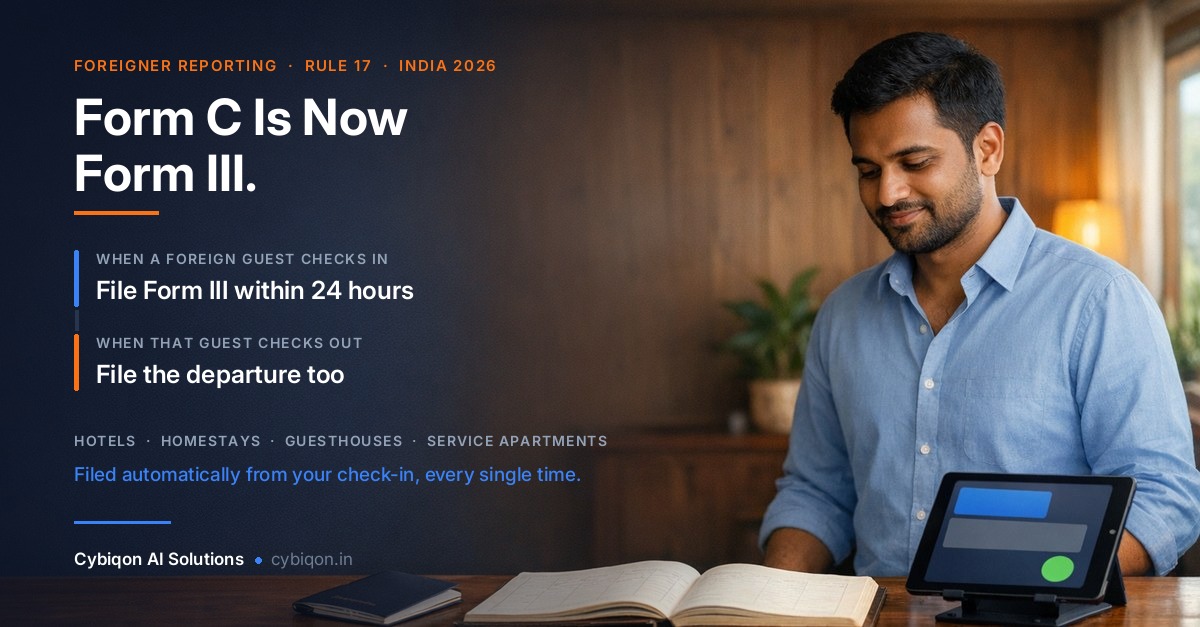
Form C Filing for Hotels and Homestays India: 2026 SOP
If you run a 12-room hotel in Jaipur, three cottages in Coorg, or a service apartment block in Bengaluru, almost everything you have read about Form C filing for hotels and homestays India is out of date. The guides ranking on Google still quote the Foreigners Act, 1946 and the Registration of Foreigners Rules, 1992 — both repealed on 1 September 2025 by Section 36 of the Immigration and Foreigners Act, 2025. Airbnb's own India host help page still cites the old law, as do several guides dated 2026.
The penalty numbers floating around — ₹5,000, ₹25,000, ₹50,000 — are wrong too. In June 2026, police in Ratlam booked a hotel owner and his manager under a section carrying up to three years' imprisonment.
This post is for the person who owns the front desk, not the traveller or the lawyer: the current law with sections cited, the real penalty, whether OCI cardholders and homestays are covered, a check-in-to-checkout SOP, and how to automate it.
Form C or Form III? What the 2025 Act actually renamed
Everyone still says "C-Form" at the desk, and that is fine. But the legal instrument changed name. Under the Immigration and Foreigners Rules, 2025, the document is Form III, prescribed by Rule 17. The parent statute is the Immigration and Foreigners Act, 2025 (Act No. 13 of 2025), in force from 1 September 2025 and published on indiacode.nic.in.
Section 36 of that Act repealed four older laws in one stroke:
- Passport (Entry into India) Act, 1920
- Registration of Foreigners Act, 1939
- Foreigners Act, 1946
- Immigration (Carriers' Liability) Act, 2000
So no — the Foreigners Act, 1946 is not in force. If a vendor or a training deck cites it to you in 2026, that document is a year out of date.
Your duty sits in Section 8, which binds the keeper of any premises where a foreigner stays. Parallel duties sit on educational institutions (Section 9) and hospitals and nursing homes (Section 10) — worth knowing if you take medical-tourism guests, since the hospital carries its own reporting duty and will often ask for your filing reference. Small hospitals fold that into their clinic management software rather than a separate register.
One piece of good news: the Immigration and Foreigners (Amendment) Rules, 2026 (G.S.R. 424(E), June 2026) changed registration timelines, child-citizenship reporting and appeals — but did not touch Rule 17 or Form III. Your hotel duty is unchanged as of August 2026.
The penalty is not ₹50,000 — it is Section 23(b)
This is the most misreported fact on the topic, so let us be precise about where each wrong number comes from:
| Number you have seen | Where it actually comes from | Applies to you? |
|---|---|---|
| ₹5,000 / ₹25,000 | Foreigners Act, 1946 — repealed | No |
| ₹50,000 | Section 18 — carriers, for Section 17 passenger-manifest breaches (airlines, shipping lines) | No |
| ₹1,00,000 "for hospitals" | Section 22 minimum — forged or fraudulently obtained travel documents (₹1–10 lakh) | Only if forgery is involved |
| Up to 3 years and/or up to ₹3,00,000 | Section 20(1) read with Section 23(b) | Yes — this is the hotel charge |
Section 23 is the general contravention provision: up to three years, up to ₹3,00,000, or both. Section 25 allows compounding for Sections 21, 23 and 24, capped at that section's maximum — but compounding is a discretion, not a right, and it does not undo an FIR already registered. Claims about property sealing, daily fines, or a hotel-specific ₹50,000 MHA compounding notification have no statutory basis we could locate on any .gov.in host.
The point is not to frighten you. It is that the number you were quoted comes from the wrong section of a repealed Act — and if you ever have to argue your case, you want to know which section is actually being read to you.
Does this apply to homestays, guesthouses and OCI guests?
Three scope questions decide your exposure, and the answers surprise most operators.
Homestays and small guesthouses: yes. Section 8 binds the keeper of the premises, not "hotels" as a category. There is a proviso for non-commercial premises and Section 8(3) gives the civil authority an override — but if you take money for a room, you are a commercial keeper. Srinagar police made this concrete on 8 December 2025: five FIRs across nine establishments — four hotels, one homestay, one private house and four houseboats — citing Sections 8 and 23-B.
NITI Aayog's August 2025 report with IAMAI, Rethinking Homestays: Navigating Policy Pathways, counted roughly 2.6 lakh active homestays in India, only about 12% of them formally registered — a ₹4,722-crore market (IMARC, 2024) largely outside the compliance system.
OCI cardholders: yes — this is new and it catches people out. The Bureau of Immigration is unambiguous: "Form III applies to all foreigners, including OCI Cardholders. The responsibility of filling Form III and submitting it on the e-FRRO portal is of the accommodation provider." The Kohima DC's order of 6 May 2026 says the same — "any foreigner or OCI cardholder." OCI holders were previously exempt. If your desk still waves an OCI card through, fix that today.
That quietly enlarges your filing population. India saw about 9 million foreign tourist arrivals in 2025 (Ministry of Tourism / BOI via PIB, 11 February 2026) but 18.6 million international visitors overall, down 7.4% (TTG Asia, 24 August 2026). The gap is largely NRI and OCI arrivals — and since Form III now covers OCI cardholders, the bigger number is your obligation.
Nepali and Bhutanese guests: do not assume. The Immigration and Foreigners (Exemption) Order, 2025 exempts them from passport and visa requirements — that is not an exemption from your filing duty, and the BOI says Form III covers all foreigners. Likewise the "12 hours for Pakistani, Bangladeshi and Chinese nationals" line appears only in legacy training material, not in the 2025 Act or Rules. If either comes up, ask your local FRRO in writing and keep the reply.
The 24-hour clock, the departure filing, and the one-year retention
Rule 17(5) — quoted verbatim in the Kohima DC order — says the keeper "shall transmit duly filled Form-III electronically within 24 hours of the foreigner's arrival," via indianfrro.gov.in or the official MHA app Indian Visa Su-Swagatam.
But Rule 17 asks for three more things almost no guide mentions — and they are exactly what an inspector checks:
- Particulars at both arrival AND departure. The check-out filing is real, not a leftover myth. You record the date and time of departure and the onward address.
- The guest signs. Form III carries the foreigner's signature, so capture has to happen while they are at the desk, not reconstructed later.
- Records retained electronically for at least one year.
Districts can be stricter than the statute. Shopian Police's advisory of 10 July 2026 requires submission "immediately after the guest checks in" — tighter than the 24-hour window. Goa Police publish their own advisory on citizen.goapolice.gov.in. Check your district's order: the Act sets a floor, not a ceiling.
That one-year retention duty has a second consequence: you are holding a foreign national's passport image, visa details and photograph for at least twelve months. That is sensitive personal data, and DPDP Act obligations around consent, purpose limitation and deletion apply. Rule 17's retention floor and the DPDP Act's minimisation principle meet at "keep it a year, in one controlled place, then delete it" — not "WhatsApp the passport photo to the owner's phone forever."
The front-desk SOP: what to capture, who owns the clock
Here is the process, written for a property running two or three people on rotation, not a compliance department.
At check-in, capture once and capture completely:
- Full name exactly as printed on the passport
- Nationality, passport number, place and date of issue, expiry
- Visa number, type, place and date of issue, validity — or OCI card number
- Date and time of arrival at your property
- Previous address in India and intended duration of stay
- Contact number, email, and the guest's signature
- Scans of the passport photo page, the visa page or OCI card, and the arrival stamp
Who owns the 24-hour clock. Name one person per shift — not "reception." The case small properties get wrong is the late arrival: a guest checking in 11:40 pm Friday must be filed by 11:40 pm Saturday — a weekend shift with the least experienced staff. Write the deadline on the handover, every time.
At check-out. File the departure particulars: date, time, onward address. Ask for that onward address at check-in, not while the taxi waits.
The inspection folder. Keep one record per guest for a year: the Form III submission reference and timestamp, the departure filing, the signed form, the scans. Pahalgam is the cautionary tale — the March 2026 FIR at Hotel Misty Mountains, covering 23 foreign nationals including 19 British citizens, came out of a routine inspection, not a complaint. Chasing scans and signatures after the fact is the same losing game as chasing paperwork from clients, which is why a structured document collection portal beats a WhatsApp thread.
What enforcement actually looked like in 2026
If you think this is a big-city problem, look at the 2026 record.
- Ratlam, MP — 2 June 2026. Four Chinese nationals stayed at Ajanta Palace Hotel from 17 December 2025 to 20 January 2026. No C-Form was ever uploaded and the local police station was never informed. Station Road police registered an FIR under Section 20(1) r/w Section 23(b) against operator Dr Subhash Agarwal and manager Shiv Singh Rathore — over four months after checkout (Free Press Journal). A tier-3 town.
- Pahalgam, J&K — March 2026. Hotel Misty Mountains, Anantnag. 23 foreign nationals, caught in a routine inspection.
- Srinagar — 8 December 2025. Five FIRs, nine establishments, including a homestay and four houseboats.
- Goa — 15 May 2026. Nine deported in May alone (five Ugandan, three Russian, one Nigerian), seven more detected at Mandrem, ~120 deported through 2025. Goa FRRO urged hotels, guest houses and landlords to file C-Forms promptly (O Heraldo).
Two patterns matter. The trigger is usually a routine inspection, not a complaint — "nobody has asked us in years" is not evidence of safety. And the exposure is retrospective: Ratlam was charged for a stay that ended in January.
How to register and file on indianfrro.gov.in
There is no successor portal; indianfrro.gov.in is current. Hotels, guesthouses and homestays use indianfrro.gov.in/frro/FormC — district pages such as hpkangra.nic.in route you there.
- Register your property in the FormC section — legal name, address, district, category (hotel, guesthouse, homestay, service apartment) and state licence details.
- Nominate the responsible person with a working email and mobile; credentials land there, then wait for FRRO or district approval of the account.
- File Form III per guest within 24 hours of arrival, and again at departure.
- Or use the official MHA app, Indian Visa Su-Swagatam, named in Rule 17(5).
Can the guest file it themselves? No. The duty sits on the accommodation provider under Section 8 — a guest's own registration does not discharge your obligation.
Automating Form C filing from your hotel software
The failures we see at Cybiqon are predictable: the 11 pm arrival, the staff member who left, the checkout nobody filed, the passport scan in a phone gallery. And Form III is not your only paperwork — Hotelivate's Manav Thadani noted in July 2024 that Indian hotels need roughly three times the licences other countries do, some states demanding up to 100 approvals. Form C filing is the one that repeats every single check-in.
What automation should do:
- Capture passport, visa and OCI details once, at the desk, on a tablet or the guest's phone
- Validate the fields Form III needs before the guest walks away
- Auto-submit inside the 24-hour window and store the acknowledgement
- Fire a departure-filing reminder at check-out
- Keep a timestamped, one-year, inspection-ready log you can hand over on demand
The principle is the one behind every recurring deadline in a small business: an obligation tracked in someone's head is one you will eventually miss. Properties that solve it stop treating bookings, guest documents and compliance as three systems and move to one unified digital system where the check-in record is the compliance record — the approach Cybiqon builds for.
With the October inbound season opening, this is the quarter to fix it.
FAQs
What is the penalty if a hotel does not file Form C?
The charge police actually use is Section 20(1) read with Section 23(b) of the Immigration and Foreigners Act, 2025: up to three years' imprisonment, a fine up to ₹3,00,000, or both. The widely quoted ₹50,000 is Section 18 and applies to carriers such as airlines. The ₹5,000 and ₹25,000 figures come from the repealed Foreigners Act, 1946.
Do I have to file Form C for an OCI cardholder?
Yes. The Bureau of Immigration states that Form III applies to all foreigners including OCI cardholders, and that responsibility to submit it on the e-FRRO portal rests with the accommodation provider — reversing the earlier position, where OCI holders were exempt.
Do homestays and small guesthouses have to file, or only hotels?
Section 8 binds the keeper of the premises, not a category called "hotels". Commercial homestays, guesthouses, service apartments and houseboats are covered — Srinagar's December 2025 FIRs included a homestay and four houseboats.
Do I have to file again at check-out?
Yes. Rule 17 requires particulars at both arrival and departure, including date and time of departure and the onward address — the step small properties miss most often.
Get your front desk and your filing on the same system
Cybiqon AI Solutions is a small Indian LLP building websites, apps and AI automation for MSMEs — including boring, high-stakes plumbing like this one. For a hotel or homestay that means a check-in capture, on web or app, that takes passport, visa and OCI details once, submits Form III inside the 24-hour window, sends a departure-filing reminder at check-out, and keeps a timestamped, one-year, inspection-ready log you can hand an inspector without opening a single WhatsApp thread.
The result: a 12-room property gets the compliance backbone of a chain, without hiring anyone to type into a portal at 11 pm. If that sounds like your Friday nights, visit cybiqon.in, write to [email protected] or call +91 9250711473. Happy to review your current process first and say honestly whether you need software.
The takeaway
Form C filing for hotels and homestays India is now governed by the Immigration and Foreigners Act, 2025 and Rule 17 — not the repealed Foreigners Act, 1946. The form is Form III, OCI cardholders and homestays are in scope, you file at arrival and departure, you keep records a year, and the real exposure is Section 23(b): up to three years and ₹3,00,000. None of it is hard once written down and automated. What catches operators is the 11 pm arrival nobody filed and the checkout nobody closed.
Want this set up for your business?
Book a free call — no tech jargon, no sales pressure. Just honest answers.
What we build for this: AI agents & automation