Claiming GST refunds on accumulated ITC under the inverted duty structure for Indian MSME manufacturers
How to Claim GST Refund on Accumulated ITC in India (2026)
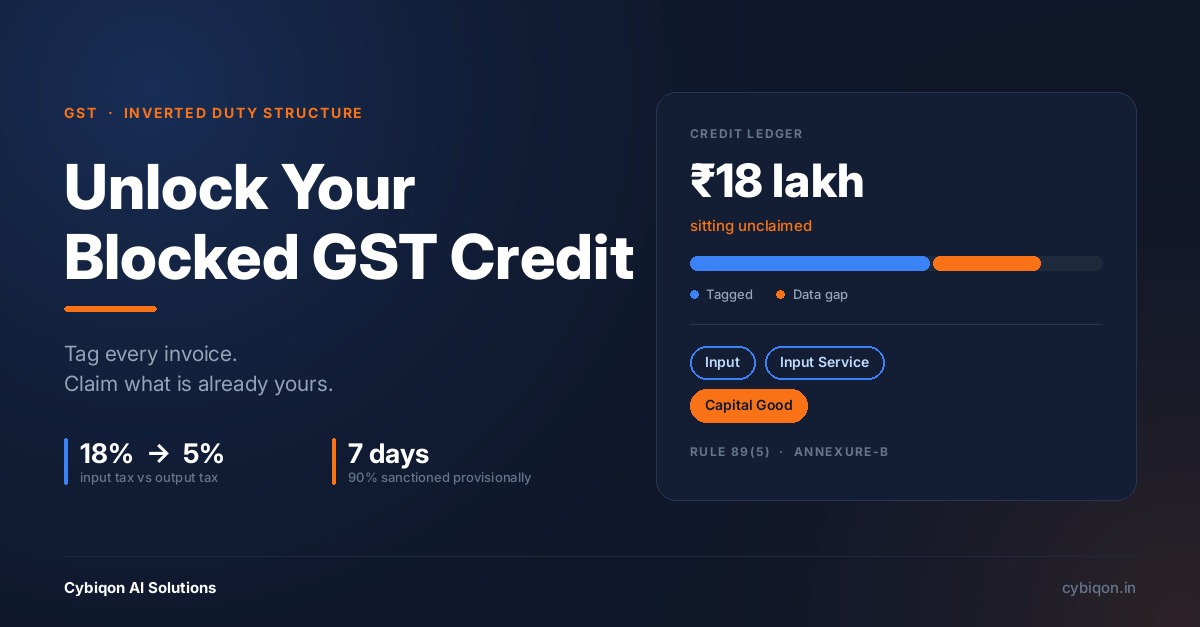
How to Claim GST Refund on Accumulated ITC in India (2026)
There is a corrugated box unit in Sonepat, Haryana that has been quietly losing money since 22 September 2025. Nothing broke. Its GST is filed on time. Its CA is good. But on that date its kraft and corrugated paper moved from 12% to 18%, while the finished box it sells moved from 12% to 5%. Thirteen points of inversion, overnight. Every month, credit piles into its electronic credit ledger and never gets set off against output tax. And nobody in the business has filed a single RFD-01 to get it back.
If that sounds like your factory, this guide is about how to claim GST refund on accumulated ITC when your inputs are taxed higher than your output — and, more importantly, about why most MSME manufacturers can't file even when they're fully eligible. The reason is not the tax office. Refund pendency with Central Tax formations has collapsed. The reason is that your purchase register cannot answer the question the refund form now asks.
Here's what you'll get: what an inverted duty structure actually is, what GSTN Advisory No. 660 changed on 18 May 2026, why your sanctioned refund is smaller than your ledger balance, how the two-year clock silently kills your oldest month first, and what your systems need to produce so your CA can file.
(Rules and rates below are cited with their instrument numbers so you can verify them. Confirm the specifics for your own unit with your CA — this is a systems guide, not tax advice.)
What is the inverted duty structure and how do I know if my business has one?
An inverted duty structure (IDS) is the plainest problem in GST: you pay a higher GST rate on what you buy than you charge on what you sell.
Normally, the tax you pay on inputs gets set off against the tax you collect on sales. Buy at 18%, sell at 18%, and the credit clears every month. But buy paper at 18% and sell boxes at 5%, and only a fraction of that credit gets used. The rest accumulates. Month after month, it sits in your electronic credit ledger — real money you have already paid to your suppliers, doing nothing.
Section 54(3) of the CGST Act allows you to claim a cash refund of that unutilised credit. Two situations qualify: zero-rated supplies (exports and SEZ), and accumulated credit "where the credit has accumulated on account of rate of tax on inputs being higher than the rate of tax on output supplies." The second one is the inverted duty structure refund.
Three quick tests to know if you have one:
- Your electronic credit ledger balance has gone up in most of the last six months, not down.
- Your output GST rate is 5% (or 12%) while your main raw material is taxed at 18%.
- You have output tax liability but you almost never pay GST in cash — it's always set off, and there's still credit left over.
Two exclusions to know before you get your hopes up. First, Section 54(3), second proviso says no refund of unutilised ITC is allowed where the output supply is notified by the Government as ineligible — that negative list flows from Notification No. 5/2017-Central Tax (Rate). The list exists and it has been amended repeatedly, so ask your CA whether your specific output HSN currently sits on it. Second, Circular No. 135/05/2020-GST dated 31.03.2020 bars an IDS refund where the input and the output are the same supply taxed at different rates at different times. That hits traders holding old stock. It does not hit a manufacturer who buys 18% paper and sells 5% boxes, because those are genuinely different supplies.
Which GST 2.0 rate changes created inversion — and which ones actually fixed it
A lot of commentary after the 56th GST Council meeting got this backwards, so it's worth being precise. The rate changes effective 22 September 2025 removed inversion in some places and created it in others.
Fixed: man-made fibre textiles. The Council explicitly corrected the MMF chain — fibre came down from 18% to 5%, yarn from 12% to 5% — which Finance Minister Nirmala Sitharaman described as a fibre-neutral policy. If you read a blog claiming GST 2.0 "broke" the textile duty structure, that blog is wrong on the headline fact. Textile and garment units still carry residual inversion, but it now comes mostly from dyes, chemicals, packaging and job-work services — and, as you'll see below, services are exactly what the refund formula refuses to give back.
Created or worsened:
| Sector | Input rate | Output rate after 22 Sep 2025 | Result |
|---|---|---|---|
| Corrugated packaging | Kraft/corrugated paper 12% → 18% | Boxes 12% → 5% | 13-point inversion |
| Aluminium cookware | Aluminium scrap 18% | Utensils 12% → 5% | 13-point inversion |
| Food processing | Packaging, cold storage 18% | Output 5% | 13-point inversion |
| Footwear up to ₹2,500 | Soles, adhesives, chemicals 18% | 12% → 5% | 13-point inversion |
| Residual job work (service) | — | 12% → 18% | 6 extra points, and non-refundable |
Business Today (27 October 2025) reported on Cargo International Packagings in Sonepat and on the aluminium cookware cluster in Jagadhri, Haryana, where a unit producing roughly 100 tonnes a month reported about ₹12 lakh locked up every month — around ₹12 per kg of output. That is one reported unit's number, not an industry average, but it gives you the order of magnitude for a mid-sized cluster unit. The same report named makers of bells and gongs, steel products, tractors and tractor parts, and sewing machines as facing the same squeeze.
The job-work line in that table deserves its own warning. Residual job work went from 12% to 18%. Concessional 5% rates were retained or extended for textiles, food, leather, printing and handicrafts, and 1.5% for diamond processing — but if your job work falls outside those, you are now paying six extra points on an input service. And input services are excluded from the refund formula entirely. That is not blocked working capital you'll eventually recover. That is a permanent addition to your cost of production. If job work is a big share of your process, price it in now.
For most units the first practical step is simply making sure the new rates are actually flowing into your invoices correctly — an automated billing and e-invoice setup that keeps the post-GST-2.0 rates in sync prevents a second problem stacking on top of the first.
The bottleneck has moved from the tax office to your purchase register
Here is the single most useful data point in this article, and almost nobody in the search results has it.
In reply to Lok Sabha Unstarred Question No. 2478, answered 3 August 2026, the government gave refund pendency figures for Central Tax formations. Claims pending beyond 90 days fell from 1,592 claims worth ₹695.84 crore in FY2023-24 to 110 claims worth ₹64.10 crore in FY2025-26. Claims pending between 60 and 90 days fell from 907 claims worth ₹274.24 crore to 64 claims worth ₹163.60 crore. Read those directionally rather than as a hard all-India total, but the direction is unmistakable: pendency has collapsed.
Which means the old MSME complaint — "we filed and they sat on it" — is largely obsolete. The refunds that aren't happening are mostly refunds that were never filed.
While we're correcting the record: you will see a figure of "₹30 lakh crore of stuck ITC" quoted across this topic. That number is SIDBI's May 2025 estimate of the MSME credit gap — the shortfall in formal lending to small business. It has nothing to do with blocked input tax credit. No government figure quantifying unclaimed inverted-duty credit exists. If a page cites it as stuck ITC, treat everything else on that page with suspicion too.
So if the department is fast and the law allows the refund, what's stopping a Sonepat box maker from filing? The purchase register. The refund application does not ask "what is your credit balance." It asks you to classify every single inward invoice, line by line, by tax category and by HSN code. Most MSME books were never set up to capture that at the moment of purchase entry. Reconstructing it a year later, across a few thousand invoices, is a project nobody has time for — which is exactly the same reason money you have already earned ends up sitting outside your bank account for months on end. It's a data problem wearing a finance costume.
What is Annexure-B and what changed on 18 May 2026?
GSTN Advisory No. 660, dated 18 May 2026 is the most important development on this topic in years, and it is barely covered anywhere.
Annexure-B is the statement of invoices on which you've claimed ITC — the evidence behind your refund. Until this advisory, you could upload it as a PDF. Your accountant exported a purchase list, printed it, attached it, done.
That is now permanently dead for all accumulated-ITC refund claims, including inverted tax structure. Every inward invoice must now be reported through a mandatory Excel offline utility, and the reporting requirements are strict:
- Each invoice must be reported as separate line items by distinct HSN/SAC code.
- Each invoice must also be classified by category of input supply: Inputs, Input Services, or Capital Goods.
- A single invoice covering more than one HSN/SAC, or more than one category, must be split into multiple line items with the tax proportionately allocated across them.
- The system rejects duplicates on the combination of supplier GSTIN + invoice number + invoice date + supply category + HSN/SAC.
- Hard limits: 10,000 line items per file, 25 files, and 2,50,000 line items per application.
- Invoices dated November 2024 onward are validated against your GSTR-2B. Anything that doesn't match is thrown into an Invalid Documents Report.
Read that list again and notice what it actually is. That is not a tax form. That is a data-engineering specification. A composite key with duplicate rejection. Mandatory dimensional tagging. Proportional allocation on split records. Referential validation against an external source of truth. File-size and row-count limits. If a software engineer handed you that spec, you'd budget a sprint for it.
The practical consequence for a factory: an invoice from your paper supplier that includes both kraft paper and freight is now two line items with the GST split proportionately. An AMC bill covering a machine service and a spare part is two line items in two different categories. A capital purchase bundled with installation is two line items. Your accountant cannot do this reliably in Excel at 11 pm on the filing deadline across 3,000 invoices.
And because Nov-2024-onward invoices are checked against GSTR-2B, any supplier who filed late or filed wrong becomes your Invalid Documents Report. This is why units that already match their purchase register against GSTR-2B every month find refund filing almost boring, while everyone else discovers their supplier problems at the worst possible moment.
Why your GST refund is much less than your electronic credit ledger balance
This is the moment that breaks most first-time claimants. Your ledger shows a comfortable balance. The sanctioned amount comes back a fraction of it. Nothing has gone wrong — the formula was always going to do that.
Rule 89(5), Explanation (a) defines "Net ITC" for inverted duty refunds as the input tax credit availed on inputs only. Input services are excluded. Capital goods are excluded. This was challenged all the way up, and the Supreme Court upheld the exclusion in Union of India v. VKC Footsteps India Pvt. Ltd. on 13 September 2021, overturning the Gujarat High Court. It is settled.
The current formula, after Notification No. 14/2022-Central Tax dated 05.07.2022, is:
Maximum Refund Amount = {(Turnover of inverted rated supply of goods and services × Net ITC) ÷ Adjusted Total Turnover} − {tax payable on such inverted rated supply of goods and services × (Net ITC ÷ ITC availed on inputs and input services)}
Look carefully at the second half. Input services appear in the denominator of the subtraction term, but not in Net ITC. The consequence is counter-intuitive and expensive: the more of your cost base sits in services — job work, freight, machine AMC, rent, security, professional fees — the smaller your refund gets. Services hurt you twice: once by not counting as Net ITC, and again by inflating the amount subtracted.
So a unit that outsources heavily to job workers, or that pays a lot for inbound freight, will recover materially less than a comparable unit that does everything in-house on owned machines — even with identical ledger balances.
In the portal, this plays out in Statement 1 of RFD-01, where columns 1 to 4 feed the formula. Net ITC auto-populates from your electronic credit ledger and can only be edited downward — you cannot argue your way to a bigger number. Statement 1A is where you declare the invoice-level detail of inward and outward supplies that supports the turnover and ITC figures. Statement 1A and the new Annexure-B utility are the two places where a badly maintained purchase register turns into a rejected claim.
Practical takeaway: before you spend three weeks assembling a claim, get someone to compute the Rule 89(5) maximum for one representative month. If your credit is mostly service-side, the honest answer may be that the recoverable amount is smaller than you hoped — and you should redirect that effort into pricing and cost structure instead.
Are input services and capital goods refundable — and will that change?
Right now: no. Both are excluded by the Net ITC definition in Rule 89(5) and the Supreme Court has upheld it. Any consultant telling you otherwise is selling something.
Is it moving? There are signals, but nothing has landed.
- A senior government official told Business Standard (9 October 2025) that the exclusion is "a structural distortion" that "needs to be addressed", that the Centre is examining capital goods first, that input services would likely take longer, and that nothing is imminent while GST 2.0 stabilises.
- Empower India Director General Krishnaswami Giri wrote to Finance Minister Sitharaman on 30 March 2026 — reported by Business Today under the headline "Working capital blocked" — asking that refunds be extended to input services and capital goods and that Section 54(3) itself be amended, specifically naming food processing, renewable energy, textiles and footwear.
- As of August 2026, not granted. Budget 2026 did not address it, and the Finance Act 2026 extended only the provisional refund facility.
One more thing you'll see litigated in headlines: Pranav Overseas LLP v. Union of India (2026-VIL-702-GUJ, 02.07.2026). It concerns whether the amended formula applies retrospectively to pending FY2017-18 and FY2018-19 claims. It does not restore input services to Net ITC, and a single High Court order is not settled national law. Don't build a filing strategy on it without your CA's view.
Plan on the law as it stands: inputs are refundable, services and capital goods are a cost. If it changes, that's upside.
When does the two-year clock start, and can I club multiple months?
This section is where the real money gets lost, and it gets one paragraph in most guides.
Section 54(1) gives you two years from the "relevant date". For refund of unutilised ITC, Explanation 2(e) to Section 54 — inserted by the Finance Act 2022 and notified with effect from 01.10.2022 via Notification No. 18/2022-Central Tax — fixes the relevant date as the due date for furnishing the GSTR-3B return for the tax period in which the claim arises.
Read that once more. The clock runs per tax period. Every single month has its own independent two-year expiry date.
Can you club months? Yes. The old restriction in paragraph 8 of Circular No. 125/44/2019-GST was withdrawn by Circular No. 135/05/2020-GST dated 31.03.2020, after the Delhi High Court stayed it in Pitambra Books. You may bundle multiple tax periods into one RFD-01, and you may span two financial years in a single application.
But here's the trap. Clubbing does not pause anything. If you bundle October 2024 through March 2026 into one application, the October 2024 month is still measured against its own due date. The oldest month in the bundle expires first, on its own schedule, silently — no notice, no reminder, no red flag on the portal. Owners routinely say "we'll do the GST refund next year when things are calmer," not realising they are writing off twelve months of credit by doing so.
What good practice looks like:
- Maintain a month-by-month limitation register: tax period, GSTR-3B due date, expiry date, estimated Rule 89(5) refund, status.
- Treat any month within six months of expiry as urgent, because assembling Annexure-B now takes real time.
- File at least annually, and quarterly if your accumulation is significant. There is no prize for one large application.
- Never let a dispute over one month hold up the filing of eleven healthy ones.
How to claim a GST refund on accumulated ITC in 2026: the filing sequence
Here is the end-to-end sequence for the inverted duty structure refund, as it stands in 2026.
- Confirm eligibility. Genuine rate inversion, output not on the Section 54(3) negative list, GSTR-1 and GSTR-3B filed for all periods in the claim.
- Pick your tax periods and check each one against its own two-year expiry.
- Rebuild the purchase register with categories. Every inward invoice tagged Input / Input Service / Capital Good, and split by HSN/SAC. This is the long pole in the tent.
- Reconcile against GSTR-2B for every invoice from November 2024 onward, before you go near the portal.
- Generate Annexure-B in the mandatory Excel offline utility per Advisory No. 660, respecting the 10,000-line and 25-file limits and the duplicate key.
- File RFD-01 on the portal under "Refund of ITC on account of Inverted Tax Structure", with Statement 1 and Statement 1A, and debit the claimed amount from your electronic credit ledger.
- Get RFD-02, the acknowledgement. This is the one that matters — see below.
- Provisional sanction in RFD-04, then final sanction.
How fast is the 90% provisional refund, and who qualifies? Under Rule 91(2) as amended by Notification No. 13/2025-Central Tax dated 17.09.2025 (effective 01.10.2025), for applications filed on or after 1 October 2025 the system risk-scores the claim, and if it is low-risk the officer must pass a provisional sanction order in FORM GST RFD-04 for 90% of the claimed amount within seven days of the RFD-02 acknowledgement. The administrative basis was CBIC Instruction No. 06/2025-GST dated 03.10.2025 (File No. CBIC-20006/4/2025-GST), an interim measure; the statutory basis arrived with the Finance Act (No. 4), 2026, enacted 30 March 2026, amending Section 54(6), with commencement to be notified. Minister of State for Finance Shri Pankaj Chaudhary confirmed all of this in the Lok Sabha on 3 August 2026 (Unstarred Question No. 2479), including that the Finance Act 2026 extended the facility to inverted duty structure claims. Notification No. 14/2025-Central Tax dated 17.09.2025 notified the class of persons excluded from provisional refund.
Two caveats nobody prints in the headline. First, the seven days runs from RFD-02 acknowledgement, not from filing — everything that takes months (building the register, reconciling 2B, fixing supplier mismatches, clearing deficiency memos) happens before that clock even starts. Second, it applies only where the system scores you low-risk, and the officer can still withhold it for reasons recorded in writing, though CBIC's instruction says that discretion should be used sparingly.
The remaining 10% follows the normal track: final sanction within 60 days of a complete application under Section 54(7), with 6% interest on delay under Section 56.
Do I need a CA certificate for a GST refund above ₹2 lakh?
For an inverted duty structure refund — almost certainly not, and this is one of the most persistent myths in the search results.
Rule 89(2)(m) does require a certificate from a Chartered Accountant or Cost Accountant certifying that the incidence of tax has not been passed on, where the refund exceeds ₹2 lakh. But the proviso to that clause excludes cases covered by clauses (a), (b), (c), (d) and (f) of Section 54(8) — and refund of unutilised ITC under Section 54(3) is clause (d). The unjust-enrichment certificate simply does not apply. You file a self-declaration instead.
Half the "documents required for GST refund" listicles currently ranking for this query still tell you to get the certificate. Read the proviso yourself, then run it past your CA for your specific facts. The point isn't to avoid your CA — you'll want him on the filing regardless. The point is that a genuine legal requirement and a copy-pasted internet checklist are different things, and one of them costs you a fee for nothing.
What a refund-ready data layer actually looks like
Everything above converges on one conclusion: the barrier to claiming GST refund on accumulated ITC is no longer legal or administrative. It is that your books cannot answer the question the form asks.
Your CA is not the problem. He files GSTR-1 and GSTR-3B accurately and on time. But he cannot retroactively invent, across 3,000 purchase entries, whether that ₹40,000 bill was an input, an input service or a capital good — because your accounting software never asked at the moment of entry. So he reasonably says "let's do the refund later," and later the oldest month expires.
At Cybiqon we build this as a thin layer on top of the accounting software you already use. We are not replacing Tally or Busy or Zoho, and you should be sceptical of anyone who says you must. What that layer does:
- Mandatory category tagging at purchase entry — Input, Input Service or Capital Good — with mixed invoices split at the point of entry, with proportionate tax allocation, rather than reconstructed a year later.
- A monthly dashboard showing both numbers: accumulated ITC, and the real Rule 89(5) maximum refund. Not the ledger balance owners assume they'll get back.
- Portal-ready Annexure-B and Statement 1A generation, pre-matched against GSTR-2B, so mismatches surface before filing instead of coming back as an Invalid Documents Report.
- RFD-01 status tracking from filing through RFD-02, RFD-04 and final sanction.
- A two-year limitation countdown, per tax period, so the oldest month can never expire quietly.
The CA still files. The difference is that the data exists on the day he asks for it — which is the same principle behind everything we build for AI-assisted financial management in a small factory: capture the structure once, at the moment of the transaction, and the reports assemble themselves.
FAQs
What is the inverted duty structure and how do I know if my business has one?
An inverted duty structure means your inputs are taxed at a higher GST rate than your output supply, so credit accumulates faster than you can use it. The clearest signs: your electronic credit ledger balance keeps rising month after month, you rarely pay output GST in cash, and your main raw material is at 18% while you sell at 5% or 12%. Section 54(3) of the CGST Act allows a cash refund of that unutilised credit, subject to the negative list notified under Notification No. 5/2017-Central Tax (Rate).
Why is my GST refund much less than my electronic credit ledger balance?
Because Rule 89(5), Explanation (a) defines "Net ITC" as credit on inputs only — input services and capital goods are excluded, and the Supreme Court upheld that in Union of India v. VKC Footsteps India Pvt. Ltd. (13 September 2021). Worse, under the formula notified by Notification No. 14/2022-Central Tax dated 05.07.2022, input services still sit in the denominator of the subtraction term. So the more of your costs are services — job work, freight, AMC, rent — the smaller your refund gets.
What is Annexure-B and what changed on 18 May 2026?
GSTN Advisory No. 660 (18 May 2026) permanently ended PDF-based Annexure-B for all accumulated-ITC refund claims, including inverted tax structure. Every inward invoice must now go through a mandatory Excel offline utility as separate line items by distinct HSN/SAC and by category (Inputs / Input Services / Capital Goods), with mixed invoices split and tax proportionately allocated. Duplicates are rejected on supplier GSTIN + invoice number + invoice date + category + HSN/SAC, limits are 10,000 line items per file and 2,50,000 per application, and invoices from November 2024 onward are validated against GSTR-2B.
When does the two-year clock start for a GST refund on accumulated ITC?
Section 54(1) gives two years from the relevant date, and for unutilised ITC, Explanation 2(e) to Section 54 — inserted by the Finance Act 2022, notified w.e.f. 01.10.2022 via Notification No. 18/2022-Central Tax — sets that as the GSTR-3B due date for the tax period in which the claim arises. So every month has its own expiry. You may club multiple tax periods and even two financial years in one RFD-01 (Circular No. 135/05/2020-GST dated 31.03.2020), but clubbing does not extend anything — the oldest month in the bundle expires first, silently.
Do I need a CA certificate for a refund above ₹2 lakh?
Generally no, for this type of claim. Rule 89(2)(m) requires a CA/CMA unjust-enrichment certificate above ₹2 lakh, but its own proviso excludes cases falling under Section 54(8) clauses (a), (b), (c), (d) and (f) — and refund of unutilised ITC under Section 54(3) is clause (d). A self-declaration is used instead. Confirm your specific facts with your CA, since many online checklists still get this wrong.
How fast is the 90% provisional refund and who qualifies as low-risk?
Under Rule 91(2) as amended by Notification No. 13/2025-Central Tax (effective 01.10.2025), a low-risk claim must receive a provisional sanction in FORM GST RFD-04 for 90% of the claimed amount within seven days of the RFD-02 acknowledgement. Risk-scoring is done by the system; officers may withhold for reasons recorded in writing, and CBIC Instruction No. 06/2025-GST (03.10.2025) says that should be used sparingly. Remember the seven days runs from acknowledgement, not filing — and the balance 10% follows the normal 60-day track under Section 54(7).
Get your factory's data refund-ready
Cybiqon AI Solutions builds websites, apps and AI automation for Indian MSMEs — and increasingly, the boring data plumbing that decides whether money comes back to your bank account or expires quietly on a portal. If you run a corrugated packaging, utensils, food processing, footwear or engineering job-work unit and you know credit is piling up but nobody can produce the register to claim it, that is exactly the kind of problem we like.
We'll look at how your purchases are currently recorded, show you what a categorised, GSTR-2B-matched, Annexure-B-ready register would look like on your own data, and build the layer on top of the accounting software you already run. Your CA keeps filing. He just stops waiting on you for numbers.
Visit cybiqon.in, email [email protected], or call +91 9250711473. No obligation, and no jargon.
Conclusion
Knowing how to claim GST refund on accumulated ITC in 2026 is really two separate skills. The tax part is well documented and, with pendency down sharply, the department is no longer the obstacle. The data part — categorising every invoice at entry, splitting mixed bills, matching against GSTR-2B, generating Advisory 660-compliant Annexure-B and watching a two-year clock that expires oldest-first — is where MSME manufacturers actually lose the money. Fix the register, and the refund becomes routine. Talk to your CA about your specifics, and talk to us about the systems underneath.
Want this set up for your business?
Book a free call — no tech jargon, no sales pressure. Just honest answers.
What we build for this: Admin panels & internal tools