jewellery billing software with HUID tracking for Indian jewellers in 2026
Jewellery Billing Software With HUID Tracking India (2026)
Jewellery Billing Software With HUID Tracking India (2026)
Between 1 July 2021 and 5 March 2026, more than 60 crore gold items were hallmarked with a HUID in India, according to a Press Information Bureau release from the Ministry of Consumer Affairs dated 12 March 2026. Sixty crore six-character codes — each one laser-marked onto a single piece sitting in somebody's showcase. Most owners who search for jewellery billing software with HUID tracking in India are not really shopping for features. They are trying to find out what the law actually asks of them, because ten salespeople have told them ten different things, and at least three of those things are wrong.
Dhanteras falls on 6 November 2026 and Diwali on 8 November — about 73 days from today, which is exactly when stock goes up and shortcuts get taken.
So this post does the opposite of every vendor page ranking for this term. It answers the compliance question first, with sources you can check — then the software question, including which of those ten "mandatory" things you can safely ignore.
Dhanteras Is 73 Days Away: What Actually Changed for Jewellers in 2026
The sixth phase of mandatory hallmarking came into force on 2 March 2026, taking the count to 380 districts. Seven districts were added: Rupnagar (Punjab), Banda (Uttar Pradesh), Beed (Maharashtra), Gomati (Tripura), Katihar (Bihar), Beawar (Rajasthan) and Neemuch (Madhya Pradesh). Mandatory caratages are 14K, 18K, 20K, 22K, 23K and 24K. 9K remains voluntary.
A few dates worth getting right, because vendor blogs routinely get them wrong:
- Mandatory hallmarking Phase 1 came into force on 23 June 2021.
- The HUID is a 6-character alphanumeric code, and the sale of hallmarked gold jewellery without a HUID has been prohibited since 1 April 2023 (PIB, PRID 1904262).
- If you read anywhere that HUID has been "mandatory since September 2021", that is simply an error that has been copy-pasted across a dozen vendor sites.
As of November 2024 — the last figure PIB published — BIS-registered jewellers had grown from 34,647 to 1,94,039, and Assaying & Hallmarking Centres from 945 to 1,622.
Enforcement is also live, not theoretical. In June 2026 BIS conducted search-and-seizure operations at jewellery shops in Hyderabad (about 1.6 kg of gold), Bengaluru and Ramanagara (about 4.1 kg) and Surat (about 241.5 g). Penalties under sections 17 and 29 of the BIS Act, 2016 run to imprisonment of up to one year and a fine of not less than ₹1 lakh, extending to five times the value of the goods.
Meanwhile the retail mix is shifting. The World Gold Council's India Focus Q2 2026 (30 July 2026) put jewellery demand at 75 tonnes, down 15% year on year, while the value rose to ₹1,132 billion, up 34% — with a clear move toward lighter-weight, lower-carat and studded pieces. Read that carefully: fewer grams, more pieces. And every piece carries its own HUID.
What BIS Actually Requires of You vs What the Hallmarking Centre Does
BIS publishes two separate documents: "Guidelines for Jewellers" (July 2026) and "Guidelines for recognition & operation of Assaying and Hallmarking Centres" (HM/AHC/Guidelines/4, June 2026). The fact that they are separate documents is itself the answer to most of the fear being sold to jewellers right now. Obligations written for an AHC are not obligations on your shop.
| What you'll be told | What is actually the case |
|---|---|
| "HUID must be printed on every invoice" | BIS states that mentioning the HUID on the invoice is voluntary at present. What is required on the bill: description of each article, net weight of precious metal, purity in carat and fineness, and hallmarking charges. |
| "You must generate the HUID" | The Assaying & Hallmarking Centre generates and laser-marks the HUID, and registers it in the BIS database. You send goods; the AHC assigns identity. |
| "A 2025 BIS API integration mandate applies to you" | That obligation is on AHC equipment — XRF machines, weighing balances and laser markers must enable direct data transfer to BIS's centralised software. It is not an obligation on a retail counter. |
| "So you need an XRF machine, ₹6 lakh onwards" | That is hardware a retail shop does not own and is not required to own. Not one page making this claim cites a circular, gazette notification or order number. |
| "BIS registration is an annual cost" | BIS registration for jewellers is free and valid for lifetime (bis.gov.in). Your real cost is operational time, not licensing. |
| "Everyone must hallmark everything" | Exemptions exist: jewellers with annual turnover up to ₹40 lakh, articles under 2 grams, and Kundan, Polki and Jadau work (PIB, PRID 1727944). |
Note the shape of the truth here. The article-level duty is real — your invoice genuinely must describe each article with its net weight, purity in carat and fineness, and hallmarking charges. The HUID field specifically is not yet mandatory on that invoice. Those are two different statements, and conflating them is how a ₹6 lakh quote gets justified.
None of this means you should ignore HUID. It means you should adopt piece-level records because they make your shop work better — not because someone frightened you.
Why a Paper Stock Register Breaks Where HUID Tracking Begins
The honest diagnosis has nothing to do with jewellers being anti-technology.
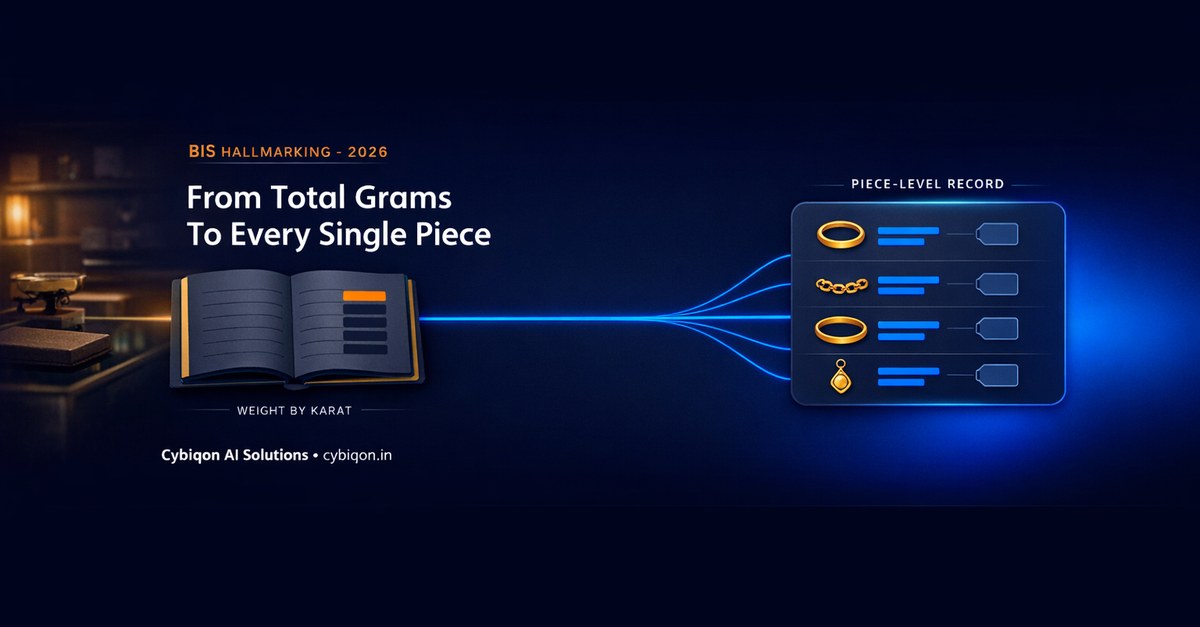
A hardbound stock register is organised around weight. "22K — 4,180 g." That format has worked for decades, and it still values the safe correctly at closing time. The compliance and retail reality of 2026 is organised around the piece — a six-character code laser-marked on one specific chain. The register isn't wrong. It simply has no column that can hold an identity.
Consider an illustrative composite of a single-counter jeweller in a tier-2 district — not a real client, but a pattern we see repeatedly. Stock lives in the register as karat-wise gram totals. Karigar issues are tracked in an Excel sheet: date, name, grams out, expected grams back. The AHC returns the pieces laser-marked with a HUID each — recorded on the article and in BIS's database, but nowhere in the shop's own books. Then a customer walks back in with a chain. Which piece is it? Which HUID? Which karigar made it? Right now that is a memory exercise, performed at festive-season speed.
Old gold makes it harder. The World Gold Council reports that some retailers say old-gold exchange runs at 60–70% of sales, with exchange volumes up 10–20% — WGC itself labels that 60–70% figure anecdotal, so treat it as a signal, not a sector average. When old gold is melted and remade, the remade piece needs a fresh HUID. And BIS's own site notes that the facility to deactivate the old HUID is still under development. So for a stretch of time, codes exist in the national database for pieces that no longer physically exist. Only your own records can tell that story — and a gram-total register cannot.
Karigar Job Cards, Fine Weight and the 3% / 5% GST Split
The second place the paperwork tears is the karigar ledger. Material issued versus material returned, with wastage and WIP in between, is precisely the reconciliation problem a small manufacturer solves with proper production planning software — a jewellery shop simply runs the same problem in gold instead of steel.
Two habits fix most of it:
- Numbered job cards instead of Excel rows. One card per issue, reconciled on fine weight (pure metal content), not gross grams — so alloy and wastage stop distorting the balance.
- Link the returned piece to its HUID at goods-inward. Scan the code when the article comes back from the AHC rather than hand-keying six characters during a Dhanteras rush. Six characters typed a hundred times in a day is a data-quality problem waiting to happen.
On tax, the widely-followed treatment is 3% GST on the metal (HSN 7113) and 5% on making charges (SAC 9988), shown as separate lines on the invoice. Karigar job work attracts 5%, and where your karigar is unregistered, reverse charge falls on you, the jeweller. Treat the 3%/5% split as solid. The claim that this structure was left untouched by the September 2025 rate rationalisation is well-reported rather than gazette-confirmed, so confirm the current position with your CA before you configure it into any billing system.
Silver Hallmarking in 2026: Voluntary, and Nobody Should Sell You a Deadline
Silver hallmarking in India is voluntary. Full stop, as of today.
What changed is the standard: IS 2112:2025 took effect on 1 September 2025, replacing IS 2112:2014, and covers seven purity grades — 800, 835, 925, 958, 970, 990 and 999. Silver that a jeweller chooses to hallmark now carries a HUID, which is why silver-side piece tracking is becoming a live question for shops that never needed it before.
Volumes back that up. Hallmarked silver articles rose from 32 lakh in FY24-25 to 59 lakh in FY25-26, per BIS Deputy Director General (Laboratories) Nishat S Haque, speaking to PTI in August 2026. But capacity is the constraint: only about 230 AHCs can test silver, against 1,622 for gold, and silver-capable centres exist in roughly 90 of about 800 districts (Koan Advisory, via ThePrint, April 2026).
On timing, BIS Director General Sanjay Garg said in June 2026: "We are going intentionally a bit slow as we don't want to make mistakes. We want to set the systems right before making it mandatory." No timeline was announced. If a software salesperson quotes you a silver deadline, they are inventing it.
What Jewellery Billing Software With HUID Tracking Must Actually Do
Use this as a buyer's checklist, not a shopping list. Ask any vendor — including us — to demonstrate each of these live, on your own data:
- Piece-level inventory alongside weight totals. Your register logic must survive; the piece layer sits on top of it, not instead of it. Gram totals by karat must still tally at day-end.
- HUID capture by scan at goods-inward, with duplicate detection. Not a free-text box someone fills in later.
- A link from each HUID to its karigar job card, so "who made this chain, from which issue" is a lookup, not a memory test.
- Old-gold exchange handled as its own transaction type — inward purity, deduction, and the link from melted lot to the remade piece's fresh HUID.
- Per-article GST invoicing with the metal and making-charge lines split correctly, plus reverse-charge handling for unregistered karigars.
- The bill fields BIS actually asks for: description, net weight, purity in carat and fineness, hallmarking charges — with HUID available but marked optional.
- Fine-weight reconciliation reports for karigar balances and wastage.
- An honest compliance answer. If a vendor tells you the HUID is legally mandatory on invoices, or that you need an XRF machine, walk away. They either haven't read BIS's guidelines or are counting on you not to.
That last point is why so many MSMEs eventually stop buying disconnected tools and move toward one connected system that matches how the business actually runs. It is also why off-the-shelf tools so often fail small Indian businesses: a jewellery counter has a workflow no generic billing app was designed for.
FAQs
Is it mandatory to print the HUID number on a jewellery invoice in India?
No. BIS states that mentioning the HUID on the invoice is voluntary at present. What your invoice must carry is a description of each article, the net weight of the precious metal, purity in carat and fineness, and hallmarking charges. Several vendor pages assert the HUID field is compulsory; BIS's own jewellers guidance and FAQ do not.
Who generates the HUID — the jeweller or the assaying and hallmarking centre?
The Assaying & Hallmarking Centre. The AHC assays the article, generates the six-character alphanumeric HUID, laser-marks it on the piece and registers it in BIS's database. You send goods for hallmarking and receive them back already marked — you never issue a HUID yourself.
Do jewellers need to integrate with a BIS API or buy an XRF machine?
No. The 2025 requirement being marketed to retailers applies to AHC equipment — XRF machines, weighing balances and laser markers must enable direct data transfer to BIS's centralised software. That is hardware an AHC owns. Pages quoting "₹6 lakh onwards" for retail shops cite no circular, gazette notification or order number.
Is silver hallmarking mandatory in India in 2026?
No — silver hallmarking remains voluntary. The revised standard IS 2112:2025 took effect on 1 September 2025 with seven purity grades, and voluntarily hallmarked silver does carry a HUID. BIS DG Sanjay Garg said in June 2026 that BIS is going "intentionally a bit slow" before making it mandatory, and no timeline has been announced.
What happens to the HUID when old gold is melted and remade?
The remade article needs a fresh HUID — a new piece is a new identity. BIS's site indicates the facility to deactivate the old HUID is still under development, so the earlier code may sit in the database for a while. Your own piece-level records are the only bridge between the melted lot and the new article.
Are jewellers below ₹40 lakh turnover exempt from hallmarking?
Yes. Jewellers with annual turnover up to ₹40 lakh are exempt from mandatory hallmarking, as are articles under 2 grams and Kundan, Polki and Jadau work (PIB, PRID 1727944). Exemption from hallmarking is not exemption from GST or invoicing duties.
What is the GST rate on gold jewellery and on making charges in 2026?
The widely-followed treatment is 3% on the metal (HSN 7113) and 5% on making charges (SAC 9988), shown as separate invoice lines. Karigar job work attracts 5%, and reverse charge falls on the jeweller if the karigar is unregistered. Confirm current rates with your CA.
Getting Piece-Level Without Buying a 200-Screen ERP
Cybiqon AI Solutions builds websites, apps and AI automation for Indian MSMEs — and for jewellery retailers that means a lightweight piece-level layer, not a system that takes three months to learn. Scan HUIDs at goods-inward instead of hand-keying six characters at festive speed. Run karigar issues as numbered job cards reconciled on fine weight. Bill per article with the 3%/5% split handled properly. And get a straight answer on which of those things BIS actually requires, which is free, and which a salesperson invented.
Because we do web, app and automation under one roof, you get the workflow your shop actually runs — not a 200-screen ERP you abandon by Diwali. If you'd like to talk it through before the festive rush, visit cybiqon.in, call +91 9250711473, or write to [email protected].
The Takeaway
The strongest reason to adopt jewellery billing software with HUID tracking in India is not fear of BIS. It is that your stock register measures weight while your business now moves in pieces, and no amount of careful handwriting closes that gap. Get the compliance facts straight first — HUID on the invoice is voluntary, the AHC generates the code, the API mandate is not yours, registration is free — then choose a tool on operational merit. Do that before Dhanteras on 6 November, and the festive season gets a lot quieter.
Want this set up for your business?
Book a free call — no tech jargon, no sales pressure. Just honest answers.
What we build for this: Admin panels & internal tools