WhatsApp appointment reminders for clinics
WhatsApp Appointment Reminder for Clinic: What Works in 2026
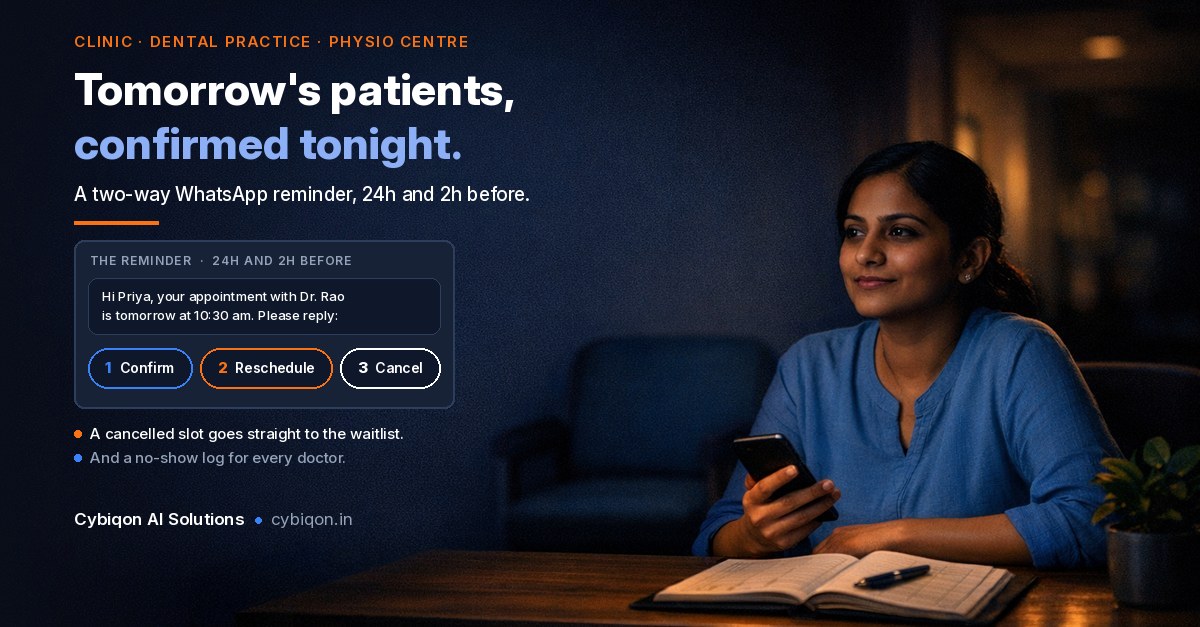
Your receptionist spends two hours every evening phoning tomorrow's patients, and chairs still go empty. The phone round isn't really the problem. What happens after the patient says "cancel", or doesn't pick up at all, is.
A WhatsApp appointment reminder for clinic use sounds like a simple fix, and partly it is. Across 105 studies, about 23% of booked outpatient appointments end in a no-show, according to a systematic review by Dantas and colleagues in Health Policy (2018). The two strongest predictors were how far ahead the slot was booked and whether the patient had missed before. Indian OPD surveys put "forgot" and "no reminder" at the top of the reasons patients give.
So the reminder matters. But most clinics already "send reminders", by phone or a hand-typed WhatsApp, and still see gaps. The gaps that hurt are these: nothing goes out automatically from the appointment book, nobody records who confirmed, and a cancelled slot is never offered to anyone waiting.
This guide covers what the trials say (including one Indian trial where WhatsApp reminders did nothing), the free steps you can take today, a ready-to-copy patient appointment reminder template, what it costs after Meta's 1 Oct 2026 pricing change, DPDP basics, and when your existing clinic software is already enough.
Why patients miss appointments, and why the evening phone round doesn't fix it
Take an illustrative clinic seeing 40 booked patients a day. At the 23% average, that's roughly nine empty slots a day. That's arithmetic, not a measurement of your clinic, but most owners recognise the shape.
The research points at a few causes:
- Forgetting. A Tehran outpatient study found "forgot" was the top reason, with a 23.8% no-show rate. In an Indian tertiary OPD study (Yadav et al., IJCMPH, June 2026), forgetfulness and lack of reminders scored highest of all reasons for missed appointments.
- Long lead time. A slot booked two weeks out is easier to forget, and easier to double-book with something else.
- Habit. Patients who have missed before are the most likely to miss again.
Even Practo's own no-show policy says patients not showing up "is a widespread phenomenon in India", and it blocks online booking for four months after a third valid no-show in 12 months. That only covers Practo bookings, though, not your walk-ins or phone bookings.
The evening phone round deals with forgetting, but it has three weak points. Half the calls go unanswered. A "yes" on the phone leaves no record anyone else can see. And when a patient cancels at 9 a.m., there's no list of people who wanted an earlier slot. Two hours of a receptionist's time a day buys you a reminder, but no confirmation and no refill.
Do WhatsApp appointment reminders actually reduce no-shows?
They usually help. They don't always help, and how much they help depends on what happens after you send them. Vendor pages promise 40–90% fewer no-shows without citing anything. Here's what the published studies say.
| Study | Setting | What was sent | Result |
|---|---|---|---|
| Cochrane review, Gurol-Urganci et al. 2013 | 7 RCTs, 5,841 people | SMS text reminder | Attendance 67.8% with no reminder, 78.6% with text, 80.3% with a phone call. Text was as good as a call and cost 55–65% less per attended appointment in two studies |
| Prasad & Anand, Int Dent J 2012 | Dental OPD, Ghaziabad | SMS reminder | 79.2% on-time attendance vs 35.5% without. Significant only in prosthodontics and endodontics; small study, 2010 data |
| Rev Paul Pediatr 2020 | Paediatric TB follow-up, Curitiba, Brazil | SMS/WhatsApp | Absenteeism 18.9% vs 33.3% with no extra contact. Small study |
| BMC Public Health, Sep 2024 | 388 hypertension patients, two public hospitals in Punjab | Two WhatsApp reminders (3 days and 1 day before) | Attendance 21.8% vs 19.6%, not significant |
| Buenos Aires preprint, medRxiv, Aug 2026 | 475,214 appointments, observational | WhatsApp ~24h before | No-shows down from 34.6% by about 8.2 points (RR 0.76). Two reminders (72h + 24h) RR 0.80; 72h alone RR 0.91 |
Two findings matter more than the headline numbers.
First, the Punjab trial. It's the Indian WhatsApp study, and it found no significant effect. Where the barrier is cost, distance or a long wait at a public hospital rather than forgetting, a one-way message won't fix it.
Second, in the Buenos Aires preprint, every reminder strategy also increased patient-initiated cancellations. That's a good thing only if you fill the freed slot. A reminder turns a silent no-show into a cancellation. Unless that cancellation reaches someone on a waitlist, you still have an empty chair, just with a few hours' warning.
Can the WhatsApp Business app send appointment reminders automatically?
Not really. The free WhatsApp Business app gives you quick replies (saved text behind a shortcut), labels, and greeting and away messages. Greeting and away messages only fire when a patient messages you first. There's no per-chat "send later".
The app does have "business broadcasts" under Tools, which can be scheduled to an audience. They're positioned as marketing campaigns, though, and in India they're paid (TechCrunch reported under ₹1 a message when they launched in September 2024). Broadcast lists are capped at 256 contacts. Nothing is triggered from your appointment book, and replies aren't tracked as confirmations.
Still, you can tighten things up for free this week:
- Pick a fixed send time, say 6 p.m. daily, for all of tomorrow's patients.
- Save the reminder as a quick reply (for example
/rem) so it takes seconds per patient. - Create three labels: Confirmed, Reschedule, No reply. Label every chat as replies come in.
- Always ask for an action: "Reply 1 to confirm, 2 to reschedule, 3 to cancel."
- Call only the No reply label the next morning instead of phoning everyone.
That alone can cut the evening phone round down to the patients who didn't answer. For the wider picture of what the app can and can't do, see our guide to WhatsApp automation for Indian businesses.
Patient appointment reminder template you can copy
A good appointment reminder message for patients gives the clinic name, the doctor, the date and time, the address or a map link, and one clear action. Keep diagnosis and treatment out of it. Anyone glancing at the patient's phone screen can read the preview.
24 hours before (English):
Hello {{1}}, this is a reminder of your appointment with Dr. {{2}} at {{3}} tomorrow, {{4}} at {{5}}.
Location: {{6}}
Please reply: 1 = Confirm, 2 = Reschedule, 3 = Cancel.
Reply STOP to stop reminders.
24 hours before (Hinglish):
Namaste {{1}}, kal {{4}} ko {{5}} baje Dr. {{2}} ({{3}}) ke saath aapka appointment hai.
Kripya reply karein: 1 = Confirm, 2 = Reschedule, 3 = Cancel.
Reminders band karne ke liye STOP likhein.
2 hours before (optional, for confirmed patients):
Hi {{1}}, see you at {{5}} today with Dr. {{2}}. If you can't make it, reply 3 so we can offer your slot to someone waiting.
A few rules for a WhatsApp utility template appointment reminder:
- On the WhatsApp Business API, use quick-reply buttons (Confirm / Reschedule / Cancel), and accept a typed 1, 2 or 3 as a fallback for patients who type instead of tapping.
- No offers, ever. A line like "book your next cleaning at 20% off" pushes the template into the marketing category, which costs about 7× more (Exotel's template-category documentation explains the rules).
- 24h or 2h? In the Buenos Aires data, a single reminder about 24 hours before did best, and 72 hours alone did least. The 2-hour nudge isn't trial-tested. Treat it as optional, mainly for patients who confirmed and morning slots.
What a WhatsApp appointment reminder for clinic costs in 2026
On the WhatsApp Business API, a reminder is a utility message. WhatsApp providers list India's utility rate at about ₹0.115 per delivered message plus 18% GST, against about ₹0.86 for marketing. Rates shift, so check Meta's pricing page before you budget.
Illustrative arithmetic for a clinic booking 40 patients a day, 26 days a month, with two reminders each:
- 2 × 40 × 26 = 2,080 messages
- 2,080 × ₹0.115 ≈ ₹240 a month before GST
- plus whatever platform fee your provider charges, which is usually the bigger number
The 1 Oct 2026 change. WhatsApp providers including YCloud and respond.io report that from 1 Oct 2026, Meta bills utility templates sent inside an open 24-hour customer-service window, which had been free since July 2025. Service replies are now free only for the first 1,000 a month per business number. India's per-message list rates haven't changed.
In practice, the 2-hour reminder sent after a patient replied to the 24-hour one used to be free, and now it's billed. It's still paise per patient, but any advice saying "messages inside 24 hours are free" is out of date. If you're weighing providers and setup, our explainer on the WhatsApp Business API for Indian businesses covers onboarding, verification and how the API differs from the app.
Beyond the WhatsApp appointment reminder for clinic: confirmations, a waitlist and a no-show log
Here's an illustrative example, not a client. Say a two-dentist practice in a tier-2 city like Nashik or Coimbatore books about 35 patients a day.
- The receptionist phones everyone from 6 to 8 p.m. Half don't pick up.
- Those who do pick up say yes, and some still don't come.
- A 9 a.m. call cancels an 11 a.m. root canal, and the slot stays empty.
- Nobody knows which dentist's patients miss most, or who has missed three times.
Step one is free: the app routine above. Step two is a small system the practice owns, running off its own appointment book:
- The appointment book triggers the reminder. An approved 24h utility template goes out automatically, with an optional 2h nudge. Nobody types anything.
- Replies become a status. Confirm, Reschedule or Cancel shows up next to the appointment on the front-desk screen, not buried in a chat.
- A cancellation frees the slot and messages the waitlist. The next patient who asked for an earlier slot gets a message offering it, first come, first served.
- A no-show log per dentist and per patient. The front desk calls only the no-replies and the repeat no-shows. The owner sees patterns, such as Monday-morning slots or one dentist's 3-week recall gap.
This is the step most "reminder tools" skip, and it's the one that answers the Buenos Aires cancellations finding. We go deeper on the booking side in how booking automation cuts no-shows. No honest builder can promise you a percentage here. The evidence runs from no effect in Punjab to about 8 points in Buenos Aires. What you get for certain is a record of who confirmed and a chance to refill each cancelled slot.
Patient consent, DPDP and what to keep out of a reminder
The Digital Personal Data Protection Rules were notified on 13 Nov 2025 and phase in over time. The consent-manager rule applies from around November 2026, and the notice requirements and most other rules from around 13 May 2027. You don't need to wait for those dates to do the sensible things:
- Collect the WhatsApp number for a stated purpose: "appointment reminders".
- Use it only for that. Promotions and health-camp offers need separate consent.
- Give an easy opt-out: reply STOP, and honour it.
- Keep diagnosis, test results and treatment out of the reminder text.
The DPDP Act has no separate "sensitive health data" category, but a reminder that reveals a condition is still a privacy problem. A plain reminder isn't telemedicine. If a doctor starts giving clinical advice in that WhatsApp chat, the Telemedicine Practice Guidelines 2020 apply, and they ask for the doctor's registration number on electronic communication.
When your clinic software is already enough
Don't build what you already pay for. Practo Ray offers SMS and email confirmations and reminders. We couldn't confirm WhatsApp support, so check your plan. Several Indian clinic and dental systems, including MocDoc, Smart Dental Desk, Dontin and MolarPlus, list built-in WhatsApp reminders. If you run one of these, switch its reminders on first and watch your no-shows for a month.
A custom build makes sense when:
- your appointment book is a register, a spreadsheet or an in-house tool, so nothing can trigger a reminder;
- you want the waitlist refill and per-doctor no-show reporting your software doesn't offer;
- you're planning a wider move to proper records. If so, read our guide to ABDM-compliant clinic management software before deciding where reminders should live.
FAQs
How do I send appointment reminders to patients on WhatsApp?
With the free WhatsApp Business app, send a saved quick-reply reminder at a fixed time each evening and label replies as Confirmed, Reschedule or No reply. To send automatically from your appointment book, you need the WhatsApp Business API with an approved utility template, through a provider or a custom build.
Can the WhatsApp Business app send scheduled appointment reminders automatically?
No. Greeting and away messages only reply to incoming chats, and there's no per-chat "send later". Business broadcasts can be scheduled, but they're paid campaigns capped at 256 contacts per list, and they aren't linked to your appointment book or tracked as confirmations.
Do WhatsApp appointment reminders actually reduce no-shows?
Usually, but not always. A Cochrane review found text reminders lifted attendance from 67.8% to 78.6%, and a large Buenos Aires preprint found a 24-hour WhatsApp reminder cut no-shows by about 8 points. A Punjab hospital trial found no significant effect. Reminders work best with a confirm/cancel reply and a waitlist to refill freed slots.
How much does a WhatsApp appointment reminder cost in India in 2026?
About ₹0.115 per delivered utility message plus 18% GST, according to WhatsApp providers' published rates. Two reminders for 40 patients a day over 26 days come to about ₹240 a month before GST, plus any platform fee. Check Meta's rate card for current prices.
Is an appointment reminder a utility or marketing template?
Utility, as long as it only covers the appointment. Adding offers or promotional wording pushes it into the marketing category, which costs about 7× more per message in India.
Get a two-way reminder system built around your appointment book
If your receptionist is still phoning everyone, tell us two things: how many appointments you book a day, and what you book them in, whether that's a register, Practo Ray or a spreadsheet. Cybiqon will scope a two-way reminder system for your clinic. It sends approved 24h (and optional 2h) utility reminders from your book, turns Confirm/Reschedule/Cancel into a status your front desk sees, offers freed slots to your waitlist, and logs no-shows per doctor and per patient.
It's written for your clinic, not configured from a template, and you own the code. Our WhatsApp automation work is listed at ₹19,999 one-time, typically delivered in 1–3 weeks. Anything beyond that, like a new booking screen, is scoped on the first call.
Book a 30-minute call, call +91 9250711473, or email [email protected]. Know a doctor whose front desk lives on the phone every evening? Send them this.
Conclusion
A WhatsApp appointment reminder for clinic use is cheap, at paise per patient, and the evidence says it usually helps. But a reminder alone isn't the fix. The trials show reminders turn no-shows into cancellations, and the Punjab result shows a one-way message can do nothing at all. What fills chairs is the system around the message: automatic sends from your appointment book, a recorded confirmation, a waitlist for freed slots, and a no-show log you actually read. Start with the free app routine this week. If you want the rest built and owned by you, Cybiqon is a call away.
Want this set up for your business?
Book a free call — no tech jargon, no sales pressure. Just honest answers.
What we build for this: WhatsApp automation