Click-to-WhatsApp ads and the lead-routing layer Indian MSMEs need behind them
Click to WhatsApp Ads for Small Business India: 2026 Guide
Click to WhatsApp Ads for Small Business India: 2026 Guide
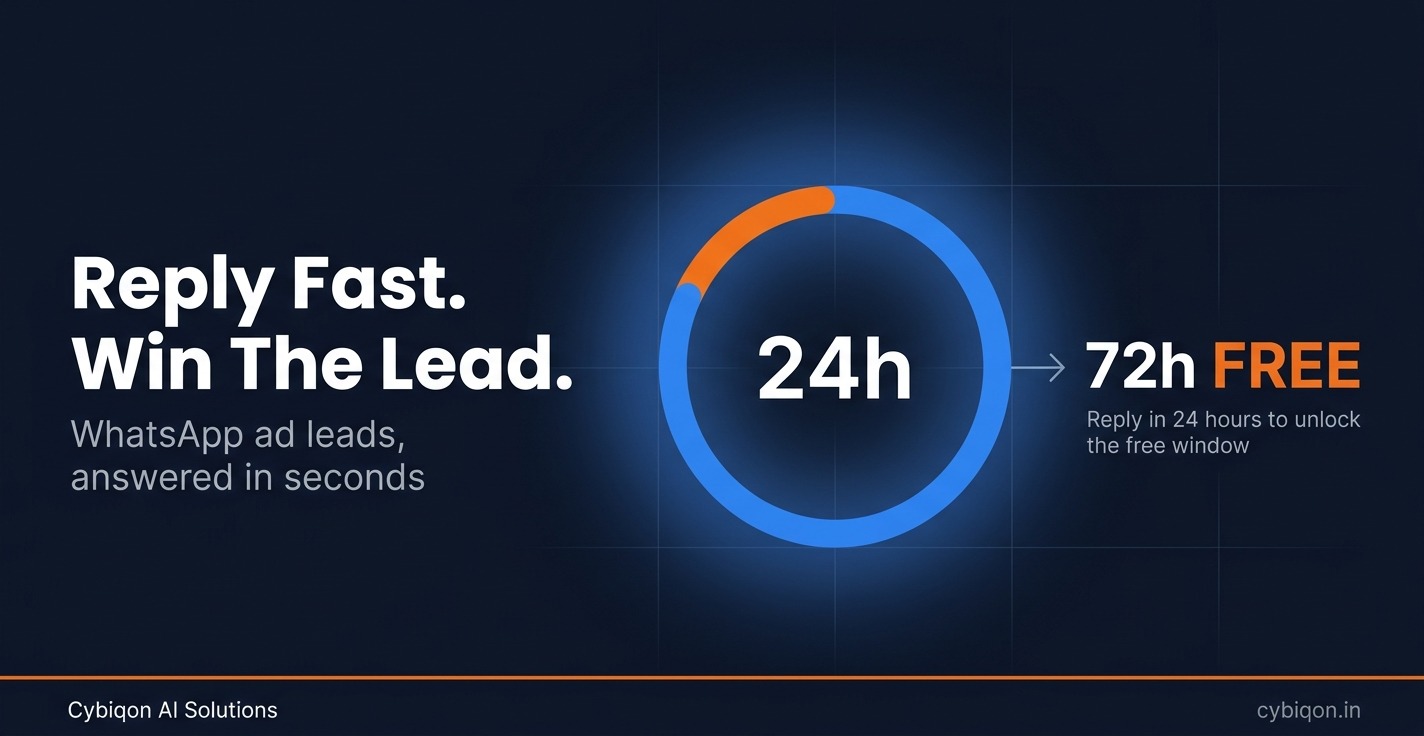
Here is a sentence from Meta's own developer documentation that almost no article about Click to WhatsApp ads for small business India bothers to quote in full: "If you respond within 24 hours using any type of message, the message will be free, and a Free Entry Point window will be opened." Those windows stay open for 72 hours, and while open you can send anything you like at zero messaging cost.
Read it again. The 72 free hours are conditional. Reply on hour 25 and you don't get a smaller window — you get no free window at all, and every message after that is billed.
More than 2 lakh Indian small businesses activate Click-to-WhatsApp campaigns every month, according to Meta India's World MSME Day release in June 2026. Most of them are paying real money for a click and then forfeiting the free window, because the reply comes that evening from the owner's personal WhatsApp.
This guide covers how CTWA ads actually work, whether you need the paid API, what a realistic cost per lead looks like, how ctwa_clid attribution lets you finally see which ad made you money, what the DPDP Act says about that ad click, and what changes on 1 October 2026.
What Are CTWA Ads and How Do They Actually Work?
A Click-to-WhatsApp ad is a normal Facebook or Instagram ad where the button opens a WhatsApp chat with your business instead of sending someone to a website. That's the whole CTWA ads meaning — no landing page, no form, no drop-off between the tap and the conversation.
Mechanically, three things happen the moment someone taps:
- A chat opens with your business number, usually pre-filled with a message you chose.
- A 24-hour customer service window opens. Any message you send inside it is free.
- Meta attaches a
referralobject to that incoming message containing the source ad ID and a Click to WhatsApp ID (ctwa_clid) — a unique fingerprint tying that human being to that specific creative.
That third one is the part that decides whether your ad spend is measurable or a guess, and we'll come back to it.
One decision inside Ads Manager matters more than most creative choices. In a Meta experiment run across 116,000 campaigns and 43,000 businesses (4–10 November 2024), ads clicking to WhatsApp optimised for LEADS delivered a 24% lower cost per lead than the identical ads optimised for CONVERSATIONS. Most Indian MSMEs pick "conversations" by default, because it sounds like what they want. It buys chatter. Optimising for leads buys buyers.
Is the Conversation From a CTWA Ad Really Free — and For How Long?
Yes, and this is genuinely the best deal left on the WhatsApp Business Platform. The sequence is:
| Stage | What you get | Cost |
|---|---|---|
| User taps your CTWA ad | 24-hour customer service window opens | Ad spend only |
| You reply within 24 hours | 72-hour Free Entry Point (FEP) window opens | ₹0 messaging |
| Inside the 72 hours | Any message type — templates, media, catalogues | ₹0 messaging |
| You reply after 24 hours | No FEP window. Normal rates apply | Billed |
Two clarifications that several BSP blogs get wrong. First, the Free Entry Point applies only to Click-to-WhatsApp ads and Facebook Page call-to-action buttons — not to wa.me links. If your "ad" is a link in bio, there is no free window. Second, the 24-hour reply is a precondition, not a formality.
A human being cannot reliably clear that bar while running a business. An automated acknowledgement inside 30 seconds clears it every single time, for every lead, at 11pm on a Sunday. That is the cheapest WhatsApp automation win available to an Indian MSME right now, and it costs nothing per message.
How Fast Should You Reply to Convert?
Fast. But let's be careful about the numbers, because this topic is full of folklore.
You will read everywhere that "78% of customers buy from the first company that responds" and that "35–50% of sales go to the first responder." We went looking for the primary studies behind both. They don't exist. No traceable source, no methodology, no sample. Treat any article repeating them as one that didn't check.
Here is what is real and checkable:
- Harvard Business Review, "The Short Life of Online Sales Leads" (March 2011) — 1.25 million leads across 42 companies. Contacting a lead within one hour made you nearly 7x more likely to qualify it than waiting one more hour, and 60x more likely than waiting 24+ hours. Across 2,241 audited companies, average first response was 42 hours, and 23% never responded at all. US data, 15 years old — but the mechanism is human, not American.
- MIT / InsideSales Lead Response Management Study, Dr James Oldroyd (2007) — replying in 5 minutes versus 30 minutes produced a 100x higher contact rate and a 21x higher qualification rate. Nearly every WhatsApp vendor blog credits this "21x" figure to Harvard. It is MIT, and it is from 2007. We mention that because you should know which articles actually read their sources.
- XANT / InsideSales Lead Response Report (2021) — 5.7 million leads, 55 million activities, 400+ companies: 8x higher conversion when first contact happens within 5 minutes versus 6+ minutes. Yet 57.1% of companies wait more than a week, and under 1% respond within 5 minutes.
Now overlay Meta's 24-hour rule. Speed doesn't just improve your odds with the customer — it is literally the toggle that decides whether your next 72 hours of messaging are free or billed. Slow replies cost you twice.
Click to WhatsApp Ads for Small Business India: Do You Need the API?
Here is the answer no Business Solution Provider will give you, because they earn a margin on every message you send: the free WhatsApp Business App may be enough for now.
The free app can be the destination of a CTWA ad, and it does support greeting messages and away messages. If you're a single-person business spending ₹10,000 a month on ads, set an instant greeting today and you've already captured most of the value in this article.
The ceiling is real, though, and it arrives fast:
| WhatsApp Business App (free) | WhatsApp Business / Cloud API | |
|---|---|---|
| Run CTWA ads | Yes | Yes |
| Greeting / away auto-reply | Yes | Yes, plus conditional logic |
| Team access | 1 phone + 4 linked devices | Unlimited agents |
| Assign a chat to one person | No | Yes (round-robin) |
| Record of who replied to what | No | Yes, timestamped |
Capture ctwa_clid for attribution |
No | Yes |
| Per-message cost | ₹0 | Marketing ~₹0.8631, Utility ~₹0.115 + 18% GST + BSP markup |
Note the team row carefully. On the free app, three people linked to one account all see every conversation, and any of them can reply without the others knowing. Some leads get three replies. Some get none. Nobody can tell which. If you're weighing the jump, our breakdown of whether the API upgrade is worth the money walks through the decision without a sales pitch attached.
To answer the question directly: no, you cannot run CTWA ads properly from a personal WhatsApp number. A personal account has no business profile, no auto-replies and no attribution data.
What's a Realistic Cost Per Lead for CTWA Ads in India?
We're going to disappoint you honestly here. You'll find articles quoting "₹250–900 per lead for CTWA versus ₹1,200–3,000 for lead forms." We could not trace that range to any credible source, so we won't repeat it.
Credible India-specific CTWA cost-per-lead benchmarks are not publicly available. What we can tell you is what actually moves your CPL:
- Optimisation objective — leads over conversations, worth roughly 24% by Meta's own test.
- Qualification depth — a "lead" that's just a tap is not the same unit as a lead that answered three questions. Compare like with like.
- Response time — an unanswered enquiry is a lead you paid for and lost. Your effective CPL is spend divided by qualified, contacted leads, not by taps.
- Sector and city — a Ludhiana machine-parts manufacturer and a Bengaluru D2C skincare brand do not share a benchmark.
Compute your own baseline over 30 days. That number is real. A blog's number is not.
How Do I Know Which Meta Ad Actually Produced a Sale?
This is where most Indian MSMEs are flying blind, and where CTWA ads for small business India quietly beat every other format — if you're set up to use it.
Every CTWA-originated message arrives with a ctwa_clid in the webhook referral object. Store it against the conversation. When that conversation eventually becomes a signed order, fire the ctwa_clid back to Meta's Conversions API with action_source='business_messaging' and messaging_channel='whatsapp'. Meta lists ctwa_clid by name in its Conversions API Parameters documentation, marked "do not hash."
The loop closes. You stop seeing leads per creative and start seeing revenue per creative.
Two hard constraints: ctwa_clid is available only through the WhatsApp Business or Cloud API — the free app cannot capture it — and it needs somewhere to live. That's a database and a dashboard, which is why serious attribution and a WhatsApp-first CRM end up being the same project.
Does an Ad Click Count as Consent Under the DPDP Act?
No. And almost nothing ranking for this keyword mentions the Digital Personal Data Protection Act at all.
Section 6(1) requires consent that is "free, specific, informed, unconditional and unambiguous... given through clear affirmative action." Someone tapping an ad about modular kitchens has affirmatively asked about modular kitchens. They have not agreed to a Diwali offers broadcast in October. Section 5(2) separately bars reusing data collected for one purpose for a materially different one.
Practically, for an Indian MSME running CTWA ads:
- The ad click gets you the conversation. That's it.
- A separate, purpose-specific opt-in captured inside the chat ("May we send you offers and updates on WhatsApp?") is what legally supports future marketing.
- Log it with a timestamp. Consent records must be retained for seven years.
The DPDP Rules 2025 were notified in November 2025. Consent Manager provisions kick in on 14 November 2026, and the core consent, notice and rights obligations land in May 2027. You have runway — but every unlogged lead you collect between now and then is a record you'll have to re-consent later.
What Changes on 1 August and 1 October 2026?
Two waves, and today is the first one.
Today, 1 August 2026: token-based Meta Business Agent billing goes live at roughly $2 per million tokens (framed at about ₹189 per million in India).
Announced for 1 October 2026: service messages and in-window utility templates stop being free for the first time since November 2024, billed at the utility/authentication rate with no volume discounts. Reported by Storyboard18 and Business Today in July 2026, and confirmed in Alibaba Cloud's ChatApp customer notice.
Two honesty caveats we'd rather you hear from us. First, as of today Meta's public pricing documentation has not been updated and still reads that service conversations are free for all businesses — so treat 1 October as announced, effective, not as already live. Second, the CTWA free entry point is reported unchanged after 1 October, but Meta has not stated this directly. We won't guarantee it.
If both hold, the CTWA 72-hour window becomes one of the last remaining ways to talk to a paying lead at zero messaging cost — with a 60-day countdown on it.
The ₹50,000 Leak: An Illustrative Jaipur Example
This is a composite, not a client. A Jaipur interior-design studio spends ₹50,000 a month on CTWA ads across six creatives — modular kitchens, full-home packages, office fit-outs. Around 130–150 enquiries a month land on the owner's personal WhatsApp.
He's on site with clients until 7pm. Replies go out that evening or the next morning. Several cross 24 hours, so those conversations never unlock the free window. Two junior designers are linked to the same account, so all three see every chat and each assumes someone else replied. When a designer resigns in March, half the client history walks out on her personal phone.
At month end he knows he spent ₹50,000 and signed four projects. He has no idea which of six creatives produced them — so he keeps funding all six. The leak is invisible in Ads Manager: Meta reports the click as a success, so the dashboard looks healthy while revenue doesn't follow. He can't distinguish "the ad didn't work" from "I answered too late," so he blames the ad and repeats the loss.
The fix is a routing layer behind the ad:
- Every click acknowledged in under 30 seconds — which alone locks in the 72-hour free window.
- Three qualifying questions: area in sq ft, locality, timeline.
- Qualified chats round-robin to the two designers with an owner-visible timestamp of who took what; unqualified ones get a polite catalogue and exit the pipeline.
ctwa_clidcaptured per conversation and fired to the Conversions API on signing.- DPDP-compliant opt-in logged in-chat.
- Automated follow-up reminders on day 2 and day 7.
Two verifiable wins: he can name which ad sets produced signed projects and reallocate the same ₹50,000 accordingly — and when someone resigns, the pipeline stays with the business.
FAQs
Do I need the WhatsApp Business API, or is the free app enough?
The free app is enough if you're one person, you can genuinely reply within 24 hours, and you don't need to know which creative made the sale. The moment a second person touches customer chats, or you want ctwa_clid attribution, the app has no answer — it caps at 1 phone plus 4 linked devices with no assignment and no audit trail.
What happens if I reply after 24 hours?
You forfeit the 72-hour Free Entry Point window entirely. It isn't reduced or delayed — it never opens, and subsequent messages are billed at standard rates. This is the single strongest argument for an instant automated acknowledgement.
Can I run CTWA ads from my personal WhatsApp number?
No. A personal WhatsApp account has no business profile, no automated greeting or away messages, and cannot receive the referral object that carries campaign attribution. Use the WhatsApp Business App at minimum.
Should I optimise for "conversations" or for "leads"?
Leads. Meta's own experiment across 116,000 campaigns and 43,000 businesses found lead-optimised CTWA ads delivered a 24% lower cost per lead than conversation-optimised ones. Conversations optimise for volume of chat, not intent to buy.
How do I stop losing leads when a salesperson leaves?
Move conversations off personal numbers onto a single business number with per-agent assignment, so chat history belongs to the business rather than a device. This is the same reason DM automation across your social channels should feed one shared pipeline instead of five personal inboxes.
Where Cybiqon Fits
Cybiqon AI Solutions builds the lead-routing layer that sits behind your Meta ads: instant auto-reply that locks in the 72-hour free window, qualifying questions, round-robin assignment, ctwa_clid attribution wired into the Conversions API, timestamped DPDP consent logging and automated follow-ups — on your own dashboard, as an asset you own.
Here's our difference, plainly: we don't take a paisa on the messages you send. Every other article on this topic is written by a BSP that does. That's exactly why we can tell you the free WhatsApp Business App might be enough for now, and mean it.
If you're spending ₹30,000+ a month on CTWA and can't name which creative paid for itself, that's a two-week build, not a platform subscription. Visit cybiqon.in, WhatsApp or call +91 9250711473, or email [email protected].
Conclusion
Click to WhatsApp ads for small business India work — the format is sound, the free window is genuinely generous, and Meta hands you the attribution data. What breaks is everything after the click: a late reply that forfeits 72 free hours, a shared inbox where nobody owns the lead, and no way to tell which of six creatives paid for itself. Fix the routing layer and the same ad budget starts producing traceable revenue. If you'd like a second opinion on your setup before you buy anything, we're at cybiqon.in.
Want this set up for your business?
Book a free call — no tech jargon, no sales pressure. Just honest answers.
What we build for this: WhatsApp automation