stopping fake and junk leads from Facebook/Instagram lead ads in India
How to Stop Fake Leads From Facebook Ads in India (2026)
How to Stop Fake Leads From Facebook Ads in India (2026)
A modular-kitchen studio in Delhi-NCR was doing exactly what the dashboard told it to: Instagram lead-form ads, the default More Volume instant form, one tap, no review step, placements left wide open. Cost per lead kept falling and lead count kept rising, so the owner raised the budget.
Then the sales executive started losing two hours every morning to the phone. Many numbers never picked up. Several belonged to people who had never heard of the studio. A few were teenagers who had tapped through from an in-app game. Site visits booked stayed flat.
If you want to stop fake leads from Facebook ads, accept first that this is not bad luck and not a bug — it is the system working correctly on the only instruction you ever gave it. Here is the spine of this article:
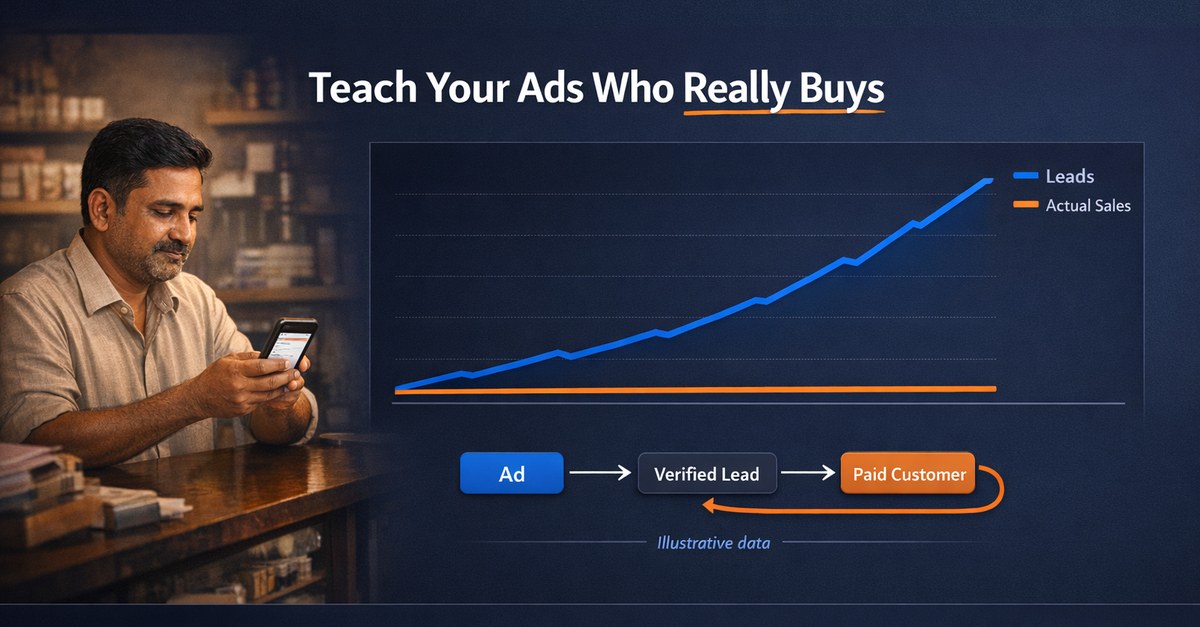
Every unqualified "form submitted" is a training signal telling Meta to buy more of that exact person. Your campaign gets measurably worse while your dashboard reports it is getting cheaper.
Below: why junk leads happen, the complete free checklist you can action today, the part you have to build, what changes on 1 October 2026, and the Indian compliance layer — DLT, TCCCPR, DPDP — that almost every article here ignores.
Why Am I Getting Fake Leads From Facebook and Instagram Ads?
Three things stack up, and all three are defaults.
1. The form asks nothing. The default instant form type is More Volume: fields pre-filled from the profile, submission in one tap, no review step. Brilliant for volume, terrible for intent — someone can complete your form without ever consciously reading your offer.
2. The optimisation goal is wrong. With the standard "leads" performance goal, the only event Meta ever receives back is form submitted. It doesn't know if that person answered the phone, lives in your city, or has money. So it optimises for people who submit forms — a learnable behaviour with nothing to do with buying kitchens.
3. Placements you never intended to buy. Left on automatic, your ad can serve inside third-party apps and games where a tap is often accidental. This is where the "wrong person entirely" junk leads on Instagram lead forms come from.
Then the loop closes. Meta buys more lookalikes-of-junk, junk submits more forms, reported cost per lead drops, that reads as success, you scale the budget — and scale the junk. It stays invisible until someone counts site visits instead of leads.
Meta Lead Ads: Higher Intent vs More Volume
Meta offers three instant form types, and switching is a two-minute edit.
| Form type | What it does | Best for |
|---|---|---|
| More Volume (default) | One-tap submit, pre-filled fields, no review step | Maximum raw lead count |
| Higher Intent | Adds a review step the user must confirm | Considered purchases — site visits, quotations, demos |
| Rich Creative | Adds space to explain the offer before the form | Products people don't grasp in one line |
Source: Meta Business Help Centre (facebook.com/business/help/252352181957512).
Higher Intent is the highest-leverage free switch for most Indian MSMEs. The mechanism is simple: it inserts a confirmation step, so accidental and half-attention submissions drop out before they reach you.
Be clear-eyed about the trade-off. Your lead volume will fall. We're deliberately not quoting a percentage — Meta publishes no figure, and every number floating around traces back to agency blogs quoting each other. Expect fewer leads and higher reported cost per lead. If your salesperson stops wasting mornings on dead numbers, that's a win.
The Free Checklist to Stop Fake Leads From Facebook Ads Today
Do all of this before spending a rupee on tooling — twenty minutes, no cost.
- Switch the form to Higher Intent (or Rich Creative if your offer needs explaining).
- Add Meta lead form qualifying questions. You get up to 15 custom questions. You don't need 15 — you need three a time-waster won't bother with: budget band, city or pincode, timeline.
- Use conditional answers. Meta supports conditional logic, so later questions change based on earlier ones. The form feels short while qualifying hard.
- Turn on Meta's native SMS/OTP verification if you can see the toggle. Meta sends the OTP itself, so no DLT registration is needed for that step. Rollout is limited and Meta doesn't document India availability — go look; if it's there, switch it on. Many accounts still cannot see it.
- Stop asking for email if you never use it. Every unused field is friction with no return.
- Fix your placements — see below.
The 60-Second Fix: The Placement Leak Nobody Mentions
For Sales and Leads campaigns, "Allow limited spend to excluded placements" is ON by default. It permits up to 5% of budget per excluded placement — so exclude four placements believing you blocked them, and up to 20% of your budget can still leak there. That is the usual source of lead ads Audience Network junk leads.
One caveat, stated plainly: this has been independently reported by ppc.land and Jon Loomer (jonloomer.com), both non-agency, but Meta has never officially documented it. So don't take our word for it — open Ads Manager and find the checkbox yourself.
The fix that holds is setting exclusions at account level: Advertising Settings → Placement Controls, which overrides the campaign-level leak. Sixty seconds, do it now.
Conversions API for CRM: The Part You Have to Build
Once the free switches are on you hit a ceiling — Meta still only knows form submitted. To go further you must teach it what a good lead looks like, which means sending data back. That's what the Meta conversion leads performance goal with the Conversions API for CRM does. Meta's published figure for this configuration versus the plain leads goal is a 44% increase in the rate at which a lead converts into a quality lead (facebook.com/business/generate-leads/conversions-api-for-crm). That's first-party, and the only number we'll quote — Meta's own surfaces give two different cost-side figures for the same setup, so we leave that claim alone.
Now the detail that makes or breaks it, absent from every top-ranking article. Meta's developer docs set hard prerequisites:
- The CRM stage you write back must convert at between 1% and 40% of leads.
- It must be reached within 28 days of the lead.
- You must store and return the 15–17 digit Meta Lead ID with each update.
- The conversion leads goal currently works only with Facebook/Instagram Lead Ads (instant forms).
This is why "just connect your CRM" is bad free advice. Write back only closed-won at a 0.5% close rate and you fall outside the band — Meta learns nothing. Pick an intermediate stage inside 1–40%: "phone verified and qualified", or "site visit booked" for our kitchen studio. That's a business decision, not an IT one, and it needs a system that records it. If enquiries still live in a notebook or a WhatsApp group, start by fixing how leads get logged and followed up; if you're choosing tools, our CRM guide for Indian small businesses covers what to rent and what to own.
Set expectations before switching: raw volume will drop and reported cost per lead will rise. Both are fine — that is the algorithm finally learning what you actually want.
Click-to-WhatsApp vs Lead Forms: The Junk-Resistance Difference
Here's a structural argument you won't find on agency blogs, for the obvious reason that both formats bill the same ad budget.
On an instant form a phone number is just characters typed into a field. Nobody proves they own it, and one wrong digit produces a perfectly formatted lead belonging to a stranger.
With a Click-to-WhatsApp ad, the person must open WhatsApp on their own device and message you. The number is verified by the act of using it — "wrong number" is largely designed out. And a second advantage survives the pricing changes below: Click-to-WhatsApp opens a 72-hour free entry point window, confirmed in Meta's developer documentation as continuing after October 2026. Seventy-two free hours to ask budget, city and timeline conversationally beats any form field. Our breakdown of how Click-to-WhatsApp ads work for small businesses covers the setup.
The honest caveat: Click-to-WhatsApp isn't compatible with the conversion leads goal above, which is instant-form only. For many MSMEs the answer is to run both and compare site visits booked — never cost per lead.
What Actually Changes on 1 October 2026
This is being widely misreported, so let's be precise. Meta must publish exact per-market rates by 1 September 2026, and from 1 October 2026 per-message charging begins for two things currently free: free-form WhatsApp service messages (free since November 2024) and utility templates sent inside the open 24-hour customer service window (free since 1 July 2025).
The guardrail: this applies to the WhatsApp Business Platform — the API, accessed through a BSP. It does not apply to the free WhatsApp Business app most shopkeepers use on their phone. If you reply by hand from the green app, nothing changes for you on 1 October. Three details if you are on the API:
- You're charged on delivery, not on send. A message to a number not on WhatsApp fails and isn't billed. But a fat-finger wrong number belonging to a real stranger is delivered, is billed, and under India's TCCCPR that stranger can file a UCC complaint against you. Junk leads carry a compliance cost, not just a cash one.
- A lead-form fill does not open a customer service window. Your first WhatsApp follow-up to a form lead is a business-initiated template, already billed today. What changes is that the free-form conversation after they reply stops being free.
- The 72-hour Click-to-WhatsApp entry point window survives.
If follow-up is metered per message, it needs to be worth sending — an argument for automating your WhatsApp replies properly rather than blasting everyone who ever filled a form.
What Fake Leads Actually Cost You
We won't quote a rupee cost-per-lead; every figure available for Indian Meta ads comes from agency blogs contradicting each other. Here's the cost structure instead — plug in your own numbers.
1. Messages are cheap, so don't build your case on them. India list rates on the WhatsApp Business Platform run about ₹0.8631 per marketing message and ~₹0.115 per utility or authentication message, ex-GST, effective 1 January 2026 (marketing up ~10% from ₹0.7846), plus 18% GST and your BSP's markup. Those come from BSP rate cards, not Meta's own pages, so treat them as indicative — but the point holds: messaging isn't your problem.
2. The real cash cost is human time. Three minutes of call attempts across a hundred junk leads a month is five hours of your salesperson's month spent dialling strangers. Multiply by what an hour of their time costs you.
3. From 1 October 2026, conversational qualification becomes a metered line item instead of a free one, if you're on the API.
4. The largest cost compounds and is invisible. Every unqualified submission trains Meta to buy more of that person. The campaign degrades while the dashboard reports improvement — and by the time you notice, you've spent months teaching a very capable machine to find the wrong customers.
For scale: India's digital ad spend hit ₹71,621 crore in 2025, up 19% year on year and now 59% of total adex (dentsu India Digital Advertising Report 2026) — and Meta claims 92% of businesses using its platforms in India are MSMEs (about.fb.com; no methodology published). A lot of small Indian businesses are paying to train the algorithm badly.
The India Layer: DLT, TCCCPR and DPDP
Almost every article ranking for this query cites the American TCPA. You are not in America.
DLT registration (TRAI). Before any commercial SMS you need the full chain registered: Principal Entity → Header → Content Template → Consent Template. Transactional and OTP messages don't need explicit consent; promotional messages do, recorded on DLT (trai.gov.in). This is why Meta's OTP toggle is valuable — Meta sends that OTP, so you skip DLT for verification.
TCCCPR Second Amendment, notified 12 February 2025. The UCC complaint window widened from 3 days to 7, action against unregistered senders was cut from 30 days to 5, and TRAI can direct disconnection or usage-capping of all telecom resources of a non-compliant entity (trai.gov.in). Cold-calling a hundred strangers a month is a live risk now, not a theoretical one.
DPDP Rules 2025, notified 14 November 2025 (PIB, PRID 2190014), phased over roughly 18 months — full compliance lands around May 2027. The key principle for lead ads: consent must be standalone and purpose-specific. A form fill is consent to be contacted about the thing you advertised, not blanket permission to broadcast forever. Practically: keep the creative, form questions and follow-up about the same offer, log when and where consent was given, and give people a working opt-out.
FAQs
Does Meta refund invalid leads?
Plan on prevention, not refunds. You're billed for ad delivery, not lead quality, and we could not find any published Meta policy that automatically credits advertisers for leads they consider junk. A billing dispute through ad account support is slow and uncertain; fixing the form, placements and optimisation goal is faster and permanent.
Can I add OTP verification to a Facebook lead form?
Sometimes, natively. Meta has an SMS/OTP option for instant forms where Meta sends the OTP itself, so no DLT registration is needed for that step. Rollout is limited and India availability isn't documented — check your form settings. If it isn't there, send traffic to your own OTP-verified form, where you control verification completely.
Will more questions kill my lead volume?
Volume will fall — that's the mechanism working, not a malfunction. Higher Intent adds a review step and custom questions add effort, so casual submissions drop out. Judge the change on qualified leads and site visits booked, never on lead count or cost per lead, which look best exactly when your targeting is worst.
Is a lead-form submission valid consent under DPDP?
It's consent for the purpose you stated, nothing wider. Under the DPDP Rules 2025 (notified 14 November 2025), consent must be standalone and purpose-specific. Someone who filled a form about modular kitchens consented to be contacted about modular kitchens — not to receive Diwali offers three years later.
Do I need DLT registration to SMS or call leads in India?
For commercial SMS, yes — TRAI requires the full DLT chain: Principal Entity, Header, Content Template, Consent Template. Transactional and OTP don't need explicit consent; promotional does, recorded on DLT. Since the TCCCPR Second Amendment of 12 February 2025, recipients get 7 days to complain and TRAI can act against unregistered senders in 5.
Where Cybiqon Fits
We don't run your ads and take no cut of your ad spend. We build the layer you own, between Meta and your sales team: an OTP-verified enquiry form carrying your qualifying questions, instant routing of verified leads to the owner's phone, and automated write-back of "qualified" or "site visit booked" against the Meta Lead ID via the Conversions API — with the intermediate stage chosen so you stay inside that 1–40% band.
That combination is our edge: web, app and AI automation built together rather than bolted on. If you're an Indian MSME burning budget on leads your team can't reach, we'll look at your setup and tell you what's free to fix before quoting anything.
Visit cybiqon.in, call +91 9250711473, or email [email protected].
Conclusion
To stop fake leads from Facebook ads, work in order: switch to Higher Intent, add three qualifying questions with conditional answers, turn on OTP verification if you can see it, and kill the placement leak at account level. Then build what Meta can't — verified capture, instant routing, and Conversions API write-back of a stage converting between 1% and 40%. Your lead count will fall and your cost per lead will rise. Your site visits won't. That's the entire point.
Want this set up for your business?
Book a free call — no tech jargon, no sales pressure. Just honest answers.
What we build for this: WhatsApp automation