Disputing and preventing courier weight discrepancy charges for Indian D2C and ecommerce sellers
How to Dispute Courier Weight Discrepancy Charges in India
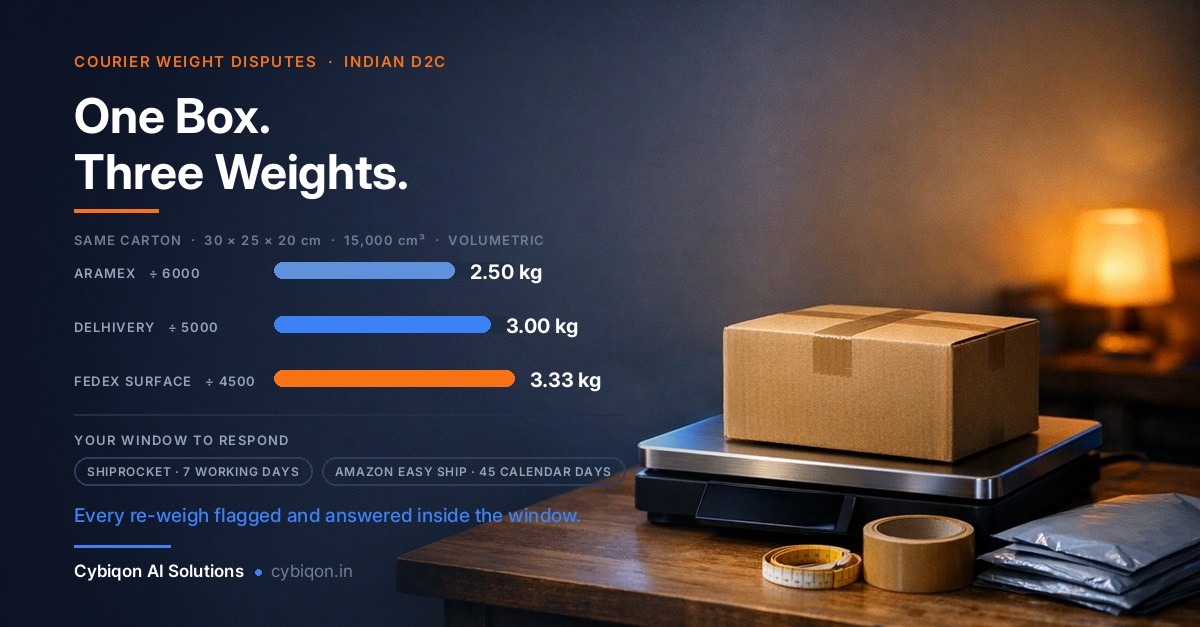
How to Dispute Courier Weight Discrepancy Charges in India
Your courier wallet is draining faster than your orders explain, and you have quietly decided that "shipping just got expensive." It probably didn't. What most likely happened is a weight discrepancy charge — a small debit raised when the courier's hub re-weighs your parcel and disagrees with the weight you declared. Learning how to dispute courier weight discrepancy charges in India matters because of one line buried in Shiprocket's own weight dispute policy: "In case the sellers do not respond to the dispute within 7 working days, Shiprocket auto accepts, and the amount is debited from the Shiprocket wallet."
Read that again. Silence is consent. You don't lose the argument — you never see it.
This guide gives you what page one of Google gets wrong: the real dispute window per platform (Amazon gives 45 calendar days, not 7), where the money is actually taken from, the evidence carriers themselves ask for, the honest legal position on consumer court, a Legal Metrology lever almost no seller uses, and how to stop the debits before the festive rush buries them.
What is weight discrepancy in courier shipping, and why am I being charged?
When you book a shipment, you declare a weight and dimensions. The courier bills on chargeable weight — the higher of dead weight (what the scale reads) and volumetric weight (the space the box occupies in the vehicle). At the hub, your parcel goes across an automated weighing and dimensioning belt. If the machine's reading is higher than your declaration, the difference is raised as a weight discrepancy and the freight difference is recovered from you.
Here is the part sellers take personally and shouldn't: at Indian courier volumes this is systemic, not malicious. Delhivery moved 1 billion express parcels in FY26 (revenue ₹10,486 crore; Q4 FY26 volumes 306 million, up 72% YoY). Re-weighing at that throughput is machine-driven.
The three ordinary causes:
- Flat declared weights. You set 500g for every order because your catalogue has no per-SKU packed weight, so a single item and a four-piece set manifest identically.
- Packaging not counted. Dead weight means the packed parcel — box, bubble wrap, filler, invoice pouch and tape included.
- Volumetric arithmetic you never did. A light but bulky parcel is billed on space, not mass. This is where most disputes actually originate — and it is a maths problem, not a fraud problem.
Understanding volumetric weight vs dead weight in India is step zero: skip it and you will dispute correct charges while accepting wrong ones.
How is volumetric weight calculated in India, and which divisor does each courier use?
The formula is (L × B × H in cm) ÷ divisor, and chargeable weight = the higher of dead weight and volumetric weight. The divisor is where sellers get ambushed, because it is not uniform across carriers.
| Carrier / mode | Volumetric divisor | Note |
|---|---|---|
| Default (most aggregator couriers) | 5000 | Standard across the panel |
| Delhivery — surface AND express | 5000 | Delhivery's help centre applies 5000 to both, with no differentiation |
| Aramex | 6000 | More generous — same box, lower volumetric weight |
| FedEx Surface | 4500 | Harsher — same box, higher volumetric weight |
Two rules that quietly cost money. First, fractions of weight are rounded up to the next full kilogram (per Shiprocket's support documentation), so a 1.02 kg chargeable weight bills as 2 kg. Second — and this is the answer to "why does the same parcel get a different chargeable weight on two couriers?" — a 30×25×15 cm box is 2.25 kg volumetric at divisor 5000, 1.875 kg at 6000, and 2.5 kg at 4500. One declared weight cannot be right everywhere. When your aggregator rotates couriers by pincode serviceability, mismatches are mathematically guaranteed.
Also ignore the widely repeated claim that "Delhivery uses 4000 for surface" — Delhivery's own volumetric weight documentation does not say that. Argue from the carrier's published divisor, not from a blog.
Free money most sellers miss: Delhivery's help centre states that "for shipments packed in flyers, we charge only based on the dead weight of up to 1 kg." For apparel, accessories and other light non-fragile goods, deliberately keeping qualifying orders in poly flyers instead of boxes removes volumetric exposure on those orders entirely. No negotiation, no tool required.
How many days do I get to dispute on Shiprocket, Delhivery and Amazon Easy Ship?
The Shiprocket weight dispute time limit is the number every seller half-remembers, and the per-carrier table circulating on page one is simply wrong. It tells sellers "roughly 7 days everywhere," which causes them to abandon Amazon claims that are still very much alive. Here is what the platforms actually publish:
| Platform | Window to act | What happens if you don't |
|---|---|---|
| Shiprocket | 7 working days | Auto-accepted; amount debited from your Shiprocket wallet |
| Amazon Easy Ship | 45 calendar days from the date charged | Claim lapses; Amazon responds to filed disputes within 15 business days |
| Delhivery (direct) | No deadline published | Claims restricted to delivered shipments only — check your own contracted SLA |
| Other aggregators (e.g. iThink Logistics) | Platform-specific | Auto-accept is the industry norm, not one platform's quirk |
On Shiprocket the disputed amount is placed on hold in your wallet and released to the courier if unchallenged — visibly frozen before it disappears, if anyone is looking. On Amazon, the route is the "Dispute on EasyShip Weight Dimensions Clawback" form under Claim Refunds in Seller Central. Forty-five calendar days is six times the aggregator window, which makes the amazon easy ship weight discrepancy dispute the most recoverable of the lot and the most commonly abandoned.
For a delhivery weight mismatch claim, the documented path is Disputes > Weight Mismatch > select AWB > Raise a Claim, with weight in grams, dimensions in cm and package images; claims track as Open or Closed. Delhivery publishes no day-count — every article quoting "7 days for Delhivery" invented it. Your real constraint is your contract.
iThink Logistics' knowledge base states the norm plainly: "The weight discrepancy will automatically be accepted by the courier if no action is taken within a certain time period."
Where is the money deducted from — my wallet or my COD remittance?
This is the question nobody answers, and it is the entire reason these charges go unnoticed. The debit hides in a different place on every platform:
- Shiprocket and similar aggregators: held, then debited from the prepaid wallet — it empties faster than your shipment count justifies.
- Amazon Easy Ship: "debited from your account and reflected in your next payment cycle" — no wallet, just a smaller settlement.
- COD-heavy sellers: netted off your COD remittance, which simply arrives lighter.
This is why sellers describe courier overcharging as a feeling rather than an event. Shipping reconciliation for D2C brands has to be per-order, and the detection tactic changes by platform: prepaid aggregator sellers should watch wallet burn per shipment, Amazon sellers should reconcile the clawback line in the settlement report against dispatch records, and COD sellers should compare COD collected to COD remitted, order by order. The same reconciliation discipline that helps you reduce RTO in ecommerce applies here — both losses are invisible until you count them per order rather than per month.
What evidence do I need to win a courier weight dispute?
Use what the carriers themselves ask for, not what a vendor says works.
- Amazon asks for eight images — length, breadth and height with the box; length, breadth and height without the box; weight with the box; weight without the box — plus the clawback month cycle, the Seller Central debit date, the affected ASINs and the monthly audit report.
- iThink Logistics asks for "clear, distinct photos of the parcel with a ruler and weighing scale."
- Delhivery asks for weight in grams, dimensions in cm and package images.
The common denominator: a single frame showing the parcel, the scale reading, a dimension reference (ruler or tape), and the AWB or shipping label — all visible together. If the AWB is not in the photo, the courier cannot tie your evidence to their shipment, and the claim dies there.
Practically: keep the scale beside a printed measuring mat, put the labelled parcel on it, and shoot one photo per order at the moment of packing. A continuous packing video of the dispatch bench is good practice and is echoed in carrier documentation — record it. But be sceptical of anyone quoting a specific "win rate with packing video"; that number traces back to a company selling packing-video software, not to any carrier or regulator. Keep the boring stuff too: the AWB, the manifest showing your declared weight and L×B×H, and the SKU's packed weight from your master.
Can I take a courier company to consumer court for overcharging my business?
Almost every article on this topic says "file a consumer complaint, it's an unfair trade practice" and stops. That advice is incomplete and, for most readers, likely wrong.
Under Section 2(7) of the Consumer Protection Act 2019, a person availing services for a commercial purpose is excluded from the definition of "consumer." The Supreme Court's test in National Insurance Co. Ltd. v. Harsolia Motors (2023) asks whether the service is closely connected to the complainant's profit-generating activity. For a D2C brand, courier freight is not incidental — it is the profit-generating activity, so the exclusion will usually bite.
The narrow escape is the statutory carve-out for services availed "exclusively for the purpose of earning his livelihood by means of self-employment," which the Supreme Court has confirmed preserves consumer status. But the burden of establishing it sits on you, and it fits a genuinely one-person operation far better than a funded brand shipping thousands of orders a month.
So, honestly:
- One-person self-employed seller who can evidence the livelihood carve-out: consumer forum is viable.
- Anyone larger: unreliable. Your realistic route is the contractual one — the dispute and escalation mechanism, and any arbitration clause, in the carrier's or aggregator's own terms of service, backed by written records.
Also ignore the frequent suggestion to file on MSME Samadhaan: it implements MSMED Act sections 15–24, which govern a buyer failing to pay an MSE supplier within 45 days. Here you are the buyer of a service — wrong forum, wasted weeks.
Does the Legal Metrology Act apply to the weighing scale a courier uses to bill me?
Here is a lever essentially absent from every competing article. The statutory chain holds on the bare text of the Legal Metrology Act 2009:
- Section 2(u) defines "transaction" to include "the assessment of any work done, wages due or services rendered." Weighing a parcel to assess the freight payable for a carriage service is exactly that.
- Section 2(w) expressly includes "a weighing or measuring instrument" within "weight or measure."
- Section 24(1) requires any weight or measure used in any transaction to be verified and stamped before being put to use.
- Rule 27(2), Legal Metrology (General) Rules 2011 sets a re-verification interval of 12 months for weighing instruments (24 months for beam scales, counter machines and weights), stamped by the Legal Metrology Officer of the State where the instrument is used.
- Section 33 penalises use of an unverified weight or measure: a fine of not less than ₹2,000 and up to ₹10,000 for a first offence, with imprisonment up to one year for repeat offences.
The honest caveat, stated plainly: we found no Controller of Legal Metrology order, prosecution or FIR against a courier over a hub weighing scale. This is a well-founded statutory argument, not a demonstrated enforcement practice. Do not go around claiming couriers are breaking the law.
What you can do is ask one precise question in writing inside your dispute: "Please provide the Legal Metrology verification and stamping certificate, and the last re-verification date, for the weighing instrument that produced the disputed reading on AWB XXXX." If it cannot be produced, escalate to the State Controller of Legal Metrology via the Department of Consumer Affairs' Legal Metrology Division (lm.doca.gov.in). A polite, citable question changes the tone of a ticket that would otherwise be closed with a template.
How do I stop weight discrepancy charges before they happen?
Recovery is the emergency. The way to reduce weight discrepancy charges permanently is prevention — and the carrier tells you how.
Delhivery's own "Pre-population of Weight and LBH" documentation explains it: maintain an accurate packaged weight and shipping-box dimensions against each product in your catalogue and the panel auto-populates weight and L/B/H per order — single-item orders use the packaged weight, multi-item orders sum by quantity, dimensions come from the associated box. Load it by manual entry, bulk CSV, or a Shopify/WooCommerce sync. Weight discrepancy is, at root, a catalogue-data problem.
Take a Jaipur home-furnishing brand shipping ~1,800 orders a month through an aggregator. Every order is declared at a flat 500g because no SKU carries a packed weight, so the panel manifests the same weight for one cushion cover and a four-piece set. The hub re-weighs, differences go on hold, nobody in a two-person team opens the Weight Discrepancy tab, and after 7 working days the platform auto-accepts. The founder concludes shipping rates went up.
The turn is three moves:
- Load per-SKU packed weights and box dimensions into the catalogue so the panel pre-populates weight and L/B/H.
- Run a daily automated reconciliation — pull each carrier's discrepancy report and match every flagged AWB against your own recorded packed weight, so real errors get disputed inside the window with dispatch-bench evidence.
- Act on what the data says. Genuinely under-declared SKUs get repriced so you stop selling shipping at a loss; flyer-packed sub-1kg orders stay in flyers to use Delhivery's published dead-weight-only concession.
Timing matters. Redseer forecasts festive-season ecommerce GMV of ₹1,15,000 crore (about US$13.12 billion), up 20–25% over a 30–35 day window from the festive sale period opening late September into October — the strongest festive run in five years. Volume that size buries small debits, so fix your weight master and your festive season website readiness before the wave, not during it.
And margin is being squeezed from the other side too: Amazon India has raised seller closing fees by ₹1 on orders up to ₹500 and ₹3 above ₹500 from 7 September 2026 across FBA, Easy Ship and Seller Flex, attributed in press reports carrying an Amazon company statement to higher fuel and logistics costs — weeks after seller-cancellation fees of up to 10% of order value took effect on 17 August 2026. If you are tracking marketplace penalty and fee changes but not your weight debits, you are losing margin from two directions and can only see one of them.
FAQs
How many days do I get to dispute on Shiprocket, Delhivery and Amazon Easy Ship?
Shiprocket gives 7 working days, after which it auto-accepts and debits your wallet. Amazon Easy Ship gives 45 calendar days from the date charged and responds within 15 business days. Delhivery publishes no deadline but restricts claims to delivered shipments — check your contracted SLA rather than trusting a blog.
Where is the amount deducted from — my wallet or my COD remittance?
It depends on the platform. Aggregators like Shiprocket hold and then debit the prepaid wallet. Amazon debits your account and reflects it in the next payment cycle settlement. COD-heavy sellers see it netted off the COD remittance. Knowing which applies to you decides where to look for it.
Can I take a courier company to consumer court for overcharging my business?
Often no. Section 2(7) of the Consumer Protection Act 2019 excludes services availed for a commercial purpose, and Harsolia Motors (2023) asks whether the service is closely linked to your profit-generating activity — courier freight usually is. A genuinely self-employed seller may qualify under the livelihood carve-out but must prove it; larger sellers should use the carrier's contractual dispute and arbitration route.
Why does the same parcel get a different chargeable weight on two couriers?
Because divisors differ. The default is 5000, Aramex uses 6000 and FedEx Surface uses 4500, and fractions are rounded up to the next full kilogram. The same 30×25×15 cm box is 2.25 kg, 1.875 kg or 2.5 kg depending on the carrier. It is arithmetic, not cheating.
Let Cybiqon build the reconciliation you can't staff
Most MSMEs don't lose these disputes — they never open the tab. That is an automation gap, not a discipline failure. At Cybiqon AI Solutions we build the layer a two-person team cannot hire for: a scheduled job that pulls each carrier's weight-discrepancy report daily, reconciles every flagged AWB against your own packed-weight and dimension master, and alerts you on WhatsApp or email while the dispute window is still open. A silent default-loss becomes a decision you get to make.
We're a small Indian LLP building websites, apps, Chrome extensions and AI automation for MSMEs — including the shipping and order software stack that sits around this. If your wallet is emptying faster than your orders explain, talk to us: visit cybiqon.in, call +91 9250711473, or write to [email protected].
Conclusion
Knowing how to dispute courier weight discrepancy charges in India comes down to three habits: know your real window per platform (7 working days on Shiprocket, 45 calendar days on Amazon Easy Ship, your contract on Delhivery), know where the money is taken from, and photograph the parcel with the scale, the ruler and the AWB in one frame. Then fix the cause — per-SKU packed weights and box dimensions in your catalogue, plus a daily automated check. Do it before the festive wave, and ask Cybiqon if you'd rather it ran itself.
Want this set up for your business?
Book a free call — no tech jargon, no sales pressure. Just honest answers.
What we build for this: Custom websites