How to reduce RTO in ecommerce for COD-heavy D2C and marketplace sellers
How to Reduce RTO in Ecommerce India: A 2026 Blueprint
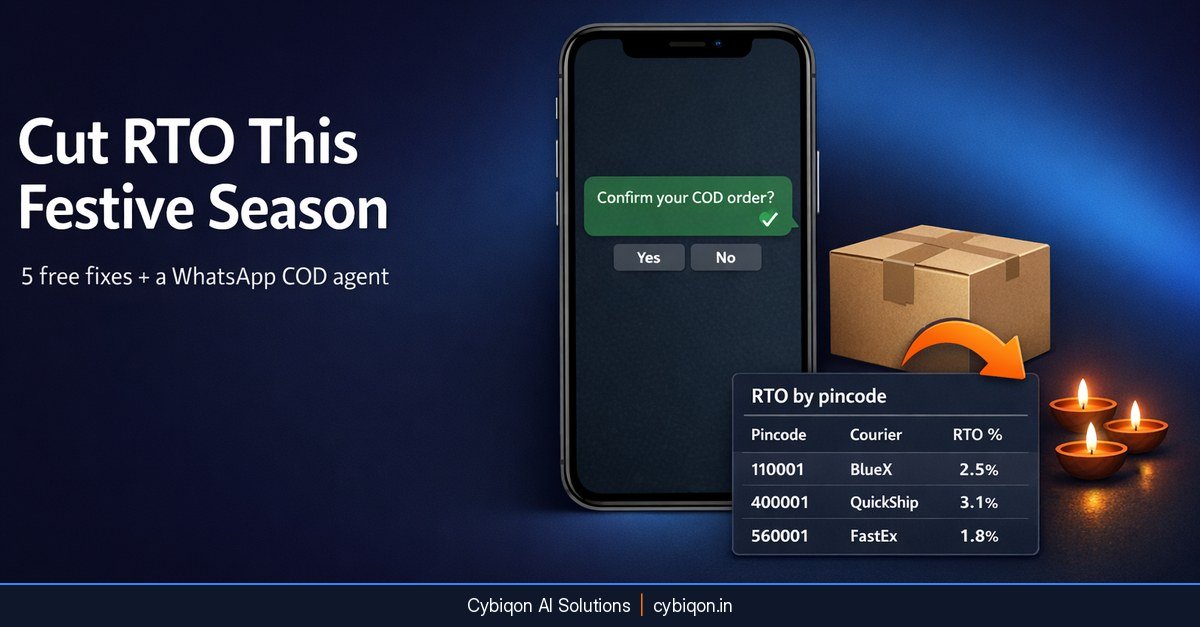
At last year's Diwali peak, more than one D2C parcel in three came back unopened. Unicommerce's India D2C Report 2026 charts D2C RTO at 39.2% in November 2025, and each of those parcels cost the seller forward freight, return freight and the ad spend that won the order. If you are working out how to reduce RTO in ecommerce this week, the timing matters: Amazon's Great Indian Festival opened on 8 October 2026, Flipkart Big Billion Days opened to everyone on 9 October, and Diwali is Sunday 8 November.
The orders you take in the next four weeks are the ones that come back in late October and November. Nobody has published an independent RTO figure for festive 2026, so the number to trust this season is your own, split by pincode, courier and SKU.
Below: the short answer (free steps first), what your shipping panel already does for free, the RTO rate formula, who publishes each benchmark, the rupee cost per RTO, NDR timing, and a dated plan from 8 October to the post-Diwali review.
How to Reduce RTO in Ecommerce: The Short Answer
The first five steps cost nothing but time. The sixth tells you whether they worked.
- Confirm every COD order on WhatsApp before dispatch. A one-tap "Ship it / Cancel" message within minutes of the order. No reply means a call; still no reply means you hold the parcel.
- Check the address and pincode before printing the label. Missing house numbers, landmark-only addresses and pincodes that don't match the city are cheap to fix now. After pickup, most panels won't let you change the pincode.
- Show the prepaid nudge honestly, on the product page and cart. A small prepaid discount or free shipping works best when the buyer sees it before checkout. Any COD fee belongs there too, not on the last screen.
- Move high-RTO pincodes to another courier. If one courier keeps failing in one cluster of pincodes, reroute those orders instead of blocking COD for the region.
- Act on every NDR within 24 hours. A Non-Delivery Report is the last chance to save the order. Reach the buyer the same day, fix the address or reschedule, and update the courier.
- Measure your own RTO by pincode, courier and SKU. Export last month's shipments, mark each one delivered or RTO, and see where returns cluster.
What You Already Get Free From Shiprocket, Delhivery and Shopify
Before paying for an RTO tool, check what your stack already does. At the time of writing (October 2026):
| Tool | What it does | Cost | Limits |
|---|---|---|---|
| Shiprocket NDR buyer flow | SMS on every NDR; buyer can request a reattempt or update the address (a missed call counts as a reattempt) | Free on all plans; IVR on Advanced/Pro | Can't change pincode, city or state; WhatsApp isn't a documented NDR channel |
| Shiprocket panel (Aug 2026 update) | NDRs by reason, each buyer's RTO history for 6 months, prepaid-only for risky buyers | Included | SLA shown by zone, not pincode or courier; AI confirmation calls still in development |
| Shiprocket Engage (Shopify app) | Order confirmation, address check, COD-to-prepaid | ₹2.49 per order, billed in USD | Rated 2.6 from 6 reviews |
| Delhivery One | Reattempt, reschedule or return from the dashboard; up to 3 reattempts | Included | Help docs last updated Nov 2023 |
| Shopify COD apps (COD King, Cashfree CODFIRM, Verify COD, MSG91) | OTP or WhatsApp verification before dispatch | Free to install, then per message or plan | Ratings and prices change often |
| DIGIPIN (India Post) | Free 10-character geocoded address code, launched 27 May 2025 | Free | No confirmed courier adoption yet, so not an RTO fix this season |
If you want to know how to reduce RTO in Shopify, these free pieces already cover steps 1, 2 and 5 reasonably well. None of them gives you one view of RTO by pincode, courier and SKU across every channel you sell on.
A caveat for Amazon, Flipkart and Meesho sellers
On marketplaces the platform runs COD and owns the buyer conversation. Amazon masks buyer numbers and allows contact only about delivery. So your own WhatsApp confirmation works for orders from your website, Shopify store or Instagram shop, not marketplace orders.
To reduce RTO on Meesho, Amazon or Flipkart, your levers are accurate listings (size charts, real photos), sturdy packaging, fast dispatch and the platform's own tools. Marketplace RTOs also show up as settlement deductions, worth checking with marketplace payout reconciliation.
RTO Meaning in Ecommerce, and the RTO Rate Formula
RTO means Return to Origin: a shipped order never reached the buyer and came back at your cost. Shiprocket confirms the seller pays RTO freight and the COD charge is reversed, so a COD RTO earns ₹0. A customer return is different: it happens after delivery, you were paid, and you fix it with better product information and a smoother returns and exchange process. A sealed RTO parcel should go back into stock, but a "QC Passed" status is only a doorstep check, so read what RTO QC Passed actually means before trusting it.
There is no single agreed RTO rate formula. Guides use two denominators:
(RTO orders ÷ COD orders dispatched) × 100, your COD risk rate(RTO orders ÷ total orders dispatched) × 100, your business exposure
Say you dispatched 1,000 orders: 600 COD, 400 prepaid. 150 came back, 140 of them COD. That is 23.3% on COD orders and 15.0% on total orders. Compare one with a benchmark published the other way and you are off by more than 8 points. Track both monthly.
Build your RTO-by-pincode sheet in an afternoon
- Export last month's shipments: order ID, pincode, courier, SKU, payment mode, final status.
- Add a column: 1 for RTO, 0 for delivered.
- Pivot with pincode in rows, courier in columns, and the average of that column as the value. Repeat for SKU.
- Ignore cells with fewer than about 20 orders.
The high-RTO cells with real volume are your list for rerouting and for prepaid-only rules.
What Is the Average RTO Rate in India?
Every benchmark below comes from a company selling logistics or checkout software. Know who published each:
| Benchmark | Figure | Source |
|---|---|---|
| D2C festive peak | 39.2% (Nov 2025) | Unicommerce chart; press release says "nearly 39%" |
| D2C, Jan 2026 | 25.6% | Unicommerce |
| "Optimised brands", Mar 2026 | 21.0% | Unicommerce. Brands that ran three fixes, not a national rate; others stayed at 39% |
| Festive-quarter COD return rate | 58% vs under 15% prepaid | Unicommerce (a "return" rate, not strictly RTO) |
| Average RTO in India | About 23% | GoKwik figure quoted by Amazon Shipping (25 Aug 2026); GoKwik sells RTO tools |
| By category | Fashion 25–40%, beauty 18–25%, electronics 10–15% | ClickPost, which calls these "a directional gauge" |
The Unicommerce data (400 million+ order items, 6,000+ brands) is useful because of the gap it shows. Some brands went from about 39% to 21% while others stayed put. Unicommerce credits a prepaid incentive at checkout, pincode-level courier routing based on actual delivery performance, and order verification. Those are steps 1, 3 and 4 above.
Our rule of thumb (on total orders, not drawn from any dataset): under 10% is excellent, 10–18% is a realistic target with confirmation and a prepaid nudge, and 30%+ means the basics are missing.
The causes you can act on: impulse COD orders, the same product ordered from several sites, bad addresses, unreachable phones, fake or missed delivery attempts, and slow deliveries. Nearly 66% of new D2C orders in FY2026 came from Tier II and III cities (Unicommerce), so confirm harder there rather than block them.
How Much Does One RTO Order Cost?
- Logistics-only: about ₹180–240 per returned COD order (Amazon Shipping India blog, 15 July 2026, citing Pragma). ClickPost's direct-cost range of ₹150–300 brackets it.
- Fully loaded: ₹450–900 per RTO (ClickPost, updated 5 August 2026), including the ad spend on an order that never paid. On our arithmetic, roughly ₹300–600 of that is written-off acquisition cost.
Say you ship 1,000 orders a month at 23% RTO, so 230 come back. At a ₹210 logistics midpoint that is ₹48,300 a month (about ₹5.8 lakh a year). At the ₹675 fully loaded midpoint it is ₹1,55,250 a month (about ₹18.6 lakh a year).
Confirming each order costs far less. Third-party rate summaries put Meta's fee for an Indian utility template at about 12–15 paise per message (Flowcall ₹0.115, AiSensy ₹0.145), before GST and your provider's markup: roughly ₹115–145 per 1,000 COD orders, against ₹180–240 lost on one RTO. Check your own provider's invoice.
Cash flow is the hidden cost. Shiprocket's standard COD remittance is D+8, about 8–9 days to your bank; paid Early COD pays on D+2, D+3 or D+4 for 0.99%, 0.69% or 0.49%, with a 30-day lock-in. Delhivery's 2023 docs say within 48 hours of delivery. Check your contract. On an RTO you never get that money, and both freight legs are billed, which is why a wrong weight hurts twice before you dispute a courier weight discrepancy.
NDR Management in Ecommerce: Act Within 24 Hours
Shiprocket makes up to 3 delivery attempts, and Delhivery allows up to 3 reattempts before RTO. No courier publishes a fixed window, but attempts are usually about a day apart, so act within 24 hours of the first NDR. Eshopbox says buyers will wait up to 36 hours after an NDR notice (a vendor figure, no stated method).
A workable NDR desk:
- NDR raised → WhatsApp the buyer within the hour with one-tap replies: "Reattempt tomorrow", "Update address", "Cancel".
- No reply in 3–4 hours → call.
- Buyer responds → update the courier the same day.
- Nothing by hour 24 → offer prepayment, or let it go rather than pay for a doomed third attempt.
- Log every NDR reason to see whether it is addresses, phones or one courier's zone.
Be careful with results claims. ClickPost claims "up to 40%" fewer failed deliveries and an average 20–30% within about 60 days; its published customer cases show 5–10% (Kapiva 10%, Avimee 5%). Plan on the smaller number.
How to Reduce RTO in Ecommerce During the Festive Sale: 8 Oct to 8 Nov 2026
Festive COD is growing. In Diwali 2025, COD orders rose 22% year on year and COD GMV 35%, against 26% for prepaid orders, and Tier II and III cities made up about 55% of festive orders (Unicommerce). Redseer forecasts festive 2026 ecommerce GMV of $15–16 billion, about 25% up, with 180–185 million shoppers (BestMediaInfo, 18 September 2026). More first-time buyers means more Diwali sale COD returns.
| Dates | What is happening | What to do |
|---|---|---|
| 7–9 Oct | Myntra 7 Oct (early access), AJIO 7–18 Oct, Amazon GIF 8 Oct, Flipkart BBD 8–9 Oct, Meesho 9 Oct | Turn on WhatsApp COD confirmation and address checks; prepaid offer on product page and cart |
| 10–18 Oct | First NDRs from opening-week orders | Daily NDR desk, weekends included; respond within 24 hours |
| 19–31 Oct | First RTOs land back | Restock sealed RTOs; move worst pincodes to another courier |
| 1–8 Nov | Dhanteras Fri 6 Nov, Diwali Sun 8 Nov | Freeze changes; keep weekend NDR cover |
| 9–15 Nov | Bhai Dooj Tue 10 Nov; late orders in transit | Keep the desk running until the last parcel settles |
| Late Nov | RTOs settled | Review RTO by pincode, courier, SKU and payment mode; reconcile payouts; set next year's COD rules |
No platform has published a sale end date, so treat this as the window around Diwali.
Should you disable COD during the festive sale?
Blocking COD everywhere cuts sales along with RTO. Instead, restrict COD only where your own data says so (Shiprocket can set high-risk buyers to prepaid only), and make COD-to-prepaid conversion easy. Razorpay's vendor case study on Borosil starts at 60% COD and 11% RTO; after Magic Checkout, Razorpay reports RTO fell 36.36% (roughly 11% to 7%, our arithmetic) and prepaid share rose 70%, without saying whether that is relative or in points.
Show the nudge honestly. The Consumer Protection (E-Commerce) (Amendment) Rules, 2026, notified 9 September 2026 and effective 1 January 2027, require disclosure of payment methods and return shipping costs. They contain no COD-fee clause, but a fee revealed only at checkout sits close to the "drip pricing" named in the 2023 Dark Patterns Guidelines, and the CCPA began probing COD handling fees in October 2025. More in is a COD fee legal in India.
The Build That Ties It Together: A WhatsApp COD and NDR Agent You Own
Steps 1, 2, 5 and 6 are one conversation: a message, a reply, an action, and a record of what happened. Today it usually lives on a staff phone or in an SMS tool that never records whether the order was delivered. An agent on your own WhatsApp Business number can:
- Confirm each COD order and address before dispatch, with a one-tap prepaid link
- Follow up every NDR within hours and pass the buyer's answer to the courier
- Log every outcome against pincode, courier, SKU and payment mode
- Show your own RTO rate in a dashboard you own
Two WhatsApp details first. Pricing is contested: Meta's developer docs (read 8 October 2026) still say utility templates inside an open customer-service window are free, while several providers say that changed on 1 October 2026. A confirmation sent right after an order is billed as a utility template either way. And Indian businesses must move WhatsApp Business Accounts to INR billing by 31 December 2026, or Meta stops delivering their messages from 1 January 2027. The same setup can also run WhatsApp abandoned cart recovery.
FAQs
What is a good RTO rate in India?
There is no independent national benchmark. Unicommerce charted 39.2% at the November 2025 peak and 21.0% for "optimised brands" by March 2026; GoKwik's figure, as quoted by Amazon Shipping, is about 23%. Our rule of thumb on total orders: under 10% is excellent, 10–18% is realistic, 30%+ needs urgent work.
Does WhatsApp COD confirmation reduce RTO?
Yes. Unicommerce credits order verification as one of three changes that took some brands from about 39% to 21% RTO. Confirmation catches fake numbers, wrong addresses and changed minds before you pay freight, for about 12–15 paise per message in Meta fees.
What is NDR and how is it different from RTO?
An NDR (Non-Delivery Report) is raised when a delivery attempt fails, and the order can still be saved. RTO follows once the attempts run out (up to 3 on Shiprocket and Delhivery) and the parcel heads back. Act within 24 hours of the first NDR.
Should I disable COD during the festive sale?
Not across the board. COD orders grew 22% in Diwali 2025. Restrict COD only for the pincodes, SKUs and buyers your own data flags, confirm the rest on WhatsApp, and show a prepaid offer upfront.
How much does one RTO order cost?
About ₹180–240 in logistics for a returned COD order (Amazon Shipping, citing Pragma), or ₹450–900 fully loaded with written-off ad spend (ClickPost). Both are vendor figures, so check them against your courier invoices.
What Cybiqon Would Build for Your Store
For a D2C brand shipping COD-heavy orders through Shiprocket or Delhivery, Cybiqon would build the agent described above on your WhatsApp Business number: COD and address confirmation before dispatch, a prepaid link, NDR follow-up within hours, and every outcome logged by pincode, courier and SKU into your own dashboard. Marketplace shipment reports can be imported into the same RTO view, even though the agent only messages buyers from your own channels.
It is written for your order flow, couriers and catalogue rather than configured from a template, and you own the code and the data. See our WhatsApp automation work, book a 30-minute call, or reach us at +91 9250711473 or [email protected].
Conclusion
Learning how to reduce RTO in ecommerce starts with free steps: confirm COD orders on WhatsApp, check addresses before dispatch, show the prepaid offer upfront, reroute bad pincodes, and answer every NDR within 24 hours. Then measure your own RTO by pincode, courier and SKU, because no vendor benchmark shows where your parcels come back. The festive sales run up to Diwali on 8 November 2026, with the RTO review due in late November. If you want confirmation, NDR follow-up and logging built as one system you own, Cybiqon can build it.
Want this set up for your business?
Book a free call — no tech jargon, no sales pressure. Just honest answers.
What we build for this: WhatsApp automation