what RTO QC Passed means on Indian marketplace returns dashboards
RTO QC Passed Meaning: What It Really Tells Indian Sellers
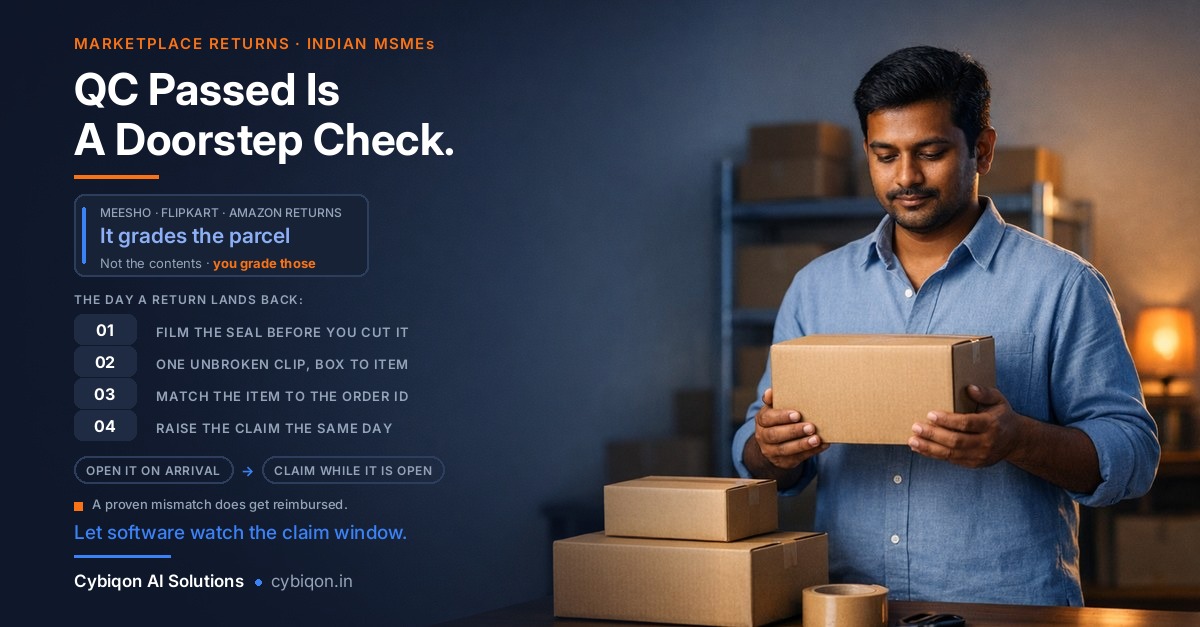
If you have ever opened your returns dashboard and seen the status "RTO QC Passed", here is the plain-English answer. The RTO QC passed meaning that matters to an Indian seller is this: a delivery agent stood at the customer's doorstep, spent a few seconds checking the parcel's condition, and decided it was eligible to be sent back to you. That's it. It is not a promise that your product is inside the box. It is not a verification that the right SKU, the right size or the right item is coming home. It is a doorstep condition check, not a contents audit.
That one misunderstanding costs sellers real money every festive quarter. Search this term today and you'll get factory quality-control guides for electronics buyers — nothing that explains what the status actually means on a Meesho, Flipkart or Amazon India seller panel.
In this guide you'll get the exact definition backed by the platforms' own wording, why RTO is different from a customer return, what the verified 2026 RTO numbers actually say, the uncomfortable truth about claim deadlines, and the evidence routine to install before this year's festive rush.
RTO QC Passed Meaning: What the Platforms Actually Say
Don't take a blogger's word for it — including ours. Read the platforms' own language.
Meesho's legal terms (meesho.com/legal, "Returns, Refunds and Replacement") state it verbatim:
"At the time of pick up, Meesho's delivery partner may conduct a quality check on the product to ensure it meets the criteria specified under return guidelines. If the product fails such a quality check, the product shall not be returned, and no refund shall be made against such product."
Amazon India's help pages (nodeId=202111950) put it this way:
"The delivery agent will check the product during the pickup. If the verification fails, because the product is not in its original state (has been used, missing original tags etc.), the delivery agent may cancel the pick-up."
Read those two carefully and the picture is clear. The QC step is a gate on whether the pickup happens at all. "QC Passed" means the parcel cleared that gate. Amazon separately says a return is processed only if "the product is not different from what was shipped to you" — but that determination happens after pickup, back at the facility, not at the customer's door.
So the honest RTO QC passed meaning is: "the agent found nothing obviously wrong in a few seconds, so this is coming back to you." Whether a ₹1,299 kurta or a ₹200 lookalike is inside the polybag is a question nobody has answered yet.
Why Google Gets "QC Passed" Wrong: Two Different QC Processes
There is a category error baked into most search results for this term, and it's worth naming because it explains why you couldn't find a straight answer.
- Catalogue QC — the check a marketplace runs on a new listing before it goes live: images, titles, attributes, mandatory fields. This is what most of the ranking pages describe.
- Returns QC — the doorstep condition check performed by the courier at pickup. This is what you see on a returns dashboard.
They share three letters and nothing else. A third bucket, factory/inspection QC on imported electronics, dominates the rest of the results. None of them is your returns panel.
RTO vs customer return is the second distinction that changes what you can claim:
| RTO (Return to Origin) | Customer return | |
|---|---|---|
| What happened | Never delivered — refused, unreachable, address failed | Delivered, then sent back by the customer |
| Who handled the box | Courier only | Customer had it, then courier |
| Doorstep QC applies | Usually not — nobody accepted it | Yes — this is where "QC Passed" appears |
| Claim route | Lost/damaged-in-transit route | SAFE-T (Amazon) / SPF (Flipkart) / Meesho claim |
Mixing these up is how sellers file the wrong claim type and get rejected on a technicality. If RTO itself is your bigger leak, the operational fixes — COD confirmation, pincode-level courier allocation, fast NDR follow-up — belong in a separate playbook: our guide on how to reduce RTO in ecommerce covers that side end to end.
How Bad Is the RTO Problem in India Right Now?
Here are the verified numbers, and only the verified ones.
The Unicommerce India D2C Report 2026 (published April 2026, built on 400 million-plus order items from 6,000+ digital-first brands between April 2024 and February 2026) found that RTO peaked at roughly 39% during the November 2025 festive period, then fell to about 21% by early 2026. That finding was independently reported by Entrepreneur India, YourStory and CXOToday.
Unicommerce also reports that 58% of COD orders came back in the FY26 festive quarter, against under 15% for prepaid. Treat that as Unicommerce's figure specifically — it appears on their own page and was not repeated in the independent write-ups.
On returns fraud, the only solid dataset is global, not Indian. The NRF 2025 Retail Returns Landscape puts 9% of retail returns as fraudulent against $849.9 billion in total 2025 returns. Among retailers that track returns fraud, 65% report increases in "empty box" returns, 71% in overstated return quantity, and 64% in decoy or counterfeit returns. Useful as a signal that the wrong-item-in-the-box problem is real and growing — not as an India statistic. Anyone quoting it as Indian data is guessing.
The pressure is compounding from the fee side too. Flipkart's three-tier fulfilment penalty went live 23 August 2026 (₹30 late dispatch, ₹60 seller cancellation, ₹90 for both; new sellers exempt for their first three months). Amazon India's graded cancellation fee started 17 August 2026 — 10% of order value below ₹10,000, tapering to 2% above ₹1 lakh, plus 18% GST — and closing fees rise by ₹1/₹3 from 7 September 2026. We broke down all of these in our post on the 2026 seller penalty and fee changes.
How Long Do You Have to File a Claim? Nobody Agrees
This is the section no ranking page will publish, so here it is openly: the claim windows are contradictory across every public source. We checked.
| Platform | Programme | Windows claimed in public sources | Actually authoritative |
|---|---|---|---|
| Amazon India | SAFE-T | 60 days (pre-Feb 2026, US), 30 days (US, Feb 2026), 45 days (a Unicommerce blog), 15 days (an Indian seller quoting Amazon's own rejection on sellercentral.amazon.in), 7 days (TrackVid) — while Amazon India's own Easy Ship seller blog states no window at all | Seller Central → Orders → Manage SAFE-T Claims → enter the Order ID |
| Flipkart | SPF | 14 days from return delivered / 120 days from return created / 48–72 hours | Flipkart Seller Hub, per order |
| Meesho | Returns claim | 72 hours / 7 days / 15 days / 30 days | Meesho Supplier Panel, per order |
One important correction while we're here: Amazon's February 2026 announcement about a 30-day SAFE-T window reads, verbatim, "for US seller-fulfilled orders." India and amazon.in appear nowhere in it. The rule is real; its jurisdiction is the United States. Several Indian blogs repeat it as an India change. It isn't one — at least not on the public record.
So what do you do with a contradiction? Don't trust any published number, including a range. The authoritative source is per-order and sits inside your own account. Amazon's Manage SAFE-T Claims screen doubles as an eligibility checker (Amazon India documents a 7-business-day response time on claims). Flipkart's is in Seller Hub; Meesho's in the Supplier Panel.
Until you've checked for that specific order, treat every return as same-day. It's the only instruction that survives every possible window.
Two Things About SAFE-T and SPF Nobody Tells You
1. There is an undocumented cap on how many claims you can file.
Indian sellers on Amazon's own India seller forum (sellercentral.amazon.in) have posted rejections reading: "YOU HAVE EXCEEDED THE ACCEPTABLE LIMIT OF FILING SAFE-T CLAIMS." No vendor blog mentions that filing too many claims is itself a rejection reason.
That single line should change your strategy. Reflexively claiming every return burns a budget you didn't know you had. File selectively, on the cases where your evidence is strongest — and make sure the evidence exists before you decide.
2. There is no statutory remedy if a claim is denied.
This is the load-bearing fact. There is no Indian regulatory or judicial record of marketplace seller claim-denial disputes. The CCI matters people cite — the January 2020 probe following the Delhi Vyapar Mahasangh complaint, the August 2024 findings, the Supreme Court transfer litigation — and AIOVA's petitions all concern seller preferencing, deep discounting and exclusive launches. None of them is about returns-claim denial.
The Consumer Protection (E-Commerce) Rules 2020 protect consumers and impose duties on sellers: a grievance officer, 48-hour acknowledgement, one-month redressal. They give a seller no remedy against a platform for a denied claim.
Plainly: SAFE-T and SPF are contractual programmes the platform runs, not statutory rights. There is no appellate authority above the platform's own decision. Which is exactly why evidence filed inside the window is the only leverage you actually have.
What Indian Sellers Should Actually Do Before the Festive Rush
Picture a Ludhiana apparel seller pushing around 400 orders a day across Meesho, Flipkart and Amazon in the festive quarter. Returns arrive in bulk sacks and get opened days later by whoever is free. One parcel comes back with a cheaper kurta instead of the ₹1,299 piece that shipped. But the packing bench has no camera, no weight recorded against the AWB, and nobody can say which of four packers handled it. The claim gets filed from memory, after the window, and is rejected for insufficient evidence.
Nothing in that story is fixable after the return arrives. Evidence has to be captured at dispatch, before the return exists.
Across platforms, the video evidence requirement has the same shape: continuous, uncut footage with the AWB or order ID visible, from sealed box back to the item. (That shape is described on vendor blogs citing no dataset — trust it for the requirement's structure, never for numbers.) Flipkart's Video Management System (VMS) is a genuine Flipkart product for order-packing video, documented on Flipkart's own YouTube channel, and Flipkart positions it as helping defend against missing-item and misshipment claims. One caution: we could not verify the widespread claim that VMS is mandatory for SPF eligibility — Flipkart's own SPF FAQ PDF doesn't mention VMS at all.
The practical ladder, in order:
- Scan the AWB at the packing bench — every order gets a scan event before it's sealed.
- Record one unbroken clip from sealed box to item, AWB visible in frame.
- Record the weight against that order ID. This also protects you when a courier raises a weight dispute — the same evidence lets you dispute courier weight discrepancy charges instead of absorbing them.
- Open every return the same day it's scanned in. Not "when someone's free."
- Check the per-order eligibility checker before assuming a deadline.
- File selectively, leading with your strongest evidence.
Festive dates aren't confirmed yet — Big Billion Days and Great Indian Festival are expected late September, though Flipkart typically confirms only two to three weeks ahead, and Diwali falls on 8 November 2026. That uncertainty is the argument for acting now: early September is the last quiet window to install evidence capture before volume triples.
FAQs
What does QC Passed mean in an RTO or return?
It means the courier's delivery agent performed a quick condition check at the customer's doorstep and cleared the parcel for pickup. QC Passed refers to the parcel's outward condition and returnability under the platform's return guidelines — not to whether the correct product is inside. The contents check, where it happens at all, occurs later at the facility.
Does QC Passed mean I will definitely get my product back?
No. QC Passed means the pickup was allowed to proceed. It is not a guarantee that the original SKU is in the box. This is precisely why dispatch-side evidence matters: if the wrong item comes back, your packing video and recorded weight are the only things that can support a claim.
What is the difference between RTO and a customer return?
RTO (Return to Origin) means the parcel was never delivered — refused, undeliverable or unreachable — and comes back from the courier. A customer return means the buyer received the item and then sent it back. Doorstep QC applies to customer returns; the claim routes for the two are different, and filing under the wrong one gets you rejected on a technicality.
Can I dispute a QC Passed return that came back with the wrong item?
Yes — through Amazon's SAFE-T claims, Flipkart's SPF or Meesho's supplier claims process. But these are contractual programmes the platforms operate, not statutory rights, and the platform's decision is final. Your only leverage is uncut dispatch video with the AWB visible, a recorded weight, and filing inside the window. On your own D2C store the rules are entirely different — that's the consumer refund and returns side, governed by consumer law rather than marketplace policy.
How long do I have to file a SAFE-T or SPF claim in India?
Nobody outside the platforms can tell you reliably — public sources give five conflicting figures for Amazon SAFE-T, three for Flipkart SPF and four for Meesho. The only authoritative answer is per-order, inside your seller account (Amazon: Manage SAFE-T Claims; Flipkart: Seller Hub; Meesho: Supplier Panel). Until you check, treat every return as same-day.
Need This Running Automatically? Cybiqon Can Help
At 400 orders a day across three marketplaces, this isn't a checklist a human can run — packers are packing, and nobody is watching a claim clock. That's a small internal app's job.
At Cybiqon AI Solutions we build exactly that kind of thing for Indian MSMEs: scan the AWB at the packing bench, auto-capture the video segment and weight against that order ID, and run a tracker that alerts you before each platform's window closes. Web, app and AI automation under one roof, built for shopkeepers, manufacturers and D2C brands — not enterprise budgets.
To be straight with you: no tool can promise a claim gets approved. Approval is always the platform's decision. What a system like this guarantees is that claims get filed, on time, with the evidence each platform asks for — instead of never getting filed at all.
Have a look at cybiqon.in, or just call +91 9250711473 or write to [email protected]. Happy to look at your returns workflow before the festive quarter hits.
Conclusion
The RTO QC passed meaning is narrower than most sellers assume: a delivery agent judged your parcel returnable in a few seconds at the customer's door — nothing more. Whether the right item is inside is still an open question, the claim window is genuinely unclear across platforms, and there is no statutory appeal above the platform's decision. That leaves exactly one lever in your hands: evidence captured at dispatch, and claims filed the same day a return lands. Install that routine in September, before the festive rush makes it impossible.
Want this set up for your business?
Book a free call — no tech jargon, no sales pressure. Just honest answers.
What we build for this: Custom websites