FSSAI improvement notice, Section 32 enforcement and the March 2026 perpetual licence reform for small Indian food businesses
FSSAI Improvement Notice 2026: Your Real Deadline to Reply
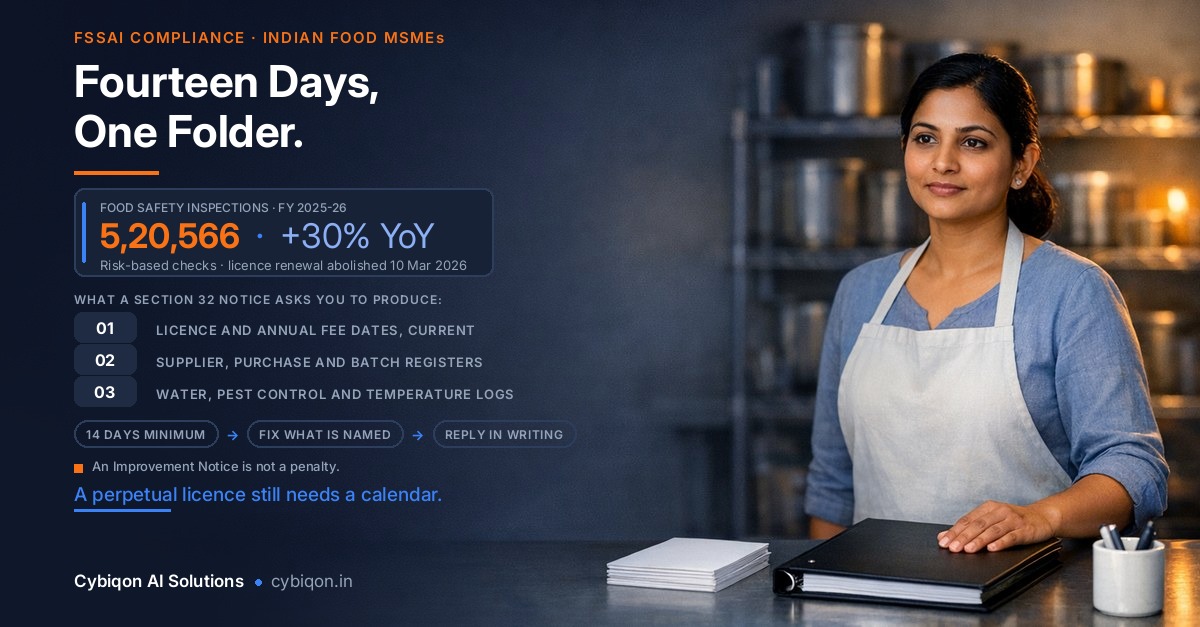
FSSAI Improvement Notice 2026: Your Real Deadline to Reply
If a Food Safety Officer has just walked out of your kitchen and left you holding an FSSAI improvement notice, take a breath. This is not a shutdown order. In Mumbai, between 25 May and 31 July 2026, the FDA inspected 3,137 establishments and issued 764 improvement notices against 165 suspensions — roughly 4.6 notices for every one licence suspended. The notice is the normal outcome of an inspection. The suspension is what happens to people who ignore it.
There is a second problem, and it is not yours. If you searched this topic last week, most of what you read was out of date. On 10 March 2026 FSSAI abolished licence renewal entirely, yet page one is still full of "2026" articles describing ₹100/day renewal late fees, 180-day expiry windows and a ₹12 lakh registration threshold that stopped existing on 1 April 2026. Several pages send you to the wrong appeal forum. One page-one result is about the United Kingdom.
So here is the accurate version, with section numbers and notification numbers you can check yourself: what an improvement notice is, exactly how long you really have, where the appeal goes, when a licence actually gets suspended, and the silent new trap that replaced the renewal deadline.
What an FSSAI improvement notice is — and who actually issues it
An improvement notice is issued under Section 32 of the Food Safety and Standards Act, 2006. It is a formal written instruction saying: you are not complying with a hygiene or safety requirement, here is what must change, and here is the time you have to change it.
The single most-blurred fact online: the Food Safety Officer does not issue it. The FSO inspects, samples and reports. The Designated Officer (DO) issues the improvement notice, and the DO also holds the suspension and cancellation powers under §32(3). Knowing who signed your notice tells you who you are actually dealing with.
Section 32(1)(d) requires the notice to specify what you must do and "a reasonable period (not being less than fourteen days) as may be specified in the notice."
Read that clause slowly, because almost every vendor blog gets it wrong.
- Fourteen days is a statutory floor, not the period.
- The Designated Officer specifies the actual window in your notice, and it can be longer.
- Never plan against a generic "14 days" you read online. Plan against the date printed on your paper.
Inspections themselves are digital now. They run through FoSCoRIS (Food Safety Compliance through Regular Inspection and Sampling), FSSAI's official web and mobile platform, where the officer scores each checklist item as Compliance, Non-Compliance, Partial Compliance or Not Applicable. The completed report is visible in real time to the authorities and to you, inside your own FoSCoS account. Very few owners know they can simply log in and read the report written about their own premises. Do that first — it tells you precisely which line items you have to close.
The appeal window can be shorter than 15 days: §32(5) explained
This is the most valuable and least-published fact in the whole topic, and getting it wrong costs people their appeal.
Section 32(5) says an appeal must be filed within 15 days from the date of service of the notice of the decision, or within the period specified in the improvement notice, whichever expires first.
"Whichever expires first" is the sting. Because the compliance period can legally be as short as 14 days, your appeal window can be shorter than 15 days. A 14-day improvement notice gives you a 14-day appeal window, not 15, and certainly not the "15 to 30 days" that several registration-agency pages vaguely quote.
Practical sequence for the week you receive an FSSAI improvement notice:
| Day | What to do |
|---|---|
| Day 0–1 | Read the notice. Note the DO's name, the exact compliance date, and every listed deficiency. Pull your FoSCoRIS report from FoSCoS. |
| Day 1–3 | Decide: comply, appeal, or both. Both is usually right — complying does not waive your position. |
| Day 2–7 | Fix the physical items. Assemble the records: water test report, pest control slips, medical fitness certificates, purchase invoices, temperature and cleaning logs. |
| Before the earlier of the two dates | File the appeal if you are contesting. File the compliance reply with dated photographs and document copies either way. |
| After | Expect a re-inspection. This is the one that decides whether you keep trading. |
Where an FSSAI improvement notice appeal goes: the Commissioner, not the Tribunal
Section 32(4) is unambiguous: an appeal against an improvement notice lies to the Commissioner of Food Safety, "whose decision thereon shall be final."
It does not go to the Food Safety Appellate Tribunal. The FSAT, under Section 70, hears appeals from an Adjudicating Officer's order under Section 68 — that is the penalty-adjudication track, with a 30-day limit extendable by another 30 days. It is a completely different route.
If you file an improvement notice appeal at the FSAT, you have not merely gone to the wrong counter — by the time it is returned, your §32(5) window has almost certainly expired. Send it to the Commissioner of Food Safety of your state.
When a licence is suspended or cancelled — and how 2026 courts are narrowing it
Section 32(3) separates two things people confuse:
- Cancellation requires an opportunity to show cause first. It is the heavier, rarer outcome.
- Suspension carries no such statutory precondition, and the proviso to §32(3) lets the Designated Officer suspend a licence "forthwith in the interest of public health for reasons to be recorded in writing."
That "reasons to be recorded in writing" is doing real work, and a line of 2026 High Court decisions has been pressing on it. Writing on SCC OnLine Blog (2 September 2026), analysts noted that courts have recently held immediate suspension must be proportionate, not reflexive:
- Wardha Tahsil Go-Dugdha Utpadak Sahakari Sangh Ltd. v. State of Maharashtra, 2026 SCC OnLine Bom 9345 — immediate suspension needs reasonable grounds to suspect a risk to human health, proportionate to the severity actually found.
- Akshay Dairy Farm v. State of Maharashtra, 2026 SCC OnLine Bom 10592 — the order must explain why immediate suspension was imperative and why a lesser measure would not do.
- Sayaji Hotels (Indore) Ltd. v. FSSAI, W.P. No. 35120 of 2026 — even serious findings such as expired stock do not automatically meet the threshold.
- Gurunanak Dairy & Sweets v. Union of India, 2026 SCC OnLine Bom 9410 — suspension vacated after a re-inspection showed 98% compliance, with ₹5 lakh compensation awarded.
- Pind Punjab v. Union of India, 2026 SCC OnLine Bom 8597 — restoration mandated after a later inspection showed 100% compliance.
Two honest caveats. This analysis comes from a single (authoritative) legal publisher, so treat it as a developing line of High Court reasoning, not settled national law. And the practical lesson is not "we can litigate our way out" — it is the opposite. In both restoration cases, what won was a clean re-inspection. Fix first, argue second.
The pattern visible across the Maharashtra drives is that suspension usually follows the second inspection, where the first round's findings were not closed. That is what turns your notice from a catastrophe into a deadline you can beat.
The March 2026 reform: renewal is gone, deemed suspension replaced it
On 10 March 2026, FSSAI notified an amendment making licences and registrations perpetual. New Regulation 2.1.7(1) states a licence is "valid and subsisting, unless otherwise suspended, cancelled or surrendered."
The paper trail, so you can verify it: Gazette notification RCD-01002/1/2021-Regulatory-FSSAI-Part(1) dated 10 March 2026; implementation order I/36087/2026 dated 13 March 2026; PIB press release PRID 2278119; and coverage by DD News / NewsOnAir on 13 March 2026 from the Ministry of Health and Family Welfare. It came out of the NITI Aayog High-Level Committee on non-financial regulatory reform. Sources differ on whether to date the effect from 10 or 11 March — treat it as notified 10 March 2026, in force from publication. FoSCoS migration was automatic, licence numbers did not change, and there was no modification fee.
Now the part nobody is telling you. Regulation 2.1.7(2): if you fail to pay the annual fee or file the annual return by the due date, your licence "shall be deemed suspended" — automatically, with no notice, no reminder and no email. No food business activity is permitted while it is suspended.
The good news is that it is comparatively benign to fix: pay the dues plus penalty and it is revoked. No fresh application, no new licence number. You can also pay annual fees in advance for several years, which is the single cheapest piece of compliance insurance available to a small food business.
The quiet risk is structural. The renewal date was the only recurring deadline that ever forced a small food business to look at its own compliance file once a year. That prompt is now gone — at exactly the moment inspections have risen sharply and become risk-based, meaning a computer-assisted model uses your past compliance record to decide how often you get inspected in future. Your FoSCoRIS score is a permanent digital record. A bad inspection buys you more inspections.
Nine in ten branded outlets failed: it is a filing failure, not a hygiene failure
In August 2026, the Maharashtra FDA ran a special drive under Commissioner Tukaram Mundhe. Of 104 branded chain outlets inspected, 95 were served improvement notices, 5 licences were suspended and 2 stop-business orders were issued. The brands included Domino's, KFC, Pizza Hut, McDonald's, Subway, Burger King, Starbucks and Monginis (Business Today, 13 August 2026; identical figures in The Logical Indian, same date).
These are SOP-driven, internally audited national chains with dedicated compliance teams. Nine in ten still failed. "We are small and we are clean" is not a defence, because cleanliness is not what most of the deficiencies were about. Here is what officers actually recorded:
- FSSAI licence not displayed
- Potable water (no valid test report)
- Food storage practices
- Pest control
- Hygiene facilities
- Temperature monitoring
- Cleaning and sanitation scheduling
- FIFO/FEFO stock rotation
- Raw/cooked and veg/non-veg segregation
- Missing food-grade certificates and maintenance records
Read that list again. Most of it is paperwork you either have in one place on the day the officer walks in, or you don't. That is the whole thesis of this article. The nationwide picture matches: in a written reply to Parliament in July 2026, MoS Health Prataprao Jadhav gave provisional figures of 5,20,566 inspections in FY2025-26, up from 4,01,391 in FY2024-25 and 3,57,072 in FY2023-24 — around 30% growth in a year and 46% in two. Of 2,23,808 samples, 40,023 were non-conforming — nearly one in five — with 31,878 civil cases decided with penalties and 1,918 criminal convictions.
One caution before anyone quotes me back: there is no national count of improvement notices issued. The Maharashtra and Mumbai numbers are state and city figures. Do not extrapolate them nationally.
New turnover thresholds, FoSTaC, and the ₹100/day fee that is probably not yours
Three things almost every page online still gets wrong.
1. The turnover thresholds changed on 1 April 2026. Under FSSAI order F. No. RCD-01002/1/2021-Regulatory-FSSAI-Part(1) (also cited as I/36087/2026), dated 13 March 2026:
| Licence type | New limit (from 1 Apr 2026) | Old limit |
|---|---|---|
| Basic Registration | Up to ₹1.5 crore turnover | Up to ₹12 lakh |
| State Licence | ₹1.5 crore – ₹50 crore | ₹12 lakh – ₹20 crore |
| Central Licence | Above ₹50 crore | Above ₹20 crore |
But do not treat ₹1.5 crore as a clean single test. Petty-FBO eligibility has always carried capacity conditions alongside turnover — notably milk procurement or handling up to 500 litres per day or 2.5 MT of milk solids per annum, plus slaughter capacity limits. And Schedule 1 pulls certain categories under the Central Licensing Authority irrespective of turnover: importers, e-commerce FBOs, 100% EOUs, multi-state operators and large manufacturers by capacity. A sweet shop under ₹1.5 crore turnover that handles more than 500 litres of milk a day is not automatically on Basic Registration. Commentators at Mondaq and CliniExperts both note that sector-specific carve-outs under the new thresholds are still awaited.
2. FoSTaC. Since 6 October 2017, you need one FoSTaC-certified Food Safety Supervisor per 25 food handlers, or part thereof. The scope condition routinely dropped by training vendors: it binds Central and State Licence holders, not Basic Registration holders (verified against FICSI, FSSAI's own Sector Skill Council). Whether businesses migrating down to Registration under the new ₹1.5 crore ceiling fall outside the obligation is an open question — FSSAI has not clarified it, and anyone telling you it is settled is guessing.
3. The ₹100/day late fee you keep seeing is real, but attached to the wrong obligation for most readers. The old ₹100/day renewal late fee is dead, along with the 180-day post-expiry window and the 3×/5× annual-fee penalties, because renewal itself no longer exists. What survives is a ₹100/day late fee on the annual return under Regulation 2.1.13(3) — Form D-1, due 31 May, capped at five times the annual licence fee.
And here is the relief, in the same spirit as explaining which jewellers genuinely need HUID tracking and which do not: Form D-1 binds manufacturers, importers, repackers, relabellers and processors. If your Kind of Business is retail, distribution, storage, transport or food service only — which covers most restaurants, caterers, cloud kitchens and kirana stores — you are exempt from Form D-1. The annual fee, however, still applies to everyone, and that is the one that triggers deemed suspension.
Two more myths worth killing: the FSSAI Hygiene Rating Scheme remains voluntary — no 2026 order made it mandatory. And claims that "from 2026 delivery platforms must display your FSSAI number" trace back to vendor blogs with no notification number behind them. Platforms do delist non-compliant restaurants, and if you sell through quick-commerce apps a suspension can cost you the listing long before it costs you a court date — but treat that as a commercial reality, not a cited legal rule.
Getting inspection-ready: the records, not the kitchen
Think about the composite case of a sweet shop and bakery — a small production kitchen behind the counter, around ₹2 crore turnover, supplying a few kirana stores and listed on a quick-commerce app. The owner keeps a genuinely clean kitchen. He would still struggle on inspection day, because:
- Nobody is watching the annual fee date now that renewal is gone
- Supplier invoices are bundled by month in a drawer
- There is no way to trace a delivered box back to the raw-material lot it came from
- The water potability report is inside an eighteen-month-old email
- Pest control service slips went into the bin
- Cleaning and cold-storage temperature logs get filled in on Saturday for the whole week
A modest custom system does not change the kitchen. It changes the retrieval time: licence and annual-fee alerts weeks ahead; a supplier and purchase register searchable by item and date; batch and lot records linking each production run to its raw materials and outward dispatches; water tests (every six months) and food-handler medical fitness certificates (annually) stored with due dates; and pest control, cleaning and temperature logs captured on a phone with a real timestamp.
Two days of paper-hunting becomes a five-minute export. Just as importantly, the paperwork stops looking reconstructed — which is often what turns a fixable notice into a suspension. This is the same discipline a chemist applies to a Schedule H1 register that an inspector can audit on the spot, and it is why we keep arguing that MSMEs are better served by one connected digital system rather than six disconnected apps. If your outlet still runs on a cash counter and a notebook, a proper restaurant billing setup built for Indian food businesses is where the record trail usually starts.
FAQs
What is an improvement notice under FSSAI and who issues it?
It is a written notice under Section 32 of the FSS Act, 2006 telling a food business which requirement it has failed and what must be corrected. It is issued by the Designated Officer, not the Food Safety Officer who conducted the inspection. The DO also holds the power to suspend or cancel the licence under §32(3).
How many days do I get to comply with an FSSAI improvement notice?
Whatever your notice says. Section 32(1)(d) requires "a reasonable period (not being less than fourteen days) as may be specified in the notice" — 14 days is the legal minimum, not a fixed rule. It can be longer. Always work from the date printed on your notice.
Where do I appeal an FSSAI improvement notice, and how long do I have?
To the Commissioner of Food Safety of your state under §32(4), whose decision is final — not the Food Safety Appellate Tribunal (the FSAT hears §68 adjudication appeals under §70). Under §32(5) you have 15 days from service of the notice of decision or the period specified in the improvement notice, whichever expires first — so on a 14-day notice, your appeal window is 14 days.
Can a food safety officer suspend my licence immediately?
The Designated Officer can, under the proviso to §32(3), suspend "forthwith in the interest of public health for reasons to be recorded in writing." But a line of 2026 High Court decisions has held that immediate suspension must be proportionate and the order must explain why a lesser measure would not serve. In practice, suspension most often follows a second inspection where earlier findings were not closed.
Is FSSAI licence renewal still required in 2026, and what if I miss the annual fee?
No. Since the notification dated 10 March 2026, licences and registrations are perpetual under Regulation 2.1.7(1). But under Regulation 2.1.7(2), missing the annual fee or annual return due date means your licence is "deemed suspended" automatically, with no notice — and trading during a suspension is operating without a valid licence. Pay the dues plus penalty and it is revoked without a fresh application or a new licence number.
What is the penalty for running a food business without a valid licence?
Under Section 63, as amended by the Jan Vishwas (Amendment of Provisions) Act, 2023 (Gazette CG-DL-E-12082023-248047, in force for FSS Act provisions from 8 November 2023), it is a civil penalty of up to ₹10 lakh — imprisonment was removed. Section 61 (false information) rose from ₹2 lakh to ₹10 lakh. Pages still printing "₹5 lakh and six months' jail" are three years stale.
How Cybiqon helps small food businesses stay inspection-ready
Cybiqon AI Solutions is a small, early-stage Indian technology firm building websites, apps, Chrome extensions, AI automation and web scraping for MSMEs. We are not a compliance consultancy and we will not file your appeal — for that, talk to a food-law professional in your state.
What we do build is the boring layer underneath: a compliance calendar that warns you about the annual fee weeks early, a searchable purchase and supplier register, batch and lot traceability from raw material to dispatch, and timestamped logs for cleaning, pest control and cold-storage temperatures that your staff can fill on a phone in ten seconds. Because we combine web, app and automation work in one place, it usually ends up as one system your team already uses for billing, not another portal nobody opens.
If that sounds useful, have a look at cybiqon.in, or just message us — +91 9250711473 or [email protected]. Tell us what your inspector asked for last time; that is usually the fastest way to scope it.
Conclusion
An FSSAI improvement notice is a deadline, not a verdict. Mumbai's own numbers put notices ahead of suspensions by roughly 4.6 to 1, courts in 2026 are pressing officers to justify immediate suspension, and businesses that fix deficiencies before the re-inspection have had suspensions vacated outright. What you must not do is miss the window — check your notice date, remember the §32(5) appeal can be shorter than 15 days, appeal to the Commissioner of Food Safety, and set an alert for your annual fee now that renewal no longer exists to remind you. Records win inspections.
Want this set up for your business?
Book a free call — no tech jargon, no sales pressure. Just honest answers.