Google review QR code for Indian clinics, restaurants and salons: free official link and QR, Google's 2026 Maps review policy (on-premises pressure, staff quotas, staff names, incentives, review gating), why reviews disappear, and an opt-in WhatsApp thank-you to every customer logged against the bill
Google Review QR Code: The Free Link and Google's 2026 Rules
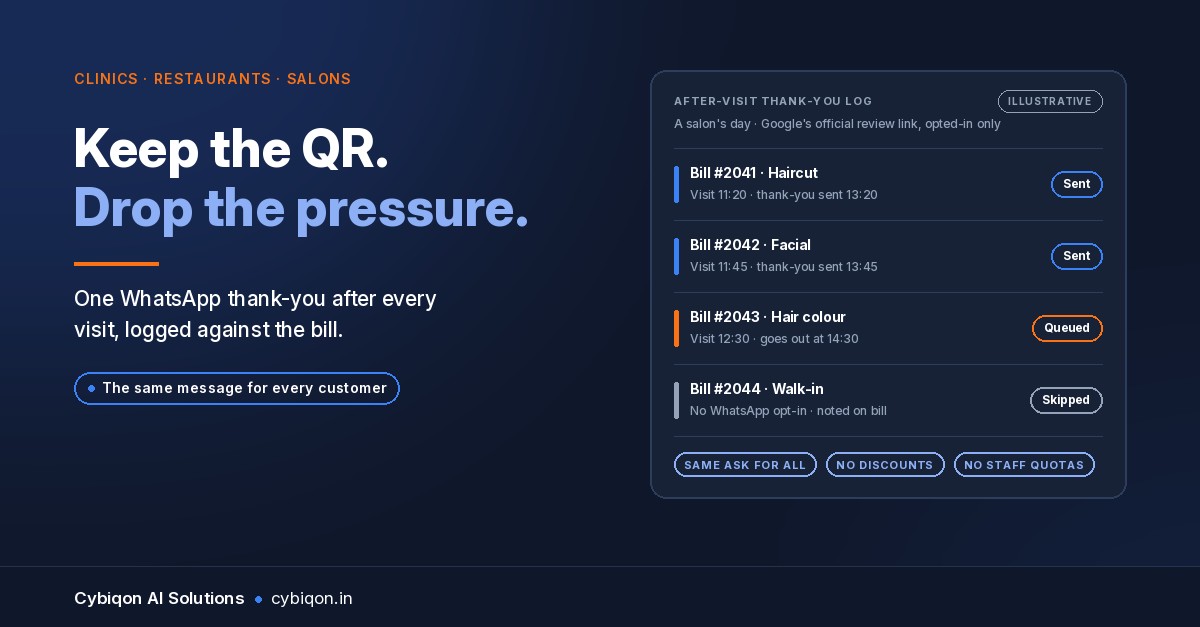
The Google review QR code at your reception desk is not the problem. Google's own help page tells businesses to "print and display the QR code in your store". What Google's policy names is everything that tends to happen around that QR in a busy clinic, restaurant or salon: the receptionist who asks a patient to post before they pay, the monthly bonus for whoever collects the most reviews, the "please mention Priya" line, the free dessert for a rating.
Google is also enforcing at scale. It says it blocked or removed more than 292 million policy-violating reviews from Maps worldwide in 2025 and restricted 782,000 accounts (Google Keyword blog, 16 Apr 2026). Reviews removed for a policy reason "won't be restored". So when the reviews from your Saturday rush quietly vanish, they usually stay gone. And nobody at the front desk can say who was asked, when, or how.
This guide covers what an owner or front-desk manager actually needs:
- how to get Google's free official review link and QR (no generator needed)
- Google's current review policy, quoted line by line
- what Google says, and does not say, about missing reviews
- a policy-safe alternative: one WhatsApp thank-you with the link, sent to every customer after they leave, logged against the bill
How to get your Google review QR code and link for free
Most of the top results for "google review qr code" are QR generator tools. You don't need one. Since around March 2025, Google Business Profile has generated the review link and the QR itself (Search Engine Roundtable).
Here is how to get your Google review link, following Google's help page:
- Sign in with the Google Account that manages your Business Profile.
- Search your business name on Google Search to open the profile.
- Click Read reviews.
- Click Get more reviews.
- Copy the link, or save the QR code.
Two catches the generator sites leave out:
- The QR is only offered on a computer browser. On a laptop, right-click the QR and choose "Save image as". On a phone you get the link, not the QR.
- Don't use the Share button in Google Maps. That link opens your profile, not the review form, so the customer has to hunt for "Write a review". Use the link from "Get more reviews".
The customer needs to be signed in to a Google Account to post. Before printing, test the link on a phone not logged in to your business account.
That one Google review link then serves everything: the printed QR, the back of the bill, your website and a WhatsApp message. Google's help page itself names WhatsApp as a place to share it.
Is a paid Google review QR code for business any better? Some add scan tracking or a "rate us first" screen. Be careful with the second: a page that asks for stars first and sends only the happy customers on to Google is review gating, which the policy prohibits (next section). Google's own QR goes straight to the review form, which is what you want.
Google review policy 2026: is a Google review QR code allowed?
Google's Maps content policy has a section on rating manipulation (support.google.com/contributionpolicy/answer/7400114). According to PPC Land, the staff and on-premises wording appeared in April 2026. Google publishes no changelog for the page, so treat that date as press-reported. The wording below is what is live.
| What the policy says (quoted) | What it means at your counter |
|---|---|
| Merchants "should not require or pressure users to leave ratings or write reviews while on the premises" | "Please scan this before you pay", or standing beside a patient while they type, is the problem. The QR on the counter is not. |
| Prohibited: "merchants requesting that staff solicit a certain number of reviews" | No review targets, quotas or bonuses for receptionists, waiters or stylists. |
| Prohibited set content, including "content that identifies a staff member" | Don't tell customers what to write, and don't ask them to name the person who served them. |
| Incentives such as "payment, discounts, free goods and/or services" | No 10% off, free dessert or free hair spa in return for a review. |
| Businesses must not "selectively solicit positive reviews" | No asking only the happy ones. This is review gating. |
Can I ask customers for Google reviews?
Yes. Google's help pages explain how to share your link with customers and tell you to display the QR. The line is not asking. It is pressure on the premises, staff quotas, scripted content, incentives and choosing who gets asked.
Is a Google review discount offer allowed?
No. Google's help page on getting reviews calls incentives "fake engagement". That covers a discount on the next visit, a free item, cashback, or a lucky draw entry for posting a review.
Many owners read the April headlines as "review QR codes banned". Wrong: a passive Google review QR code on the counter or a table tent is what Google suggests. What changes is what staff say around it.
Why Google reviews are disappearing or not showing
Google gives several reasons reviews go missing, but never the reason for a specific review. Here is what its help page on reviews says officially:
- New reviews go through screening, which may take a few days before they show.
- Reviews removed for violating policy won't be restored.
- User content can be temporarily disabled.
- After a sudden spike in reviews, Google may pause new reviews on a profile and show a banner saying so.
Two recent events add context. In July 2026 many businesses reported reviews vanishing in bulk (Search Engine Roundtable, 3 Jul 2026); Google said it may remove or pause reviews and would restore ones removed in error. And in April 2025 Google announced alerts on profiles, in markets including the US, UK and India, where it had removed suspicious five-star reviews (Google).
What Google does not confirm
Many vendor blogs say reviews posted on your shop Wi-Fi get filtered because they share one IP address. Google has not confirmed this. Treat it as unconfirmed, and don't build a process around it.
What is clear: ten reviews in an hour from people in your waiting room, after a staff member asked, is the on-premises pressure the policy describes. A steady trickle from customers who have gone home is not.
Keep the Google review QR code, drop the counter push: a hypothetical Pune clinic
This is a hypothetical scenario, not a client.
Say a dental clinic in Pune has the QR on reception. The receptionist asks each patient to post a review before paying, and front-desk staff get a monthly bonus on review count. On Saturdays the waiting room produces a burst of reviews. Some never appear. The owner has no record of who was asked, so there is nothing to check and nothing to show anyone.
Every part of that set-up except the QR itself is named in the policy. A policy-safe version looks like this:
- Drop the review quota and the bonus tied to it.
- Drop the "before you pay" ask, and any script about what to write or whom to name.
- Keep the passive QR at reception.
- Add an opt-in line at registration for WhatsApp messages.
- Send every opted-in patient, happy or not, the same thank-you with the official link a few hours after the visit.
- Log each send against the appointment or bill ID.
None of this promises more reviews, a higher rating or the return of removed reviews. What it gives you is a process that matches what Google's policy says, plus a record of it.
Why bother at all? Reviews are read, but trust in them is thin. In a LocalCircles survey from December 2022 (56,000 responses across 357 districts), 88% of Indians who look up a business on Google said they often read its reviews, but 45% thought Google ratings were inaccurate and only 3% had high trust (Business Standard). For a global benchmark, BrightLocal's 2026 survey of US adults found 74% only consider reviews from the last three months (BrightLocal). Recent, genuine reviews from ordinary visits matter more than a Saturday burst.
How to send a Google review link on WhatsApp the right way
The core rule: every opted-in customer gets the same message, after they leave, with no incentive and no filtering by how the visit went. If you have been wondering how to get Google reviews without breaking the policy, that rule is the answer. WhatsApp is the obvious channel here, and it is one Google's own help page names.
Step 1: collect consent. The WhatsApp Business Messaging Policy requires opt-in and requires you to respect opt-outs, and it applies to both the free app and the paid platform. At registration or billing, record a yes to something like: "We'll send your receipt and a short thank-you on WhatsApp. Reply STOP any time."
Step 2a: start with the free WhatsApp Business app. There is no per-message fee. But broadcasts only reach contacts who have saved your number, and a broadcast list holds at most 256 contacts (WhatsApp FAQ). That is why some customers simply never get your message; we cover the limits in why a WhatsApp broadcast is not delivered.
Step 2b: move to the WhatsApp Business Platform (API) when volume grows. Messages go out as pre-approved templates, and Meta decides the category. Feedback on a specific past interaction can count as utility; a generic "review us" request won't be approved as utility; anything promotional makes it marketing. Meta has billed per message since 1 Jul 2025, and its docs say utility messages inside the customer-service window became chargeable from 1 Oct 2026. Reported rates are about ₹0.115 per delivered utility message and about ₹0.86 per marketing message, before 18% GST (IBTimes, Route Mobile, MSG91). These are reported figures, not Meta's rate card.
A neutral message looks like this:
Hi {name}, thank you for visiting {clinic} today. If you'd like to share your experience, you can leave a Google review here: {link}. Reply STOP to stop these messages.
No stars, no "five-star", no offer, and it goes to everyone. If you already send WhatsApp appointment reminders for your clinic, the thank-you can go out from the same system a few hours after the appointment.
Keep a send log against every bill
The send log is what turns "we think we asked people" into a record. One row per bill or appointment:
| Column | Why it's there |
|---|---|
| Bill or appointment ID | Ties the message to a real visit |
| Visit date | Shows the message went out after the visit, not at the counter |
| Consent recorded (yes/no, when) | Opt-in is a WhatsApp rule, and good data practice |
| Template used | Proves everyone got the same wording |
| Sent / delivered time | Shows what actually reached the customer |
| Opted out | So nobody gets a second message after saying stop |
When reviews disappear, you can show what you did and when. It proves every opted-in customer got the same message, the opposite of gating, and it keeps opt-outs honoured.
What the log should not contain: a satisfaction score, a "happy customer" flag, or any field that decides who gets the message. Don't try to match reviews back to bills either. You can't do it reliably, and it isn't needed.
Rules in India: clinics, IS 19000 and consent
- Clinics and doctors. The NMC's "Guidelines on Ethical Advertising and Public Communication", dated 6 Oct 2026, bar soliciting, purchasing or manipulating fake, paid or misleading patient reviews. They also say a registered medical practitioner "shall not request or share patient testimonials, recommendations, endorsements or reviews for professional promotion" on social media (The South First). Whether a neutral Google review request falls under that has not been settled. Check with your council or a lawyer before you send one.
- IS 19000:2022. This BIS standard on online consumer reviews is voluntary and aimed at platforms that publish reviews (Rajya Sabha answer, March 2025). A conformity scheme followed in February 2026.
- Consent under DPDP. The DPDP Rules 2025 consent duties phase in around May 2027. Recording WhatsApp consent at billing now is good practice anyway.
FAQs
How do I get a QR code for my Google reviews?
Open your Business Profile on Google Search in a computer browser, click Read reviews, then Get more reviews, and save the QR (right-click, "Save image as"). Google generates it for free. The QR option doesn't appear on a phone.
Can I give a discount or free item for a Google review?
No. Google's policy prohibits "payment, discounts, free goods and/or services" in exchange for reviews, and its help page calls incentives "fake engagement".
Is it okay to send the review link only to happy customers?
No. Google prohibits businesses that "selectively solicit positive reviews". That is review gating. Send the same message to every opted-in customer, whatever their experience.
Can I send a Google review link on WhatsApp?
Yes. Google's help page names WhatsApp as a sharing channel. Send it only to customers who opted in, after they leave, and honour every opt-out.
Can doctors and clinics in India ask patients for Google reviews?
It is not settled. The NMC guidelines of 6 Oct 2026 restrict requesting patient reviews for professional promotion on social media, and it is unclear whether a neutral Google review request is covered. Check with your council or a lawyer first.
What Cybiqon would build for this
Cybiqon builds the post-visit thank-you into the billing or appointment software you already use. A consent field at registration, one approved WhatsApp template carrying your official Google review link, sent to every opted-in customer a few hours after they leave, and a send log against each bill: sent, delivered, opted out. No counter pressure and no filtering by satisfaction.
It is written for your front desk and your system rather than configured from a template, and you own every line of the code. It is part of our WhatsApp automation work; for the wider picture, see our guide to WhatsApp automation for Indian businesses. Cybiqon does not sell review monitoring or rating promises.
Book a 30-minute call, or reach us on +91 9250711473 or [email protected].
Conclusion
A Google review QR code at the counter is fine. Google tells you to display it. What its policy names is pressure on the premises, staff quotas, scripted mentions, incentives and asking only happy customers. Get the free official link from "Get more reviews", keep the QR passive, and send every opted-in customer the same WhatsApp thank-you after they leave, logged against the bill. Clinics should check the NMC position with their council first. If you want that flow built into your own system, Cybiqon is a 30-minute call away.
Want this set up for your business?
Book a free call — no tech jargon, no sales pressure. Just honest answers.
What we build for this: WhatsApp automation