Managing Instagram and WhatsApp orders and one-of-a-kind stock for boutique brands
Instagram Order Management: Stop Selling One Piece Twice
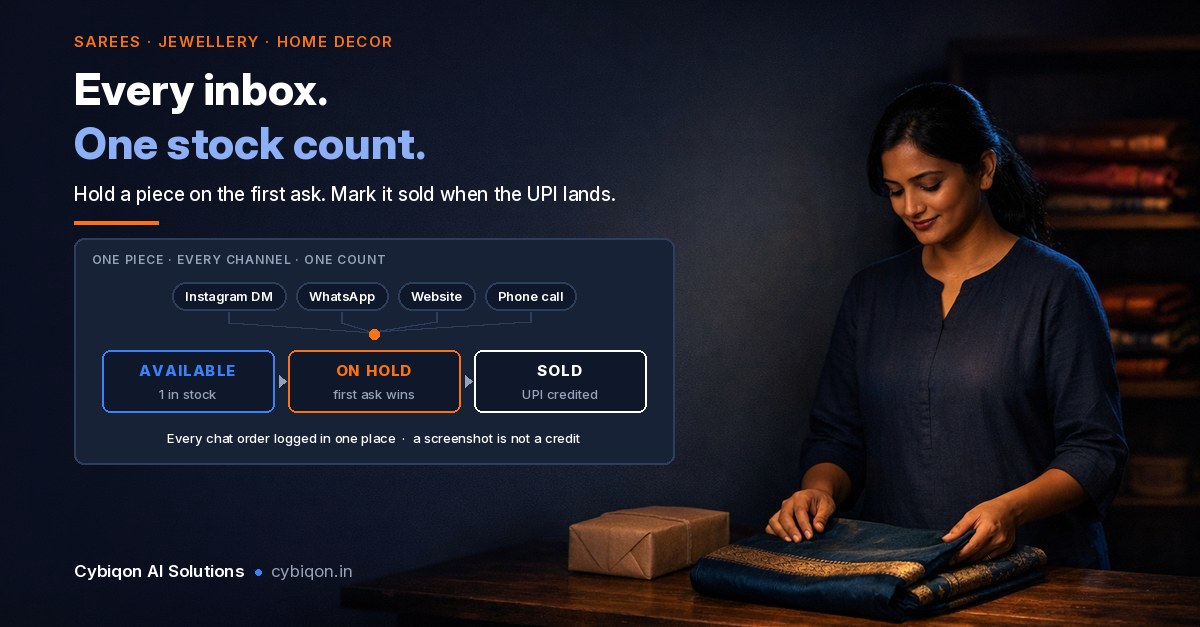
Say a handloom saree brand in Bhubaneswar posts a one-off Sambalpuri ikat in a Reel at 8 pm. By 9 pm two people have DMed "is this available?", a third buyer has WhatsApped after seeing the Story, and the same saree is still live on the brand's small website. The owner says yes to a DM. Her brother, minding the WhatsApp phone, confirms the WhatsApp buyer. A GPay screenshot lands in one chat, and the website quietly takes a prepaid order. Three lists, one saree, and someone gets a refund and an apology.
That is the whole problem Instagram order management has to solve for a boutique, a jewellery label or a home-decor brand. Your orders aren't scattered because you're disorganised. Each free tool you use works alone, and none of them holds stock across channels.
It matters more each year. According to Meta, 91% of online adults in India chat with a business on WhatsApp every week (quoted by IANS on 7 May 2026). This guide covers what Instagram and WhatsApp can and can't do in India, a free setup that works, how to check a UPI payment is real, and when to move off the spreadsheet.
Can you sell directly on Instagram in India, or does checkout go to a website?
Start with the facts, because a lot of guides get this wrong. Indian sellers never had in-app Instagram checkout. When Meta announced Checkout on Instagram and Facebook Shops in August 2020, the rollout was US-only. And Meta has since ended Checkout on Facebook and Instagram altogether, by 4 September 2025, as platforms like BigCommerce told their merchants.
So when you sell on Instagram in India without website checkout, the sale actually closes in one of three places:
- Instagram DMs — the buyer asks, you quote, they pay by UPI.
- WhatsApp — via a "Message" button, a Click-to-WhatsApp ad or a link in your bio.
- Your website — a product tag or link that sends the buyer to your own checkout.
Meta's own numbers show why every brand ends up running all three. Its whitepaper with the Retailers Association of India, Reimagining Retail (Meta Newsroom, 24 Feb 2026), says 77% of retail brand and product discovery in India happens on social media, 96% of that on Meta's platforms, and 72% of product discovery happens on WhatsApp. The same Meta–RAI report says omnichannel shoppers spend 2.5x more. Meta also says retailers using Click-to-WhatsApp ads reported 22% higher order values and 62% more leads, though those are self-reported figures on Meta's own page.
The reach is real too. Meta's ad tools put the Instagram ad audience in India at about 532–555 million (NapoleonCat's reading of Meta's estimate, which counts ad reach rather than unique people). The catch is that every one of those channels keeps its own list of what's sold.
Instagram order management: how to handle orders from DMs
If you've wondered how to track orders for an Instagram boutique, start here: a DM is a conversation, not an order. The first step in managing orders from Instagram DMs is to turn each conversation into one record the moment money is involved. A good record needs five things:
- Buyer — name, phone, Instagram handle, delivery pincode.
- Piece — a code you also use in the caption ("SR-114"), not "the blue one from Tuesday".
- Amount — price, shipping and any discount you agreed in the chat.
- Status — enquiry, on hold, paid, packed, shipped, delivered.
- UPI reference — the 12-digit UTR from your bank or UPI app, not from the buyer's screenshot.
Put a code on every post and every catalog item. It sounds fussy, but it's what lets you line up an Instagram DM, a WhatsApp chat and a website order for the same piece. Without it, you have three conversations about "the mustard kanjeevaram" and no way to match them.
Use Instagram's quick replies for the stock answers (price, shipping time, COD or prepaid) and labels to tag chats as Hold, Paid or Shipped. These help, but they live inside one app on one phone. Labels on Instagram don't show up on WhatsApp, and neither touches your website. That's the gap the rest of this guide is about.
Does the WhatsApp Business catalog track stock or show out of stock automatically?
No. A sold piece doesn't flip to "out of stock" on its own, which is the most common WhatsApp Business catalog out-of-stock complaint. The catalog is good for showing products, but it isn't an inventory system. Third-party guides such as SleekFlow's describe it as holding up to 500 items with no inventory tracking. You can Hide an item (a feature added in 2021, per ChannelX) to take it off the catalog, but you have to do that by hand, every time a piece sells.
Carts, which WhatsApp added in December 2020, let a buyer send several catalog items to you as one order message. That's useful, but the cart doesn't reserve anything. Two buyers can send carts holding the same one-of-a-kind necklace a minute apart, and WhatsApp will happily deliver both.
This is where the news makes the problem sharper. In May 2026 Meta announced Business AI on WhatsApp for businesses in India (IANS reported it on 7 May; Meta's Newsroom post followed on 14 May). It's free to turn on today. According to Meta, it answers product, price, discount and shipping questions in Indian languages using your catalog. Meta says in-chat UPI payments are "starting soon", so you can't count on it to take payments yet.
Faster answers are good. But the AI answers from the catalog, and the catalog doesn't know your stock. If a piece sold in a DM ten minutes ago and nobody hid it, the AI can tell a buyer it's available, quickly and politely. With Diwali on 8 November 2026 and festive DMs peaking now, that's the week double-selling is most likely.
How do I stop selling the same piece to two customers on Instagram and WhatsApp?
If you stock 400 units of a kurta, a small mismatch is just a reorder. When you avoid overselling one-of-a-kind products, you need three rules, and every channel has to follow them.
Rule 1: Hold on the first serious ask. When a buyer says "I'll take it", the piece goes On hold for that buyer for a fixed time, say 30 minutes. Everyone else who asks hears "on hold, I'll tell you if it frees up", whether they asked on Instagram, WhatsApp or the phone.
Rule 2: Release on timeout. If payment doesn't arrive in the window, the hold lapses and the next person in line gets a message. No "she said she'll pay tonight" holds that last three days.
Rule 3: Sold only on confirmed UPI. A piece is Sold when the credit shows in your own bank or UPI app. Then it gets hidden on the WhatsApp catalog and marked sold out on the website, straight away.
At Cybiqon we'd call this the minimum spec for any one-off-piece brand. It's the same discipline marketplace sellers use when they avoid overselling on Amazon and Flipkart with one stock count feeding every listing. The difference is that a boutique's "listings" are DMs and chats, so the hold has to be visible to whoever is answering them.
Prepaid-first also pays off after dispatch. Pushing for UPI before you ship, rather than offering cash on delivery by default, is one of the most direct ways to reduce your RTO rate, the returns-to-origin that quietly eat a D2C brand's margin.
How do I confirm a UPI payment is real before marking an order as paid?
Never mark an order paid on a screenshot. Fake "payment successful" UPI screenshots have turned up in police cases in Delhi, Jharsuguda and Basti between August and September 2026, as CyberPeace documented from PTI, Hindustan Times and Times of India reports. A screenshot takes seconds to fake. A credit in your bank doesn't.
UPI payment confirmation for online orders works best as a simple routine:
- Check your own app. Open your bank app or UPI app (or your merchant QR app's sound box or history) and find the credit.
- Match the amount and UTR. Copy the 12-digit UTR from your own statement into the order record. If it's not there, the order isn't paid.
- Give one person the job. Whoever confirms payments is the only person who can move an order from On hold to Sold.
Volumes make this routine non-negotiable. NPCI data reported by DD India on 2 October 2026 shows UPI handled 24.07 billion transactions worth ₹29.37 lakh crore in September 2026, up 23% by volume year on year. Your buyers pay by UPI by default.
One thing to watch: ThePrint reported on 13 October 2026 that a merchant discount rate on UPI, 0.4% on person-to-merchant payments above ₹2,000 capped at ₹300, has been deferred to "after Diwali", with no start date announced. It applies to merchant QR payments, not person-to-person transfers. Factor it into pricing once a date is set, but don't change how you take payments yet.
Is a Google Sheet enough for Instagram order management?
For many brands, yes, for a while. Here's a free-tools-first setup that handles WhatsApp order management and Instagram DMs without spending anything:
- WhatsApp catalog with codes, hidden by hand the moment a piece sells, and carts turned on.
- Business AI switched on for the repeat questions (price, shipping, fabric care), knowing it answers from the catalog.
- One shared Google Sheet with one row per piece: code, status, buyer, channel, amount, UTR, hold expiry.
- A "sold on payment" rule written at the top of the sheet: a piece is sold only when the UPI credit shows in the seller's own bank or UPI app.
- Instagram labels that mirror the sheet's status column.
Be honest with yourself about where a sheet stops working for Instagram and WhatsApp order tracking:
| Situation | A shared sheet copes? | Why |
|---|---|---|
| One person answers every chat | Yes | The sheet and the owner's memory agree |
| Two or more people answer chats | Shaky | Nobody knows who put the hold on, or when it expires |
| Instagram, WhatsApp and a website | No | The website sells the piece without checking the sheet |
| Mostly one-of-a-kind pieces | Shaky | Every sale needs a hide, and every hide is manual |
| Festive spike (Diwali, wedding season) | No | Holds expire while you're packing, and nobody releases them |
| Business AI answering from the catalog | Shaky | It's only as right as your last manual hide |
If two or more rows describe your brand, the sheet is now the bottleneck.
When should a boutique move to an Instagram order management system?
Move when the sheet stops being the truth. You'll know because you find yourself checking three places before answering "is this available?", or because a family member says yes from memory.
Most off-the-shelf inventory management for Instagram sellers is built for stores with 1,000 SKUs, barcodes and warehouses. A jewellery label with 60 one-off pieces doesn't need purchase orders and bin locations. It needs the three rules above enforced automatically, so it's no surprise that heavy tools feel like overkill.
What a right-sized order management system for a boutique in India looks like:
- One record per order from DM, WhatsApp, phone or website, with buyer, piece, amount and UPI reference.
- A timed hold that every channel can see, so whoever is answering says "on hold" instead of "yes".
- Sold on confirmed UPI, which then hides the piece on the WhatsApp catalog and marks it sold out on the website.
- A daily view of what's on hold, what's paid but not packed, and what's shipped.
Once orders sit in one place, you can also follow up with buyers who went quiet after asking for a price, instead of losing them in the chat list.
FAQs
Instagram order management: how to handle orders from DMs
Turn each DM into one order record as soon as the buyer commits: buyer details, a piece code, the amount, a status and the UPI reference from your own bank. Use Instagram labels and quick replies to keep chats tidy, but keep the record outside Instagram so WhatsApp and website orders land in the same place.
Can I sell directly on Instagram in India, or does checkout go to a website?
Indian sellers never had in-app Instagram checkout. Meta's 2020 rollout was US-only, and Meta ended Checkout on Facebook and Instagram by 4 September 2025. In India the sale closes in DMs, on WhatsApp or on your own website.
Does the WhatsApp Business catalog track stock or show out of stock automatically?
No. Third-party guides describe the catalog as holding up to 500 items with no inventory tracking. You hide sold-out items by hand, and carts don't reserve stock.
Is a Google Sheet enough for Instagram order management?
It is while one person answers every chat and you sell on one or two channels. Once several people answer chats, a website sells the same pieces, or a festive spike arrives, holds and hides get missed and you start selling pieces twice.
How do I confirm a UPI payment is real before marking an order as paid?
Check for the credit in your own bank or UPI app and copy the UTR into the order. Never mark an order paid on a screenshot; fake "payment successful" screenshots have appeared in several 2026 police cases.
Want this built for your brand?
If your stock count lives in your head and three phones, Cybiqon can build you a small order-and-stock panel that your brand owns. It puts a timed hold on a piece at the first ask, so anyone answering Instagram, WhatsApp or the phone sees "on hold". It marks the piece sold only when UPI is confirmed, then hides it on your catalog and marks it sold out on your website. Every order gets one record with the buyer, piece, amount and UPI reference.
It's written for how your brand actually sells rather than configured from a template, the two founders build it, and you own every line of the code. See how we approach admin panels and internal tools, then book a 30-minute call, call +91 9250711473 or write to [email protected].
Conclusion
Selling through Instagram and WhatsApp in India works, as Meta's own figures show. What breaks is the stock count once more than one person and more than one channel are involved. Good Instagram order management comes down to three rules: hold on the first ask, release on timeout, and mark a piece sold only on a UPI credit you can see in your own bank. Start with the free setup. When the sheet stops being the truth, Cybiqon can build the panel that enforces those rules for you, before Diwali orders make the problem worse.
Want this set up for your business?
Book a free call — no tech jargon, no sales pressure. Just honest answers.
What we build for this: WhatsApp automation