RCS vs WhatsApp business messaging cost comparison for Indian MSMEs ahead of the 1 October 2026 WhatsApp service message pricing change
RCS vs WhatsApp Business Messaging India: The Real 2026 Cost
If you run a business in India and use WhatsApp to talk to customers, you have probably received an email from your provider in the last few weeks with a sentence like: "WhatsApp support replies will no longer be free from 1 October 2026." Right behind it comes the pitch — migrate to RCS, it's cheaper, it's the future, sign here.
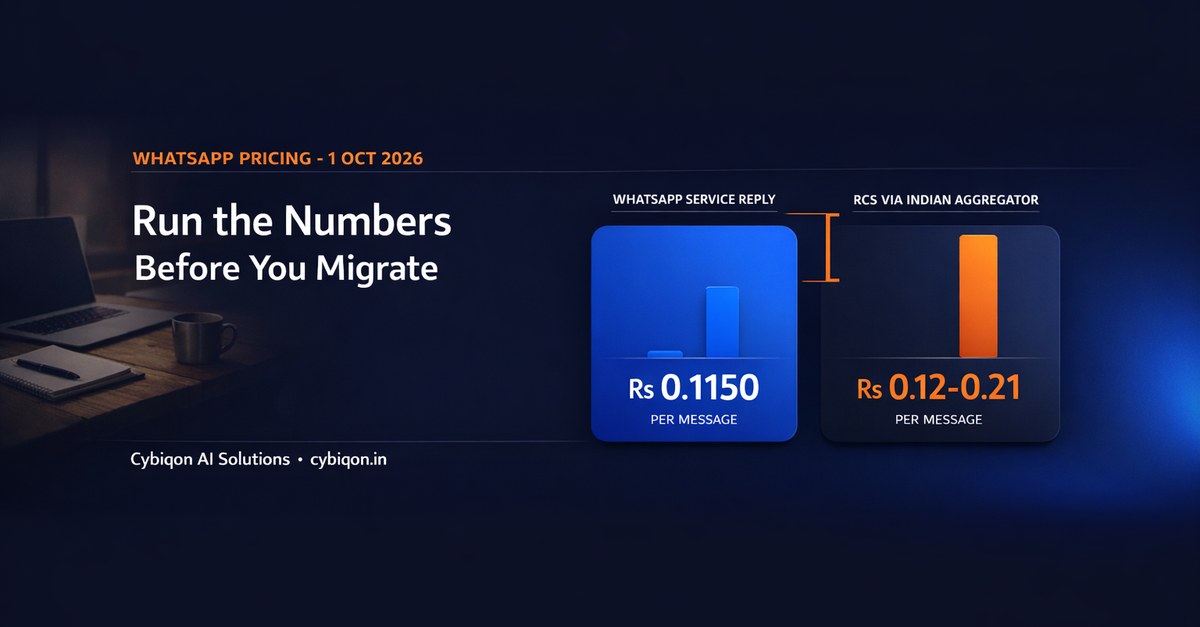
Before you sign anything, do the arithmetic. Because when you actually price RCS vs WhatsApp business messaging in India at what Indian aggregators really charge, the "cheap escape hatch" story falls apart. RCS at ₹0.12–₹0.21 per basic message costs the same or more per message than WhatsApp's expected service rate of about ₹0.1150. And that is before the roughly ₹5,900 you'll pay for DLT Principal Entity registration.
Here's what this post covers: exactly what changes on 1 October 2026, why the free WhatsApp Business app is completely unaffected, a real cost table at 500 / 2,000 / 10,000 messages including 18% GST, the one place RCS genuinely wins, and an India-only billing deadline almost nobody is writing about.
Full disclosure up front: Cybiqon earns nothing on your message volume. Every other article ranking for this query is published by someone who does.
What Exactly Changes in WhatsApp Pricing on 1 October 2026?
Two things change, and both are narrower than the panic emails suggest.
1. Service messages become billable. Meta's own developer documentation states plainly that from 1 October 2026, "Meta will charge on a per-message basis for service messages, consistent with how Meta charges for template messages." Service messages — your free-text replies to a customer who messaged you first — have been free since November 2024. That ends.
2. Utility templates lose their free-in-window status. Since July 2025, utility templates (order confirmed, payment received, delivery out) sent inside the 24-hour customer service window were free. From 1 October they are billed like any other utility message.
Now the part the fear emails skip. The 24-hour customer service window itself is not being removed. It still exists, it still governs when you may send free-form replies instead of a pre-approved template. What changed is only that replies inside it now carry a charge. Your conversation flows, your chatbot logic, your WhatsApp automation setup — none of that needs re-architecting. Only your invoice changes.
And one more thing: as of 22 August 2026, Meta has not yet published the actual rates. Its documentation commits to announcing them "by September 1, 2026." So every number you see quoted today, including ours, is a derivation — not a published price.
First, Find Out Which Bucket You're In (This Decides Everything)
This is the single most important paragraph in this article, and it is missing from almost every piece ranking for this topic.
If you reply to customers by hand on the free green WhatsApp Business app on your phone, none of this applies to you. Not on 1 October 2026, not after. You pay nothing. No service message charge, no utility charge, no migration, no decision to make. India has 7.83 crore MSMEs registered on Udyam and Udyam Assist as of 28 February 2026 (Ministry of MSME), and the overwhelming majority of them are in exactly this bucket.
The 1 October change hits only the WhatsApp Business Platform — the API — which you access through a Business Solution Provider and use to send at scale or run automations.
| WhatsApp Business App (free) | WhatsApp Business Platform (API) | |
|---|---|---|
| How you use it | Phone app, manual replies | Through a BSP, software-driven |
| Who it suits | Shop, clinic, local service, small studio | D2C brand, multi-agent support, high volume |
| Cost today | ₹0 | Per-message, per category |
| Affected on 1 Oct 2026? | No | Yes |
If you're unsure which one you're on, the test is simple: are you paying a monthly bill to someone for WhatsApp? If no, you're on the app and you're fine. If you're weighing a move between the two, our breakdown of the WhatsApp Business API for a small business walks through when the upgrade is actually worth it.
How Much Will a WhatsApp Service Message Cost in India?
Meta's documentation gives us two published facts. First, "By market, rates for service messages are the same as the rates for utility and authentication messages." Second, India's published utility and authentication rate is ₹0.1150 per message.
Put those together and the expected India service rate is ₹0.1150. We want to be clear: that is a sound derivation from two published Meta facts, not a published service rate. The official India figure is due by 1 September 2026 — about ten days after this post goes live. We'll update this article the day Meta publishes.
What does that mean in rupees for a real business? Take a Bengaluru D2C brand handling roughly 2,000 support replies a month on the Platform:
- Today: ₹0
- From 1 October 2026: 2,000 × ₹0.1150 = ₹230, plus 18% GST = ₹271.40 per month
That is a rounding error for a brand doing that volume. It is not a reason to rebuild your customer messaging stack. Meanwhile, WhatsApp's marketing rate in India is ₹0.8631 per message — up roughly 10% from ₹0.7846 on 1 January 2026, and about 7.5 times the utility/service rate. Hold that number; we come back to it.
RCS vs WhatsApp Business Messaging India: The Real Cost Table
Here is the arithmetic the BSP emails don't run. Indian aggregator RCS pricing in 2026 sits at roughly ₹0.12–₹0.21 for a basic message, ₹0.24–₹0.27 for a rich card, and ₹0.35–₹0.38 for a conversational session. There is no TRAI-regulated tariff for RCS — each operator sets its own rate and CPaaS providers layer margin on top, which is exactly why quoted prices swing so wildly.
All figures below include 18% GST.
| Monthly volume | WhatsApp service/utility (@ ₹0.1150 expected) | RCS basic (@ ₹0.12–₹0.21) |
|---|---|---|
| 500 messages | ₹67.85 | ₹70.80 – ₹123.90 |
| 2,000 messages | ₹271.40 | ₹283.20 – ₹495.60 |
| 10,000 messages | ₹1,357.00 | ₹1,416.00 – ₹2,478.00 |
| One-time setup | ₹0 (already on Platform) | ~₹5,900 DLT Principal Entity, + bot setup fee (~₹500 at some aggregators) |
Read that table again. At every volume, RCS is the same or more expensive per message than WhatsApp — before you've paid a paisa of the ₹5,900 DLT registration. At 10,000 messages a month, switching support to RCS to escape a ₹1,357 bill could cost you up to ₹2,478 a month plus the setup, plus weeks of approvals.
You might have seen a ₹0.11 RCS figure floating around, tied to an 80:20 revenue share. Be careful with it. Airtel's own 1 March 2026 press release — which announced a collaboration with Google on secure, spam-protected RCS — contains no pricing and no revenue share at all. That number traces to Economic Times citing unnamed industry executives, and it describes a wholesale/operator rate. It is not what an MSME pays through an aggregator.
The Category Error: RCS Is a Broadcast Rail, Not a Support Channel
Even if RCS were cheaper, the swap being pitched to you isn't like-for-like. This is the structural point, and it matters more than the pricing.
Service-window replies are inbound conversations. A customer messages you, you reply, back and forth, inside 24 hours. That is a two-way support thread.
RCS, as sold in India today, is an outbound broadcast rail. It's built for you to push a rich, branded, verified message out to a list — offers, alerts, tracking cards, carousels. You register a Principal Entity, get a sender ID, get templates approved, and send. It is SMS with better clothes.
So "move your support to RCS" isn't a cost decision, it's a category error. You cannot replace an inbound service window with an outbound campaign channel and expect your customer conversations to keep working.
There's a delivery problem too. RCS on iPhone in India is genuinely patchy. Apple added RCS support in iOS 18 and a Jio–Apple arrangement was reported around August 2025, but Airtel iPhone users have reportedly still not had it. That is a strong reason not to put support on RCS: if a slice of your customers can't receive the message, your support channel silently fails for them. Verify against your own customer base before you believe any vendor's coverage claim.
Where RCS Actually Beats WhatsApp Business Messaging in India
Now the honest other side — because RCS does win somewhere, just not where you're being told.
Go back to that ₹0.8631 WhatsApp marketing rate. Our Bengaluru D2C brand also sends a monthly promotional broadcast to 20,000 opted-in customers:
- WhatsApp marketing: 20,000 × ₹0.8631 = ₹17,262, + 18% GST = ₹20,369 per month
- RCS rich card at ₹0.24–₹0.27: 20,000 messages = ₹4,800–₹5,400, + 18% GST = ₹5,664 – ₹6,372 per month
That's a potential saving of roughly ₹14,000 a month — and it dwarfs the ₹271 "crisis" that started this whole conversation. The real WhatsApp cost problem in India is broadcast marketing, not support replies.
There's primary-source evidence RCS performs on this job. Google's own RCS for Business site publishes a case study on BigHaat, an Indian agri D2C company that used RCS with Netcore Cloud to send crop-cycle-timed, regional-language rich messages to farmers. Reported results: 103% uplift in ROAS, 3x uplift in CTR, and one-third the cost per order.
Read that carefully, though. Those gains are measured against SMS, on outbound campaigns — not against WhatsApp, and not for support replies. It's a genuine signal that RCS earns its keep as a campaign rail in India. It is not evidence that RCS should carry your customer service. If you're auditing your promotional spend, our guide to WhatsApp marketing software in India covers how to cut that line item without changing rails at all.
The Switching Costs Nobody Puts in the Quote
If the numbers do point you toward RCS for campaigns, price the full switch — not just the per-message rate.
- DLT Principal Entity registration: ~₹5,900 including GST, one-time. Data syncs across operator portals, so you pay it once, not per operator.
- A six-character alphanumeric header / sender ID, registered against that Principal Entity.
- Per-template approval, message by message.
- A separate Google brand verification for RCS — this is not the same as TRAI DLT registration, and vendors routinely blur the two.
- A bot setup fee, around ₹500 at some aggregators.
One regulatory correction worth having, because you'll see it stated wrongly: TRAI issued a draft TCCCPR (Third Amendment) consultation on 13 March 2026 with comments closing 27 April 2026. As of August 2026 it is not notified, and it does not explicitly name RCS. So don't let anyone tell you "RCS rides India's DLT rails" as though it were settled law. What's true is narrower and more useful: in practice, Indian aggregators route commercial RCS through the same DLT chain, so you'll be doing the paperwork regardless.
The India-Only Deadline Nobody Is Writing About: INR Billing
While everyone argues about ₹0.1150, there's a harder deadline sitting in Meta's own pricing documentation.
India billing moved to INR from 1 January 2026, and every WhatsApp Business Account must migrate to INR billing by 31 December 2026. If yours hasn't migrated, your messages stop being delivered from 1 January 2027.
For an Indian MSME on the Platform, that is a far bigger operational risk than a ₹230 monthly service bill. A stalled migration doesn't make messaging more expensive — it makes it stop. Check with your BSP this week which currency your WABA is billed in. If the answer isn't INR, that's the actual fire, and it takes ten minutes to find out.
RCS vs WhatsApp Business Messaging India: When NOT to Switch
A plain checklist. Do not switch if:
- You're on the free WhatsApp Business app. Nothing changes for you. Full stop.
- Your volume is mostly support replies and utility alerts. You'd pay more per message and lose the two-way service window.
- Your monthly Platform bill is under ₹1,000. Registration and approvals will cost you more than a year of the "problem."
- A meaningful share of your customers are on iPhone, where India RCS delivery is unreliable.
- Your provider is pushing urgency but hasn't shown you your own message mix split into service, utility and marketing.
It's genuinely worth testing if you send large opted-in promotional broadcasts — that ₹0.8631 line is where the money is — and your audience is verified Android-heavy, and you're willing to run RCS as an additional campaign rail rather than a replacement for support.
The general rule: keep support on WhatsApp, test RCS against the marketing line. That is almost exactly the opposite of what the migration emails recommend. Whichever rail you use, the follow-up matters more than the channel — a message that lands and then gets ignored internally is wasted either way, which is why tracking every lead through to follow-up beats any per-message saving.
FAQs
What exactly changes in WhatsApp pricing on 1 October 2026?
Two things. Service messages — your free-form replies to customers who messaged you first — become billable per message. And utility templates lose their free-inside-the-24-hour-window status. Both changes apply only to the WhatsApp Business Platform (API).
Will the free WhatsApp Business app start charging for replies?
No. The free WhatsApp Business app is completely unaffected on 1 October 2026 and after. If you reply to customers by hand on the green business app, you pay nothing and have no decision to make here.
Is the 24-hour customer service window being removed?
No. The 24-hour customer service window survives. What changes is that replies sent inside it are now billed instead of free. Your conversation logic and automation flows don't need to change — only your invoice does.
Is RCS cheaper than WhatsApp for Indian businesses?
It depends entirely on message type. At Indian aggregator prices (₹0.12–₹0.21 basic), RCS is the same or more expensive than WhatsApp's expected ₹0.1150 service/utility rate. But RCS rich cards at ₹0.24–₹0.27 are far cheaper than WhatsApp's ₹0.8631 marketing rate. RCS wins on campaigns, loses on support.
Do I need DLT registration to send RCS messages in India?
In practice, yes — Indian aggregators route commercial RCS through the same DLT chain: a Principal Entity ID (~₹5,900 including GST, one-time), a six-character sender ID, then per-template approval. You also need a separate Google brand verification, which is not the same thing. Note that TRAI's TCCCPR Third Amendment is still a draft as of August 2026 and does not explicitly name RCS.
Do Click-to-WhatsApp ad conversations still get a free window?
Meta's 1 October 2026 announcement covers service messages and utility templates; it does not mention free entry point conversations. Since the full rate card is due by 1 September 2026, treat that publication as the confirmation point before you plan spend. If ads are a big part of your pipeline, our post on Click-to-WhatsApp ads for small businesses explains how that entry point works today.
Do I have to move my WhatsApp Business Account to INR billing?
Yes, if you're an Indian business on the Platform. India billing moved to INR from 1 January 2026 and all WABAs must migrate by 31 December 2026. Messages stop being delivered from 1 January 2027 if you haven't. Ask your BSP now.
Get Your Own Numbers Before You Migrate Anything
Cybiqon AI Solutions builds websites, apps and AI automation for Indian MSMEs — shopkeepers, manufacturers, D2C brands, exporters and local service businesses who want enterprise-grade systems without enterprise jargon or enterprise pricing.
On this particular question, we do something no BSP can: we read your actual message mix — support replies vs utility alerts vs marketing broadcasts — price each one on both rails against Meta's published India rate card, and then build only the routing layer the numbers justify. If RCS genuinely wins for your campaigns, we'll handle the DLT Principal Entity, sender ID, template approvals and Google brand verification chain for you. If it doesn't, we'll tell you to stay put and save you ₹5,900 plus six weeks.
We earn nothing on your message volume. That's the whole point.
Have a look at what we do at cybiqon.in, or just message us on +91 9250711473 or [email protected] with your last month's messaging bill. We'll run the maths and send it back.
The Bottom Line
Strip out the urgency and RCS vs WhatsApp business messaging in India comes down to one sentence: keep support on WhatsApp, test RCS against your marketing spend. A 2,000-reply-a-month business goes from ₹0 to about ₹271 including GST on 1 October 2026 — not a migration trigger. The ₹17,000 marketing broadcast is. Meanwhile the deadline that can actually stop your messages is the 31 December 2026 INR billing migration, so check that first. And watch for Meta's official India rates by 1 September — we'll update this post the day they land.
Want this set up for your business?
Book a free call — no tech jargon, no sales pressure. Just honest answers.
What we build for this: WhatsApp automation