Reducing Zomato/Swiggy commission with direct ordering channels and ONDC
How to Reduce Zomato Swiggy Commission for Restaurants
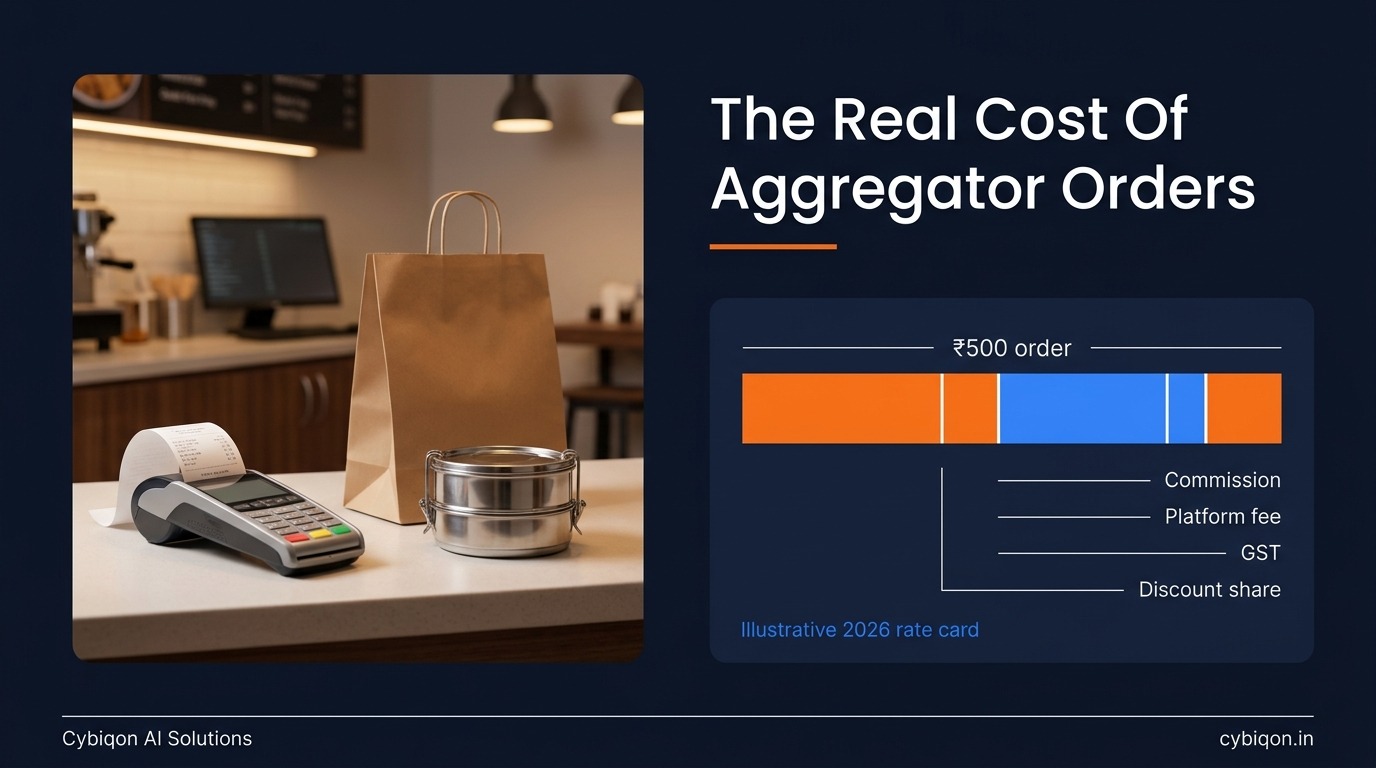
How to Reduce Zomato Swiggy Commission for Restaurants (2026 Rate Card)
If you run a restaurant, a cafe or a cloud kitchen in India, you have probably searched for the Swiggy commission rate and come back with five different answers. One page says 18–25%. Another says 15–30%. A third says 17–28%. They cannot all be right, and the reason they disagree is simple: neither Swiggy nor Zomato publishes a public rate card.
That is the honest starting point of this guide, and it is the thing most pages hide from you. Commission on both platforms is a per-outlet commercial contract, negotiated and re-negotiated, and it moves with your city, your order volume, your cuisine, your brand strength and whether you have signed up for exclusivity or a minimum business guarantee. There is no single number to look up.
What does exist is a set of figures that can be sourced — to regulatory filings, to court records, to earnings reports and to dated tariff changes. This page assembles all of them into one rate card, with the source and its reliability marked on every line. Then it walks a ₹500 order and a full month of a 100-orders-a-day kitchen through every deduction, explains the GST trap that quietly costs another four percentage points, corrects the ₹17.58 platform fee mistake almost every article on this topic makes, and only then gets to what you can actually do to reduce Zomato Swiggy commission. Where it contradicts what you have read elsewhere, we have named the source and the date so you can check us.
Swiggy and Zomato Commission Rates 2026: The Verified Rate Card
Here is every commission and deduction line we could trace to a source we are willing to name. The Confidence column is the part no competitor page gives you — treat "Regulatory record" and "Company filing" very differently from "Media-attributed range".
| Line item | Figure | Who it applies to | Source | Date | Confidence |
|---|---|---|---|---|---|
| Cap on total payable by a restaurant, "including all components" | 30% | Zomato restaurant partners | Outlook Business; Storyboard18 (independent, same day) | 10 Jun 2025 | High — two independent outlets |
| Commission range stated by Swiggy to the CCI, under its own name | 10–24% | Swiggy restaurant partners | CCI order, Case No. 16 of 2021, para 90 | 4 Apr 2022 | Highest — regulatory record, but 2022 vintage |
| Restaurant-side long-distance fee (4–6 km, orders above ₹150) | ₹20 | Zomato restaurant partners | Outlook Business; Storyboard18 | 10 Jun 2025 | High |
| Restaurant-side long-distance fee (beyond 6 km) | ₹40 | Zomato restaurant partners | Outlook Business; Storyboard18 | 10 Jun 2025 | High |
| Collection fee on restaurant partners | 2% | Swiggy restaurant partners | Inc42; Indian Startup News; Verdict Foodservice | Effective 16 Feb 2025 | High |
| Payment gateway charge (levied even on COD, per NRAI) | 1.84% + GST | Zomato restaurant partners | CCI order, para 22 (NRAI's allegation) | 2022 | Medium — allegation on record, 2022 |
| Commission computed on gross order value including GST and packaging | Structural, not a rate | Both platforms, non-metros first | Business Standard; Inc42 | From 14 Aug 2024 | High |
| Swiggy One per-order fee on select partners | ~₹2–5 blended, ~1% of partners | Swiggy restaurant partners | NDTV Profit, via Verdict Foodservice | From 25 Nov 2025 | Low — an expectation described in reporting, not a published tariff |
| "Visibility assurance" programme | ₹6,000–6,500 per month per brand | Zomato — pilot | Storyboard18 | 10 Jun 2025 | Medium — explicitly a pilot |
| Commission range | 17–25% | Industry-wide | CNBC-TV18, via Verdict Foodservice | 2025 | Low — media-attributed range |
| Commission range | 10–28% | Industry-wide | NDTV Profit, via Verdict Foodservice | Sep 2025 | Low — media-attributed range |
| GST on platform commission | 18% | Both platforms | CBIC / ClearTax / TaxGuru | Standing | Highest — statutory |
| GST on the restaurant's supply through an aggregator | 5%, no input tax credit | Restaurants under Section 9(5) | CBIC; Section 9(5) regime | Effective 1 Jan 2022 | Highest — statutory |
How to read this table. The 30% cap is your ceiling and the single most useful number here, because Zomato stated it as an all-in limit. The 10–24% from the CCI order is the only commission range either platform has ever put on the record, to a regulator, under its own name — but it is from 2022, so treat it as a shape reference, not today's quote. Anything marked Low should inform expectations and nothing more.
Notice what is not here: the "18–25%", "15–30%", "17–28%", "20–28%" and "22–28%" bands that dominate search results. We could not source a single one to anything primary — there is a section on that below.
Why Don't Swiggy and Zomato Publish Their Commission Rates?
Because commission is not a tariff — it is a negotiation, and publishing it would eliminate the platform's ability to price each outlet differently.
Swiggy told the Competition Commission of India exactly this. In para 90 of the 4 April 2022 order in Case No. 16 of 2021, Swiggy stated that its commissions "vary in the range of 10–24%, the final quantum of which is determined on the basis of objective criteria such as the popularity of restaurant, volumes of orders generated, cuisines of the restaurant, location of restaurant, length of association with Swiggy etc."
Read that list again, because it is your negotiation checklist:
- Popularity of the restaurant — a brand that pulls its own traffic is worth more to the platform
- Volume of orders generated — scale is the strongest lever an MSME actually has
- Cuisine — margin structure varies enormously between biryani, pizza and salads
- Location — metro versus tier-2 rates are not the same
- Length of association — tenure is a real bargaining chip, and almost nobody uses it
In the same order (para 89), Swiggy also argued that it uses standard term contracts and "should not be expected to negotiate the agreement with each RP on its platform." Both things are true at once: the band is wide and criteria-driven, but the paperwork is designed to be take-it-or-leave-it. So when a page tells you "the Swiggy commission rate is 22%," it is describing one outlet's contract, or nothing at all.
The ₹17.58 Platform Fee Is Paid by the Customer — Not by Your Restaurant
This is the most common factual error on this topic, and correcting it changes how you think about the whole problem.
The ₹17.58 platform fee is a customer-side charge. It appears on the diner's bill. It does not come out of your settlement. If you have been adding it to your list of deductions — and a lot of restaurant-focused articles do, including an earlier version of this very page — you have been over-counting your commission.
The arithmetic reconciles exactly, which is how you can verify it yourself:
- Zomato raised its platform fee from ₹12.50 to ₹14.90 (pre-GST) on 20 March 2026
- 18% GST on ₹14.90 = ₹2.68
- ₹14.90 + ₹2.68 = ₹17.58
- Swiggy reached the same ₹17.58 GST-inclusive figure on 24 March 2026
If this were a restaurant-side commission line, it would not be quoted GST-inclusive on a consumer bill, and it would not be identical across two competitors within four days.
So why care at all? Because it still hurts you, through a different mechanism. Every rupee added to the customer's final bill reduces affordability, which suppresses order frequency and average order value — especially in price-sensitive tier-2 and tier-3 markets. A ₹17.58 fee on a ₹250 order is a 7% surcharge on a working-class lunch. It does not shrink your payout percentage; it shrinks your order count. That is a volume problem, not a margin problem, and it needs a different fix. Get the distinction right and you will negotiate better, because you will stop arguing about a line the platform can honestly say it never charged you.
What Does a Restaurant Actually Get on a ₹500 Zomato or Swiggy Order?
Let us walk one order end to end. Every assumption below is visible and adjustable — swap in your own numbers.
Assumptions (change these to match your contract): menu value ₹500; packaging ₹20; GST on food 5% on menu value plus packaging; commission 21%, chosen to sit just under Zomato's stated 30% all-in cap once GST and fees are added and inside the 10–24% band Swiggy stated to the CCI (your rate may differ); commission charged on gross order value including GST and packaging and computed before any discount (Business Standard, Inc42, from 14 Aug 2024); delivery in the 4–6 km band, typical for a delivery-only kitchen.
Step 1 — the commission base
₹500 (menu) + ₹20 (packaging) + ₹26 (5% GST on ₹520) = ₹546 gross order value
Step 2 — the deductions, on a Zomato-style order
| Line | Amount | Notes |
|---|---|---|
| Commission @ 21% of ₹546 | −₹114.66 | Computed on gross, before discount |
| GST @ 18% on that commission | −₹20.64 | Unrecoverable if you are on the 5%-no-ITC route |
| Long-distance fee, 4–6 km, order above ₹150 | −₹20.00 | Verified restaurant-side charge |
| GST @ 18% on the long-distance fee | −₹3.60 | |
| Total deducted | −₹158.90 | 29.1% of the ₹546 gross order value |
Step 3 — the deductions, on a Swiggy-style order
| Line | Amount | Notes |
|---|---|---|
| Commission @ 21% of ₹546 | −₹114.66 | |
| GST @ 18% on that commission | −₹20.64 | |
| Collection fee @ 2% of ₹546 | −₹10.92 | Effective 16 Feb 2025 |
| GST @ 18% on the collection fee | −₹1.97 | |
| Total deducted | −₹148.19 | 27.1% of gross order value |
Step 4 — your payout
The 5% GST on the food is the aggregator's liability to remit under Section 9(5); it never reaches your bank account. So your revenue basis is ₹500 + ₹20 = ₹520.
- No discount: ₹520 − ₹158.90 = ₹361.10 on Zomato; ₹371.81 on Swiggy
- With a 20% restaurant-funded discount (−₹100): ₹420 − ₹158.90 = ₹261.10 on Zomato; ₹271.81 on Swiggy
Two things jump out. First, at 21% commission the total deduction lands at 29.1% of gross order value — just under Zomato's own stated 30% ceiling. That is not a coincidence; it is what a cap does. Second, the discount is the swing factor: you fund it, it is deducted on top, and commission is still calculated on the pre-discount value. The discount is the single largest controllable line on this bill — and exactly what the Bengaluru associations went to war over in August 2026.
One caveat: reporting does not make clear whether Zomato's 30% cap sits before or after the 18% GST on commission. Check where your own settlements land.
The GST Trap: Why 18% GST on Commission Is a Cost, Not a Wash
This is the most valuable and least-understood point in the entire topic, and almost no page explains it correctly.
Platform commission is a service, so it attracts 18% GST. Most restaurant owners assume this is neutral — you pay GST on the input, you claim it back. For the vast majority of restaurants supplying through Swiggy and Zomato, you cannot.
Under Section 9(5) of the CGST Act, effective 1 January 2022, restaurant service supplied through an e-commerce operator is taxed at 5% without input tax credit. The aggregator collects and remits the 5%. You, the restaurant, are on the no-ITC route. Which means the 18% GST charged on your commission invoice is an absorbed, unrecoverable cost — it never comes back.
Do the arithmetic. On a 22% commission, 18% GST on it is roughly 4 percentage points of order value, gone permanently. Your "22% commission" is functionally about 26% — which explains much of the gap between the rate you negotiated and the payout you see.
The exception matters too, and nobody states it. If your restaurant is on the 18%-with-ITC route — certain hotel-attached restaurants, for example, where room tariffs push the establishment into the higher slab — you can offset GST on aggregator commission against your output liability. For those outlets the 18% genuinely is a wash. Check which regime you are in before modelling anything; the classification is worth four points of margin. (Sources: CBIC; ClearTax; TaxGuru — verify your own position with your CA.)
One thing that did not happen: a proposal to cut GST on delivery charges from 18% to 5% was discussed at the 55th GST Council meeting in December 2024 and was deferred, not implemented. You will find articles written as though it went through. It did not.
The Monthly Picture: A 100-Order-a-Day Cloud Kitchen
Per-order percentages are abstract. Here is a month, for a single-outlet cloud kitchen doing roughly 100 orders a day at ₹400 average order value — about ₹12,00,000 of gross order value a month, essentially all of it through the two aggregators.
Assumptions, again visible and adjustable: 21% commission; a 50/50 split of orders between Zomato and Swiggy; 70% of the Zomato orders falling in the 4–6 km band that attracts the ₹20 fee; restaurant-funded discounts averaging 15% of order value.
| Line | Monthly amount | % of gross order value |
|---|---|---|
| Gross order value | ₹12,00,000 | 100.00% |
| Commission @ 21% | ₹2,52,000 | 21.00% |
| GST @ 18% on commission (unrecoverable) | ₹45,360 | 3.78% |
| Swiggy collection fee @ 2% (on the Swiggy half) | ₹12,000 | 1.00% |
| GST on collection fee | ₹2,160 | 0.18% |
| Zomato long-distance fee, ₹20 × 1,050 orders | ₹21,000 | 1.75% |
| GST on long-distance fee | ₹3,780 | 0.32% |
| Subtotal before discounts | ₹3,36,300 | 28.02% |
| Restaurant-funded discounts @ 15% | ₹1,80,000 | 15.00% |
| Total channel cost | ₹5,16,300 | 43.03% |
| Payout to the kitchen | ₹6,83,700 | 56.97% |
This is a worked illustration, not a finding. Change any assumption and the answer changes — that is the point. Drop discounts to 5% and total channel cost falls to about 33%. Negotiate commission to 18% and it falls further. Push more orders past 6 km and it rises.
It also explains something. PC Rao, honorary president of the Bengaluru Hotels Association, has publicly claimed deductions reach 40–45%, and that ₹1 lakh billed leaves roughly ₹40,000. That is an interested party's spoken claim, not an audited figure, and we would not state it as fact. But the table shows how someone arrives there: it is a discount-inclusive number. Commission alone does not reach 43%; commission plus unrecoverable GST plus fees plus self-funded discounts does.
That distinction is the whole game. Roughly two-thirds of this table is contractual and hard to move. One-third is the discount line — negotiable, controllable, and yours.
How Much Commission Does Zomato Take From a Cloud Kitchen?
This is the query where the honest answer is genuinely different from a normal restaurant's — and where the CCI order is the only real evidence in existence.
First, the number everyone is looking for. In para 22 of the same 2022 CCI order, NRAI alleged that for Zomato's own cloud kitchens, "Zomato does a guarantee of certain sales per month but the commission rate is as high as 37%." NRAI also alleged Zomato charged listed restaurants approximately 27.8% of order value, and that Swiggy's rates went "as high as 24%."
Label this properly, because it is misquoted everywhere. These are NRAI's allegations as recorded in a CCI order from April 2022 — not CCI findings, not current rates, but one industry body's characterisation filed in a dispute four years ago. NRAI's rejoinder in para 94 put commissions "presently standing over and above 25% and can reach as high as 37%", while Swiggy in para 90 said 10–24%. The two sides bracket each other, and that bracket is itself the most honest available answer.
Second, and far more useful: the actual structure. Paras 14 and 59 of the order set out what a Zomato Infrastructure Services access-kitchen contract looked like. The "Kitchen Commission" was defined as:
- 16% online ordering commission, plus
- 1.84% payment gateway, plus
- a rental commission of the higher of (a) 10% of the revenue the restaurant partner earns in that month, or (b) ₹30,000 — plus taxes
Look at that third line, because it is structurally unlike anything a normal restaurant faces. A ₹30,000 monthly floor does not scale down in a bad month. In a strong month, 10% of revenue applies and the rent behaves like a variable cost; in a weak month ₹30,000 lands regardless, and the effective percentage climbs exactly when you can least afford it. The order also notes that where the partner sold through other aggregators, additional payouts applied — so the operator paid on revenue earned outside Zomato too.
That is why cloud-kitchen economics are not "restaurant economics with lower rent." A delivery-only brand has no walk-in channel to fall back on, a radius skewed toward the 4–6 km band where the ₹20 fee bites on nearly every order, and — in an access kitchen — a fixed floor underneath the commission. If you run a cloud kitchen out of Koramangala, Andheri or Sector 62, the aggregator is not a channel. It is the entire business, which is precisely the risk.
What the CCI Actually Decided — and Why It Is the Opposite of What You Think
Almost every article on this topic implies a regulator is about to cap restaurant commissions. The record says the opposite, and you should plan accordingly.
In paras 96 and 97 of the 4 April 2022 order, the Competition Commission of India considered NRAI's allegations on "delayed payment cycle, imposition of one-sided clauses in the agreement, charging of exorbitant commission etc." and held that "prima facie these do not seem to have an effect on competition in the facts and circumstances of the present case."
Read that plainly: the CCI found no prima facie case on the commission amount itself. No regulator in India has held that Swiggy's or Zomato's commission percentage is illegal.
What the CCI did do in para 97 was direct the Director General to investigate other conduct under Section 3(4) read with Section 3(1) — the vertical-restraint provisions. The issues sent for investigation were platform neutrality, exclusivity arrangements, minimum business guarantees and price parity. Not the rate.
Why this matters to your planning: if you are waiting for a regulatory cap on commission, you are waiting for something already declined once. The live legal risk to the platforms is the clauses restricting what you can do elsewhere — the ones that stop you pricing lower on your own website or pushing volume to a competing channel. Those are the constraints on your escape route, and those are the ones actually under challenge.
Where it stands in 2026. NRAI sought interim relief from the CCI on 15 July 2026, ahead of a hearing on 22 July, against price-parity and exclusivity clauses. Reporting indicates the DG's report found that exclusivity, minimum business guarantees and wide price-parity clauses may violate Section 3(4) read with 3(1). Zomato has said it removed price parity earlier in 2026. There is no final order yet. (Business Standard, 14–15 July 2026.) Anyone telling you the outcome is decided is guessing.
Why 1,000+ Bengaluru Restaurants Threatened to Delist in August 2026
The most important development in this space is live and unresolved as you read this.
More than 1,000 Bengaluru restaurants threatened to delist from Swiggy and Zomato from 15 August 2026. The delisting was deferred to 31 August 2026 after the Bengaluru Hotels Association, the Bruhat Bengaluru Hotels Association, the Karnataka State Hotel Association and NRAI met Zomato CEO Aditya Mangla and Swiggy CEO Rohit Kapoor. Zomato has reportedly promised a resolution by September. (Business Today, 29 July 2026; The News Minute, 29 July 2026; Oneindia, 8 August 2026.)
Now the part that should reframe how you think about your own contract. The associations put forward six demands. Only one of them is about the commission rate. The rest are about:
- Consent before discounts are applied to a restaurant's menu — instead of discounts being switched on and funded from the restaurant's payout
- Itemised settlement reports — a line-by-line breakdown of what was deducted and why
- An end to automatic deductions made after a customer complaint, without the restaurant getting a say
Sit with that. A thousand restaurants ready to walk away from their largest sales channel, and five of six demands are about visibility and control, not price. The grievance is not that 21% is too much. It is that the restaurant cannot see, verify or contest what is being taken.
That is a different problem with a different solution. You can negotiate a rate down two points; you cannot negotiate your way into controlling a channel you do not own. If you cannot reconcile an aggregator settlement against your own records, the first fix is not a lawyer — it is a POS that produces your own numbers. Decent restaurant billing software gives you an independent order-level ledger to check the settlement against, which is the minimum bar for having this argument at all.
Two figures we are deliberately not repeating: a "22% commission cap" demand and an "8–28%" range attributed to BBHA circulated widely during this dispute. Neither Business Today nor The News Minute carries any percentage. Both appeared only in low-quality aggregator sites, so we are leaving them out.
The Numbers Everyone Quotes That Nobody Can Source
Here is a section no competitor page will write, because it is inconvenient. These figures dominate the search results for Swiggy and Zomato commission. We tried to trace each one to a primary source and could not.
| Widely-quoted claim | What we found |
|---|---|
| "Effective deduction is 25–35% per order" | Appears near-universally across vendor blogs. Sourced by none of them. No study, no survey, no filing. |
| "35% of restaurants would quit Zomato and Swiggy tomorrow" (Dec 2025 survey) | No named organisation, no sample size, no methodology. The citation chain simply terminates. |
| "60% of Indian restaurants never cross 10% net margin" | Traces back to a POS vendor's blog. No underlying study exists. |
| Base commission of "17–28%" | Vendor-sourced only. And the circulating bands — 18–25, 15–30, 17–28, 20–28, 22–28 — contradict each other, which is the tell that they are copies of copies, not data. |
| "Direct ordering lifts repeat orders 20–30%" | An unattributed assertion. Plausible, unproven. |
| "ONDC commission is 3–5%", "600+ cities, 5 lakh+ sellers" | Vendor-quoted; we could not reach an official ONDC figure to confirm. |
We are including our own page in this criticism. An earlier version of this article, published in July 2026, carried several of these — the 25–35% effective deduction, the "35% would quit" survey, the 60% margin claim, and the ₹17.58 platform fee listed incorrectly as a restaurant-side deduction. They are gone, because we could not stand behind them.
If a number matters enough to price your business on, it should carry a name and a date. Everything in the rate card at the top of this page does.
Take Rate Is Not Commission: What the Platforms' Own Filings Show
You will sometimes see a platform's "take rate" quoted as though it were the restaurant commission. It is not, and conflating them will make you angrier than the facts warrant.
Eternal (Zomato's parent) reported a blended food-delivery take rate of 32.84% of Net Order Value in Q1 FY27 — ₹3,537 crore on ₹10,769 crore NOV, for the quarter ended 30 June 2026. Swiggy's comparable figure is around 23.3%, but computed on a Gross Order Value denominator. These are not like-for-like — a different denominator makes the percentages non-comparable, and anyone placing them side by side without saying so is misleading you.
More importantly: take rate ≠ restaurant commission. Take rate is total platform revenue divided by order value, and it includes:
- Customer-side delivery fees
- Customer-side platform fees — including that ₹17.58
- Restaurant advertising spend — which you choose to spend, and which is not commission
So a 32.84% take rate does not mean restaurants pay 32.84% commission. A meaningful chunk comes from the diner's side of the bill and from ad budgets. Use take rate to understand platform economics, never to estimate your own deduction — for that, read your settlement report. For scale, from the same reporting: Eternal held 58%+ of GOV share, about 3.28 lakh active restaurant partners and 27.2 million monthly transacting customers. That is the market you are negotiating against, and it is why a single outlet has almost no leverage while a city association has quite a lot.
Zero-Commission Alternatives: Rapido Ownly, ONDC and the Honest Assessment
The most interesting competitive development is Rapido's Ownly, which runs a zero-commission model — the platform charges restaurants no commission on the order.
Ownly went citywide in Bengaluru on 3 March 2026 and signed an MoU with NRAI in August 2026. Rapido claims roughly 10% of Bengaluru's online food delivery market — its own claim, unaudited. Even discounted, a third player with a genuinely different revenue model is the first real structural pressure on the duopoly in years, and it is why the Bengaluru associations had a credible threat at all.
A note on ONDC. The Open Network for Digital Commerce is frequently pitched as the low-commission escape route, and it may well become one. But we could not source an official commission figure from ONDC itself, and the "3–5%" number you will see quoted everywhere is vendor-supplied. So we are mentioning ONDC without a number: it is a real and growing option worth evaluating, particularly combined with a WhatsApp-based digital storefront, and you should get your own quote rather than trusting a blog's percentage.
Two figures circulating about Ownly — a "₹30 flat delivery fee" and "20,000 restaurant partners" — appeared only in aggregator sites, so we are not using them.
The honest assessment: alternative platforms reduce your dependence on two companies. They do not solve the underlying problem, because you still do not own the customer relationship. They are a hedge, not a cure.
How to Reduce Zomato Swiggy Commission: What Actually Works
Now the practical part. There are exactly two levers, and most restaurants only pull the weaker one.
Lever 1 — negotiate the contract you are already in. This is worth real money and takes an afternoon:
- Use Swiggy's own criteria against the quote. Para 90 names them: popularity, volume, cuisine, location, tenure. Walk in with your own numbers on each.
- Attack the discount line first, not the commission line. In the monthly model, discounts were ₹1,80,000 of a ₹5,16,300 channel cost. Two points off commission saves ₹24,000; halving self-funded discounts saves ₹90,000. Demand consent-before-discount — platforms are under pressure on it right now.
- Check the long-distance band. If many orders cross 4 km, the ₹20 and ₹40 fees are real money. Tightening your radius can beat a point of commission.
- Confirm your GST route. On 5%-no-ITC, the 18% on commission is a hard cost. Model it explicitly.
- Reconcile every settlement. You cannot contest a deduction you never spotted.
Lever 2 — stop paying acquisition-grade commission on customers you have already acquired. This is the bigger lever by far, and here is the logic.
Aggregator commission is fundamentally a customer acquisition cost. It is a fair price for discovery — for reaching a diner in Whitefield who has never heard of you. It is a terrible price for the fourth order from the family two lanes away who already knows your biryani and orders every Friday. You are paying a discovery fee, forever, on customers who no longer need discovering.
The fix is not to leave the aggregators. Keep them for discovery, exactly as you would use paid advertising: to meet new people. Then give those people a reason and a route to come back directly — your own ordering site, a QR code on the packaging, a WhatsApp reorder link, a loyalty offer that only works on your channel. Nothing about this requires you to delist, and nothing about it requires a fight.
What a Direct Order Actually Costs You Instead
Here is why moving repeat orders across matters so much more than negotiating two points off commission.
On a direct order, you pay for the payment rail and the delivery leg only. There is no discovery fee, because there was no discovery.
- Payment: UPI carries zero MDR at MSME scale — a customer paying by UPI costs you nothing in transaction fees. For cards and netbanking, Razorpay's published standard domestic pricing is 2% + 18% GST. Compare either to 21% + 18% GST.
- Delivery: run it yourself or buy the leg from a third-party partner. Modern AI-assisted hyperlocal delivery tooling makes this far more manageable for a single outlet than it was three years ago. Get your own quote — we will not invent a per-order number for you.
Run it on the model kitchen. If 25% of that ₹12,00,000 monthly volume moves to your own channel — ₹3,00,000 of gross order value — you stop paying 21% commission plus 18% GST on it: ₹74,340 a month, roughly ₹8.9 lakh a year, before the discount funding and long-distance fees you also stop paying.
Here is what makes it disproportionate: your food cost, rent, kitchen staff and equipment are already paid for. Those orders were happening anyway, so almost every rupee you stop handing over converts directly into margin. Moving even a modest slice of your repeat base beats any commission negotiation you will ever win.
One honest hedge on UPI. The Payment and Settlement Systems (Amendment) Bill 2026 passed Parliament on 6 August 2026, creating the framework to enable MDR on UPI and RuPay in future. It has not been notified and no charge is in force. Reported proposals point to a maximum of around 0.4%, only for merchants above roughly ₹1–1.5 crore turnover, and only on transactions above ₹2,000, with UPI staying free for individuals. Even at the top of that range, 0.4% against 21% is not a close call — but it is enabling legislation, not an implemented charge, and anyone describing it otherwise is worth treating with suspicion.
The logic applies well beyond food. Any Indian brand that owns its checkout controls its own economics — it is the same reason owning the order flow is how D2C sellers reduce their RTO rate instead of paying a marketplace to control the customer for them. And if you sell packaged products alongside the kitchen — sauces, masalas, ready-to-eat — listing on Blinkit, Zepto and Instamart is a separate channel decision with a different commission structure.
FAQs
What commission does Swiggy charge restaurants in 2026?
Swiggy does not publish a rate card — commission is set per outlet by contract. The only figure Swiggy has ever stated on the record is 10–24%, submitted to the Competition Commission of India in para 90 of the 4 April 2022 order in Case No. 16 of 2021, and determined by restaurant popularity, order volume, cuisine, location and length of association. That is a 2022 figure. Separately, Swiggy applies a 2% collection fee on restaurant partners effective 16 February 2025, and 18% GST applies on top of commission. Media-attributed ranges of 17–25% (CNBC-TV18) and 10–28% (NDTV Profit) circulate for 2025 but are not company-published.
How much commission does Zomato take from a cloud kitchen?
The most-cited figure is 37%, but label it correctly: that is NRAI's allegation recorded in para 22 of the 2022 CCI order — not a CCI finding and not a current published rate. More useful is the structure in paras 14 and 59 for Zomato Infrastructure Services access kitchens: 16% online ordering commission + 1.84% payment gateway + a rental commission of the higher of 10% of monthly revenue or ₹30,000, plus taxes. That ₹30,000 floor is the key difference — it does not shrink in a slow month, so the effective percentage rises exactly when volumes fall.
Is the ₹17.58 platform fee paid by the restaurant or the customer?
By the customer. It appears on the diner's bill and does not reduce your settlement. Zomato moved its platform fee from ₹12.50 to ₹14.90 pre-GST on 20 March 2026; adding ₹2.68 of GST gives ₹17.58. Swiggy reached the same ₹17.58 GST-inclusive figure on 24 March 2026. Most articles wrongly list it as a restaurant deduction. It still affects you indirectly: a higher final bill reduces affordability and therefore order volume.
Can restaurants claim GST paid on Zomato and Swiggy commission?
Usually not. Under Section 9(5) of the CGST Act, effective 1 January 2022, restaurant service supplied through an e-commerce operator is taxed at 5% without input tax credit. Because you are on the no-ITC route, the 18% GST on platform commission is an absorbed cost — roughly 4 percentage points of order value on a 22% commission. The exception: restaurants on the 18%-with-ITC route, such as certain hotel-attached restaurants, can offset it. Confirm your classification with your CA.
What is the maximum Zomato can deduct from a restaurant?
Zomato has stated a cap of 30% on the total payable by a restaurant, "including all components" (Outlook Business and Storyboard18, both 10 June 2025). That is the most defensible ceiling available. In our worked ₹500 example, 21% commission plus 18% GST on it plus a ₹20 long-distance fee lands at 29.1% of gross order value — just under the cap. Reporting does not make clear whether the 30% is measured before or after GST on commission, and restaurant-funded discounts sit outside it.
Is commission calculated before or after discounts?
Before. Commission is computed on the gross order value including GST and packaging, and on the pre-discount amount, with restaurant-funded discounts deducted separately on top (Business Standard; Inc42, applied to non-metros from 14 August 2024). This is why discounts hit so hard: you fund the price reduction and pay commission on the price you did not receive. Consent before discounts is one of the six demands the Bengaluru associations raised in 2026.
What is Swiggy's 2% collection fee?
A 2% charge on restaurant partners, effective 16 February 2025, applied over and above commission (Inc42; Indian Startup News; Verdict Foodservice). On a ₹546 gross order it works out to ₹10.92 plus ₹1.97 of GST — small per order, but roughly ₹14,000 a month on ₹6 lakh of Swiggy volume.
What is the Zomato long-distance fee for restaurants?
A restaurant-side charge of ₹20 on deliveries of 4–6 km for orders above ₹150, and ₹40 beyond 6 km, reported 10 June 2025 by Outlook Business and Storyboard18. It is not passed on to customers. It matters disproportionately to cloud kitchens, whose delivery radius sits mostly in that 4–6 km band, so it can apply to the majority of orders.
What does a restaurant actually receive on a ₹500 order?
On our stated assumptions — ₹500 menu value, ₹20 packaging, 21% commission on a ₹546 gross base, plus GST and fees — a Zomato-style order returns about ₹361 and a Swiggy-style order about ₹372 with no discount. Add a 20% restaurant-funded discount and those fall to roughly ₹261 and ₹272. The full workings are shown above so you can substitute your own numbers.
Is Zomato and Swiggy commission negotiable?
Yes, within limits. Swiggy told the CCI that the quantum is set by popularity, order volume, cuisine, location and tenure — so those are legitimate negotiating grounds. In the same submission (para 89) it also argued it uses standard term contracts and should not have to negotiate individually, so expect resistance. In practice volume and tenure are the strongest levers for an MSME, and the discount funding line is usually more movable than the headline rate — and worth more.
What did the CCI actually decide about restaurant commissions?
In paras 96–97 of the 4 April 2022 order, the CCI held that allegations about exorbitant commission, delayed payment cycles and one-sided clauses did not, prima facie, appear to have an effect on competition — so it found no prima facie case on the commission amount. It did direct the Director General to investigate other conduct under Section 3(4) read with Section 3(1): platform neutrality, exclusivity, minimum business guarantees and price parity. NRAI sought interim relief again on 15 July 2026 and no final order has been issued.
Why are Bengaluru restaurants boycotting Swiggy and Zomato?
More than 1,000 restaurants threatened to delist from 15 August 2026, deferred to 31 August 2026 after associations met Zomato CEO Aditya Mangla and Swiggy CEO Rohit Kapoor. Only one of their six demands concerns the commission rate. The others are about consent before discounts are applied, itemised settlement reports, and ending automatic deductions after customer complaints. The grievance is as much about transparency and control as about price.
Is Rapido Ownly really zero commission?
Ownly operates a zero-commission model for restaurants, went citywide in Bengaluru on 3 March 2026, and signed an MoU with NRAI in August 2026. Rapido claims roughly 10% of Bengaluru's online food delivery market — its own claim, not independently audited. Several other figures circulating about Ownly appear only in low-quality aggregators, so we have not repeated them. Worth evaluating as a hedge; it still does not give you ownership of the customer.
What does a direct order cost compared to an aggregator order?
On a direct order you pay only the payment rail and the delivery leg. UPI carries zero MDR at MSME scale; Razorpay's published standard domestic pricing for other methods is 2% + 18% GST. Against 21% commission plus 18% GST on it, the gap is enormous — shifting 25% of the model kitchen's monthly volume to direct saves about ₹74,340 a month in commission and its GST alone. Note the Payment and Settlement Systems (Amendment) Bill 2026, passed 6 August 2026, enables future MDR on UPI but has not been notified.
Build the Channel You Actually Own
This is where Cybiqon comes in, and we will keep it short because the guide above is the point, not the pitch.
Cybiqon AI Solutions is a two-person LLP in India that builds the owned stack for MSMEs — the ordering website, the mobile app, QR-code table and takeaway ordering, WhatsApp reorder flows, and the AI automation that ties them together so a single-outlet kitchen can run it without hiring a tech team. If you have never had your own channel, an online store builder set up properly for Indian payments and logistics is a smaller project than most owners expect.
We are not going to tell you to delist from Swiggy or Zomato. Keep them — they are excellent at discovery, and that is worth paying for. What Cybiqon builds is the second channel: the one your repeat customers use, where the commission is zero and the customer is yours.
If you want to talk through what that would look like for your outlet, visit cybiqon.in, email [email protected], or call +91 9250711473. No pressure, and we are happy to just tell you whether it is worth doing at your volume.
Conclusion
The honest answer to "what is the Swiggy commission rate" is that neither platform publishes one — it is a per-outlet contract, bounded in practice by Zomato's stated 30% all-in cap and shaped by the criteria Swiggy itself listed to the CCI. On top of the headline rate sit an unrecoverable 18% GST, a 2% collection fee, restaurant-side long-distance fees, and self-funded discounts that are usually the largest and most controllable line of all.
No regulator is coming to cap that number; the CCI declined to on commission amount in 2022. So the way to reduce Zomato Swiggy commission is not to wait — it is to negotiate what you can, reconcile every settlement, and move your repeat customers to a channel you own, where the commission is zero and the margin is yours.
Want this set up for your business?
Book a free call — no tech jargon, no sales pressure. Just honest answers.