salesman order booking app for Tally distributors
Salesman Order Booking App: Tally, Offline and Credit Limits
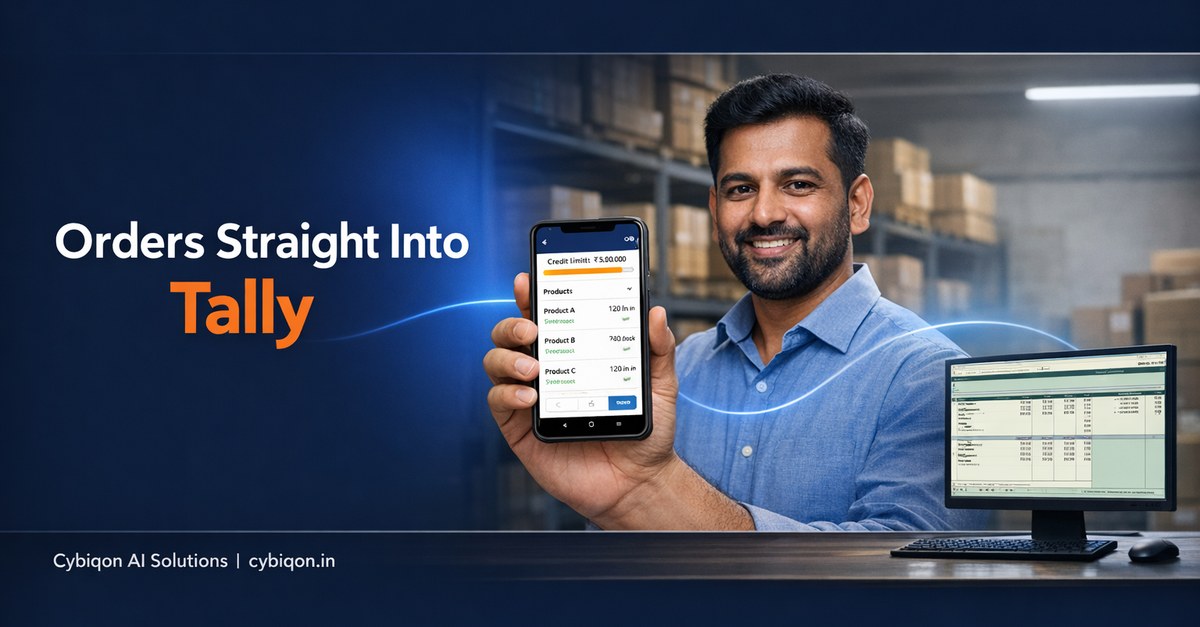
Salesman Order Booking App: Tally, Offline and Credit Limits
It is 11 pm and a billing clerk in a Ludhiana FMCG distributor's office is typing a salesman's handwritten orders into Tally. One line reads "Sharma gen. 12 cs?" and nobody can say whether that is Sharma General Store or Sharma Garments. The order was taken at 11 am. The truck leaves at 7 am.
A salesman order booking app is meant to end this. But the market is confusing, and a lot of what is written about it gets basic facts wrong. Marg's eOrder works only with Marg. BUSY's mobile app works only with BUSY. Tally has no official mobile app at all. And "works offline" means very different things on different pricing pages.
This guide is for a distributor with 10 to 30 salesmen who book orders in a notebook or on WhatsApp. It covers what the apps do, what they cost, where "offline" breaks, and when building your own is the better call. All vendor details below are as published by the vendors, as read on 5 Oct 2026.
What a salesman order booking app actually does
Stripped down, an order booking app for distributors does four things on the salesman's phone:
- shows the retailer list for today's beat
- shows the item list with rates, stock and schemes
- takes the order and sends it to the office
- shows the retailer's outstanding before the order is confirmed
The fourth is the one most distributors miss when they compare apps. Taking an order is easy. Knowing, at the shop counter, that this retailer already owes you ₹2 lakh past 45 days is the part that saves money.
Your salesman is the user here, not the owner. He is standing in a narrow lane in a shop with one bar of signal and a retailer who wants to be done in two minutes. An app that needs six taps per line item will lose to the notebook within a week. That is the real test of any app on this list.
If you are still deciding whether you have outgrown the notebook-and-sheet stage, the signs a business has outgrown Excel are a useful checklist.
Can orders go from mobile straight into Tally?
Yes, but not the way people assume. There is no official Tally mobile app. Every salesman order booking app Tally users can buy is a third-party layer. According to Tally's own integration help (help.tallysolutions.com), TallyPrime exposes an XML/JSON HTTP gateway, and these apps talk to it.
Third-party vendors describe the practical consequence: TallyPrime has to be running, with your company loaded, on an office PC (or on a cloud-hosted Tally). If the clerk shuts the laptop at 7 pm, a sync that depends on it waits.
Also check which voucher the order lands as. A good tally order booking app android setup writes a Sales Order, so stock is not reduced until you actually invoice. One that writes a Sales Invoice directly makes your books look sold before the godown has picked anything.
Then there is the licence. TallyPrime Silver costs ₹22,500 plus 18% GST one-time and is single user, one computer (Tally Solutions' total-cost-of-ownership page). Gold is ₹67,500 plus GST and allows unlimited users on a local network. If your clerk is typing in Tally while an app is also writing vouchers, ask whether you need Gold.
Last point: the Tally brand is not going away. Outlook Business (13 Jul 2026) reports about 2.7 million customers and unaudited FY2025-26 revenue of ₹852 crore. Building on Tally is a safe bet. Just know you are building on a gateway, not on a mobile product.
Does an order booking app work offline?
"Offline" is not one feature. It is two:
- Taking the order offline. Easy. The app keeps the cart on the phone and sends it when signal returns.
- Seeing live stock and outstanding offline. Impossible by definition. What you see is a copy from the last sync.
So the right question is not "does it work offline?" but "how old is the stock and outstanding figure on the screen?"
The vendors themselves show how slippery the wording is. Takkada's pricing page says plans "work offline when your Tally laptop is off", yet its FMCG page says "The app needs a connection to read live stock and to write the order back." Both can be true, which is the point. SalesOn's order-taking page says "Live stock shown per SKU" and states no offline mode. Marg's eOrder lists offline cart editing, with live stock when connected.
For an offline order booking app for distributors working in lanes and basements, test it properly before paying:
- switch the phone to flight mode in the shop
- take three orders
- check what outstanding the app displays and how old it is
- reconnect and see whether all three reach the office, once each
If any order arrives twice, or vanishes, you have found your answer in ten minutes.
Can the app block an order over the credit limit?
This is where distributors get burned, and it connects to a quieter problem in Tally itself. Tally's help FAQ says that when a party crosses its credit limit, a warning appears, and the user can press Enter and save anyway. A hard block needs configuration (a blocking limit and credit-days ceiling, as in Tally's dealer-receivables guide) or a TDL add-on. We cover the setup in our post on setting a credit limit in Tally Prime.
A mobile app can move that check to the moment of booking, which is much earlier than invoice time. SalesOn's order-taking page says the credit limit is "checked before confirmation" and that "credit limit warnings block over-credit orders", with outstanding and limit visible before booking. That is the vendor's claim, and it is worth testing with a retailer who is deliberately over the limit.
Then ask the follow-up questions most demos skip:
- Can a manager approve an exception from his phone?
- Is the override recorded, with who and when?
- Is there a cap on total exposure per salesman, not just per retailer?
- What about post-dated cheques sitting in the drawer?
If the answer to most of these is "no, but we can look at it", your credit rules are more complex than a standard app expects. Keep that in mind for the build-or-buy section.
What does a salesman order app cost per user in India?
Here is what the vendors publish, read on 5 Oct 2026. Treat it as a snapshot, because plans change.
| App | Works with | Published price |
|---|---|---|
| SalesOn Pro | Tally Prime, ERP 9 | ₹2,500 per user per year, ₹0 setup |
| SalesOn Enterprise | Tally, adds DMS, van sales, delivery/POD | ₹4,000 per user per year |
| Takkada | Tally companion | ₹2,900 to ₹8,500 per year per plan, GST extra, 1 user included, extra user ₹3,000 per year |
| Marg eOrder | Marg ERP only, not Tally | ₹5,550 for 2 salesmen, ₹13,900 for 12, ₹25,000 for 25, plus 18% GST, as listed on Marg's eOrder page in Oct 2026 |
| BUSY Mobile App | BUSY only | ₹3,600 per device per year (1 to 4), ₹2,700 for 5+, excluding GST |
SalesOn also offers a 7-day free trial, no minimum users, and says you can be live in one to two days. Its GST treatment is not stated on the pricing page.
Our arithmetic, not the vendors': 10 to 30 salesmen on SalesOn Pro comes to about ₹25,000 to ₹75,000 a year. Twenty salesmen is about ₹50,000 on Pro or ₹80,000 on Enterprise. Takkada's Momentum plan at 20 users works out near ₹61,500 a year, though the page does not say whether a "user" means a salesman.
Pricing is not published for Spectra Compunet, Antraweb, Distributo, PepUpSales or Dealerbuddy, so we quote nothing for them. Remember that Marg and BUSY apps only help if you run Marg or BUSY. Moving accounting software just to get an app is the most expensive way to buy one.
Questions to ask any vendor before you pay
Whichever app you shortlist, put these seven questions to the vendor in writing:
- What happens with no signal? Are stock and outstanding cached, and how old can they be?
- Is the credit limit a warning or a hard block? Can a manager approve an override?
- Does the order land in Tally as a Sales Order or a Sales Invoice?
- What happens with a duplicate or rejected voucher?
- Where does the sync run? Must an office PC stay on, or is it cloud?
- Do I need Tally Gold if the clerk and the sync both write vouchers?
- If I leave, who owns the data, and in what format do I get it back?
Question 4 is the quiet one. Sooner or later a voucher is rejected because a ledger name changed in Tally. A good system tells someone. A bad one drops the order, and the salesman learns about it when the retailer calls.
Schemes are the other thing to put on the table. If your free-goods and slab offers change every month, check how the app applies them. Our explainer on what a trade scheme is for an FMCG distributor shows why a simple "discount percentage" field often is not enough.
Build or buy a salesman order booking app?
Be honest about the money first. A custom build costs more upfront than 20 users at ₹2,500 a year. If your needs are standard, buy.
Buy off-the-shelf if:
- your Tally data is clean
- you run one godown
- pricing is party-wise and standard, with a simple scheme
- you want to be live in days at roughly ₹2,500 to ₹4,000 per salesman per year
- you can live with the vendor's roadmap and a fee that never ends
Build custom if:
- you need credit days, limit and manager approval with an override trail, PDC handling and per-salesman exposure caps
- your schemes are slab-based or free-goods
- you have multiple godowns, batch and expiry (pharma), or hardware with many size and variant combinations
- you want to own the code and the data
- you want WhatsApp ordering or a retailer-facing app on the same backend
Say a pharma distributor with 18 salesmen, two godowns and batch-expiry rules may find that a standard app cannot choose the right batch at booking, so the clerk re-checks every line anyway. The app saved typing, not checking. That is the case for building.
If your retailers will also order for themselves, our post on a B2B ordering app for distributors in India covers that side, and the field force management app guide covers beat plans and tracking.
A day in the beat (illustrative)
This is an invented example, not a client story. Say a hardware distributor in Jaipur has 14 salesmen. Ramesh opens the app at 9 am and sees today's 28 retailers sorted by beat. At the third shop he books 40 pipes and 10 cartons of fittings. The app flags that the retailer is ₹60,000 over his limit and asks for manager approval. The manager approves from his phone with a note. At 6 pm Ramesh syncs on mobile data. The order is in Tally as a Sales Order by the time the clerk opens the day, with nothing to re-type. That is the whole point.
FAQs
Does Marg eOrder work with Tally?
No. Marg eOrder works only with Marg ERP 9+. If your books are in Tally, you need a Tally-compatible third-party app or a custom build.
Can I take orders on mobile and have them go straight into Tally?
Yes, through third-party apps using Tally's XML/JSON gateway. TallyPrime must be running with your company loaded on an office PC or cloud Tally, according to third-party sources. Check whether orders arrive as Sales Orders.
Does an order booking app work offline?
Taking an order offline works. Live stock and outstanding cannot be live without signal, so the app shows cached figures. Ask how old they can be.
Can the app block an order over the credit limit?
Tally itself warns by default. Some apps, such as SalesOn by its own claim, block over-credit orders at booking. Test with an over-limit retailer and ask about manager override.
How much does a salesman order app cost per user in India?
Published prices run from about ₹2,500 to ₹4,000 per user per year (SalesOn), with Marg and BUSY apps priced by user bundles. Custom builds cost more upfront.
What Cybiqon would build
If your credit rules, schemes or godowns do not fit a standard app, Cybiqon would build an Android order-booking app for your salesmen: offline order capture, cached stock and outstanding with a visible "as of" time, credit checks with manager approval and an override trail, and a clean Sales Order pushed into Tally. It is written for your business, not configured from a template, and you own the code and the data. Our Android apps service starts at ₹29,999 one-time and is scoped per build, with 4 to 6 weeks as the typical timeline. A Tally-connected field app is at the larger end of that range, and we will quote after the call. Book 30 minutes at https://tidycal.com/itspyguru/cybiqon-30-minute-meeting, call +91 9250711473, or write to [email protected].
Conclusion
A good salesman order booking app removes the 11 pm re-typing, and it only works if it handles offline orders honestly and checks credit at the shop counter. For standard needs, buy one at about ₹2,500 to ₹4,000 per salesman per year and test it in flight mode first. If your credit, schemes or stock rules are complex, build one you own. Either way, ask the seven questions above before you pay, and talk to Cybiqon if a build is the better fit.
Want this set up for your business?
Book a free call — no tech jargon, no sales pressure. Just honest answers.