What a custom Android app costs an Indian business as of 31 Oct 2026: price drivers, Play's one-time $25 fee, yearly upkeep and a quote-comparison checklist
Android App Development Cost in India 2027: Why Quotes Differ
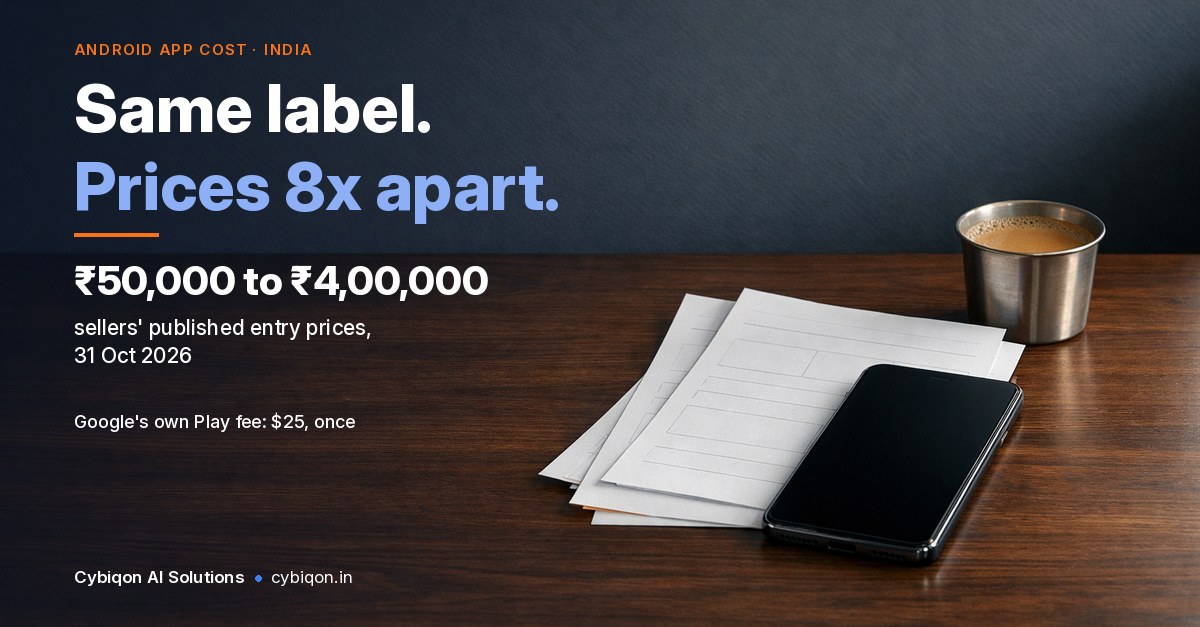
Google charges US$25, once, to register a business on Play. So why does one seller's Android app price start at ₹50,000 and another's at ₹4 lakh?
If your field staff, riders or customers run through WhatsApp and a sheet, you may be holding quotes several times apart with no way to compare them. The Android app development cost in India isn't one number, because "Android app" isn't one thing. One quote may be screens with no backend. Another may include login, offline sync, an admin panel, a payment gateway and Play setup.
A word on the 2027 in the title: you may be budgeting for it, but no 2027 price list exists, and we won't predict one. Every figure here is as of 31 Oct 2026, with a note on what would change it.
You'll get the published seller ranges, what drives them, Google's actual charges, yearly upkeep line by line, a checklist that makes quotes comparable, and an honest test for when you shouldn't buy an app at all.
How much does Android app development cost in India as of 31 Oct 2026?
We found no independent survey of Indian app prices. What exists is sellers' own marketing ranges, so read everything below as a seller estimate, not a measurement.
| Seller | Published estimate | Page date |
|---|---|---|
| Groot | Basic Android: about ₹50,000–1,00,000 | Undated |
| IT Guru | Simpler Android: ₹1.8–7 lakh | 13 Oct 2026 |
| Innovatrix | Simple ₹2–4.5 lakh; moderate ₹4.5–9 lakh; complex ₹9–22 lakh | 30 Oct 2026 |
| Zethic | Android-only: ₹4–40 lakh | 13 May 2026 |
| Ureka | ₹14,999 cross-platform, no custom backend; complete system ₹2.5–10 lakh | 5 Oct 2026 |
Take the lowest Android figure from the first four and you get ₹50,000 to ₹4,00,000, an 8x spread by our arithmetic. Ureka's ₹14,999 sits outside that comparison because it is cross-platform with no custom backend. Cybiqon's own price also sits outside it, and we come to that below.
These tiers aren't defined alike, so this spread in custom Android app development cost doesn't prove anyone is overcharging. What would change these figures: any seller editing its page. Android itself is rarely the debate in India: StatCounter puts it at 93.97% of mobile OS share for September 2026, against 5.97% for iOS, though that measures web traffic rather than phones sold.
Android app development cost in India: why do quotes differ so much?
Google's one fixed charge is too small to explain the gap, so by our reading the difference comes from scope and labour. Five things move the cost to build an Android app for business most.
| Driver | Question that sets the price | Seller estimates we found |
|---|---|---|
| Screens and roles | How many screens, and do salesman, rider, manager and customer each see different ones? | None stated separately |
| Login | OTP, password or company-issued account? OTP also adds SMS costs every month | None stated separately |
| Payments | Does the app collect money, and does it reconcile to orders? | Gateway integration ₹40,000–1 lakh (Innovatrix) |
| Offline use | Which actions work without signal, and who wins when two edits clash on sync? | $2,400–6,000 (isynbus) |
| Admin panel | Who manages users, rates and reports from a desk? | ₹75,000–2 lakh (Innovatrix); $2,400–9,600 (isynbus) |
Does an app need an admin panel? Usually, if staff enter data that somebody else must see or correct. Without one, every new user or changed rate becomes a request to your developer. A quote without one may simply have left it out, so the admin panel cost for an Android app is the first line to look for.
So the field staff app cost for, say, a Ludhiana distributor with one role and no payments won't resemble the delivery app development cost for a chain with riders, customers, collections and a dispatcher. The features themselves belong to other posts: see what an order booking app needs when it has to work with Tally, and how rider tracking and nightly cash settlement fit together. Our question here is what those features do to the bill.
What does Google charge to publish an Android app?
The Google Play Console fee an Indian business pays is one line: "There is a US$25 one-time registration fee." The route you register by matters more, because it changes your timeline.
- Personal account. Google says "personal developer accounts created after November 13, 2023" must run a closed test with at least 12 testers, opted in continuously for at least 14 days. Plan that into the launch date.
- Organisation account. You must provide a D-U-N-S number. Google says it's free through D&B, warns about third parties charging for it, and tells you to allow up to 30 days. Organisation accounts are mandatory for financial products, health apps, VpnService apps and government apps.
Google's testing page names only personal accounts. It doesn't confirm that organisation accounts are exempt, so don't accept that as a promise from a vendor without seeing it in writing from Google.
For a company app, we'd apply for the D-U-N-S number the day you decide to build. The account then sits in the company's name from the start.
Does Google take a cut if my app sells physical goods or services?
By our reading of the policies, not on those sales. Google's payments policy lists physical goods and physical services, including transportation and food delivery, as not supported by Play billing. Digital items, subscriptions and in-app features fall under it.
- Order, delivery or field service app: you pay a gateway, not Play. Razorpay lists 2% plus 18% GST, or 2.36% effective, and Cashfree lists 1.95% plus taxes, or 2.301%. The full gateway fee breakdown, including refunds and settlement, is in a separate post.
- Digital content or subscriptions: Play's service fee in India today is 15% on your first US$1 million a year, 30% above that, and 15% on auto-renewing subscriptions. Alternative billing is 4 points lower.
What would change this: Google's lower-fee table lists "Rest of World" for 30 Sep 2027, but neither page names India, and it says other regions' details are "forthcoming". The Play billing dispute was also pending at the Supreme Court as of a 9 Oct 2026 article.
Android app maintenance cost in India: what recurs each year
Upkeep recurs because Google keeps moving the target. New apps and updates must now target Android 16 (API 36), and Google's extension window runs to 1 Nov 2026. Existing apps need API 35 to stay visible to new users. An app on API 34 or lower reaches only devices on the same or a lower Android version, though current users keep access.
Next, Google's February 2026 blog says API 37 becomes "mandatory for distribution in August 2027". That's a stated plan Google could revise. It's also why the target API level update cost isn't only a version number: under Android 17's behaviour changes, most apps targeting API 37 get standard OTP SMS only three hours after receipt, so login may need rework.
| Recurring item | Figure checked 31 Oct 2026 | Changes when |
|---|---|---|
| Android updates | Seller estimate: ₹50,000–2 lakh a year (Innovatrix) | Google's yearly target rules |
| Server | Hostinger KVM 1 renews at ₹999 a month; DigitalOcean $6, $12 or $24 a month for 1, 2 or 4 GiB. Seller estimate: ₹60,000–6 lakh a year (Innovatrix) | Provider pricing, your load |
| Database and push | Firebase: FCM no-cost; Firestore free to 1 GiB, 50K reads and 20K writes a day | Usage above those limits |
| SMS | MSG91: ₹0.25 each at 5,000, ₹0.18 at 30,000 (₹5,400 plus 18% GST). Undated, and not labelled as OTP rates, so confirm | Vendor pricing, volume |
| SMS registration (DLT) | ₹5,900 for one year including GST, as reported by sellers, undated | Seller or operator fees |
| Maps | India pricing: Maps SDK unlimited at no cost; 70,000 free monthly events on Dynamic Maps, Geocoding and Compute Routes Essentials, then $2.10 or $1.50 per 1,000 | Google's page, updated 30 Oct 2026 |
| Play registration | None: the US$25 is one-time | Google changing it |
Sellers also repeat a rule of thumb: 15–20% of the build a year (Ureka, Groot, Innovatrix), or 15–25% (Zethic). That isn't independent data, and it breaks at low build prices, as the example shows.
An illustrative year, not a real client. Say a distributor buys 5,000 SMS in the year (₹1,250, or ₹1,475 assuming the same 18% GST), renews the ₹999-a-month server at its listed price (₹11,988) and pays ₹5,900 for DLT. That's ₹19,363 before gateway fees and developer time. Add our optional ₹2,999-a-month maintenance and the year comes to ₹55,351. On a ₹29,999 build, the 15–20% rule would suggest only ₹4,500–6,000, so don't budget from a percentage. Budget from these lines.
Compare Android app development cost in India: a quote checklist
Send every vendor this same list and ask for a yes, a no or a price against each line. Then the quotes can be compared.
- Screens and roles: a written list of each, not "as discussed".
- Login: which method, and who pays for SMS and DLT?
- Backend: is one included, or only the app screens?
- Admin panel: what can your staff change without calling the vendor?
- Payments: which gateway, and does the price cover integration and reconciliation?
- Offline: which actions work without signal, and how are clashes resolved?
- Play setup: whose account, which route, and who runs any 12-tester test?
- Upkeep: who handles the yearly target API update, and at what price?
- Hosting: whose account does the server sit on, and is there a markup?
- Payment terms: what's due when, and what do you hold if the job stops halfway?
Three ownership lines deserve their own signature:
- Source code: the full repository, handed over, with no clause holding it back.
- Signing keys: without these credentials, shipping updates to the same listing can become your problem the day you change vendors.
- Play Console: the listing in your company's account, or transferred to it in writing.
If a vendor won't commit on these three, a low price buys less than it appears to.
When a phone-friendly website is enough, and an app isn't worth buying
Plenty of what gets called an app is a website that works well on a phone. Skip the app when:
- Customers come occasionally, and won't keep your app installed for a monthly order.
- Staff have signal wherever they work, and only fill in forms or view reports.
- You need one form and one report. A sheet that's stopped coping doesn't automatically need an app; first check the signs your business has outgrown Excel, and the smallest fix.
An app starts earning its cost with offline use, hardware access, staff tools and anything opened repeatedly. A rider's route, a salesman's beat in a patchy market, or counting the galla every night can all qualify. For telecallers, read what Android allows a telecalling CRM to do before you pay for a feature it may restrict.
Where Cybiqon's ₹29,999 price sits
Our published price for an Android app is from ₹29,999, one-time, scoped per build, typically 4–6 weeks. Against the table above, that's below every Android-specific floor we found and above Ureka's ₹14,999 no-backend entry.
Two honest notes:
- It's a starting price. A multi-role offline app with an admin panel will cost more than ₹29,999, and the scope sets the number before work starts.
- The ₹1,50,000+ on our pricing page is our own comparison, not market data. Groot publishes from ₹50,000, for one.
Maintenance is optional at ₹2,999 a month (₹35,988 a year, our arithmetic), and declining it doesn't affect your code. Hosting is paid directly to the provider with no markup. Above ₹20,000, we take 50% upfront and 50% on delivery.
FAQs
How much does it cost to make an Android app in India?
Sellers' published entry estimates run from ₹50,000 to ₹4 lakh as of 31 Oct 2026, with complex builds quoted far higher. They aren't defined alike, so compare scope first.
Do I need a D-U-N-S number to publish my company's app on Google Play?
Yes, for an organisation developer account. Google says it's free through D&B and to allow up to 30 days.
What is the 12 testers for 14 days rule, and does it apply to a company account?
Personal accounts created after 13 Nov 2023 must run a closed test with at least 12 testers opted in for at least 14 continuous days. Google's page names only personal accounts and doesn't confirm an organisation exemption.
Can field staff use the app without listing it publicly on the Play Store?
Yes. Managed Google Play private publishing still needs a registered developer account and an Organization ID/EMM setup. Google also excepts permanently private internal apps from target API rules. Developer verification expands globally in 2027 by Google's statement, though the pages we read don't name India. Apps from a managed device's organisation store won't need it.
Who should own the code and Play Console account?
You should. Get the source code, signing keys and Play listing in writing, whichever vendor you choose.
What Cybiqon would build
Say your field team runs on WhatsApp and a sheet. Cybiqon would build the Android app for those roles, the backend it needs, the offline behaviour your routes require, and the admin panel your office uses to manage it. It's written for your business rather than configured from a template, and you own the code, the signing keys and the Play Console entry.
We ship apps on Play under our own name too, including LLMBytes, MeFlow, Lumina and Orbitone. See how we build Android apps, then bring your quotes to a 30-minute call. We'll go through them with the checklist, and tell you if a website would do. You can also reach us on +91 9250711473 or at [email protected].
Conclusion
The Android app development cost in India depends on the scope behind each quote, far more than on Google's one-time US$25. As of 31 Oct 2026, sellers' entry prices sit 8x apart, and the next change to watch is Google's stated API 37 plan for August 2027. Give every vendor the same checklist, price the recurring lines separately, and get the code, keys and Play listing in writing. If you'd like a second opinion on what you've been quoted, Cybiqon is happy to read through it with you.
Want this set up for your business?
Book a free call — no tech jargon, no sales pressure. Just honest answers.
What we build for this: Android apps