telecalling CRM and call tracking for telecaller teams on company SIMs
Telecalling CRM: What Android Allows and What TRAI Now Checks
Telecalling CRM: What Android Allows and What TRAI Now Checks
Last quarter, 1,37,053 phone numbers and connections in India had their outgoing calls barred for 15 days over unsolicited commercial calls, according to TRAI's April–June 2026 data reported by Republic World and IANS. If your telecallers dial leads from company SIMs, those numbers carry your whole sales pipeline. And if all you have is a Google Sheet the team fills in at 7 pm from memory, you can't show who was called, why, or what was promised.
A telecalling CRM fixes the record-keeping. But before you buy one or build your own, three rules shape what any app can actually do in 2026: Google Play's Call Log policy, the 2022 end of third-party call recording on Android, and TRAI's spam amendments of February 2025 and 18 September 2026.
This guide is written for the owner or sales head of a phone-led business: a real-estate channel partner, a coaching admissions desk, a loan DSA, a solar installer. You'll learn what a telecalling CRM tracks, what Android permits, how recording really works, what TRAI now watches on 10-digit SIMs, what the off-the-shelf tools cost, and when building your own app makes sense.
What is a telecalling CRM, and how is it different from a normal CRM?
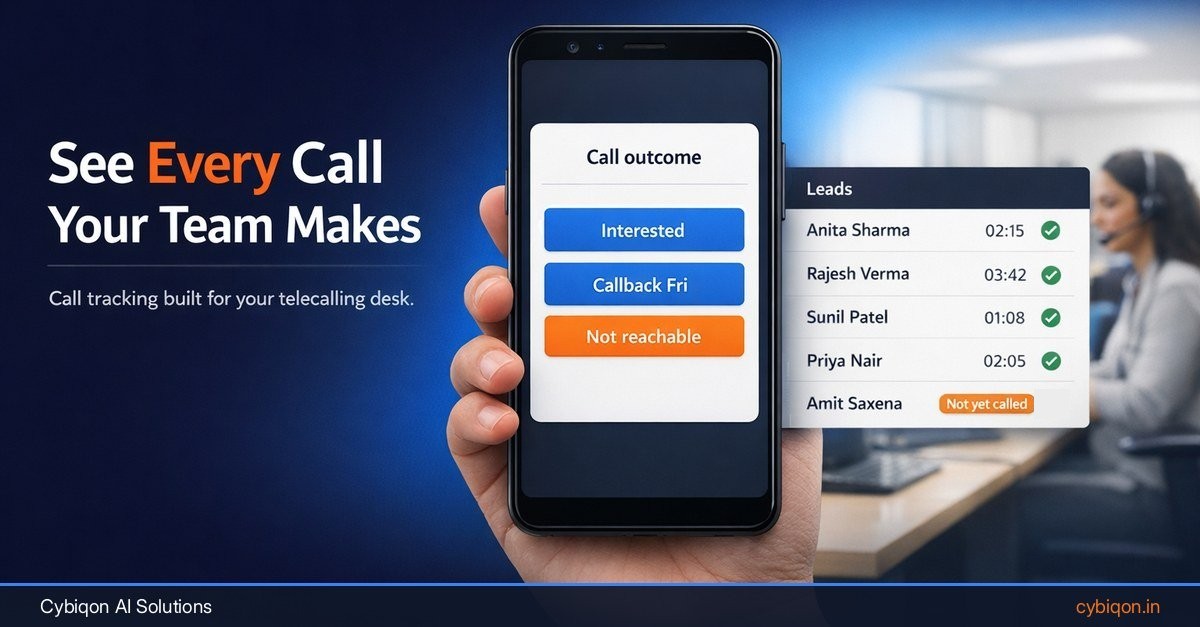
A normal CRM stores leads, deals and notes. A telecalling CRM adds a layer for the calling itself: it lives on the telecaller's Android phone, dials from the lead list, logs every call against the right lead, and asks what happened when the call ends.
That difference matters because the call is where a phone-led business wins or loses the lead. A general CRM tells you a lead exists. A telecalling app for business tells you:
- whether the lead was dialled at all, and how quickly after it arrived
- how long each call lasted (an 8-second "not reachable" and an 8-minute site-visit discussion look identical in a day-end sheet)
- the outcome: interested, callback on a date, not reachable, wrong number
- what was promised, such as a discount, a brochure or a site visit on Saturday
- which callbacks are overdue
Speed matters more than most owners assume. The best-known benchmark is old and American: a Harvard Business Review audit of 2,241 US companies (March 2011) found firms that responded to a web lead within an hour were nearly 7 times as likely to qualify it as firms that responded later, while 23% never responded at all. No comparable Indian study exists, but anyone who has paid for Meta or 99acres leads knows the pattern.
If you haven't set up any CRM yet, start with how to choose a CRM for your business and come back here for the calling layer.
How to track telecallers' calls on company SIM cards
Here is a composite scenario (an illustration, not a client). A solar installer has 12 telecallers on company SIMs. Leads land from Meta lead forms, IndiaMART and 99acres into a shared Google Sheet. Each evening, telecallers fill a "call register" tab from memory. The owner cannot tell which leads were never dialled or what was promised on which call.
Good SIM-based call tracking replaces that tab with a flow like this:
- Leads arrive in the app automatically. Ideally the telecalling software pulls IndiaMART enquiries straight into the CRM alongside Meta and portal leads, so nobody copies rows.
- Every dial starts from the lead record, so the call is tied to the right person.
- When the call ends, the app asks for the outcome and the promise made, before the telecaller moves on.
- Owner alerts flag leads with no dial within a set number of minutes, and any missed callback date. This is the missed follow-up reminder app most teams actually need.
- One tap sends a WhatsApp follow-up with the quote or brochure.
Telecaller performance tracking then comes from real data: dials, connected calls, talk time and outcomes per person, not self-reported numbers. An employee call tracking app of this kind should be introduced openly to the team: it logs work calls on company phones, it doesn't watch people.
Android runs on 92.79% of mobile phones in India (StatCounter, August 2026), so an Android-only call tracking app for a sales team covers almost every company phone you'll hand out.
Can a telecalling CRM read the call log on Android? Google Play's rules
This is the question vendor pages skip. Google Play's policy on SMS and Call Log permissions says apps must be registered as the default Phone, SMS or Assistant handler before asking for these permissions. There are listed exceptions, and one of them is "Enterprise archive, business & enterprise customer relationship management (CRM), and/or enterprise device management". Under it, an app may use READ_CALL_LOG, PROCESS_OUTGOING_CALLS and WRITE_CALL_LOG, subject to Play review and a Permissions Declaration Form.
A few points worth knowing:
- The declaration applies even to internal test tracks. Assume Play policy and review apply to anything you publish through Play Console, private or public.
- What is changing, and when. In a policy announcement on 15 July 2026, Google said it will no longer allow account verification via phone call as a use of READ_CALL_LOG. That change takes effect on 27 January 2027. The Enterprise CRM exception is not affected and is unchanged in Google's preview of the updated policy.
- Without READ_CALL_LOG, the number is hidden. Since Android 9, an app without that permission receives an empty phone number in phone-state callbacks.
- A design option. If the app places the call itself from the lead record, it already knows the number and can detect the call ending through phone state, then ask for the outcome. That could avoid READ_CALL_LOG entirely. This is our engineering inference, not something Google documents, so treat it as a design option to confirm during a build.
Separately, Google's developer verification programme (rolling out globally in 2027) exempts apps distributed through an organisation's store on managed devices from developer verification. That is about sideloading. It is not an exemption from the Call Log policy.
Call recording CRM on Android: why apps can't record calls any more
Google blocked third-party call recording apps on the Play Store from 11 May 2022. So any call recording CRM on Android today works one way: the phone's own dialer records the call, and the CRM syncs the file. Callyzer's help pages say it plainly: the app does not record calls directly; the device records them and Callyzer syncs the recordings.
What this means for you:
- Recording works only on phones whose built-in dialer supports it. Check before you buy 12 handsets.
- On the Google Phone app, both parties hear that the call is being recorded, recordings stay on the device, and availability varies by country. On non-Pixel phones in India it varies by model.
- Recording storage is often billed separately (see the pricing table below).
Is it legal to record sales calls in India? The honest answer is that it is not settled. The old Telegraph Act interception clause, section 5(2), has been replaced by section 20 of the Telecommunications Act 2023 (in force from 26 June 2024), but neither sets rules for a private business recording its own sales calls. Sensible practice: tell the caller at the start, record only for a stated purpose, and keep recordings for a limited time. This is not legal advice; ask your lawyer for your case.
DPDP note: under the Digital Personal Data Protection rules, obligations around notice, consent and security of personal data apply from 13 May 2027. Call recordings and lead lists are personal data. Build the notice, the purpose and a deletion schedule into your process now.
TRAI rules for telecallers calling from 10-digit SIMs
Most telecalling teams dial from ordinary 10-digit company SIMs. Two TRAI amendments to the TCCCPR (the telecom commercial communication rules) change the risk.
February 2025 (Second Amendment, notified 12 Feb 2025):
- Promotional calls must come from the 140-series, through a registered telemarketer on DLT. The 1600-series is for service and transactional calls and is allotted to BFSI and government entities, with a phased BFSI rollout from 1 January 2026. A solar installer or coaching institute cannot simply take a 1600 number.
- Ordinary 10-digit numbers used for commercial communication are to be acted against.
- Action against unregistered senders now starts at 5 complaints in 10 days, down from 10 in 7.
- On a first violation, all the sender's telecom resources can be barred for 15 days; repeat violations lead to one-year disconnection and blacklisting.
18 September 2026 (Third Amendment, finalised):
- Telcos will use AI/ML to flag suspected spam numbers (Regulation 21A).
- If 5 or more numbers linked to one sender are flagged within 10 days, the telco can re-verify KYC, physically verify, bar outgoing calls or disconnect.
- Action can start at 3 unique complaints when the number is also AI-flagged.
- Automated (A2P) calls must be declared in advance, and apps like Truecaller can no longer block or tag calls from TRAI-designated commercial series.
Telco systems flagged 22.99 billion incoming calls as suspected spam in April–June 2026. A telecaller making 150 short outbound calls a day from one SIM matches that pattern. Note too that the 1.12 billion subscribers without a DND preference have not given consent. Calls to people who enquired rely on inferred consent, which lasts only for the duration of the relationship. (The Rs 2, 5 and 10 lakh penalties in the news fall on telcos, not on you.)
This is where a telecalling tracking app earns its keep: a clean record of who enquired, when, how often they were called and what they said, plus a hard stop on re-dialling people who said no. For the practical steps, read how to stop your business number being marked as spam.
Telecalling CRM price in India, and when to build your own
Here is what public vendor pricing looked like at the time of writing (fetched September 2026, excluding GST):
| Tool | Price | Notes |
|---|---|---|
| RMDialer | Rs 159/user/month (yearly), Rs 249 (3-month plan) | Lowest entry price |
| Callyzer | Rs 175/number/month (Basic), Rs 275 (Basic + Lead) | Recording storage Rs 500 per 5 GB/month |
| TeleCRM | Rs 799/user/month (annual), Rs 1,099 (quarterly) | Fuller CRM features |
For 10 telecallers, that is roughly Rs 1,600 to Rs 11,000 a month before GST. Check each vendor's page before you decide; prices change.
Buy an off-the-shelf telecalling CRM if:
- your leads come from the usual sources (Meta, IndiaMART, 99acres, website) and the vendor already connects to them
- your process is standard: dial, log outcome, schedule callback
- you want to start this week
Consider building your own Android app if:
- leads flow through your own dealer portal, ERP or a custom IndiaMART pipeline that vendors don't reach
- your outcome codes and follow-up rules are specific (site-visit slots, loan document checklists, admission counselling stages)
- you want the call data and the code to be yours, not rented per seat
- you want the WhatsApp follow-up wired into the same flow, as part of wider WhatsApp automation for the business
A built app still has to pass the same Play review and follow the same recording limits. Building doesn't unlock anything Google or TRAI forbids.
FAQs
What is a telecalling CRM and how is it different from a normal CRM?
A telecalling CRM is a CRM with an Android app on the telecaller's phone that dials from the lead list, logs each call against the lead and asks for the outcome when the call ends. A normal CRM stores leads and deals but doesn't see the calling itself.
How can I track my telecallers' calls on company SIM cards?
Put a telecalling tracking app on each company phone and have every call start from a lead record. The app logs the call, captures the outcome and the promise made, and alerts you to leads never dialled and callbacks missed.
Can a CRM app read the call log on Android? Is it allowed on Google Play?
Only under Google Play's exception for business and enterprise CRM, subject to Play review and a Permissions Declaration Form. Otherwise an app must be the default Phone, SMS or Assistant handler. The 27 January 2027 change removes phone-call account verification as a use; the CRM exception is unchanged.
How much does a telecalling CRM cost per user in India?
At the time of writing, excluding GST: RMDialer from Rs 159/user/month (yearly), Callyzer Rs 175/number/month, TeleCRM Rs 799/user/month (annual). Recording storage may cost extra.
Should I buy a telecalling CRM or build my own app?
Buy if your lead sources and process are standard. Build if leads flow through your own systems, your follow-up rules are specific, or you want to own the data and code.
Not sure whether you need a tool or your own app?
DM us or email [email protected] with how many telecallers you have and where your leads come from. We'll tell you honestly whether an off-the-shelf telecalling CRM is enough. For many teams it is.
Where it isn't, Cybiqon builds an Android calling app written for your business, not configured from a template: it dials from your lead list, captures the outcome and promise when each call ends, flags missed callbacks and sends the WhatsApp follow-up, all within Google's Call Log rules. You own every line of the code. See how we approach custom Android apps, or book a 30-minute call. You can also reach us on +91 9250711473.
Conclusion
The day-end Google Sheet can't tell you which paid leads went cold, and under TRAI's 2025 and 2026 amendments a sloppy calling record is now a risk to the SIMs themselves. A telecalling CRM gives you the record: who was dialled, for how long, what was promised and which callbacks slipped. Just know the limits: call log access runs through Play review, recording depends on the phone's own dialer, and DPDP duties apply from 13 May 2027. Start with a vendor tool if it fits. If it doesn't, talk to Cybiqon about an app you own.
Want this set up for your business?
Book a free call — no tech jargon, no sales pressure. Just honest answers.