stopping a business number from being flagged as spam in India
How to Stop Your Business Number Being Marked as Spam in India
How to Stop Your Business Number Being Marked as Spam in India
A parent fills your enquiry form at 9:12 PM asking about your NEET batch. Your counsellor dials back a minute later. It rings out. So does the next one, and the one after that. Somewhere in the last few months your number started arriving on customers' screens wearing a red "Spam" label, and the leads you already paid for stopped answering.
If you are working out how to stop your business number being marked as spam in India, start here: your customers are not rejecting you. They are playing the odds. Truecaller's full-year 2025 platform data — from The Machine Era of Spam Calls: How Automated Fraud Scaled Globally in 2025 — found 66% of all calls from unknown numbers in India were flagged as spam or fraud, across roughly 4,168 crore spam calls, making India the fifth most spam-hit of ten markets analysed. When two of three unknown calls are junk, ignoring unknown numbers is rational.
This guide gives the literal answer first, then the part nobody else will tell you: which "trusted number" fixes you are legally ineligible to buy, and what actually moves your connect rate instead.
The Short Answer: Yes, You Can Fix It — But Not by Buying a Number
Most articles on this topic answer a different question than the one you asked. Half the search results are American, built on STIR/SHAKEN and CNAM — carrier systems that do not exist in India. The other half are India-flavoured but never mention TRAI, DND, DLT, CNAP or the 140/1600 series at all. The honest version, in three lines:
- India does have a hierarchy of trusted, sector-specific number series — 1600, 1601 and 140.
- A general MSME — coaching centre, clinic, interior contractor, D2C brand, local manufacturer — cannot buy into the good ones at any price.
- What you can control: your calling pattern, your connection type, whether a wrong label gets contested, and — the big one — whether the customer recognises your number before it rings.
140, 1600, 1601 or Ordinary: Who Can Actually Get a Trusted Number
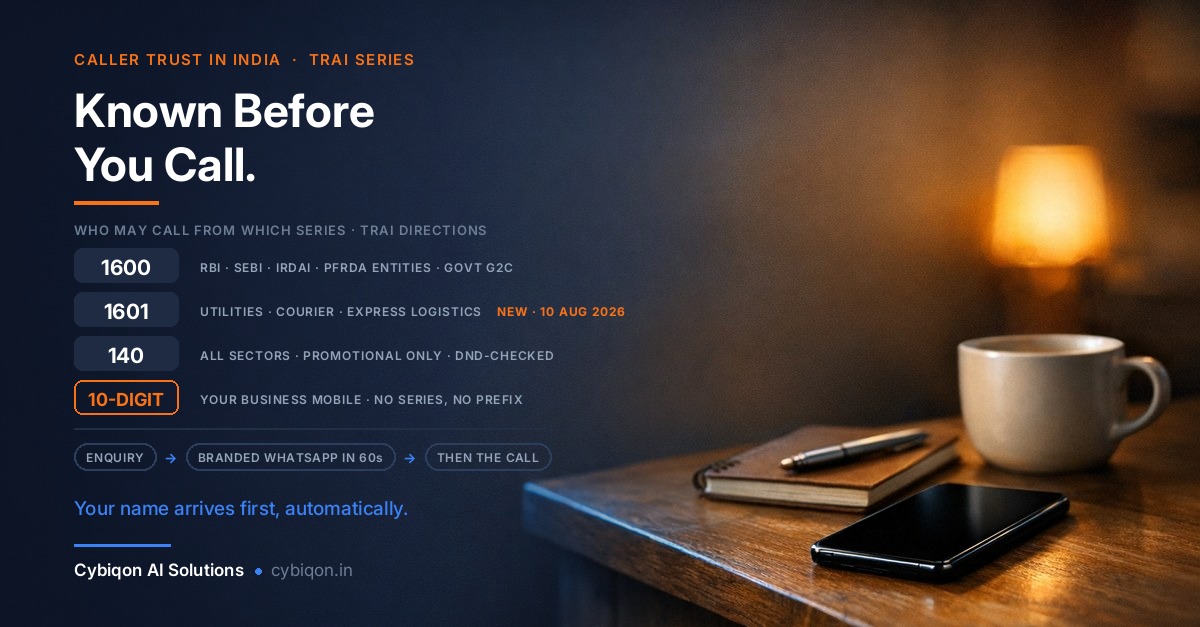
TRAI has been building this hierarchy sector by sector. Where it stands in September 2026:
| Series | Who can get it | What it is for | Can a general MSME get it? |
|---|---|---|---|
| 1600xx | Only entities regulated by RBI, SEBI, IRDAI and PFRDA, plus government entities for G2C calls | Transactional and service calls from banks, NBFCs, insurers, pension entities | No — not at any price |
| 1601xx (opened 10 Aug 2026) | Utilities (electricity, water, gas, LPG), courier, express logistics, parcel and freight entities only — not intermediaries or aggregators | Service and transactional calls; promotional calls barred outright | Only if you are in those exact sectors |
| 140xx | Entities across all sectors, on registration with their telecom service provider | Promotional calls | Yes — but read the catch below |
| Ordinary 10-digit mobile | Anyone | Everything else, including a callback to someone who enquired | Yes — this is what you have today |
The 1600 restriction is easy to verify: TRAI Press Release No. 91/2026 (10 July 2026) and the Direction of 19 November 2025, which phased it in — banks from 1 Jan 2026, large NBFCs 1 Feb, IRDAI entities 15 Feb, the rest 1 Mar 2026. Tellingly, the biggest sellers say the same against their own commercial interest: Tata Tele Business Services states that "1600 series can only be issued to the entities regulated by RBI, IRDAI, SEBI, and PFRDA," and Jio Business markets it solely to BFSI.
The 1601 series (TRAI Press Release No. 113/2026, 10 August 2026, with a 90-day migration window) is three weeks old and barely covered anywhere. It matters for what it proves: the trusted-number club is expanding one sector at a time, and there is currently no announced pathway for general MSMEs to join it. Taking the calls inside WhatsApp instead looks like the way round this, but it is a different gate rather than a lower one.
So why not just take a 140 number?
Because 140 is the wrong tool for a callback. It is designated for promotional calls, and ringing back a parent who enquired an hour ago is a service interaction, not a promotion. It is also DND-blockable and widely ignored: in April–June 2026 alone, 1.48 billion promotional calls were blocked under DND preferences, alongside 7.30 billion promotional SMS. So the accurate answer to "can an MSME get a trusted number?" is not a flat no — it is you can get 140, and 140 will not help you here.
Why Your Business Number Is Being Marked as Spam in India
Spam labels come from two places at once, and most owners only know the first: community reports (customers tapping "report spam" in apps like Truecaller) and automated call-pattern detection (algorithms watching the shape of your outbound traffic).
The telemarketing signature is a combination — high outbound volume + short average call duration + low answer rate — not any one alone. A number making 70 calls a day where most last eight seconds and most go unanswered looks statistically identical to a cold-calling operation, whatever your business actually does.
Note what is not here: a published calls-per-day threshold. No Indian telco or TRAI document publishes one. The "200–250 calls a day" figure circulating online is a US carrier heuristic; anyone quoting a hard Indian number is guessing.
This explains the vicious circle. Take a nine-person NEET/JEE coaching centre in a tier-2 city, pulling 40–60 enquiries a week from its website form, Google Business Profile and Instagram DMs. Two counsellors dial back from ordinary personal prepaid SIMs, 60–80 calls a day each, mostly short, mostly unanswered. Within months both numbers carry spam labels, answer rates collapse, and the counsellors respond by dialling more — which makes the signature look even more like telemarketing. The owner buys new SIMs, gets a few clean weeks, and the cycle restarts.
Buying a new SIM fixes nothing, because the flag follows the pattern, not the number.
What You Cannot Buy: Three Fixes the Internet Still Recommends
Before spending money, delete these three from your list.
1. Google Verified Calls — dead. Google shut it down completely on 31 January 2023. India was one of its five launch markets (with the US, Mexico, Brazil and Spain), which is why stale Indian guides still recommend it. Exotel's and Telnyx's own developer documentation confirm the shutdown.
2. "Unlist your number from Truecaller" — backwards for a business. The most common free tip online is the wrong move here. Unlisting is free and takes about 24 hours, but it only removes your number from Truecaller's searchable database; it does not delete tags already saved in other users' contact lists. And a business that wants its callback answered needs to be more identifiable, not less. Unlisting turns you from "tagged" into "totally unknown" — the category people already ignore two-thirds of the time.
3. Truecaller Verified Business Caller ID — real, but set expectations. This exists and is worth evaluating, with two caveats. Its pricing is not published — "Growth" and "Enterprise" tiers are quoted on request by call volume, and reseller listings span ₹1,000 to ₹20,000 for nominally the same product, a 20x spread telling you none is authoritative. And a verified badge does not immunise you: the community can still mark a verified caller as spam if your calling behaviour stays bad.
CNAP: Will Caller ID Ever Show My Company Name?
CNAP — Calling Name Presentation — shows a caller's name, not just their number. It is the fix most MSME owners actually want, and there is an almost unknown detail buried in TRAI's Recommendations on Introduction of CNAP Service, 23 February 2024:
"The subscriber entities holding bulk connections and business connections should be given the facility of presenting their preferred name in place of the name appearing in the Customer Application Form (CAF)."
That preferred name can be a trademark registered with MCA, a trade name registered with the GST Council, or another government-registered unique name, on production of ownership documents. The implication is large: on a personal prepaid SIM, CNAP shows the proprietor's own CAF name — "Rakesh Kumar Sharma," not "Vidyarthi Classes." On a proper business or bulk connection with a registered trade name, your brand can show.
The honest caveat that must travel with that fact: as of 1 September 2026, no telco has published an operational, consumer-facing procedure for an MSME to register a preferred name. The right exists in the framework; the counter is not open yet. This is not a step you can complete this week.
CNAP is also not live pan-India. DoT's March 2026 deadline was missed and rollout is circle-by-circle: Jio in roughly 12 circles (West Bengal, Kerala, Bihar, both UP circles, Rajasthan, Punjab, Assam, Uttarakhand, Himachal, Jharkhand, Odisha), Airtel in about 5 (West Bengal, Gujarat, MP, Maharashtra, J&K), Vi in Maharashtra and partly Tamil Nadu, BSNL trialling in West Bengal. TRAI, aligning with DoT in October 2025, shifted it from "on request" to default-with-opt-out. It also cannot work on 2G or circuit-switched networks, so feature-phone users — disproportionately rural and semi-urban, and often a large slice of an MSME's customer base — are excluded entirely.
Is It Legal to Call Customers Who Enquired? DND, TCCCPR and the Real Risk
This is the fear behind most of these searches, so let us be precise. Returning a call to someone who just enquired with you is not telemarketing. A solicited callback is a different animal from bulk cold outbound; do not let compliance anxiety stop you calling back a warm lead.
What is risky is unregistered bulk outbound. Under TCCCPR 2018, as enforced by TRAI's August 2024 direction, an entity acting as an unregistered telemarketer can have all its telecom resources disconnected and blacklisted for up to two years, across every operator, with the blacklisting propagated to all access providers through the DLT platform within 24 hours. Note where the parties sit: the duty to disconnect and blacklist rests on the originating access provider — your telco — while the consequence lands on the sender, which is your business.
Enforcement is not theoretical. TRAI's Q1 FY2026-27 UCC report (PR No. 111/2026, 4 August 2026) records 10.85 lakh complaints, 1.83 lakh telecom resources actioned, 1,37,053 numbers barred for 15 days on a first violation, and 22.99 billion calls AI-flagged as suspected spam.
One widely misreported point: TRAI has not ordered Truecaller to stop spam-labelling 140/1600 calls. PR 91/2026 was a clarification issued to counter press reports "that could potentially lead to misinformation," and draft regulations proposing that call-management apps not tag or filter these series have been out for consultation since March 2026. TRAI clarified the rules, Truecaller complied under protest, and the jurisdictional question is still open.
The Free-to-Paid Ladder: How to Stop Your Business Number Being Marked as Spam
Work down this list in order. The free rungs do most of the work.
Free, this week:
- Contest the label, don't abandon the number. Truecaller has a not-spam / business-name-correction flow. Use it for every wrongly-tagged number. Most businesses skip straight to a new SIM instead.
- Fix the calling pattern. Stop repeat-dialling non-answerers on the same day, let calls ring the full duration instead of cutting at four seconds, and confine calling to sane hours. These three habits change the exact signature that triggers automated detection.
- Warm the channel before you dial — covered next.
Structural, low cost:
- Move enquiry callbacks off personal prepaid SIMs onto a proper business connection whose CAF details carry your registered GST trade name. It costs little and positions you for CNAP whenever the preferred-name counter opens.
- Route enquiries through a system, not a WhatsApp group. When nobody can see which leads have been called, dialling volume goes up and quality goes down; proper lead tracking and follow-up automation cuts the calls needed per conversion, which directly improves your pattern.
Paid, only after the above:
- Get a direct quote for Truecaller Verified Business Caller ID and judge it on your call volume. It is a badge, not armour.
- If most of your losses are inbound calls ringing out rather than outbound calls unanswered, that is a different problem — an AI voice agent that answers missed calls fixes it without touching your number's reputation.
Warm the Channel Before You Dial
The mechanism that actually changes outcomes: make the customer recognise your number before it rings. Directionally, the research supports this. A randomised controlled trial in PLOS One — Pre-Survey Text Messages (SMS) Improve Participation Rate in an Australian Mobile Telephone Survey (n=5,191) — found a pre-notification SMS lifted response rates from 7.7% to 12.4% and cooperation from 16.0% to 28.6%, while refusals fell from 35.9% to 27.3%. That is an Australian population-health survey, not an Indian business callback, so treat it as evidence for the mechanism, not a number to expect.
Indian consumers do still want the call. Kantar's July 2026 study (1,000 consumers and 500 businesses across 17 cities) found 76% of consumers prefer calls over digital alternatives, and 49% said the ability to schedule a callback would increase their willingness to engage.
Back to the coaching centre — three changes, none expensive:
- The callback stops being a cold dial. Within 60 seconds of the enquiry, an automation sends a WhatsApp message naming the centre, referencing the exact course the parent asked about, and saying a counsellor will call from a stated number. The number is recognised — often saved — before it rings. This is the highest-leverage use of WhatsApp automation for Indian MSMEs, and it costs less than the SIMs the owner keeps replacing.
- Enquiries route to a proper business connection whose CAF details carry the registered GST trade name, not two personal prepaid SIMs.
- Outbound behaviour gets cleaned up, and wrong labels get contested rather than written off.
The measurable win is not "more calls" — it is the same lead volume converting at a materially higher connect rate. And if most enquiries come from paid campaigns, you can dodge the cold-number problem earlier: click-to-WhatsApp ads start the conversation in a channel the customer already trusts, so the phone call is never the first contact.
FAQs
Why is my business number showing as spam on Truecaller?
Two forces, usually together: customers reporting it, and automated pattern detection. The flagged pattern is high outbound volume plus very short call durations plus a low answer rate — the fingerprint of telemarketing. If your team dials 60–80 warm leads a day from a personal SIM and most go unanswered, your traffic looks like spam even though your intent is not.
Can a small business get a 1600 series number in India?
No, unless you are regulated by RBI, SEBI, IRDAI or PFRDA, or are a government entity making G2C calls. TRAI Press Release No. 91/2026 (10 July 2026) and the Direction of 19 November 2025 set this out, and the telcos selling these connections confirm it — a coaching centre, clinic, contractor or D2C brand cannot obtain one at any price. The newer 1601 series (PR No. 113/2026) is similarly restricted to utilities, courier, express logistics, parcel and freight, and not to intermediaries or aggregators.
Does buying a new SIM remove the spam tag?
Temporarily, then no. A fresh number starts clean, but if the behaviour that caused the flag is unchanged, the same pattern rebuilds the same label within weeks. The flag follows the pattern, not the SIM. Fix the pattern first, then decide whether you even need a new number.
Is CNAP live yet, and will it show my company name or my own name?
CNAP is live circle-by-circle, not pan-India — DoT's March 2026 deadline was missed. Jio covers roughly 12 circles, Airtel about 5, Vi is live in Maharashtra and partly Tamil Nadu, BSNL is trialling in West Bengal, and it does not work on 2G. On a personal SIM it shows the proprietor's CAF name. TRAI's 23 February 2024 recommendations allow business and bulk connections to present a preferred name — an MCA-registered trademark or GST-registered trade name — but no telco has published a working registration procedure for MSMEs as of 1 September 2026.
How many calls a day will get me flagged?
There is no published Indian threshold; anyone quoting one is repeating a US carrier heuristic. What matters is the combination — volume plus short durations plus low answer rates — not a count. A team making 100 calls a day that mostly connect and run several minutes is far safer than one making 40 that all last eight seconds.
Where Cybiqon Fits
We are Cybiqon AI Solutions LLP — a two-person Indian tech firm building websites, apps and AI automation for MSMEs. Everything free in this guide, do yourself today; you do not need us for that. Where we help is the sequence. Most businesses lose leads in the gap between "customer submitted the form" and "somebody called them back" — and that gap is exactly what turns a callback into a cold call. Cybiqon wires your enquiry form, WhatsApp and your callback process into one flow, so a named, branded message reaches the customer within seconds of them enquiring, and your number arrives recognised instead of unknown. If your connect rate has been sliding and you want a straight opinion on whether automation would help, visit cybiqon.in, call +91 9250711473, or email [email protected]. No pressure, no jargon.
Conclusion
Nobody answering is structural, not personal: with 66% of unknown-number calls in India flagged as spam, the default assumption runs against you. The honest answer to how to stop your business number being marked as spam in India is that you cannot buy your way out — 1600 and 1601 are closed to general MSMEs, 140 is the wrong tool, and CNAP's preferred-name facility is not yet operational. What works is contesting wrong labels, fixing your calling pattern, moving off personal SIMs, and making sure the customer knows who is calling before the phone rings. Fix the sequence, and the connect rate follows.
Want this set up for your business?
Book a free call — no tech jargon, no sales pressure. Just honest answers.
What we build for this: WhatsApp automation