Whether an Indian MSME can actually qualify for the WhatsApp Business Calling API
WhatsApp Business Calling API India: Can You Actually Qualify?
WhatsApp Business Calling API India: Can You Qualify?
Your counsellor rings a parent at 7:40pm. No answer. Rings again at 8:15pm. No answer. The lead was hot four hours ago and is now cold, and nobody did anything wrong.
That is the everyday reality behind the numbers: 79% of Indian businesses say their customers avoid answering calls from unrecognised numbers, while 76% of consumers still say they prefer a phone call — from The State of Business Calling 2026, a Truecaller study with Tata Tele Business Services, researched by Kantar across 500+ businesses and 1,000 consumers in 17 Indian cities (7 July 2026). Separately, Truecaller Insights found 66% of all unknown-number calls in India in 2025 were spam — 41.68 billion of them.
So calling from inside WhatsApp — where your business name, logo and green tick show up instead of a strange 10-digit number — looks like the obvious fix. And the WhatsApp Business Calling API in India is real, live, and supports calls in both directions.
But here's the thing page one of Google won't tell you: there is a prerequisite in Meta's own documentation that gates this entire feature, and we could not find it on a single first-page result. This post is the qualification check, not the onboarding brochure. By the end you'll know whether your business can switch this on at all — and what it costs when you do.
Is the WhatsApp Business Calling API available in India?
Yes — and more fully than most vendor pages admit.
Meta's Cloud API calling documentation states that user-initiated calling (your customer taps "call" on your WhatsApp business profile) is "available in every location Cloud API is available." For business-initiated calling (you dial the customer), Meta lists it as available everywhere except the United States, Canada, Egypt, Vietnam and Nigeria.
India is on neither exclusion list. Both directions work here.
You will still find blog posts and BSP pages claiming the feature is "supported for phone numbers from Mexico, Brazil, India and Indonesia only." That was the beta country set, and it is now out of date. The feature was announced by WhatsApp for Business on 15 July 2025 and is generally available now. If a vendor's page still carries the four-country line, treat the rest of that page's freshness with suspicion too.
One thing worth pausing on before you get excited about outbound: user-initiated calls are the underrated half of this feature. They are free, they need no permission, and they let a customer who is already on your WhatsApp thread escalate to voice in one tap. For a lot of MSMEs that single change — letting the customer call you — delivers most of the value with none of the gate below.
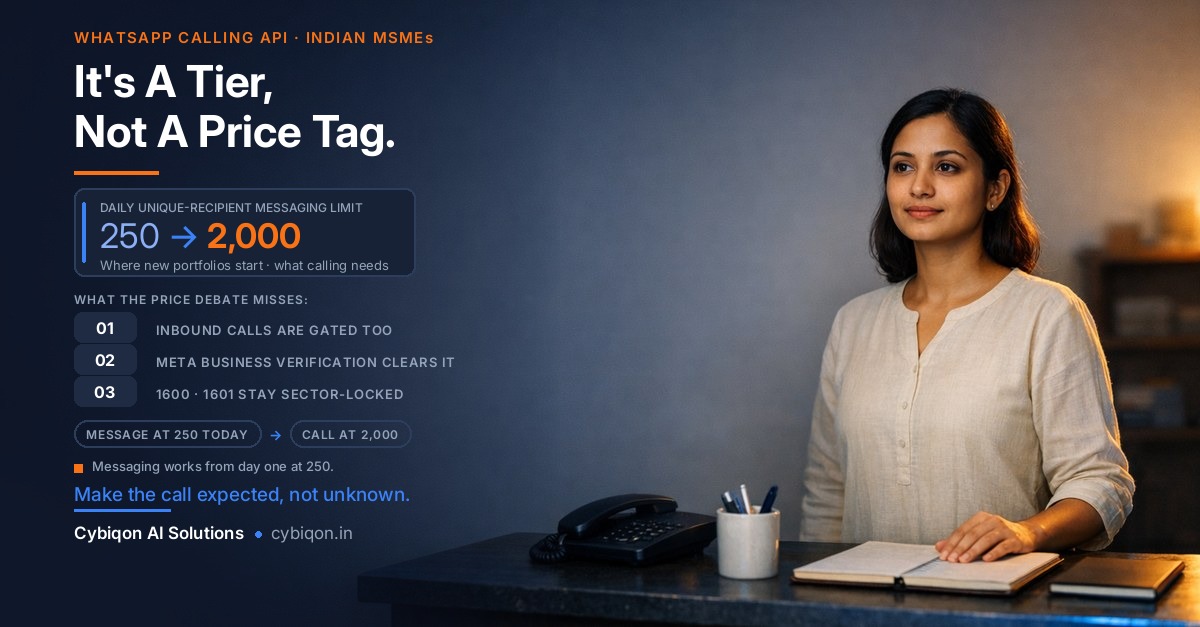
The gate nobody on page one mentions: 2,000 unique recipients per day
Here is the prerequisite. Straight from Meta's Step 1 prerequisites for calling:
To enable the WhatsApp Business Calling API, your phone number's daily messaging limit must be at least 2,000 unique recipients.
Read that twice, because three things follow from it.
First, it gates inbound too. This is not an outbound-only rule. Until you clear 2,000, customers cannot call you inside WhatsApp either. The only exceptions Meta lists are public test numbers and Sandbox accounts — neither of which you can run a business on.
Second, most businesses start nowhere near it. Meta's messaging-limit ladder runs 250 → 2,000 → 10,000 → 100,000 → unlimited, and Meta states plainly that "newly created business portfolios have a messaging limit of 250." If you set up your WhatsApp Business Platform account last month, you are at 250. You are one full rung below the calling gate.
Third — and this is the part that matters — the gate does not open with money. There is no plan you can buy. Per Meta's messaging-limits documentation, you move from 250 to 2,000 by:
- completing Meta Business Verification, or
- being verified through a Solution Partner, or
- delivering 2,000 template messages to unique recipients outside service windows within 30 days, while holding a high quality rating.
That first route is the realistic one for most MSMEs: it is a document check — legal entity name, registration, address, a utility bill or GST certificate that matches. Tedious, free, and entirely doable. But it is a compliance gate, not a budget gate, and it takes days to weeks, not minutes.
Two vendors on page one do touch eligibility and they contradict each other — one says a "1K tier," another says 2K. There is no 1,000 tier on Meta's ladder. If your provider quotes you one, they have not read the documentation.
WhatsApp Business Calling API requirements: the honest checklist
Before you spend a rupee, walk this list. Every item is from Meta's own docs.
- Are you on the WhatsApp Business Platform (Cloud API), not the free WhatsApp Business app? Calling API is a Cloud API feature. The green consumer app doesn't qualify. If you're not there yet, start with the WhatsApp Business API setup before you think about voice.
- Is your number's daily messaging limit at least 2,000 unique recipients? Check it in WhatsApp Manager. If it says 250, this is your blocker.
- Is your business Meta-verified? If not, this is the task — everything else waits behind it.
- Do you actually need outbound voice, or would inbound-only solve it? Inbound is free and ungated once you're over 2,000. Be honest about which problem you have.
- Can you handle the calls? Max 100 connected calls per 24 hours per number. That is a real ceiling if you're planning a calling campaign — and a calling campaign is the wrong use of this feature anyway.
- Do you have a warm thread with the person you want to call? Because of how permission works. Which brings us to the correction.
The "72-hour" call permission rule is wrong. Meta says 7 days.
Several well-ranked pages — Wati and respond.io among them — state that once a customer approves your call permission, "the call must happen within 72 hours."
Meta's user call permissions documentation says something different:
"Temporary permissions are granted for 7 calendar days (168 hours)."
And separately: "Permanent permissions do not expire."
That is a 2.3x difference in your operating window, and it changes how you'd design a callback flow. It is the cleanest example of what is wrong with the current search results for whatsapp business calling api india: the pages ranking are BSP marketing assets, and marketing assets copy each other. Check the primary source — we have linked every one of them at the bottom of this post.
How WhatsApp business call permission actually works
Meta is unambiguous on the core rule: "If you want to place a call to a WhatsApp user, your business must receive user permission first." There is no way around it for business-initiated calls.
The mechanics, all from Meta's documentation:
- You request permission via a call permission request message. Meta's own worked example builds it as a MARKETING-category template.
- "Call permission request messages are subject to per-messaging pricing." The request is a billable message — and in India, marketing is the most expensive category. Asking to call costs you money whether or not they say yes.
- You may send a maximum of 1 permission request in any 24 hours, and a maximum of 2 within 7 days. Any connected call resets those counters.
- Approved permission is either temporary (7 calendar days / 168 hours) or permanent, and permanent permissions do not expire.
- On production accounts, 2 consecutive unanswered calls trigger a system message asking the user to reconsider the permission. 4 consecutive unanswered calls result in "an approved permission being automatically revoked."
- Meta's changelog of 19 December 2025 raised business-initiated calls per user to 100 per day, up from 10.
That penalty structure is the whole design philosophy in one line: four missed calls and you lose the customer's permission entirely. This is not a dialer. It is a scarce, revocable privilege that you spend on people who are already engaged. Fire it at a cold list and the platform takes it away from you — the same underlying dynamic that gets an ordinary business number marked as spam, just enforced by Meta instead of by carriers.
WhatsApp calling API pricing in India: what's free, what's billed, what nobody can quote you
Start with the good news, quoted directly: "All user-initiated calls are free." Every call your customer places to you costs you nothing.
Outbound is billed. Per Meta's calling pricing documentation, the charge depends on:
- Call duration, calculated in six-second pulses. Meta's own example: "a 56-second call (9.33 pulses) would be counted as 10 pulses." Fractional pulses round up.
- The destination country code.
- Your monthly volume tier — using the same accrual model as messaging. When you cross a tier boundary mid-call, "the entire call is priced at the lower rate."
Now the part no vendor will write for you. We could not retrieve a public INR per-minute figure for India. Meta does maintain an INR rate card (effective 1 April 2026, updated 1 July 2026), but the actual table is a linked downloadable asset rather than a published page — and every per-minute number circulating on vendor blogs is inconsistent with the others and marked up on top of Meta's rate.
So the correct framing, and the one Cybiqon gives every client who asks: inbound is free; outbound is billed by Meta per six-second pulse at a rate that varies by destination and volume. Ask your provider for Meta's current INR rate card, and separately ask what their markup on top of it is. Two questions. A good BSP answers both without flinching.
And don't forget the hidden line item: every permission request is a marketing-category message you pay for. Budget for the asks, not just the calls.
While we're clearing the deck — you may have seen chatter about a "1 October 2026 WhatsApp pricing change." Two unrelated Meta changes share that date, and almost every article blurs them.
The one that does affect India. Meta's documentation states: "Effective October 1, 2026, Meta will charge on a per-message basis for service messages, consistent with how Meta charges for template messages." Service messages are your free-form replies inside the open 24-hour customer service window — free today, billable from that date. Meta also begins charging for utility templates sent inside that window. This is global and market-priced ("by market, rates for service messages are the same as the rates for utility and authentication messages"), so India is included. If you run support on the API, this changes your monthly bill. We cover what it means for an Indian MSME in our breakdown of the October pricing change and whether RCS is actually cheaper.
The one that does not. Separately, that same date moves Bangladesh, Iraq, Nepal, Sri Lanka, Kazakhstan, Kuwait, Morocco, Oman and Ukraine out of "Rest of" pricing regions onto standalone rate cards. India is on neither of those lists.
Neither one changes anything about calling. Call-permission requests are marketing-category templates, which are always charged regardless of any service window, so the October change does not touch them — and Meta's pricing-updates page does not mention calling at all. India's move from conversation-based to per-message pricing happened earlier, on 1 July 2025.
One caution on a figure doing the rounds: several vendor pages claim each business phone number will get 1,000 free service messages a month before billing starts. That allowance does not appear anywhere in Meta's documentation. Treat it as unverified vendor detail, not Meta policy, and do not budget on it.
WhatsApp calling vs the TRAI 1600 and 1601 series
Many MSMEs land here after being told to get a 1600 or 1601 number so their calls display as legitimate. Then they discover they aren't eligible. Here's the actual position from TRAI's primary text:
| Series | Purpose | Who can get it |
|---|---|---|
| 140 | Promotional / telemarketing calls | Open across sectors, for promotional calling |
| 1600xx | Service and transactional calls to existing customers | Entities regulated by RBI, SEBI, IRDAI and PFRDA, plus government-to-citizen services (TRAI Press Release No. 91/2026, 10 July 2026) |
| 1601xx | Service calls, Phase 1 rollout | Utilities (electricity, water, city gas, LPG) and logistics/courier, allotted directly to eligible entities and explicitly "not to intermediaries or aggregators" (TRAI direction, 10 August 2026; telcos given 90 days to verify and migrate) |
A coaching centre, a dental clinic, a salon, a D2C brand — genuinely ineligible for both 1600 and 1601. That's not a paperwork problem you can solve; it's a scope decision.
Which makes WhatsApp calling look like the escape hatch. It isn't, quite. WhatsApp calling is not a lower gate than TRAI's — it is a different gate, and it opens with Meta Business Verification rather than sectoral regulation or a per-minute budget. For a clinic in Nashik or a 400-student coaching centre in Indore, Meta's gate is genuinely clearable where TRAI's is not. That is the real difference, and it's worth knowing precisely.
Do TRAI DND and spam rules apply to WhatsApp calls?
Honestly: this is unsettled, and anyone who tells you otherwise is guessing.
As of September 2026, WhatsApp calls are not carried on a licensed telecom network, so the 140/1600/1601 number series and DND/TCCCPR scrubbing do not currently apply to them. Supporting that reading: TRAI's 18 September 2024 recommendations did not bring OTT communications under telecom authorisation; DoT has publicly rejected the "same service, same rules" argument; DoT's Principal Telecom Services Rules (notified 24 June 2026) and Telecommunication Network Rules (notified 20 July 2026) contain no OTT communications category; and the draft TCCCPR Third Amendment, out for consultation since 13 March 2026, remains scoped to access providers and registered telemarketers.
Cutting the other way: the Telecommunications Act 2023 defines "telecommunication" broadly — "transmission, emission or reception of any messages, by wire, radio, optical or other electromagnetic systems" — and serious commentators read that as arguably capturing OTT services. COAI continues to press for same-service-same-rules, and TRAI has separately pushed for OTT regulation on security and spam grounds.
Do not build a compliance strategy on the current gap. If your outbound volume is material, take proper legal advice before relying on this, and design as though consent-based rules will eventually apply. Practically speaking, Meta's own permission model already enforces something close to consent — so if you build it right, a future rule change costs you very little.
What we'd actually build for you
Take that coaching centre: around 400 students, admissions running off one mobile number, a counsellor calling parents back between 7 and 10pm, most calls unanswered. (An illustrative composite, not a named client.)
Adding WhatsApp calling as a dialer fixes nothing — four unanswered calls and permission is revoked. The sequence is what fixes it, and it is the sequence Cybiqon builds:
- Capture — the enquiry form on the website drops the lead straight into WhatsApp, not into a spreadsheet.
- Open the window — an automated reply within seconds opens WhatsApp's 24-hour service window, where messages are cheap and replies are free.
- Qualify in text — course, batch, budget, sorted before a human touches it.
- Escalate only when warm — the permission request fires for one specific interested parent, then the counsellor calls with the institute's name and logo on screen.
Voice is the escalation, not the opener. That's the whole idea, and it's the same principle underneath everything in our WhatsApp automation playbook for Indian MSMEs. If your problem is the landline nobody picks up rather than the WhatsApp thread, an AI voice agent on your PSTN line is a genuinely different tool for a genuinely different channel — don't blur the two.
FAQs
Is the WhatsApp Business Calling API available in India?
Yes, for both directions. Meta lists user-initiated calling as available everywhere Cloud API is available, and business-initiated calling everywhere except the US, Canada, Egypt, Vietnam and Nigeria. The "Mexico, Brazil, India, Indonesia only" line you'll see on older pages was the beta country set and is no longer accurate.
What are the requirements to enable WhatsApp calling?
The one that stops most businesses: your number's daily messaging limit must be at least 2,000 unique recipients. New business portfolios start at 250. You clear the gap through Meta Business Verification, partner verification, or by delivering 2,000 template messages to unique recipients outside service windows within 30 days at a high quality rating.
Is WhatsApp business calling free in India?
Inbound is: Meta states "all user-initiated calls are free." Outbound is billed in six-second pulses, varying by destination and monthly volume tier — and permission request messages are billed at standard per-message marketing rates on top. No trustworthy public INR per-minute figure exists, so ask your BSP for Meta's current INR rate card and for their markup separately.
How long does WhatsApp call permission last — 7 days or permanent?
Both exist. Temporary permissions last 7 calendar days (168 hours) — not 72 hours, despite what several ranking pages claim. Permanent permissions do not expire. You may send a maximum of one permission request per 24 hours and two within any 7 days.
What happens if a customer doesn't answer my WhatsApp calls?
On production accounts, 2 consecutive unanswered calls trigger a system message asking the user to reconsider the permission. 4 consecutive unanswered calls cause an approved permission to be automatically revoked. Persistence is punished — call people who are expecting you.
Do TRAI DND and spam rules apply to WhatsApp calls?
Currently WhatsApp calls aren't carried on a licensed telecom network, so 140/1600/1601 and DND scrubbing don't presently apply — but the position is contested under the Telecommunications Act 2023 and could change. Take legal advice before relying on it, and build consent into your flow regardless.
Want this built properly?
Cybiqon AI Solutions builds websites, apps and AI automation for Indian MSMEs — and this exact sequence is a big part of what we do. We wire the enquiry form on your site into WhatsApp, automate the first reply so the service window opens while the lead is hot, qualify in text, and trigger the call permission request only for the customers who are genuinely warm.
We'll also tell you honestly whether you qualify yet, and if you don't, what the fastest route to Meta Business Verification looks like for your entity. No jargon, no vendor markup you can't see.
Talk to us at cybiqon.in, call or WhatsApp +91 9250711473, or email [email protected]. A 15-minute conversation is usually enough to tell whether voice is your bottleneck or whether the messaging layer is.
The takeaway
The WhatsApp Business Calling API in India is live and works in both directions — but it opens with Meta Business Verification and a 2,000-unique-recipient daily messaging limit, not with a budget. Inbound is free. Outbound is billed per six-second pulse at a rate you must ask your provider for. Permission lasts 7 days or forever, never 72 hours, and four unanswered calls take it away. Check the gate before you shop for a vendor — and if you want the whole sequence built rather than just the switch flipped, Cybiqon is a call away.
Sources: Meta for Developers — Cloud API Calling, User call permissions, Calling API Pricing, Call permission request message template, Messaging Limits, Pricing Updates · WhatsApp for Business launch announcement · TRAI Press Release No. 91/2026 · SCC Online on the 1600/140 framework · Moneylife on the 1601 direction · Business Standard on the Truecaller–Tata Tele study
Want this set up for your business?
Book a free call — no tech jargon, no sales pressure. Just honest answers.
What we build for this: WhatsApp automation