Tracking FMCG secondary sales from distributor Excel and Tally exports
Secondary Sales Tracking Software: When a Template Is Enough
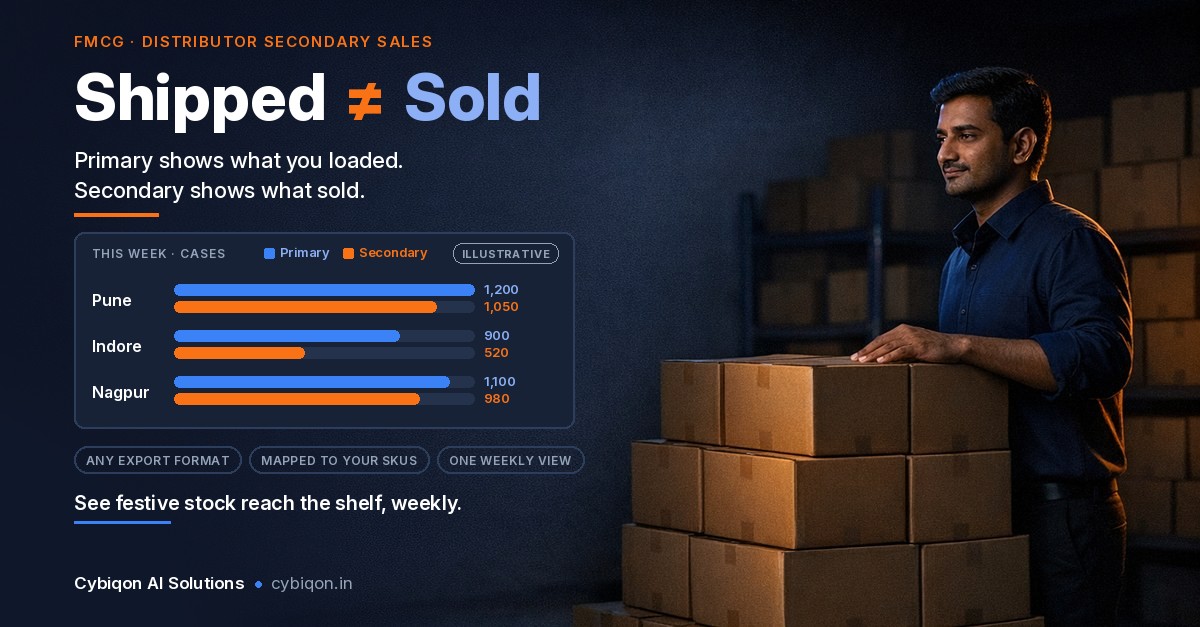
Between April and June 2026, traditional trade volume fell 6% year on year, according to NielsenIQ's FMCG snapshot. That is the kirana channel your distributors feed. Over the same quarter e-commerce grew 34.8% and modern trade 17.5%. If you sell a food, personal-care or household brand through 30 to 200 distributors, those numbers raise a question your invoices can't answer: is your stock actually reaching shops, or is it sitting in distributor godowns?
Answering it is the job of secondary sales tracking software. Most brands don't have it. What they get at month-end is forty differently formatted Excel sheets and Tally exports, which someone in the sales office spends a week stitching together.
This post explains primary, secondary and tertiary sales, and why a forced DMS rollout stalls with distributors working on 3.5–5% margins. It then covers four steps that cost nothing, when an agent that reads distributor exports is worth building, when a commercial DMS is the better answer, and who should own the data.
What is secondary sales in FMCG? Primary vs secondary vs tertiary
FMCG has three sales numbers, and only one of them is easy to get.
| Who sells to whom | Where the data lives | How easy to get | |
|---|---|---|---|
| Primary sales | Your company to the distributor | Your own invoices and ERP | Easy: you raised the bill |
| Secondary sales | Distributor to retailer (kirana, chemist, wholesaler) | The distributor's Tally or billing software | Hard: it's someone else's books |
| Tertiary sales | Retailer to consumer | The shop's counter, if anywhere | Very hard for general trade |
The gap between primary and secondary is stock that is "sold" in your books but not yet sold in the market.
Secondary sales in FMCG matter because general trade is still the largest channel. NIQ data reported by PTI puts traditional trade at about four-fifths of FMCG sales, with modern trade around 12% and e-commerce around 7%. India has more than 13 million kirana stores (FICCI-Deloitte, 2024). Nearly all of them buy from a distributor, not from you.
Dabur showed in public what happens when primary runs ahead of secondary for too long. In Q2 FY25 (July–September 2024) it took what it called a "strategic decision to correct distributor inventory in the GT channel", after modern trade, e-commerce and quick commerce had grown faster than general trade. India revenue fell about 8% that quarter and the shares dropped about 7.7% on the day of the update, according to Outlook Business. Primary growth went back to normal from October 2024. (Dabur isn't our client. It's simply a rare public example of a correction most brands make quietly.)
Why distributors resist a company DMS
The usual fix is a distributor management system (DMS), a billing and inventory tool the brand asks every distributor to run. Big companies have pushed this for years. With mid-sized brands the rollout often stalls, and the reasons are economic before they're technical.
The All India Consumer Products Distributors Federation (AICPDF) claims more than 4.5 lakh distributors across 25 states, working on margins of 3.5–5%. Its open letter of 8 June 2026, reported by Business Today, asked FMCG companies to end "forced stock push systems", "unrealistic inventory targets" and "unviable route frequencies". It also claimed that logistics, manpower and secondary transport eat up to ₹57 of every ₹100 a distributor earns. According to Outlook Business/PTI, the federation set a 30 July 2026 deadline and said it "may consider collective protest action during August 2026". As of 12 October 2026 there is no public report that the protest went ahead, and the stock-push complaint hasn't been publicly resolved.
Software has been a sore point for a while. In January 2024 AICPDF wrote to HUL objecting to charges of ₹4,000–10,000 a month for software that tracks distributor inventory, and to a cut in the fixed margin from 3.9% to 3.3% (Business Standard).
From the distributor's side, your DMS is one more login, one more set of item codes, maybe a monthly fee, alongside the Tally they already bill in. It also gives a principal a live view of their stock, which some read as a tool for pushing more of it. Unless a brand has the size of an HUL, the distributor can say no.
So secondary sales tracking for most brands has to begin with the data distributors already produce, not with software they don't want.
Can you track secondary sales without a DMS? Four steps that cost nothing
Yes. Before you buy or build anything, these four steps fix most of the mess, and none needs new software at the distributor's end.
1. One fixed template, kept small. Invoice date, retailer, item name or code, quantity, value. Five columns get filled in. Twenty get ignored.
2. A weekly cut-off day. On how often secondary sales should be reported: weekly is a realistic minimum. Monthly is too late to act on, because by the time you see that a pack isn't moving, the next month's primary has already been billed. Pick a day, say Tuesday for the week ending Sunday, and stick to it. (Illustrative. Choose whatever suits your team's calendar.)
3. A SKU master that is the only source of truth. One sheet: SKU code, product name, pack size, MRP, and every alias distributors use. "Atta 5kg", "ATTA-5", "Chakki Atta 5 Kg Pouch" all point to one code. This sheet will become the most valuable file in your sales office.
4. A primary-vs-secondary gap check per distributor. Every week, for each distributor and SKU: opening stock + primary received − secondary sold = closing stock. Divide closing stock by average daily secondary and you get days of stock.
On what a healthy primary-secondary gap looks like: there's no universal number. It depends on your shelf life, how often you replenish and how far the distributor is from your depot. Set your own norm per category. Then flag any distributor whose days of stock is rising week after week while secondary stays flat. That's how you find stock stuck at a distributor before it turns into an expiry claim or a Dabur-style correction.
If all this lives in one workbook a single person guards, check the signs your business has outgrown Excel. Secondary sales is often where it shows first.
How to get secondary sales from distributors who use Tally
Most distributors bill in Tally, and Tally can export a sales register or stock summary to Excel in a few clicks. Asking for that export is far easier than asking someone to retype data into your template.
The catch is that every distributor's export looks different:
- Column names vary. "Particulars", "Item", "Stock Item", "Product Name".
- Item names are theirs, not yours. They named the stock item when they first bought it, and maybe misspelt it.
- Units differ. Cases in one file, pieces in another, kg in a third.
- Other brands are mixed in. A multi-brand distributor's export holds every principal's lines, not only yours.
- Schemes distort quantities. Free goods and trade-scheme quantities appear as separate lines or zero-value rows. If you run schemes, how they're booked matters. Our explainer on what a trade scheme is covers how they work at the distributor's end.
Collecting the files isn't the hard part. Making forty of them agree is. A coordinator with VLOOKUPs can do it for 30 distributors in a long day each week. At 150 it's someone's whole job, and the result is still late.
Order booking is the other half of this. See salesman order booking apps that sync with Tally for orders going in rather than reports coming out.
How do you map distributor item names to SKU codes?
This is the core of any secondary sales tracking software. A sensible order is three passes:
- Exact match. Check the distributor's item name or code against the aliases in your SKU master. Once the master has matured, most lines should match here.
- Fuzzy match. For lines that don't match, compare after normalising: lower case, strip spaces and punctuation, standardise "kg/kgs/KG", read pack sizes from the text. Score the closest candidates. Accept a high score automatically, and send a middling one to the next step.
- Human review queue. Anything uncertain goes to one person as a short list: "Distributor X wrote 'Haldi Pwdr 200'. Is it SKU HP-200 or HP-200-JAR?" One click confirms it, and that answer is saved as a new alias, so the same line never comes back.
The third pass is the one that matters. Mapping that guesses silently corrupts your numbers. Mapping that asks, and then remembers the answer, gets more accurate every week. Say a brand has 120 SKUs and 60 distributors (illustrative figures). The review queue might be long in week one and nearly empty by week six, because every confirmation teaches the master a new alias.
When is it worth building an agent instead of using a template?
A template plus the SKU master plus a careful coordinator is enough when:
- you have fewer than about 25–30 distributors and a short SKU list
- most distributors actually fill in your template on time
- monthly visibility is acceptable for the decisions you make
It's worth building an agent when:
- distributors won't use your template, but will send a Tally export or forward a file on WhatsApp or email
- you have dozens of distributors and a SKU list that changes with launches and festive packs
- you need a weekly view that is ready by Monday, not compiled by the 10th of next month
The agent does the coordinator's mechanical work. It takes each distributor's file as it arrives, works out which columns mean what, drops other brands, converts units, runs the exact → fuzzy → review mapping, and fills one weekly secondary sales view: secondary sold, primary received and days of stock by distributor, SKU and town, plus who hasn't sent a file. It flags, and a person confirms. That's the same pattern we describe for an AI agent for order processing, applied to reports instead of orders.
Diwali falls on Sunday 8 November 2026 (festival 6–10 November), and festive loading is when primary jumps ahead of secondary. A weekly view then shows which distributors sold the festive stock and which are holding it into December.
When a commercial DMS is the right answer
Be honest about this. A commercial DMS is the better choice when:
- your distributors are already willing to use one, either because they're exclusive to you or because the DMS also runs their billing
- you need scheme claims, retailer-level billing and beat plans in one system, not only reporting
- you have the field force and distributor-relations budget to run a rollout and keep it running
Vendors such as BeatRoute, MAssist, FieldAssist and Bizom cover features well. A DMS works best when the distributor sees value in it. If yours do, use one. If they don't, reading their existing exports gets you visibility without changing how they bill. Many brands will end up doing both: a DMS for a few large, exclusive distributors, and export-reading for the multi-brand long tail.
Who owns the data and the code?
Your secondary sales history records how your brand moves through every town you sell in. It should live in a database you control and can export, not only in a vendor dashboard you lose if you stop paying. Cybiqon hands over the code and the database for anything it builds, and that's the standard to ask any vendor for.
Before you choose secondary sales tracking software, ask:
- Can I export the full history, raw and mapped, at any time?
- Who owns the SKU alias master that took months to build?
- If I leave, do I keep the code that does the mapping, or only a CSV?
- What do distributors see, and what stays private?
Telling distributors plainly that their export is for visibility and planning, not for pushing stock, is part of getting the files in at all.
FAQs
What is secondary sales in FMCG?
Secondary sales are what your distributor sells on to retailers such as kiranas, chemists and wholesalers. Primary sales are what you sell to the distributor. Secondary sales show actual market movement. Primary sales only show what you shipped.
How do I get secondary sales data from distributors?
Ask for the export they already have, usually a Tally sales register, on a fixed weekly cut-off day. Keep any template to five or six columns. Map their item names to your SKU codes centrally, so you don't depend on them to use your codes.
Can I track secondary sales without a DMS?
Yes. A fixed template, a weekly cut-off, a SKU master with aliases and a per-distributor gap check give you most of the visibility. An agent that reads distributor exports automates the rest without changing their billing software.
How do I know if stock is stuck at the distributor?
Track days of stock per distributor and SKU each week (closing stock divided by average daily secondary). If it keeps rising while secondary stays flat, stock is building up. Compare against your own category norm.
How do I map distributor item names to SKU codes?
Use three passes: exact match against a SKU master of known aliases, then fuzzy match on normalised names and pack sizes, then a human review queue for anything uncertain. Save each confirmed answer as a new alias so the same line doesn't need review again.
Want to see your distributor exports in one view?
If your secondary sales arrive as a pile of distributor sheets every month, the useful thing to build is usually narrow. An agent that reads each distributor's Tally export or Excel as it comes, maps their item names to your SKU codes, sends the uncertain ones to one person for review, and fills a single weekly secondary sales view by distributor, SKU and town.
Cybiqon writes this for your distributors, SKU list and review rules. It isn't configured from a template, and you own the code and the data. Our AI agents and automation work starts at ₹19,999, scoped on the first call.
Easiest first step: email [email protected] with one sample distributor export and your SKU list, and we'll show how it maps into one weekly secondary-sales view. Or book a 30-minute call, or ring +91 9250711473.
Conclusion
With traditional trade volume down 6% in April–June 2026, you need to know whether stock is selling through or piling up at distributors. Good secondary sales tracking software doesn't have to start with a DMS your distributors resent. Start with a template, a weekly cut-off, a SKU master and a gap check. Add an agent that reads distributor exports once a coordinator can't keep up. Use a DMS where distributors want one. Either way, keep the data and the mapping yourself, and send Cybiqon a sample export to see it mapped.
Want this set up for your business?
Book a free call — no tech jargon, no sales pressure. Just honest answers.
What we build for this: Admin panels & internal tools