Supplier not filed GSTR-1: 16(2)(aa) vs 16(2)(c)/Rule 37A, late-GSTR-1 timing against the 30 Nov 2026 16(4) cutoff, portal filing-status check, IMS pending, the 180-day hold-back trap, SC Bhandari Scrap Traders, and a 2B reconciliation routine for 50-300 suppliers
Supplier Not Filed GSTR-1? Protect Your ITC, Invoice by Invoice
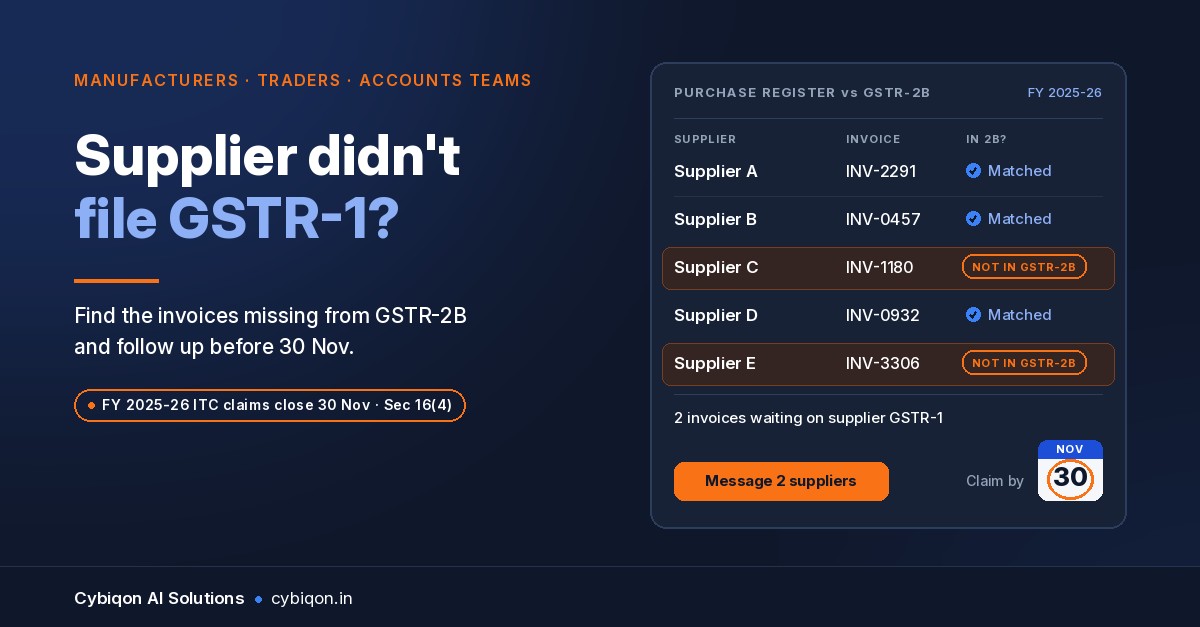
It is 11 November, the GSTR-1 due date for October, and somewhere in your purchase register sit bills your suppliers have not reported yet. If a supplier has not filed GSTR-1, the invoice never reaches your GSTR-2B, and since 1 January 2022 an invoice that is not in 2B is an invoice you cannot claim. You cannot add the bill to 2B yourself. You can only notice early, chase and pay carefully.
This year the timing is tight. 30 November 2026 is the last date to claim any FY2025-26 input tax credit under Section 16(4). For a monthly filer, that makes the October GSTR-3B, due 20 November, the last return that can carry it. A supplier who files one day late does not delay your credit by a month. For last year's bills, the credit is gone.
Below: the two rules that block ITC, the late-filing calendar, how to check a supplier, what IMS can and cannot do, the 180-day trap, what the courts protect, and a routine for 50 to 300 suppliers.
This is not tax advice; confirm every decision with your CA.
Supplier not filed GSTR-1: the two rules that can block your ITC
Rule one: the invoice must be in your GSTR-2B (Section 16(2)(aa)). It has been in force since 1 January 2022 (Finance Act 2021, Notification 39/2021-CT). Rule 36(4) was substituted at the same time (Notification 40/2021-CT, 29 December 2021), so the provisional credit you used to get for missing invoices, cut from 20% to 10% to 5%, is now zero. No GSTR-1 means no 2B line, and no 2B line means no credit.
Rule two: the supplier must actually pay the tax (Section 16(2)(c)). A supplier can report your invoice in GSTR-1, so it appears in your 2B, and still never file GSTR-3B or pay the GST. Rule 37A (Notification 26/2022-CT, effective 1 October 2022) puts a date on this. If the supplier hasn't filed GSTR-3B for that period by 30 September of the next financial year, you reverse the credit by 30 November, with interest if you are late. You re-claim it when the supplier files. For FY2025-26 that means the trigger date was 30 September 2026 and the reversal is due by 30 November 2026.
| Missing from 2B | In 2B, tax unpaid | |
|---|---|---|
| Section | 16(2)(aa) | 16(2)(c), Rule 37A |
| What you see | Bill in books, not in 2B | Bill in 2B, supplier's 3B not filed |
| What you do | Don't claim it. Chase the GSTR-1 | Reverse by 30 Nov, re-claim when the supplier files |
| Can you recover it later? | Only if the supplier files before your 16(4) cutoff | Yes, once the supplier pays |
Why is my purchase invoice not showing in GSTR-2B?
When ITC is not reflecting in GSTR-2B, non-filing is the usual reason, not the only one. Sort each missing bill first:
- Not filed at all. The supplier hasn't filed GSTR-1 or IFF for that period.
- Filed late. They filed after the cutoff, so the invoice went into next month's 2B. It isn't lost, but it isn't in this one.
- Wrong GSTIN. Your invoice was reported against another GSTIN, often your other branch or a typo.
- Reported as B2C. The sale went into the B2C tables, so it never reaches any buyer's 2B.
- Wrong invoice number, date or value. It is in 2B, but your VLOOKUP can't match "INV/245" with "245".
- Amended. A corrected invoice appears in the 2B of the month the amendment was filed.
GSTR-2B is a static statement, generated on the 14th. An invoice not shown in GSTR-2B cannot be pushed into it by you. Only the supplier's filing or amendment moves it.
Each category needs a different request: "please file" is wrong for a supplier who used the wrong GSTIN; "please amend invoice 245 to our GSTIN" is right. For the wider matching problem, see GST reconciliation software and the 2B match. One correction to that post: 16(2)(aa) has applied since 2022, not from 2026.
If the supplier files GSTR-1 late, in which month will you get the ITC?
The invoice lands in the 2B of the month it was filed, not the month on the invoice. The windows are:
- Monthly GSTR-1 filers: anything filed from the 12th of one month to the 11th of the next goes into that period's 2B, generated on the 14th.
- QRMP suppliers (IFF or quarterly GSTR-1): the window runs from the 14th to the 13th.
Here is how that plays out this month, for a monthly-filing supplier and an FY2025-26 invoice:
| Supplier files GSTR-1 | Lands in | Your GSTR-3B | FY2025-26 credit |
|---|---|---|---|
| By 11 Nov 2026 | October 2B (14 Nov) | October 3B, due 20 Nov | Claimable |
| 12 Nov 2026 or later | November 2B (14 Dec) | November 3B, filed in December | Lost: past the 30 Nov 16(4) cutoff |
Section 16(4) cuts the credit off on 30 November after the year ends, or on the date you file your annual return, whichever comes first. Finance Act 2022 set that date, effective 1 October 2022. File GSTR-9 early and your cutoff moves earlier too. QRMP buyers had their last chance in the July to September 2026 GSTR-3B. We have found no extension for FY2025-26.
Last-minute filing makes this worse. A study by BUSY of its own users (April 2024 to June 2026) found that 52.4% of GSTR-1 filings made in days 1 to 13 happen on the 9th, 10th or 11th, and 21.6% on the 11th alone. That is one vendor's data, not a national figure, but a supplier who files on the 11th is one bad day from costing you a month (in November, a year).
Supplier not filed GSTR-1 or GSTR-3B? How to check supplier GST return filing status
You don't need a login to check a supplier's GST return filing status. The portal flow, which we describe in general terms because the screens change:
- Go to gst.gov.in, then Search Taxpayer, then Search by GSTIN/UIN.
- Enter the supplier's GSTIN and the CAPTCHA.
- Click Show Filing Table, pick the financial year and search.
- You'll see GSTR-1/IFF and GSTR-3B by period, with the filing dates.
Read both columns: GSTR-1 filed but GSTR-3B missing is the Rule 37A case. An "Active" status does not mean the supplier is filing.
The limit: one GSTIN and one CAPTCHA at a time. Fine for five suppliers; for 150 it gets skipped. It shouldn't be. In a written reply to the Rajya Sabha on 28 July 2026, the Minister of State for Finance said CGST officers detected 30,162 fake-ITC cases worth about ₹74,782 crore in FY2025-26, with 358 arrests. Of the FY26 total, about ₹9,940 crore was linked to 1,517 registrations made with forged PAN or Aadhaar. A supplier that never files is sometimes just disorganised, and sometimes a registration you should not be buying from.
IMS pending invoices, GSTR-3B and DRC-01C: what you can and cannot do
The Invoice Management System (IMS), live since 14 October 2024, shows every invoice your suppliers report. Four options:
- Accept: goes to "ITC Available" in 2B and auto-fills 3B.
- Reject: goes to "ITC Rejected" and stays out of 3B.
- Pending: stays out of this month's 2B and carries forward. Once the 16(4) limit passes, it is removed.
- No action: treated as accepted when 2B is generated.
Use Pending for an invoice you aren't ready to accept: wrong rate, goods not received, value disputed. Credit notes can be kept pending for one period only (October 2025 advisory). Advisory No. 658 (21 April 2026) added an Excel offline tool.
The limit: IMS only shows what suppliers have uploaded. It does nothing for a supplier who has not filed GSTR-1, because that invoice never arrives. Also, IMS has not become "mandatory with hard blocks from April 2026".
In GSTR-3B, only the outward-liability tables (3.1 and 3.2) are locked, from the July 2025 period. The ITC table is still editable. But if you claim more than 2B shows, Rule 88D (Notification 38/2023-CT) triggers a DRC-01C intimation. You then either pay the excess through DRC-03 or explain it, or face proceedings under Sections 73/74. So typing in a missing invoice by hand is not a workaround.
What may change next: a CBIC public consultation (1 to 30 November 2026) has a draft rule 61(1B). It would require GSTR-3B ITC to equal GSTR-2B as shaped through IMS, from the April 2027 return period. It is a proposal, not law.
Can you hold GST from a supplier's payment? The 180-day trap
The most effective leverage is commercial: hold the GST until the invoice shows in GSTR-2B. Pay the taxable value on time, and release the GST once the bill appears. Put it in your purchase order terms so it isn't a surprise.
There is a trap. The second proviso to Section 16(2) and Rule 37 say that if you haven't paid the value plus tax within 180 days of the invoice date, you reverse the ITC with interest under Section 50. You re-claim it when you pay, and 16(4) does not apply to that re-claim (Rule 37(4)). When exactly interest starts is unsettled, so ask your CA. The rule of thumb is: release every GST hold before day 180, whether or not the supplier has filed by then.
If the supplier is a micro or small enterprise registered on Udyam, the MSMED Act payment limits and Section 43B(h) also apply; check them alongside your vendor payment terms and accounts payable automation.
Most missing invoices are found after the supplier is paid in full, when you have no leverage left. The check has to run before payment.
What the courts still protect in 2026
- Section 16(2)(c) is settled against the buyer. On 24 July 2026 the Supreme Court, in Bhandari Scrap Traders v Union of India (SLP(C) 23931/2026), dismissed the petitions and affirmed the Gujarat High Court's Maruti Enterprise ruling. That ruling upheld 16(2)(c) without reading it down. It relied on re-claiming when the supplier pays (Section 41) and recovery from the supplier (Sections 73/74).
- Section 16(2)(aa) offers some protection, depending on the state. In McLeod Russel (9 December 2025), the Gauhati High Court upheld the section but read it down: a buyer must get a chance to prove good faith before credit is denied for a supplier's default. The Allahabad High Court is split, with R.T. Infotech and Kesarwani for the buyer and Trendships and Safecon against. Most pro-buyer rulings concern periods before 2022.
The 57th GST Council (8 October 2026) recommended a Committee of Officers to examine ITC protection for good-faith buyers under 16(2)(c). No timeline has been announced. Plan on the law as it stands: the buyer bears the risk.
A GSTR-2B vs purchase register reconciliation that scales to 300 suppliers
Say a Rajkot pump manufacturer or a Delhi electrical trader buys from about 150 suppliers. This is an illustration, not a client. After the 14th, the accountant VLOOKUPs 2B against the Tally purchase register, dozens of bills come back "in books, not in 2B", and follow-up is phone calls to suppliers already paid in full.
A GSTR-2B vs purchase register reconciliation that holds up at that size looks like this:
- Match on cleaned keys. Normalise GSTIN, invoice number and date before matching, so "INV/245" and "245" pair up. Sort every unmatched bill into the six categories above.
- Tag before you pay. Mark unmatched bills "hold, do not claim" in payables. Release the GST when the bill appears, or on day 179 regardless.
- Send one message per supplier. List exactly which invoices are missing and what to fix: file, amend the GSTIN, move it from B2C to B2B.
- Check filing status in bulk for every supplier with an open bill, and flag GSTR-1-without-3B for Rule 37A.
- Claim in the month the bill appears in 2B, and keep a dated log of every chase for any good-faith argument later.
- Set a year-end sweep for October. Chase FY gaps before the 11th, so the October 3B can carry them.
Chasing a supplier for a GSTR-1 uses the same muscle as recovering delayed payments: written, specific, dated and repeated.
When it isn't worth automating: if you buy from fewer than about 30 suppliers, or your CA firm already does a monthly 2B reconciliation and follows up with suppliers, a spreadsheet and a calendar reminder are enough.
FAQs
Can I claim ITC if my supplier has not filed GSTR-1?
No. Since 1 January 2022, Section 16(2)(aa) allows credit only for invoices in your GSTR-2B, with no provisional credit. Claim it in the month it appears, if that is before your Section 16(4) cutoff.
If the supplier files GSTR-1 late, in which month will I get the ITC?
In the month it lands in 2B: filings from the 12th to the 11th (14th to 13th for QRMP) feed the 2B generated on the 14th. An FY2025-26 invoice filed after 11 November 2026 misses the October 3B and the 30 November cutoff.
What is the last date to claim ITC for FY 2025-26?
30 November 2026, or the date you file your FY2025-26 annual return if that is earlier. For monthly filers the practical last return is the October 2026 GSTR-3B, due 20 November 2026.
Do I have to reverse ITC if my supplier didn't pay the GST?
Yes, under Section 16(2)(c) and Rule 37A. If the supplier reported the invoice but hadn't filed GSTR-3B by 30 September of the next financial year, reverse the credit by 30 November and re-claim it when the supplier files. The Supreme Court left this rule intact on 24 July 2026.
What Cybiqon would build for your purchase team
If you buy from 50 to 300 suppliers, Cybiqon would build you an agent that matches every purchase bill to GSTR-2B and IMS each month. It reads the Tally or Excel purchase register you already keep. Unmatched bills are marked "hold" in payables, with a reminder to release them before day 180. Each non-filing supplier gets one WhatsApp message listing exactly which invoices are missing and what to fix. Your team works a short exception list, and a person approves anything that moves money.
It is written for your purchase process, not configured from a template. The founders build it, and you own the code. Our AI agents and automation work starts at ₹19,999 and is scoped on the first call. Book a 30-minute call, call +91 9250711473 or write to [email protected].
Conclusion
When a supplier has not filed GSTR-1, the credit isn't yours until the invoice reaches 2B. If the supplier doesn't pay its tax, even a 2B line can be reversed. Know the 11th-to-14th calendar, check filing status before you pay, release GST holds before day 180, and chase FY2025-26 gaps before the October GSTR-3B. The 30 November 2026 cutoff turns delayed credit into lost credit. If the monthly match has outgrown your spreadsheet, Cybiqon can build the agent that runs it.
This is not tax advice; confirm with your CA.
Want this set up for your business?
Book a free call — no tech jargon, no sales pressure. Just honest answers.
What we build for this: Admin panels & internal tools