Recovering a banned WhatsApp Business number in India, and rebuilding the lead channel on owned ground
WhatsApp Business Number Banned? How to Recover in India
WhatsApp Business Number Banned? How to Recover in India
If your WhatsApp Business number is banned, you don't need a ten-point prevention listicle right now. Your order book is offline and every hour costs money. So here is the emergency answer first, and the structural fix second.
Do this in the next 30 minutes:
- Open the app and look for a "Request a review" button. If your ban is on the free WhatsApp Business app, that button is the appeal. Tap it, write 3-4 factual sentences about what your business does and who you message, and submit. If the button is not there, WhatsApp treats the decision as final.
- If you are on the WhatsApp Business API (WABA), do NOT use the app route. Go to Business Support Home → Account Quality, select the violation, and click Request Review. Decisions typically come back in 24-48 hours, marked Unchanged or Reversed.
- Stop all outbound messaging from every other number in your business portfolio. Messaging limits and enforcement are shared at portfolio level, so a second number is not a spare tyre.
- Do not buy an "unban service." Every route Meta publishes is free. There is no paid channel in any documented Meta process.
That is the triage. Now the part nobody in the search results will tell you: for most Indian MSMEs, the appeal is not what brings the revenue back.
Why did WhatsApp ban my business number when I did nothing wrong?
Two reasons, and only one of them involves you doing something.
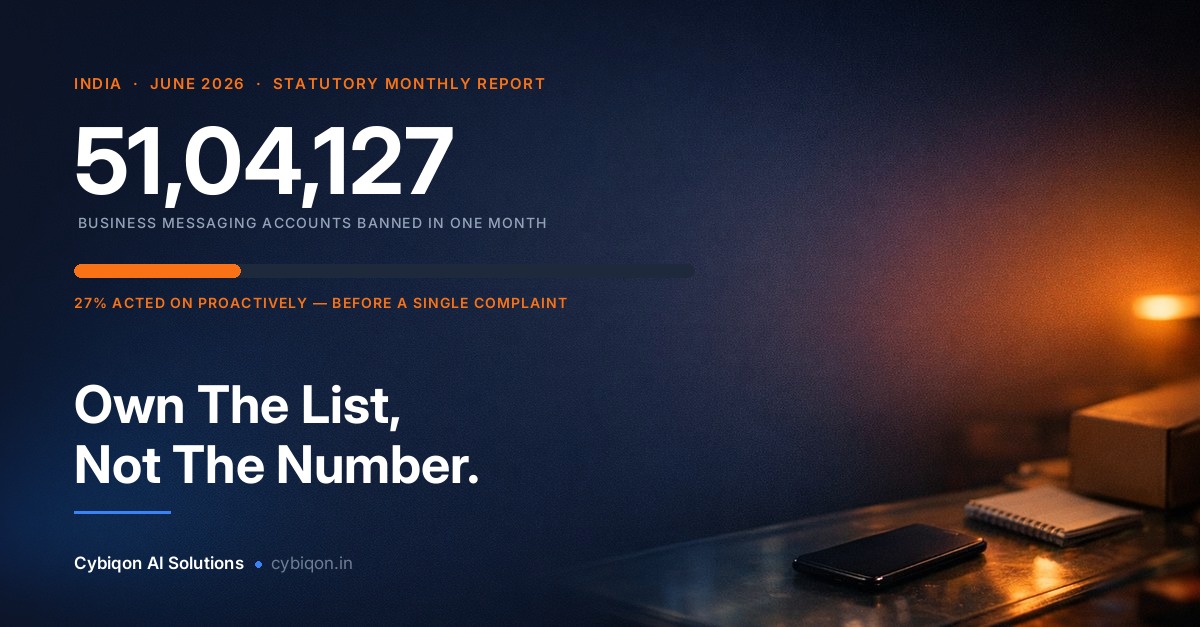
In June 2026, WhatsApp banned 51,04,127 Indian accounts — of which 13,69,080 (26.8%) were banned proactively, before a single user complaint was filed. That's from WhatsApp's Monthly India Report, a statutory publication under IT Rules 2021 (Rule 4(1)(d) and Rule 3A(7)). In May 2026 the number was 72,14,702; in April, 54,70,958.
Two things stand out. Total volume swings roughly 40% month to month, so "my number was fine last month" proves nothing. But the proactive slice stays steady at 13-14 lakh a month — the automated layer never sleeps. It doesn't wait for a complaint, and it doesn't know your shop.
The most common trigger for a WhatsApp Business account banned in India is messaging people who never opted in — a purchased list, a broadcast to numbers that haven't saved you, a forwarded rate card at scale. To the classifier, a genuine Diwali price list sent to 400 non-consenting retailers looks identical to spam. Because it technically is.
The second reason has nothing to do with Meta at all. We'll get to that.
Temporarily banned, restricted, or permanently banned — which one do you have?
These three words describe completely different situations, and conflating them wastes days.
| What you see | What it usually means | Realistic outcome |
|---|---|---|
| "You are temporarily banned" | You are on a modded app — GB WhatsApp, WhatsApp Plus or similar | The most recoverable ban there is. Back up chats, uninstall, install official WhatsApp Business from the Play Store or App Store, and the block usually lifts |
| "Restricted" / template block (WABA) | Meta's graduated enforcement ladder has started | Time-boxed. 1 or 3 days on marketing, utility or authentication templates, escalating to 5, 7 or 30 days on all messages |
| Account lock (WABA) | Indefinite hold | Removable only by appeal through Account Quality |
| "This account is not allowed to use WhatsApp" | Permanent disablement | Appeal via in-app review if the button exists. Meta states plainly that "not all spam violations might be appealed" |
WhatsApp's own words on modded apps: "Unsupported apps, such as WhatsApp Plus and GB WhatsApp, are altered versions of WhatsApp. These unofficial apps are developed by third parties and violate our Terms of Service." So if you're asking whether GB WhatsApp ban is permanent — usually no, if it's the temporary variety. Switch to the official app and stay there.
How to appeal: the app route and the WABA route are two different systems
This is where most advice online goes wrong. Ranking guides hand app instructions to API users and API instructions to app users, which is why so many appeals get filed into a system that was never going to read them.
| Free WhatsApp Business app | WhatsApp Business API / WABA | |
|---|---|---|
| Where to appeal | In-app "Request a review" | Business Support Home → Account Quality → select violation → Request Review |
| Fallback | [email protected] |
Business Manager notifications |
| Business Manager involved? | No | Yes — alerts go by webhook, email and Notifications Center to all admins |
| Typical decision time | Not published | 24-48 hours, marked Unchanged or Reversed |
| Warning before the ban | None | Yes — quality rating and the enforcement ladder |
If you searched WhatsApp Business number ban kaise hataye, the honest answer is: file in the correct system once, write plainly, and don't spam the appeal. Repeat submissions do not improve your odds, and there is no published limit that rewards persistence.
One first-party detail worth knowing: a banned number cannot simply be onboarded to the API as an escape hatch. It has to be unbanned first. Buying an API subscription today does not resurrect yesterday's number.
India's second ban route: the one nobody covers
Your WhatsApp account is exposed to two independent enforcement authorities — Meta's, and the Government of India's.
The Department of Telecommunications runs the Digital Intelligence Platform, connecting 620 institutions including 570 banks and 36 state police forces, which feeds suspected-fraud numbers to WhatsApp. Speaking in the Lok Sabha on 30 July 2025, Union Minister of Communications Jyotiraditya Scindia said roughly 24 lakh WhatsApp accounts had been "disengaged" on Indian government input, alongside 5.5 lakh handsets blocked and 20,000 bulk SMS senders deactivated (PIB Press Release PRID 2150206). The DoT-WhatsApp partnership is formal and publicly announced, and runs through Sanchar Saathi.
What this means for a shop owner in practice: if an annoyed customer reports your number on Sanchar Saathi or the 1930 cyber-fraud helpline, or if you bought a recycled SIM that carries someone else's history, you can lose the number by a route that has nothing to do with Meta's spam classifier — and nothing to do with whether you're on the official API.
No BSP sales page mentions this, because there is no product to sell against it.
Does the India Grievance Officer route actually work?
Several popular guides recommend emailing WhatsApp's India Grievance Officer as the fix. Be careful here, because the numbers are unkind.
In June 2026, only 92 of 7,873 ban-appeal grievances were actioned — about 1.2%. Across all grievance categories, 414 of 15,182 (2.7%) were actioned. This is the statutory escalation channel mandated by the IT Rules, and it is not the same thing as the in-app "Request a review."
So: file the grievance if you want the record, but understand that the in-app review and Account Quality review are what actually adjudicate a ban. Planning your week around the WhatsApp Business ban appeal grievance officer India route is planning around a 1-in-80 outcome.
Three myths that will cost you a week
"5-10 spam reports triggers a permanent ban." No Meta or WhatsApp source states any report threshold. Meta deliberately doesn't publish one. What it does expose is a three-level quality rating — high, medium, low — with block-reason insights in WhatsApp Manager, computed from customer feedback over a rolling recent window. Every specific number circulating online traces back to vendor blogs describing their own "community-tested estimates." The honest answer to how many reports does it take is: nobody outside Meta knows.
"Detection happens within 6 hours." There is no first-party source for any detection latency. The "6 hours" figure is Meta's messaging-limit upgrade cadence — limits scale up within 6 hours when quality is high and you used at least 50% of your current limit in the prior 7 days. That's an upgrade speed, not a detection speed. The claim mutated in transit.
"Guaranteed unban, ₹X,000." Every documented Meta route — in-app review, [email protected], Business Support Home — is free. There is no paid channel in any published Meta process, which means anyone selling guaranteed access is selling access that does not exist. Meta has publicly flagged fake recovery services as a scam pattern.
If I move to the official API, can I still get banned?
Yes. And this is the single most important thing to understand before you sign a BSP contract while panicking.
Almost every page ranking for this topic is published by a BSP or CRM vendor, and they all converge on the same conclusion: here are 7 ban reasons, here's how to appeal, now buy the official API from us. Meta's own enforcement documentation quietly refutes the premise.
The API does not reduce the risk of the behaviour. It changes the consequences of it. What you actually get:
- Advance warning instead of a silent cliff
- A visible quality rating you can watch
- A graduated ladder — template blocks before message blocks before account lock
- A documented 24-48 hour appeal with a real decision
That's due process and visibility. It is not immunity. If you keep sending unsolicited bulk messages on the API, you simply get a better view of yourself being banned. The genuine WhatsApp Business API ban risk is unchanged; only your ability to see it coming improves. If you're weighing the upgrade properly rather than in a crisis, our breakdown of when the free app stops being enough and the API starts making sense walks through the decision without a subscription to sell you.
Can my messaging limit go down?
Messaging limits in 2026 run 250 → 2,000 → 10,000 → 100,000 → unlimited, and they're set at Business Portfolio level, shared across every phone number in the portfolio. That's the hidden blast radius: one reckless number can consume — and one ban-evasion attempt can contaminate — every other number your business runs.
Worth flagging honestly: Meta's live documentation contains no mechanism for quality to automatically downgrade a tier, and no "Flagged" status. Quality gates upgrades. Many vendor blogs still describe an older "flagged for 7 days = drop one tier" rule. We're not going to assert either version as settled — but if a vendor quotes the old rule to you as current, that tells you how recently they read the docs. (Similarly, the claim that verified businesses get a 100,000/day baseline isn't supported: 100,000 is reached by automatic scaling, and business verification is one of three paths to the 2,000 tier only.)
Two dated changes hitting Indian WhatsApp Business users this quarter
1 October 2026 — service messages stop being free. Since 1 November 2024, service messages and in-window utility messages have cost nothing. From 1 October 2026 they're charged at utility/authentication market rates: ₹0.1150 in India. If your support desk runs on free-window replies, your WhatsApp bill is about to appear from nowhere.
For context, India template pricing effective 1 July 2026 is Marketing ₹0.8631, Utility ₹0.1150, Authentication ₹0.1150, plus 18% GST, plus your BSP's platform fee. If a proposal quotes you ₹0.78, that's the superseded pre-July rate — Meta raised India marketing templates by roughly 10%. We keep the current rate card in our comparison of RCS and WhatsApp business messaging costs, which also covers the October service-window change in detail. Separately, India billing localisation began 1 January 2026 and eligible WABAs must migrate to INR billing by 31 December 2026 — a lapsed billing setup stops messages going out and looks exactly like a ban.
SIM-binding. Under a DoT directive of 28 November 2025 issued under the Telecom Cyber Security Rules, WhatsApp must stop working if the registered SIM is removed or deactivated, with web and desktop re-verification every six hours. The deadline has slipped from 28 February and 30 March 2026 and now stands at 31 December 2026.
This breaks a setup that is everywhere in Indian MSMEs: the business number's SIM sitting in a drawer, in an old handset, or in the accountant's phone while three staff run the account on WhatsApp Web. That is not a ban. It will look and feel exactly like one — and the fix is the same fix.
The real fix: the number was never the asset
Here's the pattern we see repeatedly. A Surat textile wholesaler runs the entire business on one WhatsApp Business number — 4,000+ customer chats, price lists as broadcast lists, order confirmations, payment screenshots, a catalogue of running fabric lots. Before Diwali, staff import a purchased list of retailer numbers and forward the new rate card to several hundred people who never opted in, most of whom never saved the number. Within days: permanently banned.
That number is on the shop signage, the visiting cards, the Google Business Profile, the packaging tape and eight years of invoices. No website. No CRM. No email list.
The honest outcome: the in-app review is filed within 24 hours and comes back Unchanged — because the underlying behaviour genuinely was unsolicited bulk messaging. The grievance email produces nothing. What restores revenue is not an unban.
It's a rebuild on owned ground:
- A website with an enquiry form and a click-to-chat button, so the next lead has somewhere to land that no platform can switch off
- Contacts pulled off the old handset and out of the Tally/GST ledger into a simple CRM your team will actually use — this is the step everyone skips and everyone regrets
- A second capture channel, so email or phone can carry an order when chat can't
- Only then, a properly onboarded WABA with opt-in logged and templates kept clean — with WhatsApp automation set up the way it's meant to work for an Indian MSME
Why this is so common: 9,38,20,864 enterprises are registered on Udyam and Udyam Assist as of 27 August 2026, and 9,31,89,678 of them — 99.3% — are micro. The typical affected business is a one-to-five-person shop where the owner's personal mobile is the CRM, catalogue, order book and support desk. There is no IT team to file the appeal.
And per SIDBI's Understanding Indian MSME Sector: Progress and Challenges (May 2025), over 90% of Indian MSMEs accept digital payments, but only 13% use digital marketing or e-commerce channels. They digitised the money but not the relationship. That's precisely why a ban is total rather than merely inconvenient.
The number was never the asset. The list was — and the list was never yours.
FAQs
What's the difference between temporarily banned, restricted, and permanently banned?
Temporarily banned almost always means you're on a modded app like GB WhatsApp; it lifts once you move to the official app. Restricted is the WABA enforcement ladder — a 1-3 day template block escalating to 5, 7 or 30 days on all messages. Permanently banned means account disablement, appealable only if the review option appears.
How do I appeal an app ban — and is it the same as appealing a WABA ban?
No, they are separate systems. The free app uses the in-app "Request a review" button with [email protected] as fallback and no Business Manager involvement. WABA appeals go through Business Support Home → Account Quality → Request Review. Filing in the wrong system is the single most common mistake.
How long does a review take and how many times can I appeal?
WABA reviews are typically decided in 24-48 hours and returned as Unchanged or Reversed. Meta does not publish a timeline for app reviews, nor a permitted number of appeals — and it states directly that not all spam violations might be appealed. Repeated submissions don't improve your odds.
Can I reuse the same number after a permanent ban?
If the appeal comes back Unchanged, treat the number as gone for business messaging. You cannot route around it by onboarding that number to the API — a banned number has to be unbanned before it can be onboarded at all. Plan for redirection: update your Google Business Profile, signage and website to a new capture path.
What happens to my chats, contacts and catalogue?
This is the painful part. Chat history lives on the device, so a local backup taken before you reinstall anything is worth more than the appeal. Contacts saved only inside the app are the ones most businesses lose permanently — which is the entire argument for keeping the customer list somewhere you own.
Are "guaranteed unban" services real?
No. Every route Meta documents is free, and there is no paid channel in any published Meta process. Meta has publicly flagged fake recovery services as a scam pattern. If someone guarantees an outcome, they are selling access that doesn't exist.
How Cybiqon helps — and what we can't do
Let's be straight with you: Cybiqon cannot get a banned number restored. Nobody honestly can. Every page ranking above this one is paid on an API subscription, which is why they'd rather sell you the upgrade than say that out loud.
What we do is rebuild your lead channel on ground you actually own — a fast website with proper enquiry capture, a simple CRM holding your customer list, AI automation to route and answer enquiries across more than one channel, and data work to reconstruct contacts from your invoices, ledgers and old handsets. If you're choosing tooling rather than firefighting, our guide to picking WhatsApp marketing software in India is a good place to start.
We're a small Indian LLP building for MSMEs, not an enterprise vendor. Talk to us at +91 9250711473 or [email protected], or visit cybiqon.in.
Conclusion
If your WhatsApp Business number is banned and you're searching how to recover it in India, do the triage properly: identify whether you're on the app or the API, appeal in the correct system once, skip the grievance-officer detour and the paid unban sellers, and back up what's still on the device. Then do the harder thing — get your customer list off a platform that can disable you overnight and onto a website, a CRM and a second channel you control. Cybiqon builds exactly that, so the next enforcement decision costs you a channel instead of your entire business.
Want this set up for your business?
Book a free call — no tech jargon, no sales pressure. Just honest answers.
What we build for this: WhatsApp automation