verifying UPI payments at the counter
Fake UPI Payment Screenshot: How Shops Verify Every Payment
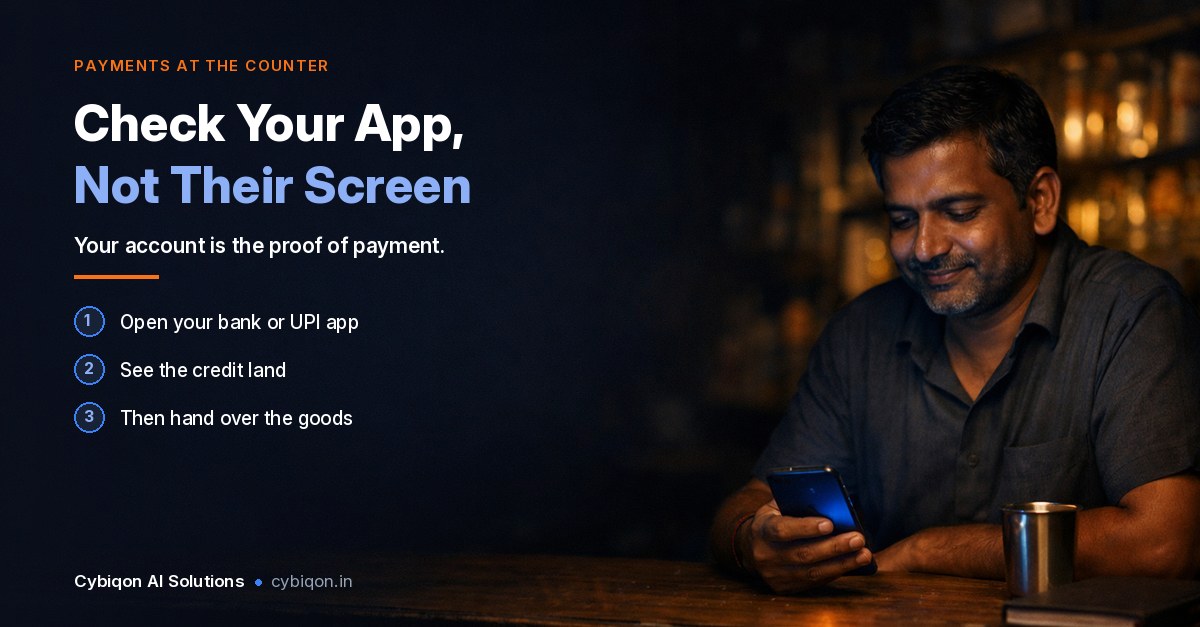
On 1 Sep 2026, Onmanorama reported that a man walked into Lipsy Silver Palace in Muvattupuzha, Kerala, and held up a Google Pay "payment successful" screen. He left with silver worth Rs 16,000. The owner found out only when the account was checked days later, and the report says he remained untraced despite CCTV footage.
That is the whole trick behind a fake UPI payment screenshot: the customer's phone shows success, the shopkeeper's account shows nothing, and the goods are already gone. India's UPI network handled 24.07 billion transactions worth Rs 29.37 lakh crore in September 2026, according to NPCI figures reported by StartupTalky. At that scale, a counter that trusts a customer's screen is a counter with a hole in it.
If you run a jewellery shop, a medical store or a kirana with two to six people at the counter, this post covers the free checks that work, where they break on a busy day, what to do if it happens to you, and when an owned billing app is worth building (and when it is not).
How do I check a fake UPI payment screenshot?
Short answer: you don't look at the screenshot at all. A screenshot, a screen recording or a "success" animation on the customer's phone is something the customer controls. The only evidence that counts is on your side of the payment.
There are three places to look, and any one of them is enough:
- Your own UPI or banking app. Open the transaction list and look for the amount, the time and the payer's name or UPI ID.
- The bank or PSP credit message that arrives on your phone from your own bank.
- Your soundbox, if you have one, with the caveat in the soundbox section below.
Pine Labs, Cashfree and Razorpay's own merchant guides all agree on the same habits: check your own app or message, never approve a "collect" request, and use a dedicated merchant account with the official QR. (Their numeric loss statistics are unsourced, so we are not repeating them. No official count of fake-screenshot losses exists.)
In that Kochi case, the screens looked convincing but the money never reached the shops' accounts. That is why the look of the screen is never the test.
Is a fake UPI payment screenshot valid proof of payment?
For a shopkeeper at the counter, no. A screenshot proves that an image exists. It does not prove money moved. Anyone can generate one with an app built to imitate Google Pay, PhonePe or Paytm screens.
It becomes useful later, in a different way: as evidence. If you are cheated, the screenshot the customer showed you, along with your CCTV and your bill, helps the police. Keep it, but never treat it as a receipt.
The same logic covers the "I paid extra, please refund me" move. In the Kochi case, an Alappuzha hotel owner caught a fake overpayment-refund claim by checking the bank statement instead of the customer's screen. Make this a rule for every staff member: no refund of any kind until the money is visible in your own account.
How can a shopkeeper confirm a UPI payment was received?
Here is a counter routine that costs nothing. Print it and stick it near the till.
- Ask the customer to pay by scanning your QR, not by sending to a number they type.
- Wait for your soundbox or phone alert, then look at your own app for that amount and time.
- Match the amount to the bill. Do not hand over goods until both match.
- For anything above your comfort limit (a ring, a strip of expensive medicines, a bulk order), wait for the amount to show in the account, not just on the alert.
- Never tap "approve" or "pay" on a request that arrives on your phone while a customer waits.
On point 5: UPI collect requests are payment requests sent to your phone. Approving one is a debit from you, not a credit. NPCI barred person-to-person collect requests from 1 Oct 2025 under a circular dated 29 Jul 2025, but merchant collect continues, so the rule for a shopkeeper stays the same: if you are being asked to pay, you are not being paid.
Can a soundbox be fooled by a fake UPI app?
Be careful with this one. In April 2025, Deccan Chronicle quoted a researcher who said fake apps could trigger soundbox confirmations, and that police were urging shop owners to verify every payment. No registered cases were mentioned at the time. We have not been able to confirm this independently, so treat it as a claim worth protecting against, not as a proven attack.
The practical takeaway is simple. A soundbox is a convenience, not proof. For high-value items, check your app or account as well.
Two other points from recent reporting, flagged as reports, not facts:
- MediaNama reported on 21 May 2026, citing the Economic Times, that NPCI is reportedly building one interoperable soundbox that works across UPI apps. We have not seen it launch.
- Soundbox rental is reported at around Rs 100 to 150 per month per device.
Where the free checks break down on a busy counter
The routine above works when one careful person is at the till. It fails in predictable ways:
- Rush hour. Staff hear the beep, see a happy customer and move to the next one. Nobody looks at the app.
- Four staff, one phone. Say a medical store has four people billing. Only one phone has the UPI app. Staff shout "paid?" across the counter and take a nod as the answer.
- Handwritten or generic QR. One shared QR for every bill means any alert can be claimed against any bill. Nothing ties the money to the sale.
- End-of-day only. If you find the gap at closing time, the customer is gone. This is exactly the Muvattupuzha story: found days later.
(The medical store above is an illustrative composite, not a real shop or a measurement.)
Closing the day with a cash-and-UPI tally helps you spot the gap, and we cover that in daily cash reconciliation for shops. This post is about the earlier moment: checking each payment at the sale, before the goods leave.
When is an owned billing app worth building?
An owned billing app earns its place when three things are true: several staff bill at once, the average ticket is high enough that one miss hurts, and you want the bill itself to show paid or unpaid with no one's word needed.
What it should do, in plain terms:
- A new UPI QR for every bill, with the amount fixed. The standard UPI link carries a payee address, a name, an amount and a transaction reference. If the amount parameter is set and the "editable amount" flag is absent, the customer cannot change it. (This is from a 2017 third-party copy of the NPCI linking spec, so confirm against the current version before building.)
- The bill turns "paid" only on a server-side confirmation from your payment provider, never because the customer's phone said so. The result a UPI app hands back on the same phone is only a hint. Google Pay India's documentation and a September 2026 PC Tech Magazine write-up both say the server must verify with the PSP or gateway.
- A webhook that handles repeats safely. Providers can send the same event twice. The app must process each event once (idempotency), check the signature, and move the bill through clear states: created, pending, paid, expired.
- A job that reconciles bills stuck in "pending." Webhooks get lost. Every few minutes, the app should ask the provider about anything unresolved.
- No reading of bank SMS. It is tempting to parse credit messages, but Google Play restricts SMS and Call Log permissions to default handler apps, so an app that depends on this may not be accepted on the Play Store.
What do gateways offer, and what do they cost now?
You do not have to build the QR layer yourself. Razorpay documents dynamic QR codes with webhooks for created, credited and closed events. Cashfree offers fixed-amount dynamic QR. Paytm uses server callbacks. For how to choose among these, see our guide to payment gateways for Indian shops and sellers.
Two cautions. Razorpay's "closed" event fires only on a manual close, so do not use it as your expiry timer. And do not assume a QR enforces the exact amount: test the credited event in the provider's sandbox with a wrong amount before you rely on it.
On pricing: NPCI planned a 0.4 percent merchant charge (capped at Rs 300) on P2M UPI payments above Rs 2,000 from 15 Oct 2026. On 13 Oct 2026 it deferred this, saying it will start "immediately post Diwali" on a date to be notified (as reported by Business Standard, ANI and ThePrint), and no new date had been announced when we checked. Small merchants collecting up to Rs 1 lakh a month through QR stay under the zero-MDR framework, per the same reports. NPCI data cited by PTI also says over 96 percent of UPI merchant transactions are Rs 2,000 or below. Recheck the rules and your gateway's pricing before you decide, because some vendor pages predate the deferral.
When should you not build an app?
Skip the custom build if:
- One owner handles the counter and checks every alert personally. The free routine is enough.
- Your tickets are small and a rare miss costs less than the app would.
- You have not tried the printed routine for a month. Most gaps come from skipped checks, not missing software.
- You would still have no one to look at the screen. Software cannot fix a counter where nobody is responsible for confirming payment.
For many shops, a gateway's ready-made QR plus the counter routine is the right answer.
What to do after a fake UPI payment screenshot fools your counter
Act the same day, and keep calm and organised. No money moved in a fake-screenshot case, so the realistic outcome is evidence for the police, and we cannot promise recovery of goods or money.
- Note the exact time, the bill number and what was taken.
- Save the CCTV footage immediately, before it overwrites, and keep the customer's screenshot or photo if you have one.
- Call 1930, the national cybercrime helpline run under I4C and MHA, and note the reference number. (This comes from secondary sources, as we could not open the portal ourselves.)
- Report on cybercrime.gov.in and follow up on the complaint.
- File an FIR at the local police station with your bill, timestamps and footage.
If a bank account freeze follows a cyber-crime complaint and you are caught up in it, see our guide on a bank account frozen in a cyber-crime case. For cash-flow problems around slow customers, our hub post on recovering delayed payments covers the other side of getting paid.
FAQs
What is a UPI collect request and why should a merchant never approve one?
A collect request asks the person receiving it to pay. If a customer sends you one, or "helps" you receive money by asking you to approve something, approving it takes money from your account. Merchants receive payments by showing a QR, not by approving requests.
A customer says they paid extra and asks for a refund. What do I do?
Do not refund anything until the extra money is visible in your own app or bank statement. A fake overpayment-refund claim was caught this way by an Alappuzha hotel owner in the Kochi case.
Can I get the money or goods back?
We cannot promise it. Report quickly, keep evidence and let the police handle it. The realistic result of a fake-screenshot case is evidence for an investigation.
How can a billing app mark a bill paid only after UPI confirmation?
Generate a per-bill dynamic QR, wait for a signed server-side confirmation from the gateway, process each event once, and reconcile any bill still pending. Never trust the success result returned on the customer's phone.
Does UPI have MDR for merchants from October 2026?
Not yet, as of 20 Oct 2026. The planned 0.4 percent charge on P2M payments above Rs 2,000 (capped at Rs 300) was deferred on 13 Oct 2026 to a date after Diwali that has not been announced. Payments up to Rs 2,000 and small merchants under Rs 1 lakh a month through QR remain in the zero-MDR framework, per reports. Confirm with your bank or gateway.
Want a billing app that confirms every UPI payment?
Start with the counter routine above. It costs nothing, and for many shops it is enough. If several staff bill at once and the tickets are large, Cybiqon can build a billing app for your counter: a fresh QR for each bill, a bill that turns "paid" only on server confirmation, and a reconciliation view for the owner. It is written for your shop rather than configured from a template, and you own the code. Read about our Android app development, then book a 30-minute call at tidycal.com/itspyguru/cybiqon-30-minute-meeting, or reach us on +91 9250711473 or [email protected].
Conclusion
A fake UPI payment screenshot only works when a counter trusts the customer's screen. Check your own app, treat the soundbox as a convenience, and never approve a request on your phone. If you bill at volume, tie every payment to a bill and confirm it from the server. Whatever you choose, keep the evidence if something goes wrong. Cybiqon is happy to talk it through.
Want this set up for your business?
Book a free call — no tech jargon, no sales pressure. Just honest answers.
What we build for this: Admin panels & internal tools