Government tender alerts across GeM, CPPP and state/PSU portals: free checks, paid-service log test, owned digest
Government Tender Alerts: What GeM, CPPP and Paid Services Miss
Government Tender Alerts: What GeM, CPPP and Paid Services Miss
Your firm checked GeM, CPPP and two state portals this morning. The tender you needed was not on any of them. It was a closing-date extension, posted as a PDF on the buying institute's own website. Nobody saw it, so the team assumed the bid had closed.
That is the real problem with government tender alerts in India. The tenders are spread across too many portals, and no single feed shows all of them. The volume is also uneven through the year. According to CPPP's own monthly newsletter, the Central Public Procurement Portal carried 1.86 lakh tenders worth ₹3.99 lakh crore in March 2023 alone, which CPPP called its highest month in 15 years.
If you run bids for a civil, electrical or facility-services contractor, or supply lab equipment, furniture, uniforms or IT hardware, this post covers:
- why tender alerts miss things, and where the gaps are
- the free official alerts to set up first
- how to test a paid tender alert service with a one-month log
- when it makes sense to own a morning tender digest, and when it doesn't
All of it should be in place before the January–March season.
Why government tender alerts miss tenders your firm should see
India has no single tender portal. It has several systems that run side by side, and the rules explain why.
Under the General Financial Rules 2017 (as summarised by Baker McKenzie and a Ministry of Road Transport circular of 25 Mar 2022):
- Rule 149: goods and services that are available on GeM must be bought on GeM.
- Rule 159: central ministries, departments, attached and subordinate offices and autonomous bodies must publish tender enquiries, corrigenda and awards on CPPP.
- Rule 160: procurement should be done electronically.
A Department of Expenditure note on PSU procurement (21 Jun 2021) adds that publishing on CPPP needs an undertaking that the item is not available on GeM. So GeM and CPPP are, by design, two different markets. Watching only one of them means you miss part of the central market.
Then there are the states. NIC's GePNIC e-procurement software runs in over 700 central ministries, departments and PSUs and is being rolled out across 31 states and UTs, according to CPPP and GePNIC material. Each installation is a separate website with its own login and its own search. Some states run their own systems instead, such as Gujarat's nProcure, Karnataka's KPPP, the AP and Telangana eGP portals, and Bihar's portal. Railways tender on IREPS. PSUs like BHEL publish corrigenda on their own sites.
So if you're working out how to track government tenders, start with a list of the portals your buyers actually use. A Noida IT-hardware supplier might need GeM, CPPP and the UP portal. A Pune electrical contractor might need Maharashtra's portal, IREPS and two PSU sites. Any alert covers only the portals it reads.
When do most government tenders come out in India?
Tendering bunches up at the end of the financial year, but less than people often assume.
| Data point | Figure | Source |
|---|---|---|
| CPPP, March 2023 | 1.86 lakh tenders, ₹3.99 lakh crore | CPPP Monthly Newsletter, March 2023 |
| CPPP, full FY2022-23 | 17.86 lakh tenders, ₹34.07 lakh crore | CPPP Annual Report 2022-23 (as quoted in search results) |
| March's share of FY23 | about 10% of tenders, about 12% of value | Calculated from the two rows above |
| Road and power construction tenders, Q4 FY24 | up 96% year on year | India Ratings, via Construction World |
An even spread would put about 8.3% of the year in each month, so March 2023 was a real peak but not an extreme one. Don't assume March is always the biggest month. A later CPPP newsletter suggests September 2025 had more tenders, though that copy was hard to read. What you can rely on is a heavier January–March load, with more corrigenda and extensions alongside it.
GeM's numbers point the same way. Cumulative GMV crossed ₹20 lakh crore by 7 Aug 2026, with 25.45 lakh profile-completed sellers and 1.37 lakh buyer organisations (Tribune India / ANI). FY2025-26 GMV was ₹5.03 lakh crore, 7.4% below FY25, mainly because of a smaller coal ministry share, while state procurement rose 38.3% (News On AIR, 6 Apr 2026). Micro and small enterprises filled 68% of GeM orders that year. Firms your size win plenty of this business, but about 25 lakh sellers can see the same bids you do.
Free checks first: GeM bid alerts, CPPP and GePNIC
Set up the free official options before you pay for anything. Here is what each one offers.
| Source | What is free | Watch out for |
|---|---|---|
| GeM BidPlus "All Bids" (bidplus.gem.gov.in/all-bids) | Public list with no login, and no captcha when we checked on 20 Nov 2026 | The page says new or changed bids can take up to 15 minutes to appear. It has no alert subscription. |
| GeM seller notifications | According to GeM's seller FAQ, sellers in the selected categories get a "Tender Publish" notification for BOQ bids | Only as good as your category mapping. Check your dashboard as well. |
| CPPP / GePNIC public view | You can view tenders without registering. A CPPP overview hosted on CBSE's site says NIC charges bidders no fee and describes email/SMS alerts at milestones. | CPPP tender search asks for a captcha on every search (confirmed on eprocure.gov.in, 20 Nov 2026) |
| GePNIC registered bidder | According to a GePNIC Bidder Registration Manual (an older version hosted by ARAI), you can save up to 10 product categories for mail alerts and mark tenders as "My Tenders" or favourites to get mail and SMS updates | Screens may differ on your state portal, so check them. You need a separate registration on each portal. |
CPPP's advanced search can filter by organisation, product category, tender value, dates and pincode. Save the combination that works for you and run it the same way every day.
Then add two simple tools of your own:
- A daily portal checklist: one line per portal, with the person who checks it and the time. Make it a tick-box sheet, so someone has to confirm the check happened.
- A bid-deadline sheet: tender ID, portal, buyer, value, closing date, pre-bid date, EMD, and a "last checked for corrigendum" column. It should be one shared sheet, so the information doesn't live in someone's WhatsApp chat.
Keep both even if you later pay for a service.
GeM bid notification not received? What GeM itself says
GeM's seller FAQ says that a seller who did not receive an alert can still take part in the bid. A missing notification doesn't stop you from bidding. It only means you may not find out about the bid in time.
There's also a homepage notice. In search results, GeM's homepage is indexed with a notice that RA (reverse auction) and bid invitation notifications may not be delivered, and that sellers should check their dashboard. We could not see that notice when we loaded the page on 20 Nov 2026. Either way, the FAQ makes the same practical point: don't rely on notifications alone to find GeM bids.
To cover the gap:
- Check your category mapping. If your offering is in the wrong category, the alerts go to other sellers.
- Search the public all-bids list by exact keyword each morning, using the words buyers use ("LED street light", "lab fume hood", "housekeeping manpower"), not your catalogue names.
- Look at your GeM dashboard, not just your inbox.
Tender corrigendum and date extension: the alert nobody sends
Missing a change to a tender you're already preparing can cost more than missing a new one. Corrigenda change closing dates, technical specifications, EMD amounts and eligibility clauses. They don't always appear where the original tender did. IIT Kanpur, for example, has posted a GeM bid extension as a PDF on its own website. BHEL has a separate "All Corrigendum" section with hundreds of pages. A tender alert service that only reads new listings won't see either of these.
On GeM, the seller FAQ refers to a 48-hour representation window after a corrigendum. That gives you very little time if you only hear about the change days later.
A practical routine for tender corrigendum and date extension checks:
- For every tender on your deadline sheet, re-open the tender page and the buyer's own tender or notice page every two or three days, and daily in the last week.
- Record the date of each check in the sheet.
- When a closing date moves, update the sheet first and then tell the team.
By hand this is slow, and in January–March it is the first check to get skipped.
Are paid tender alert services worth it? A one-month log test
Tender alerts are now marketed to every firm that bids. Tender247 announced actor Anupam Kher as its face in Sep–Oct 2026 (YourStory; Entrepreneur India), and the campaign talks about a ₹70 lakh crore tender market. That figure is Tender247's own claim.
Listed prices (as seen on 20 Nov 2026):
- BidAssist: "starting at ₹250/month (billed annually)", ₹299 per tender on pay-per-tender, and WhatsApp plus email alerts on its paid plans.
- TenderTiger and Tender247: no public prices. You have to contact sales.
Plenty of firms are happy with these services; others find too much noise. Ignore unsourced vendor claims like "60–70% of eligible tenders missed" and test a service against your own work for a month:
| Column | What you record |
|---|---|
| Tender ID and portal | where the tender was published |
| Found by | the service, your free checks, or a colleague or buyer |
| Relevant? | yes / no / maybe |
| Arrived when | how long after publication |
| Corrigenda caught? | did the service flag extensions or changes? |
After 30 days, count three things:
- Tenders the service missed that your free checks found
- Irrelevant alerts you had to read and discard
- Corrigenda caught compared with corrigenda missed
If the misses are close to zero and the noise is manageable, keep paying. That's the cheapest outcome. If the service keeps missing your state or PSU portals, or sends unrelated auctions, your log already contains the specification for a better setup.
Owning your government tender alerts: a morning digest built for one firm
Say a 20-person electrical and facility-services contractor tracks GeM, CPPP, two state GePNIC portals, IREPS and one PSU site. This is an illustration, not a client. An office executive opens each portal every morning. CPPP asks for a captcha on every search. The paid service still sends unrelated auctions. Last month an extension PDF reached nobody.
An owned digest for that firm would:
- Read only that firm's portals: public listings and the firm's own registered accounts
- Filter by its keywords, value band and districts, instead of a broad national category
- Re-check every shortlisted tender for corrigenda, including the buyer's own notice page
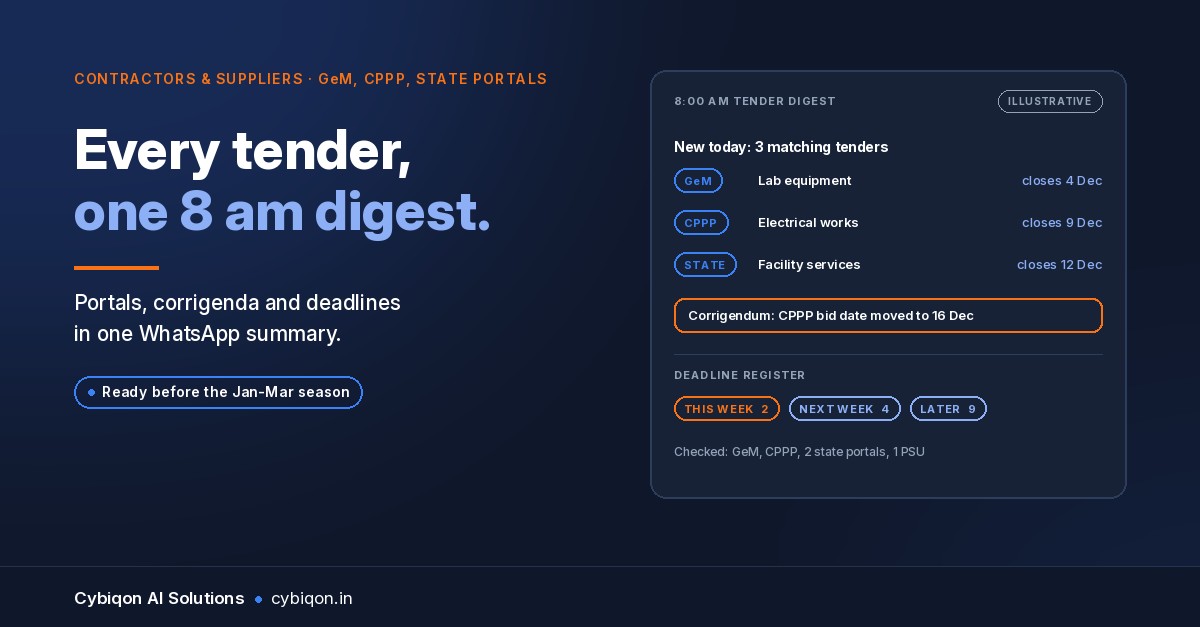
- Send one tender alert on WhatsApp at 8 am, with new matches, changed dates and bids closing this week
- Keep the deadline register updated automatically, so the sheet doesn't depend on someone remembering
It would also have limits. It doesn't bypass captchas. If a search sits behind a captcha, the digest uses the firm's logged-in alert features, saved searches or official notification emails, or it leaves that step to a person. Where a portal's terms are unclear, read whether web scraping is legal in India before automating anything. It's the same scheduled, polite reading of public pages that powers competitor price monitoring, applied to tender listings.
Finding the tender is only the first step. Pricing the bid is where the margin is won or lost, and a supplier quotation comparison on landed cost helps with that part.
When an owned tender digest is not worth it
- You bid on fewer than five or six tenders a month, all on GeM. The free all-bids list, correct category mapping and a deadline sheet are enough.
- Your paid service passed the one-month log. It caught almost everything, and the noise was manageable. Keep it.
- Your buyers use one state portal with working mail alerts. Ten saved categories may cover it.
- Most of your work doesn't come from tenders. If private customers find you through search, put the money into showing up there. Here's why your competitor shows up on Google and you don't.
An owned digest pays off when you track several portals, your keywords are specific, corrigenda have already cost you a bid, and someone is spending an hour or more every morning on manual checks.
FAQs
How do I get bid alerts on GeM for my product category?
Map your catalogue to the correct GeM categories. According to GeM's seller FAQ, sellers in the selected categories get a "Tender Publish" notification for BOQ bids. Also search the public all-bids list each day by exact keyword, because new or changed bids can take up to 15 minutes to appear there.
Why did I not receive a GeM bid notification, and can I still participate?
Notifications depend on your category mapping, and they can fail to arrive. GeM's seller FAQ says a seller who didn't get an alert can still take part in the bid. Check your dashboard and the all-bids list instead of relying on email.
Does CPPP (eprocure.gov.in) send free tender alerts by email?
According to a CPPP overview document and a GePNIC bidder manual, registered bidders can save up to 10 product categories for mail alerts and follow favourite tenders by mail and SMS. NIC charges bidders no fee for this. Screens differ between portal versions.
How do I find out when a tender's closing date has been extended?
Re-check the tender page and the buyer's own tender or notice page every few days, and daily near the deadline. Extensions sometimes appear only as a PDF on the buyer's site. Note each check in your deadline sheet.
Build your firm's tender digest with Cybiqon
If your one-month log shows tenders slipping through, Cybiqon can build your firm its own morning tender digest. It would read the portals you bid on, filter by your keywords, value band and districts, track corrigenda and extensions, send one WhatsApp summary and keep the deadline register up to date. The founders write it for your portals rather than configuring a template, and you own the code.
Our web scraping and data pipelines start at ₹11,999 one-time per pipeline. A digest across several portals is quoted once we've seen your portal list. Email [email protected] with the portals you bid on and your keywords, call +91 9250711473, or book a 30-minute call. We'll tell you honestly whether it's worth building.
Conclusion
Government tender alerts fail in predictable places: a portal nobody checks, a keyword that's too narrow or too broad, and a corrigendum posted somewhere unexpected. Fix that cheaply first with GeM's public list, GePNIC's saved categories, a portal checklist and one deadline sheet. Give any paid service a one-month log test. If the gaps are still there, a digest you own, tuned to your portals and running before January, is a practical next step. Cybiqon is happy to help you decide whether you need one.
Want this set up for your business?
Book a free call — no tech jargon, no sales pressure. Just honest answers.
What we build for this: Web scraping & data