Comparing supplier quotations on landed cost
Supplier Quotation Comparison: Landed Cost, GST and Credit Days
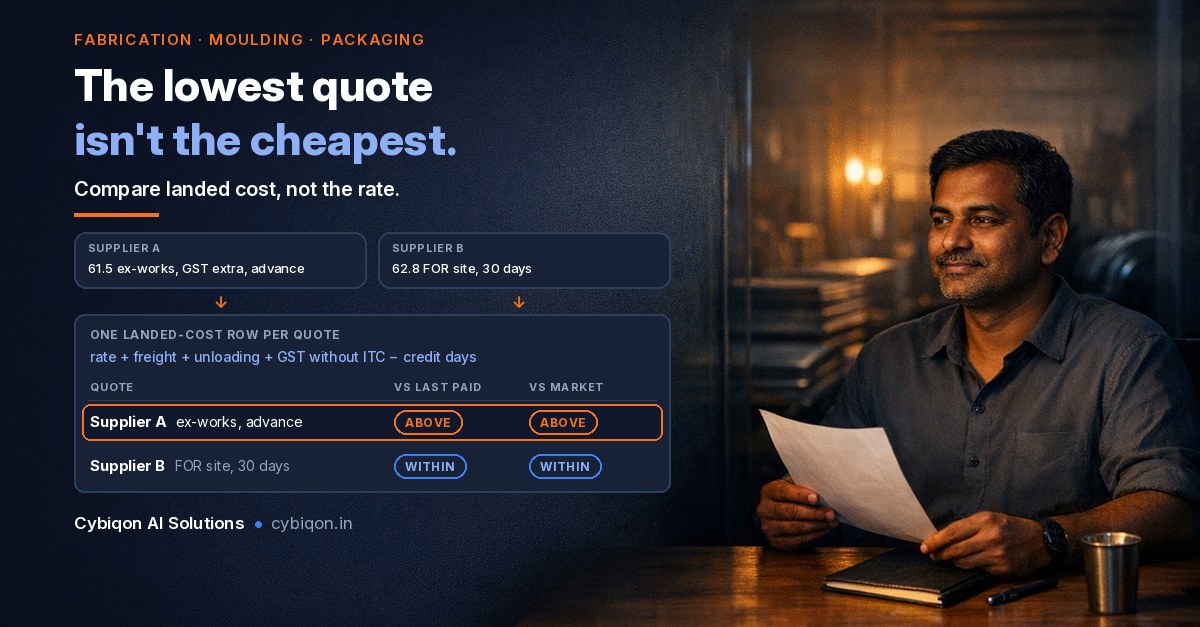
"61.5 ex-works, GST extra, advance." "62.8 FOR site, 30 days." Two HR sheet quotes land on the purchase head's WhatsApp on the same morning, and the first one looks ₹1.30 a kilo cheaper. Usually it isn't. Most supplier quotation comparison in Indian factories is still done by eye, on the headline number, with no record of what was paid last time and no idea what the market did this week.
That mattered less when prices sat still. They are not sitting still in October 2026. One tier-1 mill's flat-steel list price rose ₹2,800 a tonne between 1 September and 1 October, according to BigMint. Reliance and IOCL issued polyethylene revisions on 8, 10 and 15 October. The RBI raised the repo rate to 5.50% on 7 October, so supplier credit is now worth more too.
In a LocalCircles study released on 26 June 2026, 56% of surveyed businesses named price volatility a buying problem and 44% found it hard to compare options (a sponsored release on a self-selected poll, so a signal rather than a census).
This guide puts every quote on landed cost (freight basis, claimable GST, credit days, MOQ, lead time), then gives you a copyable Excel layout, what Tally already shows, free price benchmarks, and where a sheet stops working.
Why supplier quotation comparison by eye fails in a month like this one
Quotes on WhatsApp and PDF each arrive in their own shape: ex-works with GST extra and advance; FOR your gate on 30 days; a local trader's all-in number with no GST on the bill. Comparing those headline numbers compares different things.
Now add the market. Per BigMint, HRC hit ₹62,000/t ex-Mumbai in September 2026, its highest since June 2022. Depending on the source, it is now about ₹63,000–64,700/t. ICICI Direct called October the third straight monthly hike. The government's wholesale price index for basic metals rose 16.96% in September.
Take a sheet-metal fabrication unit near Pune that buys about 40 tonnes of HR sheet a month (IS 2062 E250), plus 60 other items from 14 suppliers. This unit is an illustration, not a client. On that volume, the ₹2,800/t list-price move alone adds ₹1,12,000 a month, which is simple arithmetic on the cited figure.
Steel is not the only one moving:
- Polymers: Reliance raised LDPE and HDPE pipe grades by ₹3,000/t from 10 October. IOCL raised HD pipe grades by ₹2,000/MT on 8 October and again on 15 October (BigMint).
- Packaging: kraft paper rose about 25–30% in under two months, and some suppliers cut credit from 30–60 days to as little as 7, according to the UP Corrugated Box Manufacturers Association (KNN India, 28 September).
When price and credit terms both move within one quote cycle, a lower headline number tells you almost nothing. That is the gap a vendor quotation comparison on landed cost closes.
Put every quote on landed cost: ex-works vs FOR price, freight and unloading
Landed cost is what one kilo actually costs you once it is unloaded at your gate and paid for. It is the only number worth comparing. A simple landed cost calculation per kg looks like this:
Basic rate + freight to your gate (if ex-works) + loading/unloading + any GST you cannot claim − the value of the credit days
Keep MOQ and lead time beside it: a ₹0.40 saving on a 20-tonne MOQ you cannot store isn't a saving.
Ex-works vs FOR price: an ex-works quote is the price at the supplier's yard, and you pay for the truck. A FOR destination quote includes delivery to your gate. Ask whether it includes unloading; often it doesn't.
Freight also carries a GST question:
- On a FOR invoice, freight is usually part of the goods value and taxed at the goods' rate, so the credit flows with the goods.
- On a separate transporter (GTA) bill, the old default was 5% under reverse charge with no credit. Secondary sources report a forward-charge option at 18% with credit from 22 September 2025. Check with your CA which applies to your transporter.
Here is the illustrative Pune unit's two quotes, with every assumption stated:
| Quote A | Quote B | |
|---|---|---|
| Headline | ₹61.50 ex-works, GST extra, advance | ₹62.80 FOR site, 30 days |
| Freight to gate (assumed ₹1.00/kg) | +₹1.00 | ₹0 |
| GST on freight, 5% RCM, no credit (assumed) | +₹0.05 | ₹0 |
| Unloading (assumed ₹0.15/kg, both) | +₹0.15 | +₹0.15 |
| Value of credit days (12% p.a., assumed) | ₹0 | −₹0.62 |
| Landed cost per kg | ₹62.70 | ₹62.33 |
Both charge 18% GST you can claim, so it cancels out. On these assumptions the "dearer" quote is ₹0.37/kg cheaper, about ₹14,800 on 40 tonnes. Change the assumptions and the answer can flip; the point is the method, not the number.
Should GST be included when comparing supplier quotes?
Leave GST out only when you are sure you can claim it. Claimable input tax credit (ITC) makes GST a cash-flow item; unclaimable GST is part of the price. Three cases decide which:
1. The composition dealer's "no GST" quote. A trader under the composition scheme issues a bill of supply, which carries no GST and gives you zero ITC. Say a local trader quotes ₹72/kg all-in. Next to Quote B's ₹62.80 + 18% = ₹74.10, it looks ₹2 cheaper. On landed cost it is ₹72.15 against ₹62.33, so it is nearly ₹10/kg dearer. Compare a composition quote against other quotes' ex-GST landed cost, never their GST-inclusive total.
2. A supplier whose filings are erratic. Under Section 16(2)(aa) of the CGST Act, your credit depends on the invoice appearing in your GSTR-2B, which happens only if the supplier files GSTR-1. Section 16(2)(c) also requires that the supplier actually pays the tax. The Gauhati High Court read down 16(2)(aa) for bona fide buyers in McLeod Russel, but don't plan margins around a court case. If a supplier's invoices have gone missing from 2B before, mark the quote "ITC at risk" and add the GST to its landed cost, or pay only once the invoice shows in 2B.
3. You don't pay within 180 days. Under the second proviso to Section 16(2) and Rule 37, ITC is reversed with interest under Section 50 if you haven't paid the supplier within 180 days of the invoice. Long credit on paper is not free.
This is a general reading, not tax advice. Run your specific cases past your CA.
How to value credit days against advance payment
Credit days are money, and the fair price for them is your own borrowing rate: cash you don't pay a supplier today saves you drawing on your cash-credit limit.
The formula: basic rate × your annual interest rate × credit days ÷ 365.
At a 12% p.a. cash-credit rate (an assumption, so use yours), 30 days is worth about 1% of the rate: ₹0.62/kg on ₹62.80. Forty-five days is about ₹0.93/kg. An advance quote has zero credit value, and costs a little extra if you pay days before dispatch. With the repo rate raised to 5.50% on 7 October 2026, the first hike since February 2023, expect your rate to rise, not fall.
Two legal limits change the arithmetic when the supplier is a micro or small enterprise registered on Udyam:
- MSMED Act, Section 15: you must pay within the agreed term, capped at 45 days, or within 15 days if nothing was agreed. A "60 days" offer from such a supplier can't really be used beyond 45. Delayed payments carry compound interest at three times the RBI bank rate, with monthly rests. Under Section 23, that interest is not tax-deductible.
- Section 43B(h) of the Income-tax Act, 1961, now Section 37(2)(g) of the Income-tax Act, 2025 from tax year 2026-27 (per a Rajya Sabha reply on 21 July 2026): an expense owed to such a supplier beyond the MSMED limit is disallowed until you actually pay it.
Both apply to micro and small suppliers, not medium ones, and generally not to pure traders. So cap the credit-days column at 45 for those suppliers. Not legal or tax advice. Confirm each supplier's status and your position with your CA.
A supplier price comparison template in Excel you can copy
Most government buyers and larger companies call this a comparative statement of quotations, or CS. It is one row per supplier per item, with the lowest landed cost marked L1. The quotation comparison format below adds the columns a basic CS usually misses. Put one quote per row and fill row 2 down:
| Col | Field | Entry or formula (row 2) |
|---|---|---|
| A | Item (e.g. HR sheet 2mm E250) | typed |
| B | Supplier | typed |
| C | Quote date | typed |
| D | Basic rate ₹/kg (ex-GST; all-in for composition) | typed |
| E | Basis (EXW / FOR) | typed |
| F | Freight to gate ₹/kg, incl. any non-claimable GST on it | 0 if FOR |
| G | Loading/unloading ₹/kg | typed |
| H | GST rate (0 for bill of supply) | e.g. 18% |
| I | ITC safe? (Y/N) | N for composition or "ITC at risk" |
| J | Non-claimable GST ₹/kg | =IF(I2="N",D2*H2,0) |
| K | Credit days (cap 45 for micro/small suppliers) | typed |
| L | Your interest rate p.a. | e.g. 12% |
| M | Value of credit ₹/kg | =D2*L2*K2/365 |
| N | Landed cost ₹/kg | =D2+F2+G2+J2-M2 |
| O | MOQ (kg) | typed |
| P | Lead time (days) | typed |
| Q | Last paid landed ₹/kg | from Tally |
| R | Benchmark basic ₹/kg today | from a price source |
| S | Rank | =IF(N2=MINIFS(N:N,A:A,A2),"L1","") |
| T | Flag | =IF(N2>Q2,"Above last paid ","")&IF(D2>R2,"Above benchmark","") |
Note that column T compares the basic rate (D) with the benchmark, because most published benchmarks are ex-works basic prices before freight and GST. MINIFS needs Excel 2019, Microsoft 365 or Google Sheets.
Where this sheet stops: it is genuinely fine for 20 items and five suppliers. But someone has to type every WhatsApp quote, paste last-paid prices from Tally and look up benchmarks every morning. At 60 items and 14 suppliers, that typing is the first thing skipped on a busy day, and raw material price tracking quietly stops.
Last-paid price and today's benchmark: what Tally and free sources give you
Purchase price history in Tally: TallyPrime already has more than most buyers use. Gateway of Tally > Display > Inventory Books > Movement Analysis > Stock Item Analysis shows supplier-wise purchase cost for an item over a period, with drill-down into vouchers (F12 shows additional cost details). What Tally doesn't do is warn you: it knows what you paid after booking, and never sees the WhatsApp quote before you accept it. Export that history into column Q.
Benchmarks, free and paid: for steel price today (HR coil) and the polymer price list (PP, HDPE) today:
| Source | Cost | Good for | Caveat |
|---|---|---|---|
| Plastemart polymer revision pages | Free | Reliance/IOCL/GAIL/OPaL/Haldia circular summaries | Summaries, so check the date |
| Tata Nexarc steel price page | Free | A rough range | Unclear method; its September range conflicted with BigMint |
| BigMint | Metered free insights; paid tiers | Steel and polymer daily prices | The full data needs a subscription |
| Mysteel Global | 7-day trial, then paid | Steel | Paywalled after the intro |
| PolymerUpdate | Subscription | Polymers | Paid |
| Joint Plant Committee (Ministry of Steel) | ~₹40,000/yr retail report | Official retail averages | Excludes GST |
| IndiaMART listings | Free | What sellers are asking | Undated; HR sheet listed at ₹46–85/kg against a ~₹62–64/kg benchmark |
As a reference point, BigMint's 12 October spot prices were PP film at ₹163.5/kg in Delhi, PP injection at ₹152/kg in Mumbai and HDPE blow moulding at ₹139/kg in Delhi. IndiaMART is useful for finding new suppliers, but it shows asking prices, not a benchmark. To widen your supplier list, it can be quicker to extract business data from Google Maps for your district and category.
When an owned supplier quotation comparison register is worth building
Once the sheet is being skipped, the useful upgrade is a quote register, not a procurement suite. Vendors such as GoComet and Procol report savings of roughly 1–6% on landed cost or spend for their clients. Those are vendor-reported figures, and we found no independent Indian number, so we won't promise one.
If you are still asking how to compare quotations from suppliers at that scale, a register built around your items does three things:
- Captures quotes where they arrive. WhatsApp text and PDFs are read into the landed-cost fields: rate, basis, GST, credit days, MOQ. A person confirms each one in a click.
- Fills the two reference columns itself. Last-paid comes from your Tally export. The benchmark comes from a polite morning scraper that reads public price pages and your suppliers' own published catalogues, once a day, within their robots.txt.
- Flags, it doesn't decide. Any quote above last-paid or the benchmark is marked before anyone says yes on WhatsApp.
Be careful with the scraper. IndiaMART's robots.txt (checked 19 October 2026) disallows product-detail and catalogue paths for all bots, so don't mass-scrape it. Paid sources like BigMint stay paid: use your subscription, don't scrape around it. Price facts carry little personal-data risk; supplier contact data does. Before building one, read is web scraping legal in India. Not legal advice.
If you also sell, it is the same technique your rivals use for competitor price monitoring, pointed at your inputs instead of your outputs. And remember your own buyers are running this comparison on you. Getting on their quote list starts with why your competitor shows up on Google and you don't.
FAQs
How do you compare quotations from different suppliers?
Convert every quote to landed cost per unit: basic rate, plus freight to your gate if ex-works, plus unloading, plus any GST you cannot claim, minus the value of the credit days at your own borrowing rate. Keep MOQ and lead time alongside. The lowest landed cost is L1, and you check it against what you paid last time and today's benchmark.
What is the difference between ex-works and FOR destination in a quotation?
Ex-works is the price at the supplier's premises, and you arrange and pay for transport. FOR destination includes delivery to your site, usually with freight inside the invoice value. Ask whether FOR includes unloading.
Is a quote from a composition dealer cheaper if there is no GST on the bill?
Often not. A composition dealer issues a bill of supply and you get no input tax credit, so their all-in price must be compared with other suppliers' ex-GST landed cost, not their GST-inclusive total.
Does Tally show the last purchase price of an item from each supplier?
Yes, after the purchase is booked. TallyPrime's Stock Item Analysis (Display > Inventory Books > Movement Analysis) shows supplier-wise purchase cost for an item over a period. It doesn't compare incoming quotes against that history or flag a higher one.
Is it legal to scrape supplier or IndiaMART prices?
India has no scraping-specific law, and the position is unsettled. Respect robots.txt and each site's terms. IndiaMART's robots.txt disallows its product-detail and catalogue paths, so don't mass-scrape it. Reading public price pages and suppliers' own catalogues at a low frequency is the safer route. This is not legal advice.
Build your quote register, owned by you
If your quotes already arrive faster than anyone can type them, Cybiqon can build the register described above for your item list. It reads WhatsApp and PDF quotes into landed-cost rows, pulls last-paid prices from your Tally export, refreshes benchmarks each morning with a polite scraper of public price pages and supplier catalogues, and flags any quote above either before you accept it.
It is written for your items, suppliers and credit rules, not configured from a template, and you own the code and the data. Our web scraping and data pipelines start at ₹11,999 per pipeline. The quote register around it is scoped on the first call.
Book a 30-minute call, call +91 9250711473, or email [email protected]. Bring your three messiest quotes from last week.
Conclusion
Good supplier quotation comparison comes down to one row per quote, on landed cost: freight basis, GST you can actually claim, credit days at your own rate (capped at 45 for micro and small suppliers), MOQ and lead time, next to last-paid and today's benchmark. With steel up three months running and polymer circulars arriving weekly, the cheaper-looking quote is often not the cheaper one. Start with the sheet above this week. When typing it becomes the bottleneck, Cybiqon can build the owned version.
Want this set up for your business?
Book a free call — no tech jargon, no sales pressure. Just honest answers.
What we build for this: Web scraping & data