matching customer payments to invoices in Tally for distributors
How to Match Customer Payments to Invoices in Tally: 3 Fixes
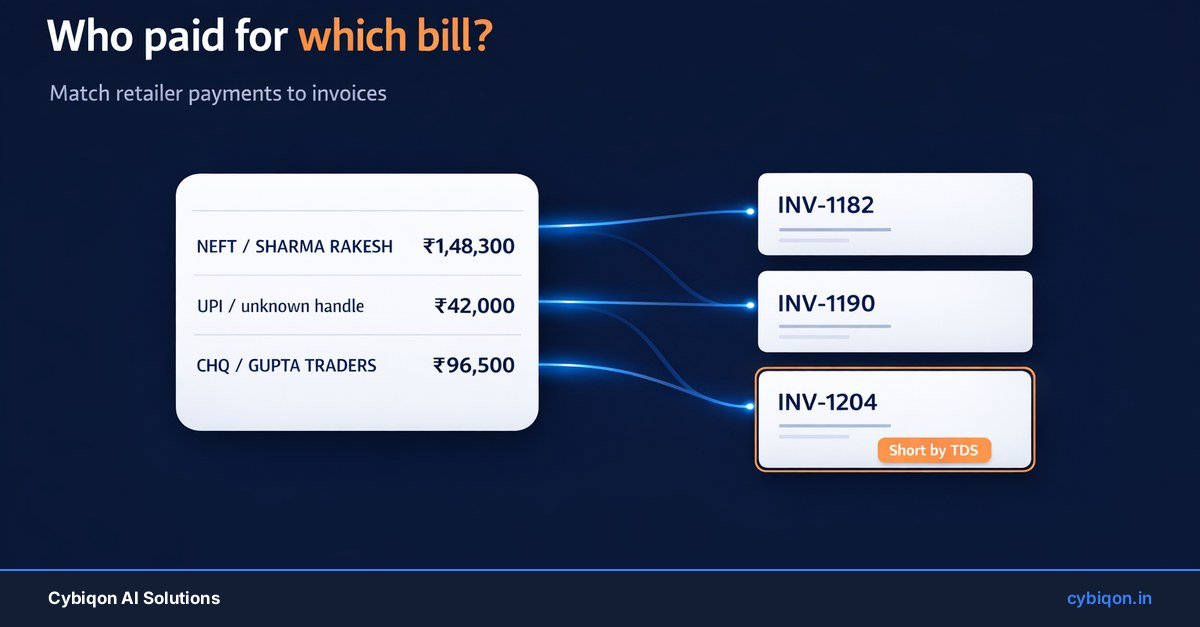
"NEFT/N2xxxx/SHARMA RAKESH — ₹1,48,300." Nobody called Rakesh Sharma buys from you. The bank has credited the money, and now someone in accounts has to work out which retailer sent it and which bills it pays. For a distributor, wholesaler or manufacturer on Tally, that happens most mornings.
Learning how to match customer payments to invoices in Tally is partly a Tally question, and TallyPrime has good tools for it. Mostly, though, it's a payments question. UPI and NEFT in India don't reliably carry an invoice number, so Tally matches amounts and dates while one person matches people and bills from memory. Whatever that person can't place goes to Suspense or On Account, and your ageing, reminders and debtor confirmations go wrong with it.
This guide covers:
- what TallyPrime's bill-wise entries and bank reconciliation already do
- why bank narrations fail you, and where unidentified money should sit
- how to book TDS and scheme short-pays
- three fixes, sorted by which kind of payment each one actually clears, including what the 15 October 2026 UPI fee changes
How to match customer payments to invoices in Tally: bill-wise basics
Matching happens in the receipt voucher. When a dealer's ledger has Maintain balances bill-by-bill switched on, every sale creates a bill reference, and every receipt has to say what it settles. TallyPrime gives you four reference types:
- New Ref: creates a new bill. It belongs on the sales invoice, not normally on a receipt.
- Agst Ref: settles one or more existing bills. This is the match itself. One receipt can be split across several Agst Ref lines.
- Advance: money received before the invoice exists. It gets set off when the bill is raised.
- On Account: the party is known, but nobody has decided which bill the money pays. It sits against the party, unallocated.
Open a receipt voucher (F6), select the bank ledger, credit the dealer, choose Agst Ref and pick the open bills the money settles. A payment that exactly matches one bill takes seconds.
None of the deciding is automatic. Tally won't decide which bills ₹1,48,300 was meant for, or tell you who "SHARMA RAKESH" is. The outstanding report, the ageing and the reminders are only as right as those Agst Ref choices.
Bank reconciliation in TallyPrime, and what 7.1 added
Bank reconciliation in TallyPrime is a separate job. It checks that entries in your books agree with lines on the bank statement. Since TallyPrime Release 6.0 you can import the statement as Excel, CSV or MT940 (a standard bank-statement format many banks export). Tally reconciles exact matches automatically and suggests likely matches for the rest.
But it reconciles a voucher someone already entered against a statement line, not a payment against an invoice. If nobody knew who paid, there's no receipt to reconcile.
TallyPrime 7.1 (release notes dated 20 May 2026) closes part of that gap: it can create receipt vouchers from bank statement lines that have no entry in the books. They come in as Optional Vouchers, which don't touch your accounts until accepted, and you can add bill-wise details first. Once the accountant has checked an entry, Mark as Regular & Reconcile turns it into a real voucher and reconciles it in one step. Two jobs are still left to a person: choosing the party ledger and choosing the bill. Those are the hard part.
A note on Payment Request (since TallyPrime 3.0, June 2023), which often gets described as automatic matching. A UPI QR or payment link on the invoice fills in the amount and an invoice note, so the credit is easier to recognise. But for QRs on your own UPI ID, Tally's help pages say payment status is not tracked in TallyPrime, so you still record the receipt yourself. Only payment-gateway links reconcile, after you import the gateway statement, where transaction ID and amount match.
Why the bank statement won't tell you which invoice was paid
Under RBI circulars from 2010, NEFT credits are made on the account number alone, and the receiving bank doesn't check the name. Your statement only has to show the name of the sending account, in a field of up to 50 characters. The remitter's note is optional, and the bank gives it to you on request. So "SHARMA RAKESH" is whoever owns the account the money left. That could be a retailer's brother, a parent, or a shop assistant who paid from their own phone.
UPI payment reconciliation is harder still. NPCI counted 24.51 billion UPI transactions worth ₹29.82 lakh crore in August 2026 (via Business Standard), each carrying a handle and whatever note the payer typed, usually nothing.
To make that concrete, here is an illustrative day for a Ludhiana distributor with about 200 retailers. It's a composite, not a real client:
NEFT/N2xxxx/SHARMA RAKESH ₹1,48,300: a retailer's brother, paying three bills (₹52,100 + ₹61,450 + ₹34,750) at once- a UPI credit from a handle nobody recognises
- a modern-trade buyer paying 0.1% less than the bill, starting this month
- a retailer paying ₹4,000 short for a scheme discount, without saying which bill
None of these credits carries a bill number, so dealer payment reconciliation falls back on one person's memory.
Suspense or On Account: where unidentified receipts should go
The rule is short:
- Payer unknown → Suspense. You have the money but not the party.
- Payer known, bill unknown → On Account. You know the dealer, just not which bill it pays.
These unidentified receipts are legitimate stopgaps, but each distorts something different.
Suspense leaves the dealer's ledger showing the full outstanding. Ageing overstates what's due, the retailer who already paid gets a reminder, and their next order may be held against a credit limit they aren't actually over.
On Account gets the dealer's total right, and Tally does show On Account amounts in outstanding reports. But the bills themselves stay open, so old invoices look overdue when they aren't, and bill-by-bill reminders still go out. Clean matching is what lets you chase the payments that are genuinely late rather than the ones nobody has allocated yet.
Don't just park an unclaimed UPI credit. If nobody has claimed it after a week, ask your bank who sent it. Payments from accounts later linked to fraud are part of how some merchants end up with a bank account frozen over a cyber-crime complaint.
At audit, it all comes out. Tax audit reports for FY 2025-26 are due 30 September 2026 unless CBDT extends the date (CA associations have asked for 31 October). Whichever date applies, your auditor wants debtor balances that agree with confirmations, and a large Suspense balance holds those up.
Short payments: goods TDS under Section 393, schemes and deductions
When a buyer pays less than the bill, there are usually two causes, and they look very different.
Goods TDS. The old Section 194Q is now Section 393(1), Table Sl. No. 8(ii) of the Income-tax Act 2025, in force from 1 April 2026. Your FY 2025-26 audit still runs under the 1961 Act. The rule hasn't changed:
- the buyer deducts 0.1%, and only if their turnover is above ₹10 crore
- it applies only to purchases from you above ₹50 lakh in the year
- so it starts partway through the year, and it's tiny: ₹100 on a ₹1 lakh bill
To book it, enter the receipt against the bill (Agst Ref) for the full ₹1,00,000. Debit the bank ₹99,900 and a TDS Receivable ledger ₹100. Check the credit in Form 26AS for FY 2025-26, and in Form 168, which replaces 26AS, from FY 2026-27. TCS under 206C(1H) hasn't applied since 1 April 2025.
Scheme, damage and rate-difference deductions. When a customer paid less due to TDS, the gap is 0.1%. If a retailer pays several thousand rupees short, TDS can't explain it. More often the retailer has deducted a scheme discount, a damaged carton or a rate difference without saying which bill it applies to. Check it against credit notes you've already raised. If there's no credit note, raise one against the right bill (Agst Ref) and the bill closes cleanly. Otherwise the ₹4,000 stays on the bill as an overdue balance and becomes an argument six months later.
How to match customer payments to invoices in Tally by payment type
Each vendor on page one sells one of three fixes. Each fix clears a different kind of payment, and none of them clears everything.
| Payment type | Example | What clears it | Why / limits |
|---|---|---|---|
| Small bills paid by UPI | ₹1,800 counter top-up | Payment link or QR on the invoice | Amount and invoice note travel with the money; ₹2,000 or less stays fee-free |
| Large, regular bank transfers | Same dealer, ₹2 lakh by NEFT each week | A static virtual account per dealer | The account number identifies the dealer; Cashfree prices from ₹20 per transaction |
| Paid from a relative's account | "SHARMA RAKESH" | Register that account as an allowed payer; otherwise an agent or a person | Razorpay's payer check allows at most 10 accounts per customer and refunds the rest |
| One lump sum for several bills | ₹1,48,300 for three bills | An agent suggests the bill combination; a person confirms | No payment rail carries three invoice numbers |
| Cheques and cash | Cheque with a covering note | A person, or an agent reading the note | HSBC lists RTGS/NEFT/IMPS only; Razorpay Smart Collect takes no cash |
| Short-pays | 0.1% TDS, scheme deduction | An agent flags them; a person books them | Needs your list of deducting buyers and open credit notes |
A virtual account for collections is a unique account number issued for each dealer. Money sent to it lands in your main account already labelled with that dealer's name. ICICI's e-Collection accepts RTGS, NEFT, IMPS and UPI; others differ, so ask which rails yours covers. Cheques move more slowly (see how Positive Pay affects business cheques), but at least the cheque shows who wrote it.
The 15 October UPI fee and the "QR on every invoice" plan
NPCI's UPI Steering Committee has approved a 0.4% fee (MDR) on merchant (P2M) UPI payments above ₹2,000, capped at ₹300, from 15 October 2026 (Business Standard, 15 Sep 2026). The merchant pays it and can't pass it on. Payments of ₹2,000 or less, which are more than 95% of merchant UPI transactions, stay free.
For a distributor, that changes the maths:
- a ₹1,800 bill paid through your invoice QR costs nothing
- a ₹50,000 retailer payment through a merchant QR or payment link costs ₹200
- anything from ₹75,000 upwards costs ₹300
- the same ₹75,000 by bank transfer into a virtual account costs from about ₹20 (Cashfree)
So a QR on every invoice still suits small bills, but big regular payers are cheaper on virtual accounts.
Check how your bank classifies your UPI ID. Whether your collection handle counts as a merchant (P2M) or person-to-person (P2P) ID depends on the bank. P2P payments are fee-free but capped at ₹1 lakh a day. Verified business merchants have been able to take up to ₹5 lakh per transaction since 15 September 2025. Ask your bank before 15 October 2026.
Where an AI agent fits, and what it must never do
Links and virtual accounts clear the easy payments. For what's left (relatives' accounts, lump sums, cheques, short-pays, unknown handles), auto reconciliation of customer receipts needs an AI agent built on your own Tally and bank data. It works like an AI agent for order processing: it reads, it drafts, and a person approves.
What it does:
- reads the day's bank statement (Excel, CSV or MT940)
- maps payer names and UPI IDs to dealer ledgers, using who has paid for whom before
- suggests which open bills a payment settles, for example spotting that ₹1,48,300 is exactly three open bills
- flags 0.1% short-pays against your list of TDS-deducting buyers, and scheme deductions against open credit notes
- creates entries as Optional Vouchers with bill-wise details, the same state TallyPrime 7.1 uses, and drafts a WhatsApp receipt for each
- lists what it couldn't place, with the question to ask, instead of parking it in Suspense
What it must never do:
- post to your books without review. A person checks every voucher and presses Mark as Regular & Reconcile
- send a receipt or reminder to a dealer on its own
- treat a guess about the payer as settled
TallyPrime 7.1 already built the approval step; the agent adds the ledger-and-bill choice. None of this needs you to leave Tally. If you're weighing whether to move off Tally at all, that's a separate decision.
FAQs
What is the difference between Agst Ref, Advance and On Account in Tally?
Agst Ref settles a specific existing bill; it is the match. Advance is money received before the invoice exists. On Account is money from a known party not yet allocated to a bill. Only Agst Ref closes a bill.
Can TallyPrime automatically reconcile UPI payments against invoices?
Not fully. It reconciles statement lines against vouchers already entered, and 7.1 can create Optional Vouchers from unmatched lines. Payments to a QR on your own UPI ID aren't tracked. Only payment-gateway links reconcile, after you import the gateway statement.
Should an unidentified bank credit go to Suspense or the party's On Account?
If you don't know who paid, use Suspense. If you know the party but not the bill, use On Account. Clear both weekly, because either one makes ageing and reminders wrong.
How do I find out who sent an NEFT or UPI payment when the name isn't one I know?
Ask your bank for the remitter details against the UTR (the transaction reference number). The bank gives you the remitter's note on request. It's often a relative's or staff member's account.
What Cybiqon would build for this
Cybiqon would build a reconciliation agent on your own Tally and bank data. It handles only what payment links and virtual accounts can't identify. It drafts Optional Vouchers and WhatsApp receipts, and your accountant approves each one. It's written for your ledgers, dealers and deduction habits rather than configured from a template, the founders build it, and you own the code. See how we approach AI agents and automation: pricing starts at ₹19,999, and each build is scoped on the first call.
To start, email [email protected] or WhatsApp +91 9250711473. Send one day's bank statement (mask account numbers if you like) and a count of the credits you couldn't match. We'll say whether a payment link, a virtual account or an agent clears them, and what the agent would cost to build. Or book a 30-minute call.
Conclusion
The hard part of learning how to match customer payments to invoices in Tally is that Indian payment rails rarely say which bill was paid, so Tally can't either. Put small bills on payment links or QRs, give large regular payers virtual accounts, and use an agent for the rest. Book goods TDS and scheme deductions against the right bill, and keep Suspense for payers you genuinely can't identify. Do it before your auditor asks for debtor confirmations. If you'd like Cybiqon to look at a day of unmatched credits, send us the statement.
Want this set up for your business?
Book a free call — no tech jargon, no sales pressure. Just honest answers.