Positive Pay System and the new CTS clearing timeline for Indian MSMEs receiving business cheques
Positive Pay System for Business Cheques India 2026: Payee Guide
Positive Pay System for Business Cheques India 2026: Payee Guide
You banked a ₹4 lakh dealer cheque on Tuesday. On Thursday your statement shows a debit and a return memo with a reason you have never seen before: "Positive Pay details not available." The goods left your factory on Wednesday. Nobody at your bank did anything wrong. Nobody at the dealer's bank did anything wrong. The dealer simply never registered the cheque he wrote — and the return landed on your account statement.
If you take dealer collections by cheque, the Positive Pay System for business cheques in India in 2026 is no longer a form your customer fills in. It is a live failure point in your receivables cycle, and almost everything written about it is written for the person writing the cheque, not the MSME banking it.
This guide is written for the payee. You will get the actual bank-by-bank Positive Pay limits with effective dates, a straight answer on whether it is mandatory, what RBI's new continuous clearing regime really changed, the deposit cut-off that most articles still print wrong, and the operational fix that stops this costing you dispatches.
Cheques Are Not Dead — And That Is Exactly Why This Matters
Everyone assumes UPI ate the cheque. The numbers say something more interesting.
In FY25, the Cheque Truncation System (CTS) cleared ₹71.13 lakh crore across 60.95 crore cheques — RBI data as reported by Business Standard. Set that against UPI's FY25: 185.8 billion transactions worth ₹260.6 lakh crore, and 83.4% of all payment volume.
So cheques carry roughly 27% of UPI's annual value on about 0.3% of its transaction count. Do the division and the reason is obvious:
- Average cheque: ≈ ₹1.17 lakh
- Average UPI payment: ≈ ₹1,293
UPI won the chai and the kirana bill. The cheque still moves the ₹2–8 lakh dealer settlement, the transporter's monthly bill, the distributor's fortnightly clearing. Which means for a manufacturing or trading MSME, the cheque is not a legacy nuisance — it is the instrument that carries most of your money. A single mishandled ₹6 lakh cheque outranks a month of UPI collections.
That is the honest structural case, and we will not dress it up: there is no credible national figure for what share of MSME invoices are paid by cheque, so treat anyone quoting one with suspicion. The average-ticket contrast is the real argument.
Is the Positive Pay System for Business Cheques Mandatory in India in 2026?
Short answer: not by RBI. By your bank, very possibly yes.
The founding circular is RBI/2020-21/41 (ref DPSS.CO.RPPD.No.309/04.07.005/2020-21), dated 25 September 2020 and operative from 1 January 2021. Read its two operative sentences carefully, because the difference between them is where most confusion in 2026 comes from:
- Banks "shall enable" Positive Pay for cheques of ₹50,000 and above — but its use is at the account holder's discretion.
- Banks "may consider" making it mandatory for cheques of ₹5,00,000 and above.
"May consider" is not a mandate. There is no national ₹5 lakh Positive Pay mandate in India. Any article telling you RBI made PPS compulsory above ₹5 lakh is misreading a permission as an instruction.
What RBI did instead was hand each bank the switch. And banks pulled it at wildly different heights — which brings us to the table nobody in the search results has bothered to build.
Under Positive Pay, before a large cheque is presented, the drawer re-confirms its details to their own bank — cheque number, date, payee name, amount — through net banking, the mobile app, SMS, WhatsApp or a branch. At presentation, CTS cross-checks the image against those declared details. A mismatch, or an absence, gets flagged.
Positive Pay System Limit 2026: The Bank-Wise Table
The threshold is your bank's decision, not RBI's. Here is where the major banks have actually set it. Accurate as of August 2026 — banks revise these, so treat this as your shortlist, not your final answer.
| Bank | Mandatory threshold | Effective | Source quality |
|---|---|---|---|
| State Bank of India | Savings ₹5 lakh+ · CA/CC/OD ₹10 lakh+ | live since 01.01.2021 | bank's own site |
| Union Bank of India | ₹2,00,000+ | 01.01.2023 | bank's own site |
| HDFC Bank | ₹2,00,000+ | 01.01.2023 | reliable secondary |
| Axis Bank | ₹5,00,000+ | 01.09.2021 | bank's own PDF |
| Punjab National Bank | ₹5,00,000+ | 05.04.2023 | secondary (Business Standard/PTI) |
| Bank of Maharashtra | ₹50,000+ individuals · ₹5,00,000+ corporates | 17.02.2022 | bank's own site |
| Central Bank of India | Savings ₹2 lakh+ · CA/CC/OD ₹5 lakh+ | 07.01.2026 | bank's own site |
| ICICI Bank | ₹5,00,000+ | — | secondary |
Look at the spread: ₹50,000 at one end, ₹10 lakh at the other. A ₹2.5 lakh cheque is mandatory-PPS at Union Bank and Central Bank of India, and optional at Axis or PNB. There is no single number to memorise.
Two corrections worth making, because they are circulating widely:
- RBI did not revise Positive Pay limits in January 2026. The 07.01.2026 date belongs to Central Bank of India's own policy in its core banking system. A finance blog misattributed it to the regulator and it spread.
- The line that "cheques up to ₹4,99,999 presented by the account holder are exempt" is likewise Central Bank of India's wording for its own customers. SBI's page carries no such exemption. Do not assume it applies to you.
Also note SBI frames its thresholds as applying "upon implementation of the mandatory clause" — so read those as SBI's published thresholds rather than a guarantee of how a given branch behaves today.
The only reliable move: open your own bank's Positive Pay page, and separately ask your top five paying dealers to check theirs.
The Clause Almost Nobody Quotes: No Positive Pay, No Dispute Resolution
This is the sentence in RBI/2020-21/41 that should worry a payee more than the thresholds do:
"Only those cheques which are compliant with above instructions will be accepted under dispute resolution mechanism at the CTS grids."
Read that as a business owner. If a large cheque was never registered under Positive Pay and something goes wrong with it, the inter-bank dispute resolution route at the CTS grids is simply closed to it. Bank of Maharashtra says the same thing in plain language on its own site.
You are not left without remedy — you still have the courts and your commercial relationship. But you have lost the fast, structured, bank-to-bank channel, and you have lost it because of a step the drawer skipped.
And the operational sting: the return memo appears on the payee's statement. Axis Bank's own document confirms that cheques of ₹5,00,000 are returned to the presenting bank with the return reason "Positive Pay details not available"; other banks phrase it as "Advice not Received." Your ledger carries the reversal, your accountant chases it, your salesperson explains it — for an omission that was entirely your customer's.
Which is why this belongs in the same conversation as every other structural leak in Indian B2B receivables. If you are already working through how to recover delayed payments as an MSME, unregistered high-value cheques are one of the quietest lines on that list.
Cheque Clearing Time in India 2026: What CCSR Actually Changed
The second half of this story is that the clearing clock itself changed, and most published guides are still describing the old one.
RBI/2025-26/73 (ref CO.DPSS.RLPD.No.S536/04-07-001/2025-2026), dated 13 August 2025, introduced Continuous Clearing and Settlement on Realisation (CCSR) in CTS. Phase 1 went live on 4 October 2025. Under it:
- Settlement is arrived at every hour from 11:00 AM.
- The presenting bank must "release the payment to the customers immediately, but not later than 1 hour from successful settlement."
So the batch-once-a-day model is gone. Your bank can now credit you within hours.
Then came RBI/2025-26/156 (ref CO.DPSS.RLPD.No.S1039/04-07-001/2025-2026), dated 24 December 2025, which did two things people keep getting wrong:
- It postponed Phase 2, verbatim: "Implementation of Phase 2 is being postponed, until further notice, to allow more time for banks to streamline their operations." Phase 2 has not been re-notified as of August 2026. So the widely reported tightening that was supposed to arrive in early January 2026 did not start.
- It modified the session timings to presentation 09:00 AM–03:00 PM and confirmation 09:00 AM–07:00 PM (down from the originally notified 10:00–16:00 and 10:00–19:00). The circular states no separate "effective from" date — RBI simply modified them in that circular.
For scale: NPCI's October 2025 media statement reported 1.49 crore instruments worth ₹8,49,557 crore cleared in roughly three weeks after 4 October 2025, with teething issues and a large volume of returns in week one, stable from 13 October 2025.
Deemed approval: the double-edged clause
RBI notified that a cheque not confirmed by the close of the confirmation session "shall be treated as deemed approved and included for settlement" — restated in RBI's FAQs on Cheque Clearing, last updated 7 January 2026.
Take this seriously in both directions. It protects you from a drawer's bank sitting on its hands. It also means a cheque can settle without anyone at the drawer's bank having actively looked at it. Which is precisely why the drawer's own Positive Pay registration — the automated cross-check — matters more now, not less.
What Time Should You Deposit a Cheque for Same-Day Credit?
The presentation session runs 09:00 AM to 03:00 PM. A cheque handed over at 3:30 PM misses the day.
Most "cheque clearing time 2026" articles still print the superseded 10 AM–4 PM window. A reader planning around them will confidently bank a cheque at 3:45 PM believing it made the cut. It did not.
Practical rules for a receivables desk:
- Bank high-value cheques before noon, not at close of business. Branch and drop-box cut-offs are internal and often earlier than the CTS window.
- Ask your branch for its own cut-off in writing. The 3 PM figure is the system boundary, not your branch's.
- Distinguish credit from finality. Money appearing in your account is settlement; a cheque can still come back on a subsequent return. Do not treat the first credit line as a closed transaction.
- Gate dispatch on the actual credit line item, never on "it should clear by Thursday."
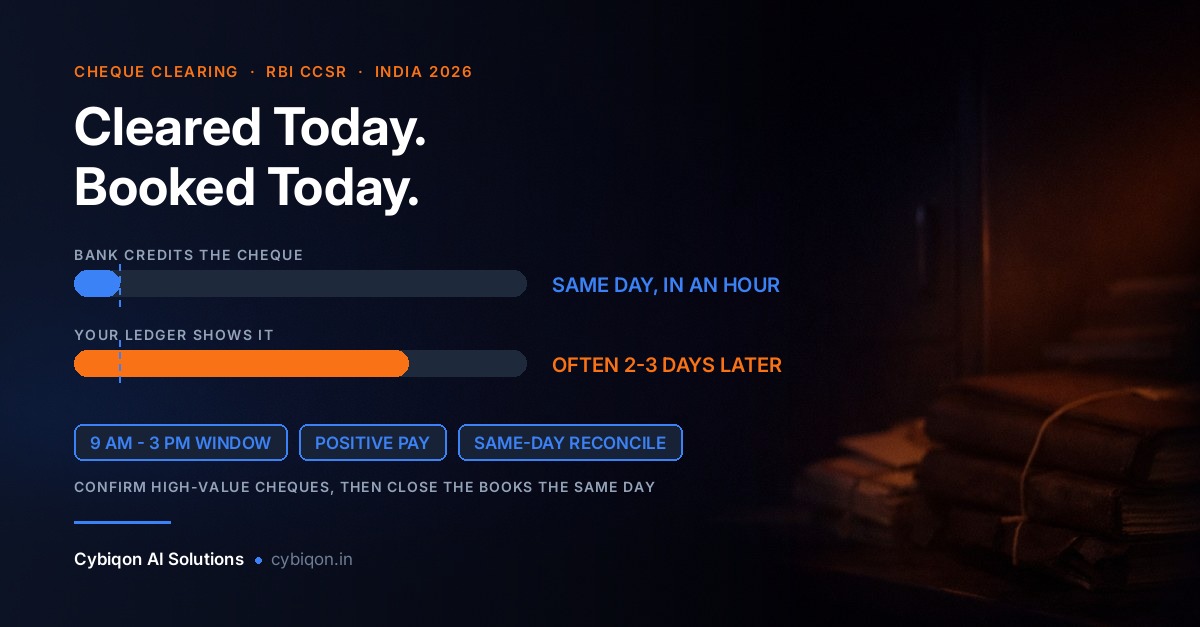
The Real Problem: Your Bank Now Moves in Hours, Your Books Move in Days
Here is an illustrative composite — not a real named firm, and we are attaching no rupee figure to it.
A Ludhiana auto-components unit takes 60–70% of dealer collections by cheque, mostly ₹2–8 lakh each. The old routine: bank the cheque, wait two days, check the passbook. Reconcile twice a week. Release dispatch on the assumption it will clear by Thursday. Returns surface days late — after the goods have left the gate.
Under CCSR, that mismatch got worse, not better. The bank now settles hourly. The books still update on Tuesdays and Fridays. Every hour of that gap is a dispatch decision made on stale information.
The fix is unglamorous and entirely operational:
- Daily bank statement pull, auto-matched to open invoices — not a twice-weekly manual tally.
- Same-day return alerts to the owner and the salesperson who owns that dealer, on WhatsApp or Telegram.
- Dispatch gated on the actual credit, verified against the statement line.
- Register your own issued cheques above your bank's threshold — free, via net banking, so you never hand a customer this problem in reverse. This sits naturally alongside how you already handle vendor payments.
- Move your predictable, repeating collections off cheques entirely. If a dealer pays you every month, collecting it automatically removes the instrument and the risk together.
And one free lever the search results bury: Positive Pay registration costs nothing. RBL Bank, Union Bank and Axis Bank each say so on their own sites. You can register via branch, net banking, mobile app, SMS, and in Union Bank's case WhatsApp through UVCONN. There is no reason a business above the threshold is not doing this on every cheque it issues.
Section 138 Is a Remedy, Not a Cash-Flow Strategy
When a cheque does bounce, the legal route exists. It is just not fast.
As of 20 December 2024, 43,05,932 cheque bounce cases were pending nationwide (Ministry of Law and Justice, Lok Sabha written reply). Cheque dishonour accounts for 49.45% of Delhi trial-court pendency. In 2026, Sumit Bansal v. MGI Developers (2026 SCC OnLine SC 49) confirmed each dishonoured cheque is a separate cause of action, and a 6 January 2026 Supreme Court ruling addressed condonation of delay in filing Section 138 complaints.
Use the remedy when you need it. Do not build your working capital around it.
One genuinely open question: whether a Section 138 case survives a cheque returned for "Positive Pay details not available" rather than for insufficient funds. We found this debated among practitioners, not settled. Ask a lawyer about your specific memo — anyone giving you a confident blanket answer is guessing.
The wider delayed-payments picture: ₹7.34 lakh crore was locked in delayed MSME payments as of March 2024, down from a ₹10.7 lakh crore peak in 2022 (GAME–FISME–C2FO 'Delayed Payments Report 3.0'), with the Economic Survey 2025-26 estimating around ₹8.1 lakh crore. Up to 31 December 2025, 2,56,892 applications worth ₹55,244.31 crore had been filed.
Two current facts most articles still get wrong:
- MSME Samadhaan stopped accepting new filings on 15 October 2025 (Ministry announcement, 3 October 2025). All new delayed-payment references now go to odr.msme.gov.in. Samadhaan tracks legacy cases only.
- The MSMED (Amendment) Bill 2026 was introduced in the Rajya Sabha on 28 July 2026. It retains the 45-day payment rule and 3x-bank-rate compound interest, and adds provisions for enforcing MSEFC arbitral awards.
FAQs
Is Positive Pay mandatory in India in 2026?
Not nationally. RBI's 2020 circular requires banks to enable Positive Pay at ₹50,000 and above, with use at the account holder's discretion, and says banks "may consider" making it mandatory at ₹5,00,000 and above. That is a permission, not a mandate. Individual banks have made it mandatory at their own thresholds — anywhere from ₹50,000 to ₹10 lakh. Check your bank's published page.
Will my cheque bounce if I don't register Positive Pay details?
It can be returned, yes. Axis Bank's own document lists the return reason "Positive Pay details not available" for ₹5,00,000 cheques; other banks use "Advice not Received." Separately, RBI's circular limits CTS-grid dispute resolution to compliant cheques — so an unregistered cheque loses that route. If you are the payee, the return memo hits your statement even though the omission was the drawer's.
Do cheques clear the same day now?
Often, yes. Under CCSR Phase 1, live since 4 October 2025, settlement is arrived at every hour from 11:00 AM and the presenting bank must release funds within one hour of successful settlement. But same-day credit is not the same as finality — a credited cheque can still be returned. Gate dispatch on verified credit, not on the first line item you see.
Did RBI's 3-hour clearing rule actually start on 3 January 2026?
No. RBI's circular of 24 December 2025 stated plainly that "Implementation of Phase 2 is being postponed, until further notice, to allow more time for banks to streamline their operations." Phase 2 has not been re-notified as of August 2026. What is live is Phase 1's hourly settlement, plus the revised session timings.
What time should I deposit a cheque for same-day credit?
The presentation session runs 09:00 AM to 03:00 PM after RBI modified the timings in the 24 December 2025 circular; the confirmation session runs 09:00 AM to 07:00 PM. Bank before noon to be safe, and confirm your branch's own internal cut-off, which is usually earlier. Ignore any guide still printing the old 10 AM–4 PM window.
Where do MSMEs file delayed-payment complaints now?
At odr.msme.gov.in. MSME Samadhaan stopped accepting new filings on 15 October 2025 and now only tracks legacy cases.
Where Cybiqon Fits
Cybiqon AI Solutions is a two-person LLP in India that builds websites, apps and AI automation for MSMEs — and this is exactly the kind of gap we close. Your bank now moves in hours; most MSME books still move in days. We build the automation that closes that gap: a daily bank-statement-to-invoice matching job, same-day cheque-return alerts pushed to the owner and the salesperson on WhatsApp or Telegram, and a Positive Pay threshold reminder on every cheque your business issues.
It plugs into what you already run — no rip-and-replace. If your accounts stack is the bottleneck, that same reconciliation layer is often what makes a lighter accounting setup viable in the first place.
No jargon, no enterprise pricing. Have a look at cybiqon.in, or just tell us what breaks in your receivables cycle — +91 9250711473 or [email protected].
The Takeaway
The Positive Pay System for business cheques in India in 2026 is set by your bank, not by a national mandate — thresholds run from ₹50,000 to ₹10 lakh, so check your own page and your top dealers' too. CCSR Phase 1 made clearing hourly; Phase 2 is postponed and unnotified; the presentation window is 09:00 AM–03:00 PM, not 10 AM–4 PM. Registration is free. The real risk is not the rule — it is that your bank now clears in hours while your books reconcile in days. Close that gap, and cheque collections stop being a surprise.
Want this set up for your business?
Book a free call — no tech jargon, no sales pressure. Just honest answers.
What we build for this: AI agents & automation