Payment collection app for distributors: how beat collections by salesmen go missing (salesman-written receipts, personal UPI, adjust-next-bill, teeming and lading), free controls (numbered receipt books, same-day deposit, company QR via TallyPrime Payment Request, monthly Confirmation of Accounts, beat rotation), and an owned app with company WhatsApp receipts, bill-wise Tally posting and day-end handover checks
Payment Collection App for Distributors: Who Writes the Receipt?
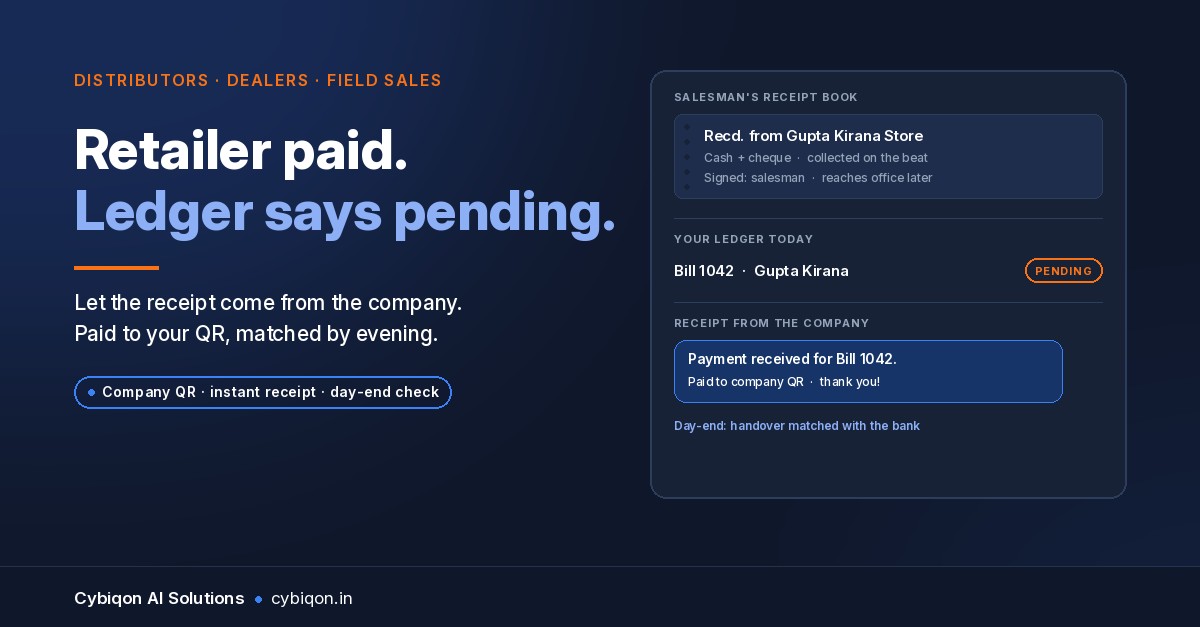
"But I already paid your salesman." If a retailer has ever said this to you, and your ledger said otherwise, this post is for you.
Picture a pharma, FMCG, plywood or paint distributor with 5 to 30 salesmen, each visiting dozens of retailers on a beat. They collect cash, cheques and UPI, write a paper receipt and hand the money over a few days later. A payment collection app for distributors is supposed to close that loop. Most only digitise the salesman's receipt book. The receipt is still written by the person holding the money.
That gap is costly. In South Goa this year, an ice cream distributor's salesman collected ₹2,24,207 in cash and UPI from shopkeepers between March and May 2026. He gave them "valid receipts" and never deposited the money (Daijiworld, 7 Sep 2026). The owner only found out by checking his ledger against shopkeepers who had paid in full.
This guide covers how collected money goes missing without anyone noticing, the free controls to put in place this week, and what an app should actually do. It also says honestly when you don't need one.
How beat collections go missing without anyone noticing
Most salesmen are honest. But the usual system gives an honest salesman no proof, and a dishonest one plenty of cover. Four gaps do most of the damage:
- The salesman writes the receipt. A paper receipt proves only that the salesman wrote something. The Goa shopkeepers had receipts, and the money still never reached the company.
- The retailer pays the salesman's own UPI. NPCI recorded 25.47 billion UPI transactions worth ₹31.53 lakh crore in October 2026 (Free Press Journal). Your retailers already pay by UPI. The question is whose UPI. A payment to a personal VPA never touches your bank statement.
- "Adjust it in the next bill." Collections are netted off against fresh orders verbally, so nothing in the books matches what actually changed hands.
- Late payment looks normal. Recordent's 2026 receivables report (about 1.1 lakh businesses) found an average payment cycle of 73 days, while 82.6% of invoices are on 0–30 day terms (MediaBrief, 29 Jun 2026). When everyone pays late, "the retailer hasn't paid yet" and "the retailer paid and the money is sitting with someone" look identical in your ledger.
A case of salesman collection fraud from Pune in August 2024 shows how long this can run. A salesman at a wholesale drug distributor in Sadashiv Peth, trusted for seven years to take orders, deliver and collect, kept ₹11,80,666 from 14 retailers in Kondhwa and Undri over about three months. The total missing came to ₹29,04,871. The owner found out only after the salesman stopped coming in and switched off his phone, when he rang the retailers and they said they had paid (The Bridge Chronicle, 30 Aug 2024).
What is teeming and lading, and how does it hide missing collections?
Teeming and lading (also called lapping) is the oldest trick in collections. A salesman keeps Retailer A's ₹40,000. When Retailer B pays a week later, he hands in B's money but credits it to A's account. A's balance now looks clear and B's looks overdue. Then C's payment covers B, and so on.
Nothing looks badly wrong. Every retailer is a little late, and nobody is wildly overdue. The shortfall rolls forward until someone confirms balances directly with the retailers, or the salesman leaves. The Bombay Chartered Accountants' Journal lists "teeming and lading of collections" among the misuses auditors look for.
Signs worth watching in your ageing analysis in TallyPrime:
- One salesman's beat steadily ageing a little worse than the others
- Payments credited to a retailer that don't match the amount on any of their bills
- Retailers who "always pay" suddenly slipping by one cycle
- Receipts from one beat bunching up just before month-end or an audit
How to check whether a retailer has actually paid your salesman
Ask the retailer, not the salesman. That is the whole principle. Auditors do the same thing: under SA 505, balance confirmations go directly to the third party, never through the person who handles the money.
The global numbers say why it works. The ACFE's Occupational Fraud 2026: A Report to the Nations (2,402 cases across 143 countries) found a typical employee fraud runs about 12 months before it is caught. Theft of cash or stock makes up about 90% of cases, and 43% are uncovered by a tip rather than an audit (Brady Ware summary). These are global figures, not Indian ones. But for a distributor, the "tip" is almost always a retailer saying "I already paid".
You can make that tip arrive in 30 days instead of 12 months.
Send a balance confirmation letter to debtors every month from TallyPrime. TallyPrime prints Confirmation of Accounts letters for one ledger or in bulk: press Alt+P, go to Others, and choose Report Type: Confirmation of Accounts (Tally Help). Send it from the office, by WhatsApp or email, to the retailer directly. Do not hand it to the salesman to deliver.
In the Pune case, a monthly confirmation to those 14 retailers would likely have shown the first unposted payment within about a month, instead of after three.
Free controls to start with, before any cash collection app
Good salesman cash collection control doesn't need software. Start here:
- Numbered receipt books, issued and returned. The office logs which book each salesman holds. Every page, including cancelled ones, comes back. A missing page number is a question to ask.
- Same-day deposit. Cash and cheques go into the bank, or to the office, the same day. This protects the salesman too. In Chennai in September 2026, a sales manager carrying ₹24,00,760 in collections from medicine distributors was robbed at knifepoint in Adyar by a six-member gang (Medical Dialogues, 27 Sep 2026). Cash carried for days is a risk even when everyone is honest.
- UPI to the company QR only, never the salesman. Tell every retailer in writing. TallyPrime's Payment Request feature can print your company's UPI QR or payment link on each invoice, so the retailer pays the company directly from the bill (Tally Help).
- Monthly Confirmation of Accounts, sent by the office as above.
- Rotate beats. Move salesmen between beats every few months, or have a second person visit each beat now and then. Lapping needs the same hands on the same accounts to keep rolling.
- Post every receipt bill-wise. Enter each receipt voucher in Tally against the specific invoice ("Agst Ref"), not "On Account". Our guide on matching customer payments to invoices in Tally walks through it. Cheques dated ahead need their own register; see post-dated cheque management in TallyPrime.
Explain the reason to your team as protection, not suspicion. A salesman whose every collection is confirmed by the company can never be wrongly blamed for a retailer's "I paid".
What a payment collection app for distributors should actually do
Most collection apps on the market (SalesOn, Marg eOrder, Distributo and others) let a salesman log full or partial collections against invoices. That is useful. But the entry is still typed by the salesman, so the app records what he says he collected. It's a neater receipt book.
The part that closes the gap is an independent channel to the retailer, plus a day-end check against the bank. Here's how the three setups compare:
| Check | Paper receipt book | Typical collection app | Owned app with company receipt |
|---|---|---|---|
| Who tells the retailer the payment was received | Salesman | Salesman (via app) | Company WhatsApp number, instantly |
| UPI goes to | Often the salesman | Varies | Company QR only |
| Posted against the bill in Tally | When the office gets to it | Sometimes, with sync | Same day, bill-wise |
| Collected vs deposited checked | Monthly, if at all | Rarely | Every evening, against bank and cash book |
| When a missing payment shows | When the retailer complains | When the retailer complains | That evening, or at the next retailer receipt |
A field collection app with WhatsApp receipts works like this. Say a salesman records a ₹15,000 cash payment from a hardware shop in Ludhiana. Within seconds the shop gets a WhatsApp message from the company's number: "Received ₹15,000 against Bill 2231, balance ₹8,400." If the salesman records less than he took, the retailer sees the wrong figure straight away. If he records nothing, the retailer gets no receipt and has a reason to ask.
At day end, the app lists what each salesman collected. The office checks it against cash handed in, cheques and the bank statement. Anything that doesn't match is flagged that evening, not months later.
When a payment collection app for distributors is not needed
Be honest about scale. You probably don't need an app if:
- You have three or four salesmen and the owner personally reconciles every evening
- Most retailers already pay by NEFT or company QR, and cash is rare
- The monthly Confirmation of Accounts comes back clean, month after month
In those cases the free controls above are enough. Spend the money elsewhere.
A cash collection app starts paying for itself when you have 10 or more salesmen, hundreds of retailers, a lot of cash and cheques, and an accounts team that can't confirm balances with every retailer every month. That's the point where a company receipt on every collection does the confirming for you.
Build or buy a DMS? Before choosing any app for payment collection, decide what you're solving. A full distributor management system does ordering, schemes, stock and collections. If you need all of that, buy one. If ordering already works and your problem is specifically the collection gap, a smaller app built around your beats and your Tally ledgers can be the cleaner fit, and you own it. Check two things either way: does the retailer get a receipt from the company, and is there a daily collected-vs-deposited check? If you also want to track visits and routes, our guide to field force management apps covers that side.
If a salesman has already run away with collection money
First, collect evidence: confirmations from each retailer, the receipt book, and your ledger. Then talk to a lawyer.
The Goa cases were filed under Section 316(4) of the Bharatiya Nyaya Sanhita (criminal breach of trust by a clerk or servant, which replaced IPC 408) alongside cheating under 318. Section 316(4) carries up to seven years' imprisonment and a fine (LawSikho). This is not legal advice, and criminal cases rarely bring the money back quickly. Controls matter more than prosecution. For chasing genuinely late payers, our hub on recovering delayed payments covers the legal and practical options.
FAQs
How do I stop my salesman from keeping cash collected from retailers?
Make sure the retailer, not just the salesman, gets a record of every payment. Use numbered receipt books, require same-day deposit, take UPI only to the company QR, and send a Confirmation of Accounts to every retailer each month from the office.
What is teeming and lading, and how does it hide missing collections?
It means crediting one retailer's payment to another retailer's account to cover an earlier shortfall. The gap rolls forward, so no single account looks badly overdue, until balances are confirmed directly with the retailers.
How do I check whether a retailer has actually paid our salesman?
Ask the retailer directly. Send a balance confirmation from TallyPrime (Alt+P > Others > Report Type: Confirmation of Accounts) by WhatsApp or email from the office, and follow up any difference.
Should retailers pay the salesman's UPI or the company QR?
Always the company QR. A payment to a salesman's personal UPI never appears in your bank statement. TallyPrime Payment Request can print your company QR on every invoice.
How often should salesmen deposit cash and cheques collected on the beat?
The same day. It shortens the window for lapping and reduces the risk of carrying cash, as the Chennai robbery in September 2026 showed.
Get a collection app built around your beats
If the free controls aren't enough at your scale, Cybiqon can build a collection app for your salesmen on Android. Every collection triggers a WhatsApp receipt to the retailer from your company number and posts against the retailer's bill in Tally. Each salesman's day-end handover is checked against the bank and cash book, so a missing payment shows up the same evening.
It's written for your beats, your ledgers and your rules about cash, cheques and UPI, not configured from a template. You own the code. Android app builds start at ₹29,999 and are scoped per build.
Book a 30-minute call, WhatsApp or call +91 9250711473, or write to [email protected] with the word "collections".
Conclusion
Collections go missing when the only proof a retailer paid is a receipt written by the person holding the money. Fix that first with free controls: numbered books, same-day deposit, company QR only, monthly Confirmation of Accounts and beat rotation. These protect honest salesmen as much as they protect you.
When you have too many salesmen and retailers to confirm by hand, a payment collection app for distributors should send the retailer a company receipt and check every evening's handover against the bank. If that's where you are, Cybiqon is happy to talk it through.
Want this set up for your business?
Book a free call — no tech jargon, no sales pressure. Just honest answers.
What we build for this: Android apps