RTO vs RVP: full forms, charges, QC and claim windows for marketplace sellers
RTO RVP Full Form: RTO vs RVP for Amazon, Flipkart, Meesho
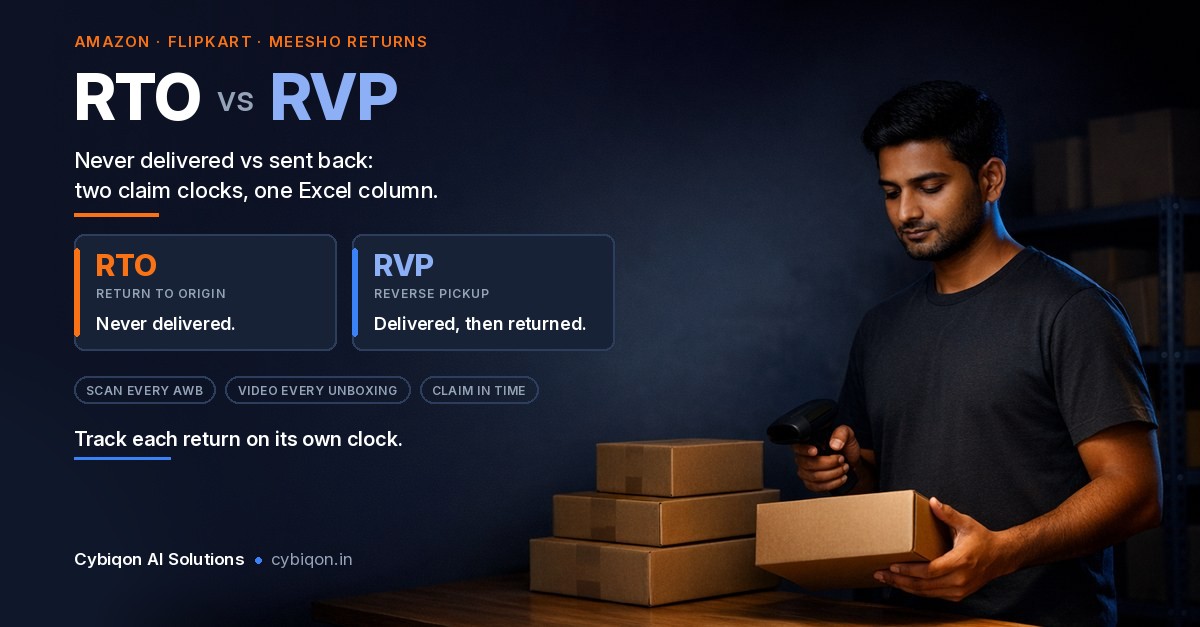
RTO full form is Return to Origin. RVP full form is Reverse Pickup. The one-line difference: an RTO is an order that never reached the customer and is sent back to you, while an RVP is a return the courier collects from the customer after delivery. Amazon's own shipping blog puts it plainly: "Unlike a customer return, an RTO occurs before the customer receives the product."
That is the whole RTO RVP full form answer, and if you sell a few hundred orders a day across Amazon, Flipkart and Meesho, it matters more than it looks. The two events are charged differently, quality-checked differently and claimed under different rules, each with its own clock. Most sellers' returns sheets have one column for both.
The timing is not great either. Amazon's Great Indian Festival opened on 8 Oct 2026 and Flipkart's Big Billion Days on 9 Oct, with Diwali on 8 Nov. Festive RTOs and customer returns will land through late October and November, which is exactly when the shortest claim windows start running out.
Below: a definition table, a platform-by-platform claim table (including where a platform publishes no number), QC vs non-QC pickup in plain words, and the returns register that stops money leaking through the gap.
RTO RVP Full Form: The Definition Table
Here is the side-by-side, worth pinning up wherever returns get opened.
| RTO — Return to Origin | RVP — Reverse Pickup | |
|---|---|---|
| When it happens | Before the customer receives the order | After delivery, when the customer returns it |
| Why | Refused at the door, COD not paid, customer unreachable, address failed | Wrong size, damaged, not as described, changed mind |
| Who last held the parcel | Only the courier | The customer, then the courier |
| Doorstep quality check | No — nobody accepted the parcel | Possible, if it is a QC pickup |
| What it costs you | Shipping both ways and no sale | Return shipping (platform-dependent) plus the refund |
| Typical courier label | RTO | RVP, reverse pickup, or DTO (Delhivery) |
| What goes wrong on arrival | Parcel tampered with or short in transit | Empty box, used item, wrong product sent back |
Two things trip people up. First, couriers use different words. Delhivery's rate card bills RTO and reverse pickups as separate shipment types, and labels reverse pickups as DTO. If your Delhivery invoice shows DTO lines, those are your RVPs, not your RTOs.
Second, the money logic is opposite. An RTO is a logistics loss: per Amazon Shipping India, the seller pays shipping both ways and earns nothing. An RVP is a sale that is being unwound, and the risk is what is actually inside the box when it comes back. The status "QC Passed" on a reverse pickup does not settle that question, which is the whole subject of our explainer on what RTO QC passed really means.
RTO vs RVP: Why the Difference Shows Up in Your Settlement
Think of rto vs rvp as two different leaks that happen to arrive through the same warehouse door.
RTO is mostly a COD problem. Shipway's ShipNotes FY25 data, cited by Amazon Shipping India in June 2026, puts RTO at around a quarter of COD orders against under 2% for prepaid. Razorpay (June 2026) and ShipPrime (July 2026) give a similar range: 25–30% for COD, 2–3% for prepaid. Fixing RTO is about who you ship to, which pincodes, and how fast you confirm the order. Our hub guide on how to reduce RTO in ecommerce covers that end to end, and if couriers are marking "customer unavailable" without trying, you can prove a fake delivery attempt before it becomes an RTO.
RVP is mostly a product and fraud problem. EasyEcom's Commerce Index 2025 Annual Review, built on real order data from merchants selling on Amazon, Flipkart, Meesho and Shopify, puts the overall return rate at 16.2% in 2025, down from 24.8%. Fashion ran at 26% in its Q4 2025 preview, against 8% for beauty and 14% for personal care.
That report does not split RTO from customer returns. Neither, probably, does your sheet. That is the blind spot. If "returns" is one number, you cannot tell whether a bad month came from COD buyers in a few pincodes (an RTO fix) or a kurta whose sizing runs small (a product fix). You also cannot tell which returned parcels still have a claim window open.
The volume is large. Redseer estimated Rs 1.15 lakh crore of online GMV in the 2025 festive month, roughly Rs 25,000 crore of it in the first two days. No 2026 results are published yet, but the returns from this season's spike are already on their way.
Beyond the RTO RVP Full Form: Claim Windows by Platform
This is where RTO and RVP part ways. Each marketplace runs its own claim programme, with a different clock that usually starts when the return reaches you. Where a platform publishes no number, the table says so rather than guessing.
| Flipkart (SPF) | Meesho | Amazon India (SAFE-T) | |
|---|---|---|---|
| Claim window | 14 days from receiving the returned product (per Flipkart's SPF FAQ — confirm in Seller Hub) | 7 days from receiving the return | Not published publicly for India |
| Reopen / resolution | Reopen a rejected claim within 7 days; resolution around 12 days | Not published | Not published |
| Evidence asked for | Clear photos from all angles, shipping label, description of the damage | Barcode visible from all sides; RTO claims only if Meesho-branded packaging was used | Evidence of the product itself — packaging and seal damage no longer qualify (below) |
| Exclusions to know | RTOs sit outside the customer-returns "Approved" tab | Accept every RTO and return packet, tampered or not, then claim | From 1 Aug 2025, Easy Ship, Self-Ship and Seller Flex claims not accepted for primary packaging/box damage or broken/open seals |
| Return shipping fee | No public reverse-fee figure found | Weight-based fee on customer returns; no return shipping fee on RTOs (confirm in the Supplier Panel) | Varies by programme; not covered here |
A few notes on reading this table honestly:
- Flipkart SPF claim time limit. The 14-day window comes from Flipkart's SPF FAQ document, and we could find no newer public version. Treat it as the working number and check Seller Hub before relying on it.
- Meesho wrong return claim. Seven days is the shortest window of the three. Meesho's revised SOP (effective 15 Mar 2023) tells suppliers to accept every packet and then raise a claim for wrong, damaged, used or short items. Refusing a suspicious parcel at the door is not the route.
- Amazon SAFE-T claim India. Amazon India does not publish a SAFE-T filing window publicly. Third-party blogs quote 7, 30 or 60 days; none of those is an Amazon India figure, so do not plan around them.
On charges, Meesho is the clearest official example of RTO and RVP being billed differently. Even there, Shiprocket noted in February 2026 that RTO reverse costs "may be adjusted in seller settlements", which is one more reason to match every return against the settlement line, as covered in our guide to Amazon and Flipkart seller reconciliation.
QC Pickup vs Non-QC Pickup: What It Means for Reverse Pickups
Search "non QC pickup meaning" and you mostly get guitar forums. Here is the plain answer for reverse pickups.
QC pickup (quality-checked reverse pickup). The pickup executive checks the item at the customer's door before collecting it: does the product match the order, are the seals and tags attached, are there stains or signs of use. If it fails, the executive can refuse to collect. Shiprocket's support pages confirm the pickup executive declines a return that fails QC.
Non-QC pickup. The courier collects whatever the customer hands over. No check happens at the door, so any problem (empty box, a different product, a used item) surfaces only when someone opens the parcel in your warehouse.
QC costs more, and the couriers price it openly:
- Delhivery adds a QC charge on "Quality Check RVP" shipments.
- Amazon Shipping's C-Returns service for India (from July 2026) charges a quality-checks fee only when doorstep checks are actually performed.
The practical rule: QC pickup suits high-value or frequently abused SKUs, where one bad return costs more than the QC fee on many good ones. Non-QC suits low-value items, but it shifts all the checking onto your unboxing desk, and that only works if the unboxing is recorded against the AWB. Even a doorstep QC is a few seconds of looking; it is not a contents audit.
Who Pays the Shipping on an RTO vs a Customer Return?
Short version, using only what the platforms and couriers publish:
- On an RTO, you do. Amazon Shipping India describes it as shipping both ways with no sale. Shiprocket's RTO charge covers the return journey, based on weight and zone. Meesho is the exception on its own platform: it states no return shipping fee on RTOs, though settlements can still carry adjustments.
- On an RVP, it depends on the platform and the reason. Meesho charges a weight-based return shipping fee on customer returns. Flipkart publishes no reverse-fee figure we could verify. A QC pickup adds a QC fee on top, where the courier offers one.
RTO and RVP charges arrive on different documents, at different times, under different names. A sheet with one "returns" column cannot reconcile them.
Why One "Returns" Column in Excel Loses Money
Here is the setup in most marketplace businesses at a few hundred orders a day. One person keeps returns in a sheet. RTO and RVP share a column. Parcels are opened when someone is free, and the unboxing is not logged against the AWB. Claims are raised from memory, if at all.
Now take an illustrative week (not a client, just arithmetic). Say a seller ships 300 orders a day across the three marketplaces and 40 returned parcels arrive on a Monday. Some are RTOs, some are RVPs, from three platforms with three windows. Five of the RVPs contain a problem: one empty, two wrong items, two damaged products.
- The Meesho ones need a claim within 7 days of receipt.
- The Flipkart ones have 14 days under SPF.
- The Amazon ones have a window Amazon does not publish, and box or seal damage no longer qualifies, so only evidence of the product itself helps.
If those five parcels sit in a pile until Friday, the Meesho clock is already more than half gone. If the unboxing was not filmed against the AWB, the evidence may not exist. And this is not hypothetical risk. An Amazon India seller's Change.org petition (July 2026) describes five customer returns, two of which contained items that were not theirs, one a completely different product. The seller had photos, an unboxing video and CCTV, and SAFE-T still auto-denied the claims. Meesho sellers have also reported rejections despite packing and CCTV video (Voxya complaints, 2021–2025, anecdotal).
Evidence does not guarantee a claim. But no evidence, filed late, guarantees a loss.
The Returns Register: Return Reconciliation for Amazon and Flipkart Sellers
What fixes this is not a better spreadsheet. It is a small internal tool, a returns register, and it is what Cybiqon would build for this problem. It does four jobs:
- Reads the return reports from Amazon, Flipkart and Meesho and marks every returned AWB as RTO or RVP, so the two never share a column again.
- Logs every arrival at the door. The parcel is scanned, the unboxing video is saved against that AWB, and the receipt is dated. That date is when most claim clocks start.
- Flags mismatches with a countdown. Not received, empty, wrong item, damaged product: each gets a deadline set by its platform's window, with an alert before it runs out.
- Reports RTO and RVP separately. RTO-heavy pincodes and COD cohorts in one view, product-quality returns by SKU in another, so the fix for each is obvious.
Again, as an illustration of what this changes rather than a measured result: in the week above, the five problem parcels would show up on Monday, matched to their videos, sorted by which deadline lands first. Nobody has to remember anything.
FAQs
What is the full form of RTO and RVP in e-commerce?
RTO stands for Return to Origin: an order that never reached the customer and is sent back to the seller. RVP stands for Reverse Pickup: a return the courier collects from the customer after delivery.
What is the difference between RTO and RVP?
The difference is timing. An RTO happens before the customer receives the order, so only the courier handled it. An RVP happens after delivery, so the customer had the product. That is why they are charged, quality-checked and claimed differently.
What does non-QC pickup mean?
A non-QC pickup is a reverse pickup where the courier collects the parcel without checking the product at the door. Any problem, such as an empty box or wrong item, is found only when you open it in your warehouse.
How many days do I have to claim a wrong or empty return on Flipkart, Meesho or Amazon?
Meesho allows 7 days from receiving the return. Flipkart SPF allows 14 days from receiving the returned product, per Flipkart's SPF FAQ; confirm in Seller Hub. Amazon India does not publish a SAFE-T filing window publicly.
What is DTO in Delhivery?
DTO is how Delhivery's rate card labels reverse pickups. They are billed as a separate shipment type from RTO, so DTO lines on a Delhivery invoice are your customer returns, not your undelivered orders.
Want a Returns Register Built for Your Warehouse?
If your returns live in one person's sheet and claims keep missing the window, this is a build, not a subscription. Cybiqon would write a returns register for your flow: it reads your Amazon, Flipkart and Meesho return reports, separates RTO from RVP, ties each returned AWB to a door scan and an unboxing video, and alerts your team while each claim window is still open. It is written for your business rather than configured from a template, built by the founders, and you own every line of the code.
Our admin panels and internal tools start from ₹29,999 one-time, scoped per build, with a typical 4–6 week timeline. Book a 30-minute call, or reach us on +91 9250711473 or [email protected].
Conclusion
The RTO RVP full form is simple: Return to Origin means the order never reached the customer; Reverse Pickup means it did, and came back. Everything else follows from that. RTO is a logistics and COD problem; RVP is a product and evidence problem, and each marketplace gives you a short, different clock to claim on it. Split the two in your records, date every arrival, film every unboxing against its AWB, and the festive returns wave becomes a list with deadlines rather than a pile. If you would rather have that list built than kept by hand, Cybiqon is a call away.
Want this set up for your business?
Book a free call — no tech jargon, no sales pressure. Just honest answers.
What we build for this: Admin panels & internal tools