Mandatory TReDS settlement for CPSE procurement from MSMEs
TReDS Is Now Mandatory for CPSEs: What It Really Means for MSME Suppliers
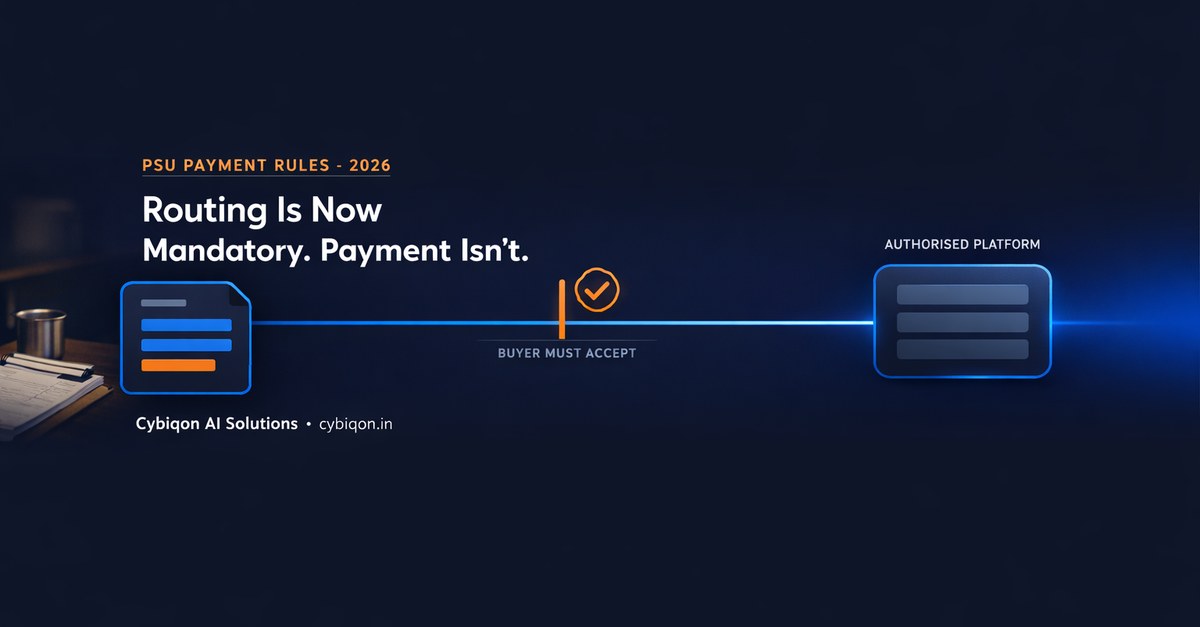
If you supply a Central PSU and you saw the headlines in July, you would be forgiven for thinking your cash-flow problem had just been solved by notification. "Government mandates TReDS for all MSME invoices." "PSUs must now pay MSMEs faster." "Faster payments, stronger MSME."
The mandate is real. It is genuinely useful. And it does not say that PSUs must pay you faster.
What it says is that they must route the settlement of your invoice through a particular kind of platform. Routing is not financing, and financing is not free. Between the notification and money reaching your bank account there is still one gate that nobody in the coverage seems to mention, and it is controlled entirely by your buyer.
This post is about what actually changed, what it gets you, and what it leaves exactly where it was.
What exactly changed on 30 June 2026?
On 30 June 2026 the Ministry of Micro, Small and Medium Enterprises notified, under Sections 9 and 10 of the MSMED Act, 2006, that all operating Central Public Sector Enterprises must route the settlement of invoices for goods and services procured from MSMEs through a TReDS platform authorised by the Reserve Bank of India. The notification took effect the same day.
Three obligations land on the CPSE:
- Route MSME invoice settlement through an RBI-authorised TReDS platform. Not "consider". Not "where feasible".
- Prove it at audit. The CPSE must obtain a statutory auditor's certificate confirming TReDS registration and compliance during its annual audit.
- Disclose it. The CPSE must disclose details of MSME invoices routed and settled through TReDS in the format specified by the RBI.
There are no turnover thresholds and no stated exemptions. Every operating CPSE is covered.
That third obligation is the one to watch as a supplier. A registration mandate with no disclosure requirement produces a tick-box exercise. A mandate that has to survive a statutory auditor and appear in a disclosure format set by the regulator is much harder to perform on paper only.
Is the MSMED (Amendment) Act 2026 in force yet?
No — and the distinction matters, because two different instruments now say similar things.
The Micro, Small and Medium Enterprises Development (Amendment) Act, 2026 passed the Rajya Sabha on 3 August 2026 and the Lok Sabha on 7 August 2026, and received Presidential assent on 13 August 2026. It is an Act, not a Bill.
But assent is not commencement. The Act comes into force on such date or dates as the Central Government appoints by notification in the Official Gazette, and different dates may be appointed for different provisions. As of today, the Amendment Act has been assented to and has not been brought into force.
So if you are wondering which rule binds your buyer right now, it is the 30 June notification — not Section 15A.
| 30 June 2026 notification | MSMED (Amendment) Act 2026, s.15A | |
|---|---|---|
| Instrument | Executive notification under ss. 9 & 10, MSMED Act 2006 | Primary legislation |
| Status today | In force (effective 30 June 2026) | Assented 13 Aug 2026, commencement not yet notified |
| Who is bound | All operating CPSEs | All CPSEs |
| Can it be widened? | No | Yes — Centre and States may extend the requirement to other notified authorities, bodies, public sector enterprises and entities |
That last row is the part worth filing away. Today only CPSEs are bound. State PSUs are not. Private buyers are not. But once Section 15A commences, the government has an express power to extend the same settlement requirement to other notified entities without going back to Parliament. If you supply a state-owned utility or a large private buyer, nothing has changed for you yet — and the machinery to change it now exists.
Does the TReDS mandate mean CPSEs must pay MSMEs faster?
This is the question the coverage gets wrong, so it is worth being blunt.
The mandate compels the CPSE to route settlement through the platform. It does not compel anyone to finance your invoice, and it does not shorten the payment term your contract specifies. The MSME retains the discretion: you may use the platform for settlement only, or you may choose to have the invoice discounted. The mandate applies to routing, not to compulsory financing.
If you want the money before the due date, that is discounting — a financier pays you early and takes a cut. You get paid faster because you paid for it, not because the notification made your buyer generous.
If you do nothing, the invoice settles through the platform on its due date. Which is better than an invoice lost in a shared inbox, but it is not the transformation the headlines promised.
What is a factoring unit, and why does buyer acceptance decide everything?
Here is the gate.
On TReDS, an uploaded invoice is not yet a financeable asset. It becomes a factoring unit only once the buyer accepts it on the platform. Only accepted factoring units are put out to auction, where banks and NBFCs bid to discount them. An invoice the buyer has disputed, or simply not acted on, cannot be financed at all.
If your factoring unit is never accepted, you are back to relying on the buyer to settle in the ordinary course of business, outside TReDS entirely — exactly the position you were in before 30 June.
This is why "PSUs must now pay MSMEs faster" is the wrong summary. The notification moved the rail. It did not remove the buyer's ability to sit on an acceptance, and it did not resolve what happens when a buyer raises a quality or quantity discrepancy to stall.
There is a related point about risk that is often oversold. TReDS financing is without recourse to the MSME seller: if the buyer defaults after your invoice was discounted, the financier's claim is against the buyer, not you. That protection is real and valuable. But it only applies if financing actually happened. An unaccepted invoice never enters the financing process, so there is nothing for the non-recourse protection to attach to. The mechanics of discounting, settlement timelines and the ₹250 crore buyer-registration rule are covered in more depth in our guide to TReDS invoice discounting for MSMEs.
Who is covered, and who is not?
Covered today: all operating Central Public Sector Enterprises, for procurement of goods and services from MSMEs.
Not covered today: state public sector undertakings, municipal bodies, private corporate buyers, and any entity the Centre or a State has not notified. Large private buyers above ₹250 crore turnover already have a separate obligation to register on TReDS, but that is a registration duty — not the settlement-routing duty created here.
If most of your receivables sit with private buyers, this notification does not touch them, and the ₹8.1 lakh crore problem the Economic Survey 2025-26 describes remains mostly a private-sector problem. Statutory recovery — the MSEFC route, MSME Samadhaan, and the ODR portal — is still the instrument for those, and we cover that ladder in detail in how to recover delayed payments for MSMEs in India.
What must an MSME actually do to get paid through TReDS?
This is the practical part, and it starts with a document most suppliers assume is a formality.
Your Udyam Registration Certificate is the eligibility gate. Only an enterprise with a valid Udyam registration can onboard as a seller. Under the 2026 framework the platform operator carries an explicit obligation to validate that a registered seller is a genuine MSME — checking not just that a Udyam certificate exists but that it is current.
That word does real work. Udyam registration is subject to annual self-certification, and an enterprise can lapse or be reclassified as its investment and turnover change. A supplier who registered years ago, crossed a threshold, and never updated the record can find the certificate failing validation at precisely the moment a large PSU invoice needs routing.
The rest of the checklist:
- A bank account in the enterprise's own name, verified on the platform. Under the 2026 framework, discounted funds are credited only to the seller's own verified account. A proprietor using a personal or family account will hit friction here.
- Onboarding on at least one authorised platform. There are five active TReDS platforms: RXIL, M1xchange, Invoicemart, C2treds and DTX. A great deal of vendor content still says there are three — that is out of date.
- Practical onboarding time is usually three to seven working days, based on platform guidance rather than any regulatory standard, so treat it as indicative.
- Invoices your buyer can accept without a query. Correct purchase-order reference, correct GST details, quantities matching the goods receipt, supporting documents attached.
Note which platform your CPSE buyer is registered on before you pick yours. Both parties have to be on the same platform for an invoice to be routed through it.
What did the RBI Master Direction 2026 change for sellers?
Alongside the settlement mandate, the RBI consolidated its TReDS rules. Master Direction RBI/DPSS/2026-27/406, issued 23 June 2026 under Section 18 read with Section 10(2) of the Payment and Settlement Systems Act, 2007, replaced the earlier patchwork of circulars and took effect immediately.
Most of it governs platform operators, but four changes reach the seller:
- Onboarding got lighter. The due-diligence burden previously placed on MSME sellers was removed, replaced by an obligation on the platform to validate MSME status and lock settlement to the seller's own bank account. Less paperwork for you; more verification duty on them.
- Financiers can now use government credit guarantee cover. A financier may obtain guarantee cover from any Credit Guarantee Fund Trust set up by the Government of India. Buyer default risk is priced into the discount rate you are offered, so anything that lets a financier lay off that risk should, in principle, narrow the spread.
- Insurance premiums cannot be charged to MSME sellers, even where a financier uses insurance cover on a TReDS transaction. This closes a hidden-cost route.
- Re-discounting is explicitly permitted — a financier may further discount a factoring unit it already holds. This is a liquidity feature for financiers rather than a direct seller benefit, but deeper financier liquidity tends to show up as more competitive bidding.
For completeness on the operator side: platforms must maintain a minimum net worth of ₹25 crore on an ongoing basis, certified by their statutory auditor, and existing operators have until 31 March 2028 to comply.
What does early payment cost, and who bears it?
Honestly: you do, if you choose it.
Discounting on TReDS works by auction. Financiers bid, and you accept a bid. The rate reflects the perceived credit risk of your buyer, not you — which is the structural advantage of the model, and why a CPSE receivable should price better than the same invoice on a small private buyer. Competitive bidding and the new credit-guarantee route both push in the direction of tighter rates.
But it is still a cost, deducted from the amount that reaches you. Beware of vendor content that describes the 2026 reforms as shifting costs "from MSME sellers to financiers". Risk allocation did move — the non-recourse structure and the guarantee provisions are real. The discount itself has not stopped being borne by the party who wants the money early.
If your margins are thin, the honest comparison is not "TReDS versus waiting". It is "the discount rate versus what a delay actually costs you" — in overdraft interest, in stalled production, in the order you could not take.
What this does not fix
A short, unglamorous list, because the rest of the internet is not writing it:
- It does not make a buyer accept your invoice. Acceptance remains a buyer action, and a disputed invoice cannot be financed.
- It does not shorten your contractual payment terms, or override the 45-day rule in either direction.
- It does not cover state PSUs or private buyers — not yet.
- It does not settle a dispute. Quality and quantity disagreements still go to the MSEFC, MSME Samadhaan or the ODR route.
- It does not make early payment free.
- It does nothing for invoices you have not raised correctly. Platform routing does not fix a wrong PO reference.
What the Amendment Act adds on disputes — once it commences
The Amendment Act's dispute-resolution provisions matter to exactly the situation the TReDS mandate cannot help with: the buyer who will not accept. These are not yet in force, but they are worth knowing because they change the arithmetic of stalling.
- Section 18: mediation before the MSEFC or a mediation service provider must be completed within 90 days from the date fixed for first appearance; the Facilitation Council must act within 30 days of mediation terminating. Under Section 18(4A), arbitral awards must be made within 90 days of the completion of pleadings.
- Section 19: a party other than the supplier who challenges an award or mediated settlement must deposit 75% of the amount before a court will entertain the application. Courts may release part of that to the supplier while proceedings run, and must order payment of at least 50% of the awarded amount if the challenge stays pending beyond six months.
- Section 27: graded penalties arrive. A false registration draws a warning first, then ₹1,000–₹50,000. A buyer's Section 22 violation draws a warning, then ₹10,000–₹50,000, then ₹50,000–₹1 lakh for repeat offences. The minimum amounts increase automatically by 10% every three years — a quiet but sensible piece of drafting that stops penalties decaying with inflation.
- Section 7: the cost of pollution control equipment, research and development, and industrial safety devices is excluded when calculating investment in plant and machinery, and classification may apply investment and turnover together. If you have been avoiding a safety or effluent upgrade because it would push you out of your MSME category, re-read that one.
How to make your invoices acceptance-proof
Every practical benefit in this notification is downstream of one thing: an invoice your buyer's team can accept without raising a query. That is not a policy problem. It is a systems problem, and it is the part inside your control.
What that looks like in practice for a supplier with meaningful PSU exposure:
- PO-to-invoice matching before the invoice leaves your office. Line items, quantities, rates and PO reference checked against the order automatically, not by eye at month end.
- Udyam and GST details validated as live data, not typed from memory into a template that was last updated two financial years ago.
- Goods receipt and inspection documents attached at the point of raising, because that is what the acceptance query will ask for.
- Acceptance tracked as a status with an owner and a clock, the way you would track a sales pipeline — so "waiting on acceptance" is a number you can see, not a thing someone remembers.
- Reconciliation of what was routed against what settled, so a short payment is caught in days rather than at year end.
None of this is exotic. Most MSMEs already do all of it, in WhatsApp, in Excel, and in one person's head. That works until you have forty open invoices with three PSU buyers on two different platforms. The same discipline applied on the buyer side is what we describe in accounts payable automation for MSME vendor payments, and the invoice-accuracy layer is covered in AI GST invoice automation.
Get your PSU invoicing workflow built to survive acceptance
Cybiqon builds the unglamorous layer that decides whether a mandate like this actually reaches your bank account: invoicing and document workflows that validate a PSU invoice before it is raised, attach what the buyer's team will ask for, and track acceptance and settlement as data instead of memory.
We work with Indian MSMEs across web, app and AI automation, which means the invoice workflow, the internal dashboard and the follow-up automation are built as one system rather than three tools that do not talk to each other. Scope depends on how many buyers, platforms and document types you are dealing with — that is a conversation, not a package.
If you supply a CPSE and you are chasing acceptance by email today, that is the thing worth fixing before the next quarter's invoices go out.
📧 [email protected] · 📞 +91 9250711473 · 🌐 cybiqon.in
FAQs
Is TReDS now mandatory for all MSME invoices in India?
No. It is mandatory for Central Public Sector Enterprises settling invoices for goods and services procured from MSMEs, under the notification dated 30 June 2026. State PSUs and private buyers are not covered by that settlement requirement, though corporate buyers above ₹250 crore turnover have a separate obligation to register on a TReDS platform.
Does the CPSE TReDS mandate mean I get paid faster automatically?
No. The mandate requires the CPSE to route settlement through the platform. Getting paid before the due date means having the invoice discounted by a financier, which costs you a discount. If you take no financing action, the invoice settles on its due date through the platform.
What happens if the PSU does not accept my invoice on TReDS?
It cannot be financed. An invoice becomes a factoring unit — and therefore eligible for auction to financiers — only once the buyer accepts it on the platform. Until then you are relying on the buyer settling in the ordinary course, and a dispute still has to go through the MSEFC, MSME Samadhaan or the ODR route.
Do I need Udyam registration to use TReDS?
Yes. A valid Udyam Registration Certificate is the eligibility gate for onboarding as an MSME seller, and under the 2026 framework the platform must validate that the certificate is genuine and current. Because Udyam involves annual self-certification and can be reclassified, check that yours is up to date before you need it.
Is the MSMED (Amendment) Act 2026 in force?
It received Presidential assent on 13 August 2026 but has not been brought into force. Its provisions commence on dates the Central Government appoints by notification in the Official Gazette, and different provisions may commence on different dates. The obligation binding CPSEs right now comes from the 30 June 2026 notification.
How many TReDS platforms are there?
Five are active: RXIL, M1xchange, Invoicemart, C2treds and DTX. Older guidance referring to three platforms is out of date. You and your buyer need to be on the same platform for an invoice to be routed.
Who bears the discount cost on TReDS?
The seller who chooses early payment bears it, deducted from the amount received. The rate is bid by financiers against your buyer's credit risk rather than yours. Insurance premiums cannot be passed to MSME sellers, and financiers may now use government credit guarantee cover, both of which should help keep spreads tighter.
Conclusion
The 30 June notification is a genuine improvement, and it is worth acting on. Settlement moving onto a regulated rail with auditor certification and RBI-specified disclosure is a real change in how a CPSE has to treat your invoice, and the ₹3.47 lakh crore of invoice discounting that ran through TReDS in FY 2025-26 — up from ₹40,000 crore in FY 2021-22 — shows the plumbing works at scale.
But read the instrument rather than the headline. It mandates routing, not payment. It leaves buyer acceptance exactly where it was. And it leaves the ₹8.1 lakh crore of delayed MSME payments that the Economic Survey 2025-26 describes largely untouched, because most of that money is owed by buyers this notification does not reach.
The suppliers who get something out of this will be the ones whose invoices are clean enough to be accepted on the first pass, whose Udyam registration is current when it is checked, and who can see at a glance which invoices are waiting on acceptance. That part was always in your hands. The notification just raised what it is worth.
Want this set up for your business?
Book a free call — no tech jargon, no sales pressure. Just honest answers.