UPI chargeback for shops and D2C sellers: NPCI rules (OC 198, 184A/B, 213, 235), provider-specific merchant deadlines, reason and representment codes, proof to keep, day-of checklist, 2026 payer-protection changes
UPI Chargeback: How Your Shop Answers a Dispute in Time
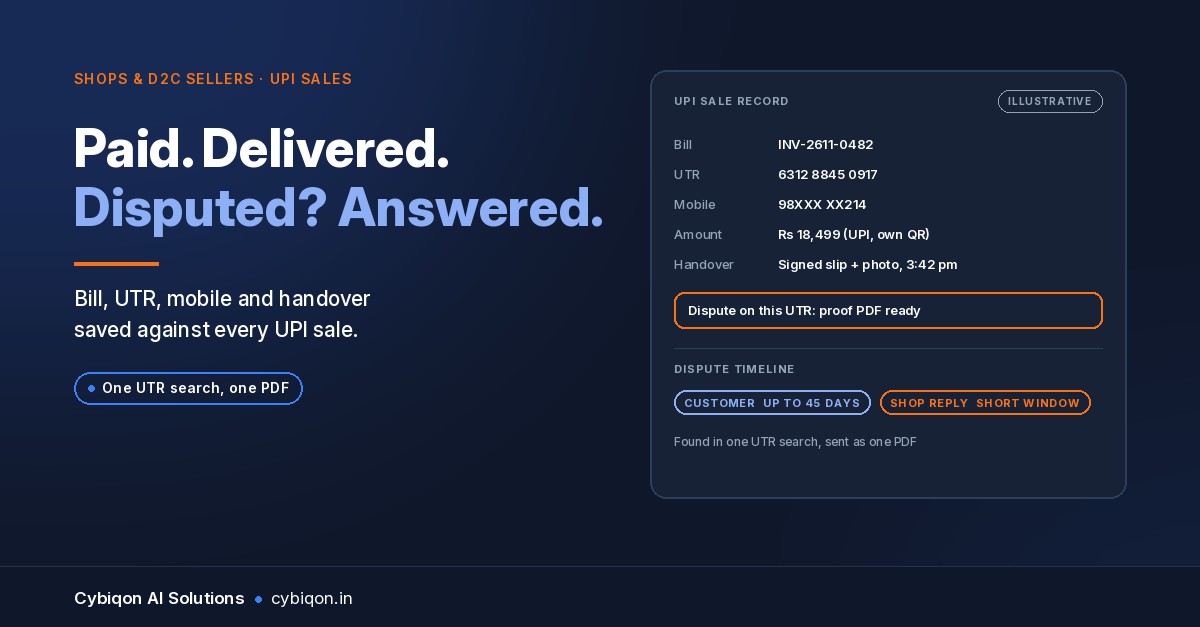
A customer pays ₹18,500 for a phone on your counter QR. The soundbox announces it, you hand over the box, and the sale is done. Thirty days later your bank sends an email saying the customer has raised a UPI chargeback for "goods not received", and you have a few days to answer.
Most shop owners don't know a UPI payment can be pulled back weeks after the sale. Under NPCI's circular OC 198 (21 June 2024, effective 25 July 2024), as reported in summaries of the circular by TeamLease RegTech and Complinity, a customer has 45 days to raise a dispute. The merchant usually gets far less time to reply.
This guide is for the owner or cashier of a mobile, electronics or jewellery shop, a medical store or a kirana taking UPI on its own QR or soundbox, and for D2C sellers taking prepaid UPI on their own site. It covers how the UPI chargeback process works, who sets your deadline, the 2026 rule changes, what proof to keep, and a checklist for the day the notice arrives.
What is a UPI chargeback, and how is it different from a refund or reversal?
Three words get mixed up, and the difference matters when you answer a dispute.
- Refund: you choose to send money back, usually through your gateway or app, because the customer returned goods or cancelled.
- Reversal: the payment failed or timed out and the system sends the money back on its own, often within the same day. Nobody is disputing anything. If customers keep showing you "pending" screens, our post on what to do when a UPI payment is pending but money is deducted covers that case.
- Chargeback: the customer complains to their bank, which raises a dispute against your bank through NPCI's dispute system (URCS). Your bank then asks you to prove the payment was for something you delivered.
Scale explains why this is now a shop problem. UPI processed 25.47 billion transactions worth ₹31.53 lakh crore in October 2026, according to NPCI data reported by Entrepreneur India. About 63% of UPI volume is person-to-merchant (P2M), and 86% of P2M payments are under ₹500, per Business Today. Most of those never get disputed. The ones that do are the bigger tickets: a phone, a gold coin, a month's medicines, a laptop.
UPI chargeback rules (NPCI): the timelines that apply to you
The UPI chargeback guidelines come from NPCI circulars. NPCI sets deadlines for banks, not for you. Here are the ones that matter:
| Rule | What it says | Who it binds |
|---|---|---|
| OC 198 (Jun 2024, live 25 Jul 2024) | Customer can raise a dispute up to 45 days after the payment, all categories | Customer and their bank |
| OC 184A (Mar 2025) | Payer capped at 10 chargebacks per account in a rolling 30 days, and 5 per payer–payee pair; fraud cases exempt | Customer's bank |
| OC 184B (issued 20 Jun 2025, live 15 Jul 2025) | Banks can raise "good faith" chargebacks; acquiring bank has 15 calendar days to accept or represent a P2M dispute, or it is deemed accepted | Your (acquiring) bank |
| OC 213 (Feb 2025) | Chargebacks auto-accepted or rejected based on the beneficiary bank's response codes (TCC/RET) | Banks |
| OC 235 (16 Jul 2026, live 1 Aug 2026) | For fraud and wrong-credit chargebacks, the beneficiary bank's response window cut from 35 to 15 calendar days, else deemed accepted | Beneficiary bank |
Sources: TaxGuru on OC 184B, Taxscan on OC 213, Sylph Corps Media on OC 235.
Look at what the last two rows mean. Your bank has 15 calendar days to answer NPCI. It needs time to review your proof, so the deadline it gives you will be shorter. If it doesn't answer in time, the dispute is deemed accepted and the customer gets the money back.
UPI chargeback time limit: how long does a merchant have to respond?
There is no single NPCI deadline for merchants. Your clock is the one written on the notice from your bank or gateway, and it is always the shortest one in the chain.
Published merchant windows vary widely:
| Provider | Merchant response window (as published) |
|---|---|
| Cashfree | 3 days per stage (3/3/3/2/1); UPI cases run 15–20 days overall |
| Razorpay | T+3 business days; missing it means an automatic loss |
| Stripe (UPI) | 7 calendar days, one submission; funds withheld when the dispute opens |
| PhonePe PG | 7 working days |
| Zoho Payments | 14 days; for UPI, no deduction until the dispute is lost |
Sources: Cashfree, Razorpay, Stripe, PhonePe Business, Zoho.
Is money deducted as soon as a dispute is raised? It depends on the provider. Stripe holds the funds when the dispute opens, while Zoho says it doesn't deduct UPI disputes until you lose. A shop on a plain bank QR and soundbox has no dashboard. Under your merchant agreement, the bank can usually debit your account if the dispute goes against you. Read your agreement, or ask your branch in writing, to find out when that happens.
One practical point: the notice usually goes to the email registered on your merchant account. Many shops registered an old Gmail ID when the QR was installed and haven't opened it since. Check that address this week.
UPI dispute for "goods not received" and friendly fraud
The customer's bank files the dispute under a reason code. Razorpay publishes the common UPI codes:
- 1064 Goods/Services Not Received
- 1062 Goods/Services Not As Described
- 1061 Credit Not Processed (refund promised, not received)
- 1084 Duplicate Processing
- 1063 Paid by Other Means
- 128 Fraudulent Transaction
- 1065 Debit on Failed Transaction, and 108/121 where the payer was debited but the payee not credited
Your answer, called representment, uses its own codes. The two that matter for a shop are NR2 "goods/services already provided" and NR3 "refund already processed" (per TaxGuru).
"Goods not received" is where friendly fraud on UPI shows up. The customer took the phone, used it, and later claimed it never arrived. PhonePe's merchant guide describes this pattern. With in-shop sales, your only defence is a record that ties that payment to that handover.
Expect more disputes, not fewer. On 10 Nov 2026, the Telangana State Consumer Commission ordered SBI to refund ₹55,000 plus ₹20,000 compensation and ₹10,000 costs for a disputed UPI debit. It held that a correct UPI PIN alone does not prove the customer authorised the payment (MediaNama). RBI's revised fraud-liability framework, applicable from 1 Jan 2027, gives customers who report within 5 calendar days a path to reversal or compensation (Angel One). Both protect the payer. Banks pass that pressure down the chain to the account that received the money, which is yours.
A related risk is a lien or freeze on your account because a UPI credit is linked to a cyber-fraud complaint. That works differently from a chargeback, and our guide on a bank account frozen over cyber crime in India explains how merchants get it lifted.
UPI chargeback proof documents: what a shop should keep for every sale
What documents does a merchant need to win a UPI chargeback? You need proof that ties the payment to the sale. Match the records to the code you will answer with:
| You will answer with | Records that prove it |
|---|---|
| NR2: goods already provided | Bill with number and date, UTR printed or noted on it, item serial/IMEI or HUID (jewellery), customer mobile, signed delivery slip or handover photo, WhatsApp invoice sent at the counter, CCTV clip if you have one |
| NR3: refund already processed | Refund UTR, date, amount, and the customer's acknowledgement |
| Answering "paid by other means" | Proof that only one payment was taken for that bill |
| Answering "not as described" | Product description on the bill, warranty card, return or replacement policy shown to the customer |
The UTR (the 12-digit UPI reference number) is the link. Your bank statement shows only the UTR and the payer's VPA. If your bill book is handwritten and doesn't note the UTR, matching a 30-day-old credit to a sale means going through pages by date and amount. That's how shops miss deadlines they could have met.
Before you hand over expensive goods, confirm the money actually landed. Our post on checking for a fake UPI payment screenshot covers that counter routine. Recording the UTR at that moment costs you ten seconds.
UPI chargeback process: what to do the day the notice arrives
- Read the deadline on the notice. That date is your deadline. Note it on paper and in your phone.
- Find the UTR and the amount in the notice. Search your statement for the matching credit.
- Match it to the bill. Bill number, item, serial/IMEI, customer name and mobile.
- Gather the proof: handover photo or signed slip, WhatsApp invoice, CCTV clip, any chat where the customer confirmed receipt.
- Don't refund outside the dispute. If you send money back on WhatsApp while the dispute is open, you can end up paying twice. If you agree the customer is right, accept through the dispute, or record the refund UTR so the bank can answer NR3.
- Submit within the deadline, through the gateway dashboard or the UPI merchant dispute form or email address your bank names. Ask for written acknowledgement.
- Keep a copy of everything you sent, filed under the UTR.
Who decides a UPI dispute: the bank or NPCI? The banks resolve it first, the customer's bank and yours, through URCS. If they still disagree, it can go to pre-arbitration and arbitration at NPCI. Zoho's guide says a lost dispute costs you the amount plus a penalty. Penalties vary by provider, so ask yours. No published data shows how often merchants win, so collect proof and don't count on any particular outcome.
How the mobile-shop dispute plays out with records (hypothetical)
Go back to the phone sale at the top. Take a hypothetical two-counter mobile and accessories shop in a tier-2 city, using a bank static QR and a soundbox. The bank emails a "goods not received" notice to an inbox nobody checks. The owner finds it with only a few days left. The bill book is handwritten. The statement shows a UTR and a VPA.
Without records: the owner spends a day matching dates and amounts and finds the bill. It has no UTR, no IMEI and no customer number. The proof is thin, and if it misses the bank's deadline, the dispute is lost by default.
With a billing app that stores the UTR, bill number, IMEI, customer mobile and a handover photo or OTP against each sale, the owner searches the UTR and exports one PDF with the bill, the UPI credit line, the handover proof and the WhatsApp invoice. They send it the same day under NR2. The outcome still isn't guaranteed, but the owner has answered on time with complete proof.
A lost dispute takes back money you had already counted as collected. It belongs with the rest of your cash-flow work, alongside chasing buyers who pay late. Our guide on how to recover delayed payments covers that side.
FAQs
Can a customer reverse a UPI payment after receiving the goods?
They cannot reverse it themselves, but they can raise a dispute through their bank within 45 days. The money goes back to the customer unless you show, within your bank's deadline, that the goods were delivered.
How many days does a customer have to raise a UPI chargeback?
45 days from the transaction, for all dispute categories, under NPCI OC 198 (effective 25 July 2024), as reported by TeamLease RegTech and Complinity.
How long does a merchant have to respond to a UPI dispute?
Whatever your bank or gateway sets. Published windows range from 3 days per stage (Cashfree) and T+3 business days (Razorpay) to 7 days (Stripe, PhonePe PG) and 14 days (Zoho). Your bank itself has 15 calendar days to respond to NPCI on a P2M dispute.
Should I refund a customer who has already raised a UPI dispute?
Not outside the dispute. Accept the chargeback through your bank or gateway, or record the refund UTR so the bank can answer "refund already processed" (NR3). A separate refund risks paying twice.
What is the difference between a UPI refund, reversal and chargeback?
A refund is money you choose to send back. A reversal is automatic when a payment fails. A chargeback is a dispute the customer's bank raises against your bank, which you have to answer with proof.
What Cybiqon would build for your counter
Most of the work in a UPI chargeback is finding the right sale in time. Cybiqon would build a billing and records app for your shop that saves the bill, UTR, customer mobile, serial/IMEI or HUID and a handover photo against every UPI sale. When a dispute arrives, you search the UTR and export one PDF ready to send. It can also show open disputes with the deadline from each notice, so none of them sit unread in an old inbox.
It is written for your counter and your products, not configured from a POS template, and you own the code and the data rather than renting them from a vendor. See what goes into our admin panels and internal tools, then book a 30-minute call. You can also reach us on +91 9250711473 or [email protected].
Conclusion
A UPI chargeback can arrive up to 45 days after the sale, and the deadline that matters is the one your bank or gateway puts on the notice, often under a week. Banks have to answer NPCI within 15 days, and courts and the RBI are adding payer protections, so disputes are not going away. Keep the UTR, bill, serial number, customer mobile and handover proof together for every high-value sale, and check the email registered on your merchant account. If you want a system that does this for you, Cybiqon can build it, and you will own it.
Want this set up for your business?
Book a free call — no tech jargon, no sales pressure. Just honest answers.
What we build for this: Admin panels & internal tools