COD remittance for D2C and Shopify/WooCommerce sellers: meaning, published cycles (Shiprocket's five conflicting timelines, Delhivery, Shipmozo, iThink) with dates, early/instant COD fees, documented hold and short-pay reasons, the 3-file match (delivered AWBs, remittance batch, bank UTR), a free weekly sheet, and when an owned reconciliation agent is worth building
COD Remittance: Meaning, Cycle and How to Check You Were Paid
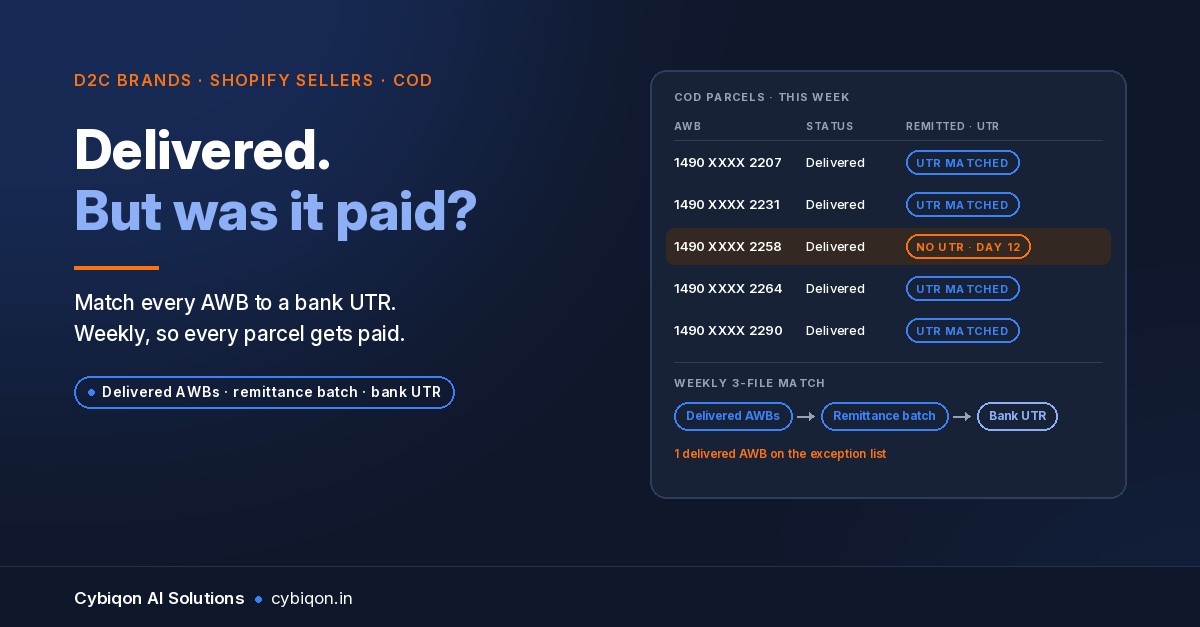
Say your courier panel shows 1,240 COD parcels delivered last month. The bank statement shows a handful of credits with UTR numbers and no order IDs. Somewhere between those two files is money you may never have been paid.
COD remittance is the cash-on-delivery money a courier or shipping aggregator collects from your customers and then transfers to your bank account, usually in batches, after deducting anything you owe it. If you ship through Shiprocket, Delhivery or Shipmozo, this transfer is how most of your revenue reaches you. The scale is large. Shiprocket alone reported 224,314 active merchants in Q1 FY27 (Kotak Neo).
Most guides to COD remittance come from the aggregators, and each one makes its own cycle look fastest. This one is written from the seller's side. You'll get the cycles exactly as each company published them, with dates. You'll see the documented reasons a remittance is held or paid short, and a free weekly method to check that every delivered AWB was actually paid.
COD remittance meaning, in one paragraph
Here is the COD remittance meaning in plain terms. Your customer pays cash (or UPI) to the delivery agent. The courier deposits it, the aggregator receives it, and the aggregator pays you a remittance batch: one bank transfer covering many AWBs (air waybill numbers, the tracking number on each parcel), minus deductions such as unpaid freight or fees for faster payouts.
Three things make it hard to track:
- One credit, many orders. Your bank shows one UTR (the unique reference number of a bank transfer) for a batch of perhaps hundreds of parcels.
- Net, not gross. The amount can be lower than your total COD value for legitimate reasons, and for some that are not.
- Delivered is not paid. An AWB marked delivered today joins a batch days later, and only if nothing holds it.
COD is a big share of Indian e-commerce, which is why this matters. In its December 2025 filing, Meesho reported COD at 72.00% of its shipped orders in April–September 2025, down from 88.71% in FY23 (Meesho RHP addendum, NSE). Those are Meesho's figures, not an average for D2C brands, but they show how much money moves through this pipe.
COD remittance cycle: what each aggregator has published, with dates
Ask "what is Shiprocket remittance time?" and you'll find at least five answers on Shiprocket's own pages. None is necessarily wrong. They were written in different years and some were never taken down. Here they are side by side:
| Source | Page date | What it says |
|---|---|---|
| Shiprocket knowledgebase | "Last Updated: 10 years ago", still live | Once a week, "anywhere between 12-17 days from delivery date" |
| Shiprocket Early COD launch blog | 7 Aug 2019 | Standard cycle "7-9 days" |
| Shiprocket app help article | Modified 14 Dec 2020 | "after 8-9 days of order delivery" |
| Shiprocket product update | Oct 2022 | "9th working day after delivery", Mon/Wed/Fri |
| Shiprocket support article | Modified 24 Jun 2024 | "D+8 days, meaning it takes 8 working days from the date of delivery"; "three times a week, typically on Mondays, Wednesdays, and Fridays"; expect it "within 10 working days" |
| Delhivery One help | Updated 14 Nov 2023 | Transfers COD "within 48 hours" (the page doesn't say from when); the help homepage offers "next day COD remittance at no additional charges" |
| Shipmozo blog | 2026 | D+1/D+2 "on selected courier partners" (vendor's own claim) |
| iThink Logistics policy | Undated | No timeline published |
For planning, use the most recent official figure for your aggregator. For Shiprocket that is the June 2024 article: 8 working days after delivery, paid on a Monday, Wednesday or Friday, and chase it after 10 working days. Shiprocket's October 2022 update also says each AWB shows its expected remittance date on the shipment screen. Use that date, not a general rule.
India Post is different. Shiprocket's India Post SOP says there is "no fixed timeline". The money is remitted only after India Post pays Shiprocket (Shiprocket India Post SOP).
Early COD charges and instant payouts: what they cost
Faster payout is a paid product, and the fee comes out of your remittance. That matters when you reconcile, because a batch paid under Early COD will be short of gross COD by design.
- Shiprocket Early COD. Shiprocket's 2019 launch post listed D+2 at 0.99%, D+3 at 0.69% and D+4 at 0.49% of the COD amount, GST included. Those are 2019 figures. The current Early COD page says only "a small fee" with "Guaranteed Remittance in 2 days*", so check the current fee in your panel before you opt in.
- Shiprocket Instant COD. The FAQ (modified 22 Oct 2024) offers "up to 70% of your COD amount ... the next day after your orders are shipped", for "a standard fee of up to 5%", on working days only. It is "exclusively available for a limited set of sellers".
- Shiprocket Postpaid. Under Postpaid, "only a set percentage of your COD remittance will be converted to shipping credits". Your bank credit will be lower than your COD total, and that's expected.
The early COD charges question isn't only about price. Once fees and conversions are in play, "the bank credit is lower than my COD" stops being evidence of a problem. You need AWB-level data to tell a fee from a gap.
Why COD remittance is on hold or paid short: documented reasons
When a COD remittance is not received on time, the cause is usually one of these. Each is written into a provider's own documentation:
| Reason | What happens | Source |
|---|---|---|
| Unpaid freight invoice | Shiprocket holds "1.5 times the amount of your COD earnings until your invoice is settled" | Shiprocket support, 12 Jul 2024 |
| Negative wallet | Delhivery remittance "shall only be processed in the next cycle" | Delhivery One help, 14 Nov 2023 |
| Unpaid invoices or suspected fraud | iThink reserves the right to hold "COD remittance, wallet balance, and payments" | iThink policy |
| India Post shipments | No fixed timeline; paid after India Post remits | Shiprocket India Post SOP |
| Early COD / Instant COD | Fee deducted from the payout | Shiprocket pages above |
| Postpaid | Part of the COD converted to shipping credits | Shiprocket Postpaid |
Two more causes show up when you match AWBs, even though no policy page lists them. An AWB can flip from delivered to RTO (return to origin) after a status correction, so it drops out of the payout. If the terms are unclear, see RTO vs RVP. And freight is often debited from the same wallet that holds your COD, so a disputed charge can push the wallet negative. That's why it's worth learning how to dispute courier weight discrepancy charges as part of the same weekly check.
COD remittance not received: what sellers report
The delays sellers describe in public go well past any published cycle:
- A Delhivery seller in Bengaluru wrote on 14 Oct 2025 that a ₹6,500 COD order delivered on 24 Sep 2025 had gone "more than 21 days" without remittance and "no one is responding" (Consumer Complaints).
- A Shiprocket reviewer on 12 Jul 2025 had been waiting for COD remittance "from LAST 40 DAYS OR MORE"; another on 17 Oct 2025 reported a "cod remittance delay" (Trustpilot).
- A Shipmozo reviewer on 24 Nov 2025 said remittance was "delayed for months" and released only if "YOU personally follow up again and again" (Trustpilot).
- A Shiprocket app review dated 10 Oct 2026 describes a wallet going "straight to -Rs 11,293.53 negative" (AppNavigator). That review doesn't mention remittance, but a negative wallet is a documented reason for a hold.
These are individual complaints, not a measure of how often it happens. They have one thing in common, though. The seller found the gap late and had to prove it AWB by AWB. A list of exact AWBs and amounts gets a ticket resolved much faster than "my COD is pending".
How to reconcile COD remittance: the 3-file match
COD remittance reconciliation comes down to joining three files. Each one answers a different question.
- File 1: delivered COD shipments (from your aggregator or store). Order ID, AWB, courier, delivered date, COD amount. What should I be paid?
- File 2: remittance batch export (Shiprocket: Tools > Reports > Remittance Report, which "Track[s] COD collections for delivered AWBs"; Delhivery: COD remittance screen). Remittance number, AWB, amount, deductions. What did they say they paid? Delhivery documents Remittance Number, Processed Date, Bank Transaction ID, Status and Amount. Shiprocket's export typically includes similar fields, but check your own export for the exact column names.
- File 3: bank statement. Credit date, UTR, amount. What actually arrived?
The join keys are simple. AWB links File 1 to File 2. Batch total links File 2 to File 3, by UTR where the aggregator shows a bank transaction ID (Delhivery says to keep it "to share with the bank in case of disputes"), otherwise by amount and date.
Every row that fails a join is one of four exceptions:
- Delivered, past the expected date, in no batch. The most common gap.
- In a batch, but no matching bank credit. The batch was "processed" but never reached you.
- Batch total ≠ bank credit. A deduction you need explained.
- AWB flipped from delivered to RTO. Check it was really returned. The hub guide on reducing RTO covers why COD RTO happens in the first place.
Tag each exception with a likely reason from the table above (negative wallet, unpaid invoice, India Post pending, bank details, RTO flip, fee, postpaid). Then raise one ticket per reason that lists the exact AWBs and amounts.
A free weekly COD remittance sheet
At a few hundred to a couple of thousand COD orders a month on one aggregator, a Google Sheet run every Monday is enough. Use four tabs:
Delivered (paste File 1): A Order ID, B AWB, C Courier, D Delivered date, E COD amount, then:
- F Expected date:
=WORKDAY(D2, 8, Holidays!A:A). Use 8 working days for Shiprocket per its June 2024 article, or the AWB's own expected date if you export it. - G Batch:
=XLOOKUP(B2, Remit!B:B, Remit!A:A, "") - H Paid:
=SUMIFS(Remit!C:C, Remit!B:B, B2) - I Status:
=IF(G2="", IF(TODAY()>WORKDAY(D2, 10, Holidays!A:A), "OVERDUE - no batch", "Waiting"), IF(H2<E2, "Short", "In batch")). This uses the 10-working-day point at which Shiprocket says to expect payment
Remit (paste File 2): A Remittance no, B AWB, C Amount, D Deductions.
Batches: A Remittance no (use =UNIQUE(Remit!A2:A)), B Batch total =SUMIFS(Remit!C:C, Remit!A:A, A2), C UTR (from the panel), D Bank amount =XLOOKUP(C2, Bank!B:B, Bank!C:C, "NOT IN BANK"), E Difference =IFERROR(B2-D2, "CHECK").
Bank (paste File 3): A Date, B UTR, C Amount, D Narration.
Filter Delivered on "OVERDUE" and Batches on non-zero differences. To catch RTO flips, paste the latest shipment status and count AWBs that were delivered last week but now show RTO: =COUNTIFS(Status!A:A, B2, Status!B:B, "RTO*"). Shiprocket's March 2026 update added a unified COD remittance dashboard covering remitted amounts, Instant COD settlements and upcoming payouts. That makes File 2 easier to get, but the dashboard still shows the aggregator's view. The bank tab is what makes this a check rather than a summary.
The same method works for marketplace payouts. If you also sell on marketplaces, see Amazon and Flipkart seller reconciliation.
When an agent is worth building, and when it isn't
Stay with the sheet if you use one aggregator, the weekly paste-and-filter is a short Monday job, and the exceptions list is short. Software can't beat that cost.
An agent starts to make sense when the sheet no longer fits in the week:
- Several aggregators or direct courier accounts, each with a different export format
- Several thousand COD orders a month, so the exceptions list is long every week
- Dispute tickets that need AWB lists the finance person builds by hand
- Wallet deductions (weight, RTO freight) mixed into the same payouts
An agent here is a program that does the job end to end. It pulls the three files on a schedule, runs the matches, tags each exception with a reason, drafts the dispute ticket and waits for a person to approve it before anything is sent. It doesn't decide what is owed. It shows you where to look. If anyone, Cybiqon included, pitches you an agent for this, ask them to run it on last month's three files and show you the exceptions list it produces.
FAQs
What is COD remittance?
COD remittance is the cash-on-delivery money a courier or aggregator collects from your customers and transfers to your bank, usually in batches covering many AWBs, after deducting fees or dues you owe it.
What is the Shiprocket remittance time?
Shiprocket's support article (modified 24 Jun 2024) says D+8 working days from delivery, paid on Mondays, Wednesdays and Fridays, and to expect it within 10 working days. Older Shiprocket pages give other figures. Check the AWB's expected remittance date in your panel.
Why is my COD remittance on hold?
Documented reasons include an unpaid freight invoice (Shiprocket holds 1.5 times your COD earnings until it's settled), a negative wallet (Delhivery moves remittance to the next cycle), suspected fraud, and India Post shipments, which have no fixed timeline.
What are early COD charges?
They're fees for receiving COD faster than the standard cycle. Shiprocket's 2019 launch post listed 0.49%–0.99% depending on speed. Its current page says "a small fee", and Instant COD charges up to 5%. Check your panel for today's rate.
Get a COD reconciliation agent built for your setup
If the weekly sheet has outgrown one person's Monday, Cybiqon can build you a COD reconciliation agent. It reads your store's delivered orders, your aggregators' remittance reports and your bank statement, then matches AWB to batch to UTR every day. It flags each overdue or short-paid AWB with a likely reason and drafts the dispute ticket for your approval.
It's written for your couriers, your exports and your bank, not configured from a template, and you own the code. AI agent builds start from ₹19,999, one-time, and are scoped on the first call.
Book a 30-minute call, call or WhatsApp +91 9250711473, or email [email protected].
Conclusion
COD remittance is where much of a COD seller's revenue actually arrives, and the published cycles disagree, even across one company's own pages. Plan around your aggregator's latest official figure, know the documented reasons for holds and deductions, and don't treat "delivered" as "paid". Every week, match delivered AWBs to remittance batches to bank UTRs, and raise tickets with exact AWB lists. A sheet handles this at modest volume. When it no longer does, Cybiqon can build the agent that runs the check for you.
Want this set up for your business?
Book a free call — no tech jargon, no sales pressure. Just honest answers.
What we build for this: Admin panels & internal tools