Damage and expiry stock for FMCG distributors carrying several agencies: why brand claims are rejected or stay pending, the company's damage and expiry audit and destruction certificate, expired stock return entries in TallyPrime, GST (Circular 72/46/2018, Section 34(2) deadline 30 Nov 2026, Section 17(5)(h), 57th GST Council recommendation), a free claims register with brand-wise ageing, and when an owned claims panel pays
Damage and Expiry Stock: Why Your Brand Claims Stay Pending
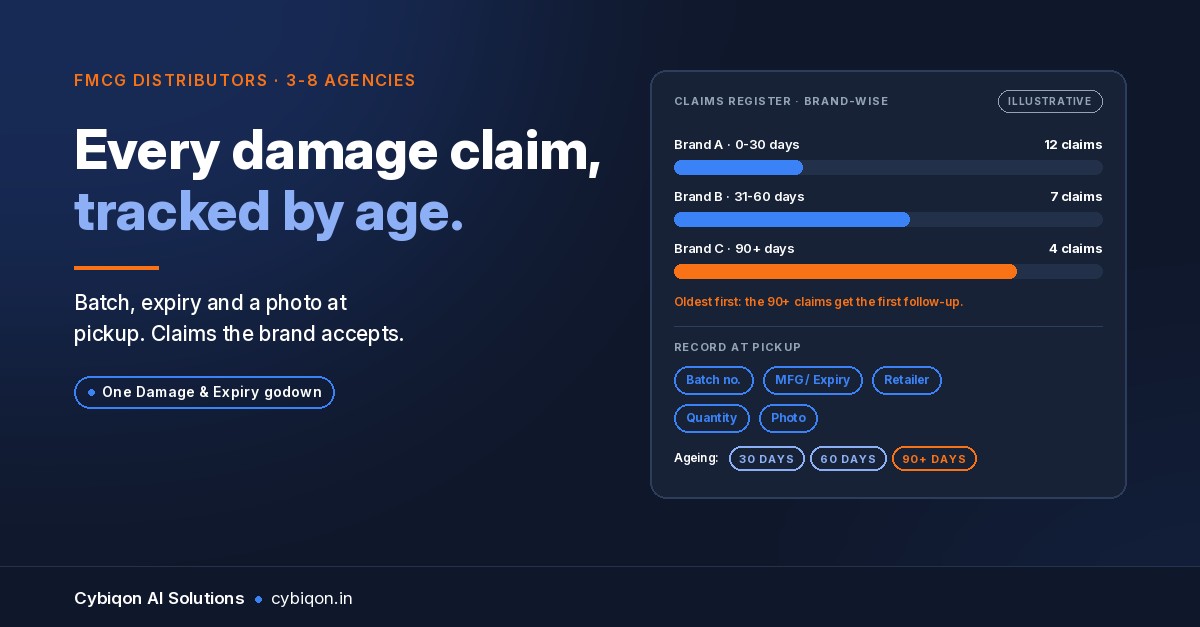
Every Monday the salesman's van comes back with the same thing: a few cartons of biscuits past their date, soap with crushed packs, tea pouches that leaked in the rain. They go into a corner of the godown. Someone writes the quantity in a notebook. And the claim to the brand sits there for months.
If you are an FMCG distributor or wholesaler carrying three to eight company agencies, damage and expiry stock is money you have already paid for. You paid the company when you bought it, gave the retailer a credit when your salesman picked it up, and now you wait for the company to settle. How long can that take? In October 2025, the All India Consumer Products Distributors Federation (AICPDF) said damage settlement claims of some Tata Consumer Products distributors had been pending for more than 15 months (Storyboard18, 8 Oct 2025). That dispute was reported settled on 30 Oct 2025 (Storyboard18). It is one late-2025 example, not an industry average. But anyone who has chased a brand for a claim will recognise it.
This guide covers why claims get rejected or part-settled, what happens in a company's damage and expiry audit, how to record the entries in TallyPrime, the GST rules (including a deadline on 30 Nov 2026), and a free claims register you can start using this week.
Why damage and expiry stock claims stay pending
A claim is a credit you have given out and not yet got back. It does not show up as a loss anywhere, so it is easy to stop chasing.
The money is not small. In April 2026, AICPDF wrote to FSSAI, the Union Health Ministry and Parle about roughly ₹5 crore of expired and damaged stock lying unattended at distributor facilities in Kerala. It asked for scientific destruction, compensation or replacement, and a standard procedure (Madhyamam, 22 Apr 2026). AICPDF, which says it represents about 4.5 lakh distributors, is an interested party, so read the figure as its side.
Margins leave little room to absorb it. In an open letter in June 2026, AICPDF said ₹57 of every ₹100 goes on logistics, manpower and secondary transport, before warehousing, bank interest, compliance or product damage are counted (Business Today, 8 Jun 2026). If you have never worked out what your agencies actually return on the capital you put in, our guide to FMCG distributor margin and ROI calculation shows how unsettled claims eat into it.
Claims usually stall for one of three reasons on the distributor's side:
- No batch-level record. The notebook says "Brand X, 40 cases damaged", but not which batch, from which retailer, or on what date.
- Every brand runs its own process. One wants a photo within 48 hours. Another sends an auditor once a quarter. A third wants goods back on a debit note. With five agencies, nobody in the office holds all five rules in their head.
- Nobody tracks ageing. Without a "days pending" figure per brand, the claim that is 200 days old looks the same as the one raised last week.
Why FMCG companies reject or part-settle claims
Brands get false claims too, so their checks are built to catch them. Knowing the checks tells you what your records need to show.
Patron Accounting, a firm that audits these claims from the brand side, lists the common reasons claims fail (Patron Accounting, 19 Aug 2026):
- Quantity is more than you could hold. Its worked example: 1,200 cases received, 950 sold onward and 180 still in stock means at most 70 cases could be damaged or expired. A claim for 140 cases fails.
- The batch never went to your territory. The brand checks batch numbers against its dispatch records.
- The goods were not expired yet. Expiry claimed on stock that was still within shelf life on the return date.
- The damage doesn't fit the packaging. Crushed contents inside an undamaged outer case.
- Destruction was certified after the money was paid. Auditors treat this as a red flag.
Kirana Club, which writes practical guides for brands selling into general trade, adds a few more (Kirana Club, 1 Mar 2026): claims raised outside the window (it suggests 48 hours, with a photo, for transit damage), missing photos, delivery notes or a visible batch number, and expiry caused by the distributor holding too much stock, which its responsibility matrix puts on the distributor. It also estimates that good documentation cuts fraudulent claims by 60–70%, and that returns can run at 6–8% when a brand enters a new state. These are practitioner estimates, not audited figures.
The pattern is clear, whether it is an expiry claim or a market return damage claim settlement. A claim with a batch number, a photo, a pickup date and a quantity that fits your stock is hard to reject.
One note on scope: this post is about goods that physically come back. Scheme payouts, display money and trade discounts are a separate kind of claim with their own credit notes. For those, see our guide on what a trade scheme is for an FMCG distributor.
What happens in a damage and expiry audit before destruction
Most companies won't settle until someone has checked the stock. In a typical damage and expiry audit, the brand's sales officer, a third-party auditor or an area manager visits your godown and:
- Counts the stock against the quantity you claimed, by SKU and batch.
- Checks batch numbers and dates against the brand's dispatch records for your territory.
- Inspects the damage to see if it fits the packaging and the reason given.
- Checks it against your sales and stock (the reconciliation from the section above).
- Signs off for destruction or asks for the goods to be sent back.
Then comes destruction, through the brand's vendor or in front of its representative, followed by a destruction certificate.
What a destruction certificate for expired goods should contain
Ask for a certificate that lists, at minimum: the date and place of destruction, the method, SKU, batch number and quantity destroyed, a reference to your claim number, and the names and signatures of the brand's representative and the destruction vendor. Keep photos or video of the destruction with it.
Make sure the certificate references your claim number, and that destruction is certified before the claim is settled.
AICPDF has also called for a mandatory national protocol for collecting and destroying expired and damaged goods, with end-to-end digital traceability (Agro & Food Processing, 4 Sep 2026). That is a demand, not a rule yet.
How to record expired stock return entries in TallyPrime
Tally's official help covers the retailer side well. For an expired stock return entry in TallyPrime:
- Return from the retailer: record a Credit Note in Item Invoice mode, referencing the original sales invoice (Tally Help: sales return). If the goods went out on a delivery note and haven't been invoiced, use Rejections In.
- Keep damaged returns out of closing stock. Tally's help says damaged goods returned should be recorded separately so they are not counted in closing stock.
- Damaged stock entry in TallyPrime: use a Stock Journal to move or write off damaged and scrapped stock (Tally Help: stock journal).
- Batches: turn on batch-wise details with manufacturing and expiry dates, so every return carries the batch it came from, across godowns.
Two more steps are common practice among distributors, though Tally has no official page on them:
- A separate "Damage & Expiry" godown. Returned stock goes into it, so your saleable stock stays clean and you can see what is waiting for audit at a glance.
- A Debit Note or Rejections Out to the company when goods physically go back to the brand, matched to the brand's credit note when it arrives.
Get your accountant to agree the exact voucher types and ledgers with you once, and write them down. If your salesmen's returns arrive as a spreadsheet, you can bring them into Tally in bulk rather than typing each one; our guide on how to import sales vouchers from Excel into TallyPrime covers the method.
GST on expired goods: credit note, fresh invoice, or write-off?
This is where distributors lose money without noticing. Confirm every point here with your CA, because the treatment depends on how the goods move.
Expired stock return to the company. CBIC Circular 72/46/2018-GST (26 Oct 2018) gives two options (circular PDF):
| Option A: fresh tax invoice | Option B: credit note | |
|---|---|---|
| Who issues the document | You (the registered distributor returning goods) | The company (original supplier), under Section 34(1) |
| How goods move | On your tax invoice | On a delivery challan |
| Input tax credit | The company takes ITC under Section 16 | The company can reduce its tax only if you haven't taken ITC or have reversed it |
| If the company destroys the goods | It reverses ITC on your return invoice | It reverses ITC attributable to manufacturing |
The circular was written for time-expired drugs. Its paragraph 3 extends the procedure to goods returned for other reasons, which is what lets other FMCG lean on it. Check with your CA that it fits your goods.
Time limit for a credit note. Under Section 34(2), a credit note for supplies made in FY 2025-26 must be declared by 30 Nov 2026, or the date you file the annual return if that is earlier. Since 1 Oct 2025 (Finance Act 2025, Notification 16/2025-CT), the supplier can reduce its output tax only if the recipient has reversed the matching ITC. Claims for last year's supplies that are still unsettled need attention before 30 Nov 2026.
If you destroy or write off the stock yourself. Section 17(5)(h) blocks ITC on goods lost, stolen, destroyed or written off. If you destroy stock in-house and write it off rather than returning it on a credit note, you must reverse the ITC on it. The Gujarat AAR ruled this way on expired cakes in Kanayalal Pahilajrai Balwani (2021). Taxmann has noted that the position on inputs is contested (Taxmann, 1 May 2024).
What the 57th GST Council recommended. On 8 Oct 2026, the Council recommended allowing ITC on shelf-life write-offs where the law requires destruction (Trilegal, 15 Oct 2026; TaxGuru, 22 Oct 2026). It is a recommendation, not law. Until the amendment is notified, Section 17(5)(h) applies as it stands, and credit taken early would have to be reversed with interest.
A free claims register format for damage and expiry stock
You don't need software to start tracking damage and expiry stock. One sheet, one row per retailer pickup, brand-wise tabs if you like. These are the columns:
| Column | Why it matters |
|---|---|
| Claim no. | Your own running number, quoted on every document |
| Brand / agency | Each company's rules and ageing are tracked separately |
| SKU and batch no. | The brand checks batches against its dispatches |
| MFG and expiry date | Proves the goods were actually expired on return |
| Retailer name and town | Shows where the stock came from |
| Quantity (units / cases) | Must fit what you received, sold and still hold |
| Reason | Expired, transit damage, market damage, leakage |
| Photo link | Taken by the salesman at pickup |
| Pickup date | Starts the brand's claim window |
| Credit note no. to retailer | Links to the Tally entry |
| Destruction note / certificate no. | The audit sign-off |
| Claim date to brand | When you raised it |
| Amount claimed | Your figure |
| Amount settled | The brand's figure; the difference is your loss |
| Days pending | Today minus claim date, until settled |
| Ageing bucket | 0–30, 31–60, 61–90, 90+ days |
At the bottom, make a small pivot: amount pending by brand, by ageing bucket. That one table tells you which company to call this week. Before every damage and expiry audit, filter by brand, check each row has a batch number and photo, and do the "received minus sold minus held" check yourself before the auditor does.
When a register is enough, and when an owned panel pays
Be honest about where you are. A spreadsheet register for damage and expiry stock is enough if:
- You carry two or three agencies and a few dozen returns a month
- One person in the office maintains it daily, and it is actually up to date
- Your salesmen send photos on WhatsApp and someone files them against the row
It stops working at a familiar point, the one our guide on signs your business has outgrown Excel describes. Photos sit in salesmen's phones. Two people edit the sheet and overwrite each other. Batch numbers are typed wrong. And the ageing table is only as current as whoever last updated it.
Take a composite example, not a real client: say a distributor in Nagpur carrying six agencies, with eight salesmen each bringing back returns from 40-odd retailers a week. That is several hundred rows a month across six different claim processes. At that volume, an owned panel starts to pay: the salesman captures batch, quantity and photo on an Android app at the counter, the office sees every claim by brand and age, and the destruction certificate is attached to the claim it settles. If you already track secondary sales, the returns can sit next to the sales data, so the "could you really have held this much" check runs before you raise the claim.
FAQs
Why do FMCG companies reject or part-settle damage and expiry claims?
Usually because the claim can't be verified: the quantity is more than you could hold, the batch never went to your territory, the goods weren't expired on the return date, the damage doesn't fit the packaging, or the photo, delivery note or batch number is missing.
What happens in a company's damage and expiry audit before destruction?
The brand's representative counts the stock by SKU and batch, checks batches against its dispatches, inspects the damage, reconciles quantity with your purchases and sales, and signs off for destruction or return.
How is an expired stock return recorded in TallyPrime?
Record the retailer's return as a Credit Note in Item Invoice mode against the original invoice, or as Rejections In if the goods went on a delivery note. Keep damaged returns out of closing stock and use a Stock Journal for scrapped stock.
Is ITC reversal required on expired goods destroyed u/s 17(5)(h)?
Yes, as the law stands. If you destroy or write off stock yourself, ITC on it is blocked under Section 17(5)(h) and must be reversed. The 57th GST Council recommended a change for shelf-life write-offs where destruction is legally required, but that is not law until notified. Confirm with your CA.
Time limit for GST credit note on returned goods?
Under Section 34(2), a credit note must be declared by 30 November following the end of the financial year of supply, or the annual return date if earlier. For FY 2025-26 supplies, that is 30 Nov 2026.
Get a claims panel built for your agencies
If the register has outgrown one person's spreadsheet, Cybiqon can build you a damage and expiry claims panel. Your salesmen capture batch, expiry, quantity and a photo at the retailer's counter on an Android app. The office sees every claim by brand and ageing bucket, attaches destruction certificates, and exports credit notes for Tally.
It is written around your agencies and each company's claim rules, not configured from a template, and you own the code. Admin panel builds start at ₹29,999 and are scoped per build.
Book a 30-minute call, call or WhatsApp +91 9250711473, or write to [email protected].
Conclusion
Damage and expiry stock is money you have already paid out twice, once to the brand and once as credit to the retailer. Claims get settled when they carry a batch number, a photo, a pickup date and a quantity that fits your stock, and when someone tracks how long each brand has owed you.
Start with the free register, set up your Tally entries once, and check last year's credit notes before 30 Nov 2026. When the volume is beyond a spreadsheet, Cybiqon can build the panel and capture app around your agencies.
Want this set up for your business?
Book a free call — no tech jargon, no sales pressure. Just honest answers.
What we build for this: Admin panels & internal tools