Shopify to TallyPrime integration for D2C brands: no native connector, Shopify GST invoice gaps, a voucher map for sales, refunds/RTO credit notes, Razorpay fees and COD remittance, Section 34(2) credit note deadline 30 Nov 2026, import app prices and caps, and when an owned sync agent pays
Shopify Tally Integration: Sales, Refunds, COD and Fees in Tally
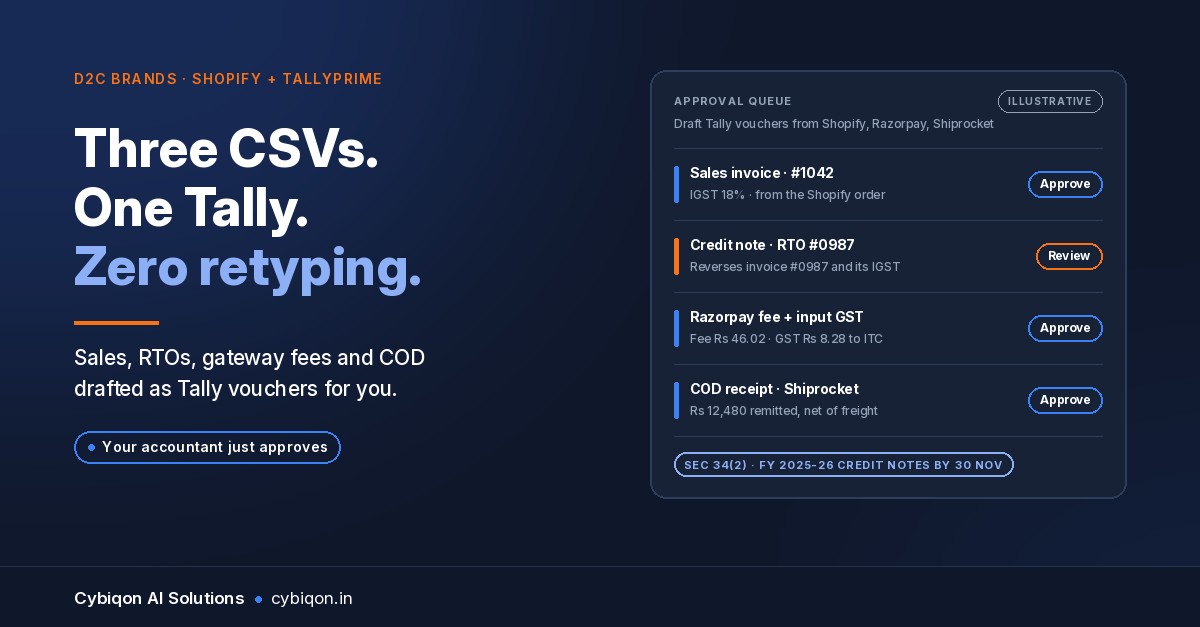
A brand doing 150 orders a day on Shopify generates about 4,500 sales a month, plus every refund, every RTO, every Razorpay settlement and every COD payout. In most D2C brands, the accountant rebuilds all of that in TallyPrime from three CSV exports every week. A proper Shopify Tally integration should end that. But TallyPrime has no native Shopify connector, and Shopify itself says it "doesn't create a GST-compliant bill" (Shopify Help, India GST).
The order volume isn't slowing down. According to Unicommerce, D2C order volumes grew 33% in FY26, and Tier 2 and 3 cities brought about 66% of new D2C orders (MediaBrief, 20 Apr 2026). More orders mean more entries, and the ones that get skipped first are the returns.
There is a date attached to those skipped returns. Credit notes for FY 2025-26 sales can reduce your output GST only until 30 Nov 2026, or earlier if you have already filed GSTR-9.
This guide covers what TallyPrime and Shopify actually give you, the voucher for every event in an order's life, what the import apps cost and cover, and how to decide between a CSV, an app and an owned sync agent.
Is there a direct Shopify Tally integration?
No. TallyPrime does not connect to Shopify out of the box. Tally's own e-commerce accounting guide says there is no native Shopify connection (Tally Solutions). Tally does ship a dedicated Amazon Data Import, and TallyPrime 7.0 (19 Dec 2025) added Connected Banking and Bharat Connect, but nothing for Shopify.
What Tally does give you is Excel import. Its help pages list a sample Shopify mapping template (a .tsf file) that maps columns from a Shopify export to Tally voucher fields (Tally Help). If your accountant already brings sales in from spreadsheets, our guide on how to import sales vouchers from Excel into TallyPrime walks through the method step by step.
So in practice, "Shopify to Tally integration" means one of three things:
- CSV plus Tally's Excel import. Free, manual, and only as good as the person cleaning the sheet.
- A Shopify app that pushes orders into Tally. Easy to start, priced per order, and usually limited to sales and credit notes.
- A sync agent written for your store that reads Shopify, the payment gateway and the courier, then drafts vouchers for an accountant to approve.
One warning if you search Zapier or Make for "Tally": most of those results are for Tally.so, an unrelated form builder. They will not touch your TallyPrime books.
Does Shopify generate a GST invoice in India?
Not one your CA will accept as-is. Shopify's India GST help page is direct about this. It "helps to automate your taxes, but doesn't remit or file your taxes for you", and it does not create a GST-compliant bill (Shopify Help).
Three things in a Shopify order export cause the most rework when you do a Shopify sales entry in Tally:
- One combined tax line. Shopify can't show CGST and SGST as separate lines. It shows one combined rate. Tally needs CGST plus SGST for an intra-state sale and IGST for an inter-state one, decided by the place of supply (the buyer's shipping state).
- HSN codes live in an odd field. Shopify stores HSN in the product's "HS tariff code" field (minimum 6 digits). If that field is blank, your GSTR-1 HSN summary is blank too.
- Order date is not obviously invoice date. A customer orders on the 28th and you ship on the 2nd. Many brands raise the GST invoice at dispatch (fulfilment), not at order. Which date you use is a point to settle with your CA, not something to leave to an export.
That last point matters for returns. If you invoice at dispatch, an order cancelled before it ships never needs a credit note. An RTO that was invoiced and shipped always does.
A clean Shopify GST invoice for India therefore needs your own invoice series, the GST split by state, HSN per line and the date your CA agrees. That's why "just import the order CSV" rarely survives the first GSTR-1.
The Shopify to Tally voucher map: every event, every entry
A single Shopify order can touch Shopify, Razorpay, Shiprocket and your bank, and each holds only part of it. These are the entries a complete Shopify Tally integration has to produce. Confirm the ledger names and treatment with your CA.
| Event | Source of truth | Tally voucher | What it records |
|---|---|---|---|
| Order dispatched | Shopify order + fulfilment | Sales invoice | Customer/party, item, HSN, CGST+SGST or IGST by place of supply |
| Prepaid payment settled | Razorpay settlement report | Receipt | Bank (net) against a Razorpay clearing ledger |
| Gateway fee | Razorpay monthly fee invoice | Journal / purchase | Gateway charges plus input GST you can claim |
| COD collected and remitted | Courier COD remittance file | Receipt + journal | Bank (net), freight booked separately, courier receivable cleared |
| Refund or RTO after dispatch | Shopify refund / courier RTO status | Credit note | Linked to the original invoice, stock back in |
| Marketplace payout | Amazon/Flipkart settlement | Receipt + journal | Bank, commission and fees, 0.5% TCS as a receivable |
Razorpay settlement entry in Tally
Razorpay's standard rate is 2% plus 18% GST on the fee, which works out to 2.36%. It settles the net amount to your bank and issues a monthly tax invoice for its fees (Reports → Monthly Invoice Report), on which you can claim input tax credit (Razorpay). Domestic card payments up to ₹2,000 carry no GST on the fee (Razorpay FAQs).
The clean way is a Razorpay clearing ledger. Sales receipts credit the customer and debit clearing for the gross amount. Each settlement debits the bank for the net. The monthly fee invoice debits gateway charges and input GST. Whatever remains in the clearing ledger is your reconciliation gap.
Booking fees as one monthly lump with no GST split is the most common shortcut, and it quietly loses the input credit.
COD remittance entry in Tally
Prepaid passed half of D2C festive shipments for the first time this year, rising from 46% to 52% across a fixed set of 200 brands (ClickPost via Medianews4u, 15 Oct 2026). So COD is still close to half your orders.
For a COD remittance entry in Tally, the courier's remittance usually arrives net of freight and charges. Record the bank receipt for the net, book freight and charges as an expense (with input GST if the courier invoices it), and clear the courier receivable for the gross COD collected. Our guide to COD remittance covers how to track what the courier owes you.
Shopify refund credit notes in Tally, and the 30 Nov 2026 deadline
Returns are where Shopify-to-Tally books break first. Return-to-origin rates are still high. They fell from about 39% in the November 2025 festive season to about 21% in February 2026 (Shipway and Unicommerce, via MediaBrief), but every RTO that was invoiced at dispatch still needs a credit note and a stock reversal. Cutting the RTO count is the bigger win, and our guide on how to reduce RTO in e-commerce covers that. The accounting job is to make sure the RTOs that do happen get booked.
For a Shopify refund credit note in Tally, record a credit note against the original sales invoice, with the same GST split, and bring the stock back in.
What the GST credit note time limit means this year
Under Section 34(2) of the CGST Act, a credit note for a supply made in FY 2025-26 can reduce your output GST only if it is declared by 30 Nov 2026, or by the date you file your FY 2025-26 annual return (GSTR-9), whichever is earlier (CBIC, Section 34). GSTN enabled GSTR-9 and 9C for FY 2025-26 on 8 Oct 2026. If you have already filed GSTR-9, the window has already closed. After the cut-off you can still issue a commercial credit note, but it won't reduce GST.
This mostly affects returns and RTOs from last financial year that were never booked, not every return. A quick checklist for this week:
- Pull every Shopify refund and courier RTO dated 1 Apr 2025 to 31 Mar 2026.
- Match each one to a credit note in Tally. List the ones with none.
- Check whether GSTR-9 for FY 2025-26 is already filed.
- Take the list to your CA before 30 Nov 2026 and ask how, and whether, to declare them.
For B2C sales, credit notes are netted in GSTR-1 Table 7 (B2CS). Only inter-state ones above ₹1 lakh go to Table 9B (CDNUR); that threshold came down from ₹2.5 lakh from 1 Aug 2024.
This is general information, not legal or tax advice. Ask your CA this week.
Buyer GSTINs, e-invoicing and TCS: the edge cases
Three things trip up almost every Shopify Tally setup.
Buyer GSTINs and e-invoicing. An order where the buyer enters a GSTIN at checkout is B2B, and your integration has to route it differently. E-invoicing is mandatory for B2B invoices once aggregate annual turnover (AATO) reaches ₹5 crore. At ₹10 crore or more, invoices and credit notes must reach the IRP within 30 days, since 1 Apr 2025 (Taxmann).
TCS. The 0.5% TCS under Section 52 (since 10 Jul 2024) is collected by Amazon, Flipkart and other e-commerce operators from marketplace payouts, not on your own store's sales.
Marketplace payouts. If you also sell on Amazon or Flipkart, each payout needs commission, fees and TCS booked separately. Our guide to Amazon and Flipkart seller reconciliation covers that settlement in detail.
Shopify Tally integration apps compared: prices and caps
If you want to import Shopify orders to Tally without building anything, apps are the first stop. Cybiqon has no tie-up with any of them; this is what their public listings say. Prices below were checked on 22 Nov 2026.
| App | Entry price | Higher tiers | What it covers | Not mentioned |
|---|---|---|---|---|
| Import2Tally (Green Duck) | Free up to 100 transactions/month | ~₹834/mo for 500; ~₹2,686/mo for 1,500 | Sales, credit notes, settlement receipts, commission | COD |
| Edesy | ₹499/mo for 100 orders | ₹999 for 500; ₹1,999 for 2,000; ₹4,999 unlimited | Sales invoices; credit/debit notes from the ₹1,999 tier | Payouts, COD, Razorpay fees |
| Fatafat Tally ERP | — | — | Shown as "not currently available" on the Shopify App Store on 22 Nov 2026 | — |
Sources: Import2Tally listing, Edesy pricing.
At 150 orders a day you are at roughly 4,500 orders a month, above most of these tiers. And sales are the easy part. The apps say little about COD remittances and gateway fees, where most of the manual work sits.
CSV, app or owned sync agent: choosing a Shopify Tally integration
Here is a simple way to decide.
- Under about 100 orders a month, one sales channel: export the CSV and use Tally's Excel import, or an app's free tier. Don't build anything.
- A few hundred to about 1,500 orders a month, mostly prepaid: a paid import app is the right answer. It handles sales and credit notes, and you can book Razorpay and COD by hand once a month.
- Thousands of orders a month, heavy COD, two or more channels: this is where an owned sync agent starts to make sense.
Take a hypothetical case. Say a D2C apparel brand does about 150 orders a day on Shopify, with Razorpay for prepaid, Shiprocket for COD and shipping, and a small Amazon listing. Every Monday the accountant exports three files, re-types sales vouchers and splits CGST, SGST and IGST by hand. Refunds and RTOs sit in a side sheet and become credit notes only when someone remembers. Razorpay fees go in as a monthly lump, and COD remittances are matched by eye.
A sync agent for that brand would draft, for every event:
- a sales invoice per dispatched order, with the GST split by place of supply;
- a credit note per refund or RTO, linked to the original invoice;
- a Razorpay fee entry with input GST against the monthly fee invoice;
- a COD receipt with freight booked separately.
Nothing posts straight into Tally. Drafts wait in an approval queue for the accountant. Missing credit notes are listed well before deadlines like 30 Nov. There's no per-order cap, and because the brand owns the code, adding Flipkart or a second store is a change to its own system, not a new subscription.
FAQs
Is there a direct Shopify integration with TallyPrime?
No. TallyPrime has no native Shopify connector. Use Tally's Excel import with its sample Shopify template, a Shopify app, or a custom sync agent.
Does Shopify generate a GST invoice in India?
No. Shopify's help page says it doesn't create a GST-compliant bill and doesn't file taxes. It shows one combined tax rate rather than separate CGST and SGST, so you need your own invoice series and GST split.
What is the last date to issue credit notes for FY 2025-26 under GST?
Under Section 34(2), a credit note for an FY 2025-26 supply can reduce output GST only if declared by 30 Nov 2026, or earlier if you file GSTR-9 before then. Ask your CA how this applies to you.
Do Shopify orders need e-invoicing?
Only B2B orders (the buyer gives a GSTIN), once your AATO is ₹5 crore or more. B2C orders need no IRN; B2C dynamic QR applies only above ₹500 crore.
Is TCS deducted on sales from my own Shopify store?
No. The 0.5% TCS under Section 52 is collected by marketplaces like Amazon and Flipkart on their payouts, not on your own store's sales.
Want to know if your store needs more than an app?
Send [email protected] one week's Shopify order export and your Tally ledger list. We'll look at your volume, your COD share and your channels, and tell you plainly whether an import app is enough. At low volume it usually is, and we'll say so.
If it isn't, Cybiqon builds the sync agent described above: it reads Shopify, Razorpay and your courier, and drafts sales invoices, credit notes, fee entries and COD receipts into an approval queue for your accountant. It is written for your store and your ledgers rather than configured from a template, and you own every line of the code. See how we build AI agents and automation, or book a 30-minute call. You can also call +91 9250711473.
Conclusion
A Shopify Tally integration is not one connector. It is a map of six events, each from a different source, into the right Tally voucher. Shopify won't give you a GST invoice, Tally won't connect to Shopify, and the apps mostly stop at sales and credit notes. Start with the 30 Nov 2026 credit note check for last year's unbooked returns. Then pick the lightest option that fits your volume. If that turns out to be an owned sync agent, Cybiqon can build it and hand you the code.
Want this set up for your business?
Book a free call — no tech jargon, no sales pressure. Just honest answers.
What we build for this: Admin panels & internal tools