Sent money by mistake scam at the shop counter: verifying a claimed UPI credit in the bank app, never returning it as a new transfer, and NPCI's wrong-credit chargeback route
Sent Money by Mistake Scam: What Your Shop Must Check First
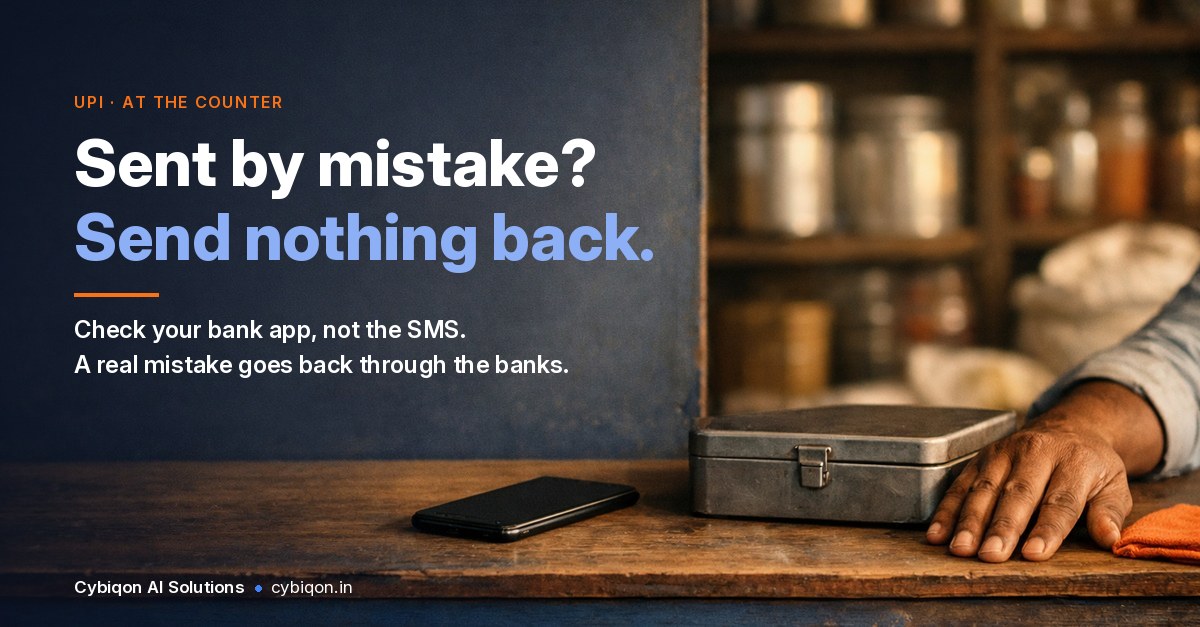
"Bhaiya, galti se paise chale gaye, wapas kar do." The call comes an hour after closing, or a man walks up to the counter holding his phone. He says he sent ₹5,000 to your shop's UPI by mistake and needs it back now, for his mother's hospital bill. Sending it back looks like the honest thing to do, and it's quick. That's why the sent money by mistake scam works on kirana stores, medical stores, jewellers and restaurants all over India.
This post covers what happens after a payment, when someone claims money reached you that wasn't meant for you. If the trouble is a customer showing you a "success" screen at the time of sale, our guide to spotting a fake UPI payment screenshot covers that.
Here's what's at stake. A wine shop in Mangalagiri, Andhra Pradesh took a ₹1,000 UPI payment, and its whole SBI current account, more than ₹8.26 lakh, was frozen for about ten months. Below you'll see the three forms this claim takes, how to check whether any money actually arrived, why you never send it back yourself, and how a genuine mistake gets returned through the banks.
What is the sent money by mistake scam? Three versions shops face
The story is always the same: "I sent you money by mistake, please return it." What sits behind it can be one of three things, and a cashier can't tell which by listening.
- The credit never happened. The caller shows you, or sends you, a message saying money reached your account. Nothing reached it. If you "return" the money, you've just paid a stranger out of your own balance. The Quint (15 Apr 2025) reported a case where the caller said he would send ₹3,000, then an SMS from a personal mobile number showed ₹30,000 credited, and he asked for the "extra" back. The person he called checked with the relative he'd named and paid nothing.
- The "refund" is really a debit. You're asked to approve something, enter your PIN or tap a link so the money can "go back". Any screen that asks for your UPI PIN sends money out of your account.
- The credit is real, and the money is stolen. This is the version owners don't expect. Ludhiana police warned shopkeepers on 5 Oct 2025 (The Tribune) that criminals were using stolen phones to send small UPI amounts to shopkeepers and vendors, then asking for a "refund" or buying goods. A Jagraon jeweller who received one of these payments had his accounts frozen. Police said shopkeepers who handed over cash against online transfers were frozen too.
Nobody publishes a count of "sent by mistake" cases specifically. For scale, a Lok Sabha written reply of 15 Dec 2025, using RBI data, put UPI fraud at 10.64 lakh incidents worth ₹805 crore in FY2025-26 up to November.
Someone says they sent me money by mistake on UPI. Should I send it back?
No, not as a new transfer and not in cash. That holds even when the credit is real. Here's why.
- If the credit is fake, a "return" is a fresh payment from your money.
- If the credit is real but the money is stolen, a second transfer ties your account to the fraud trail. That's how a ₹1,000 sale turned into the Mangalagiri freeze.
- If it's a genuine mistake, there's already a proper route. The sender asks their own bank or UPI app to raise a dispute. The banks send it through NPCI's dispute system, your bank contacts you, and you agree to the reversal through your bank. The money goes back along the same path it came, with a record at both ends.
Saying "please raise it with your bank, they'll contact mine" isn't rude and it isn't dishonest. It's the only way a returned payment is properly recorded. Maharashtra Cyber advised in 2023 that if someone insists, you ask them to come to the police station with ID instead of returning the money yourself.
A real bank customer who sent money to the wrong UPI ID can call NPCI's toll-free number, 1800-120-1740, or go through their own bank's app. Give them that number. Don't give them your money.
Spotting a sent money by mistake scam: check the bank app, not the SMS
The first thing to settle is whether anything arrived at all. Knowing how to check a UPI payment received properly protects you against version one.
Check these:
- Your bank's own app or net banking, the account statement, or a passbook entry
- The balance, not just the transaction list
- The UTR (the 12-digit UPI reference number) the caller quotes, matched against an entry in your statement
Don't treat these as proof:
- An SMS, especially one from a 10-digit personal number. Under TRAI's rules on message headers (in force since 6 May 2025), real bank alerts come from registered sender headers, not ordinary mobile numbers. Even so, don't trust any SMS on its looks. Open the app and check the balance.
- The caller's phone screen, a forwarded screenshot, or a WhatsApp message
- How sure the caller sounds, or how urgent his story is
So yes, a fake UPI credit SMS is a real thing. The only proof is your own bank's record of your own account.
If the money isn't in your statement, the call is over: "I don't see any payment, please check with your bank." If it is in your statement, move to the next section.
Do I need my UPI PIN to receive money? The jumped deposit scam
You never need a UPI PIN to receive money. You enter it only to send money or to check your balance in your own app. If a refund, a "verify receipt" screen or a link asks for your PIN, it's taking money out.
That's the idea behind the jumped deposit scam. On 12 Oct 2026, during National Cyber Security Month, SBI posted a warning on X (reported by Outlook Money): "Unexpected credit in your account? It's a Trap!" SBI told customers not to act on emergency UPI requests without confirming them, to block the caller, report it to the bank and call 1930.
One change helps. In a circular dated 29 Jul 2025, NPCI stopped person-to-person UPI collect requests from 1 Oct 2025 because they were being misused for fraud (Business Today, 13 Aug 2025). Merchant collect requests still exist, though, and SBI was still warning about "refund" pitches a year later. So the counter rule stays simple: no PIN for any refund, ever, without the owner standing there.
Wrong UPI transfer refund: how the bank route works, and how long it takes
This is where most guides go wrong. They're written for the sender, and many quote 24–48 hour timelines without a source. Here's the receiving side of a wrong UPI transfer refund, with the dated rules.
| Step | Who acts | Rule and timeline |
|---|---|---|
| 1. Sender raises a dispute | Sender, through their own bank or UPI app | Gives the UTR and amount |
| 2. Sender's bank raises a "wrong credit" chargeback | Sender's bank, through NPCI's dispute system | Bank-to-bank |
| 3. Your bank responds | Your bank, after asking you | 15 calendar days, cut from 35, for "Fraud" and "Wrong Credit" chargebacks: NPCI/UPI/OC No. 235/2026-27, dated 16 Jul 2026, effective 1 Aug 2026 (NPCI circular, as reported by TeamLease RegTech) |
| 4. If declined, the sender's bank can re-raise it | Sender's bank | Under NPCI's RGNB process, effective 15 Jul 2025, which covers reason CD2 (wrong UPI ID entered), the receiving bank must accept or contest within 3 calendar days for person-to-person and 15 calendar days for payments to a merchant, or it's deemed accepted (NPCI rule, as reported by Free Press Journal and Angel One) |
A shop paid on its merchant QR is usually on the 15-day merchant clock. The wrong credit chargeback in UPI is the formal reversal. You don't start it. You respond to your bank when it calls, and you can agree or object to the reversal.
So how long does a wrong UPI transfer refund take? Under those circulars the receiving bank has up to 15 calendar days to respond. Anyone who says "your bank will take months, just send it to me" is wrong.
Received money by mistake on UPI: should I return it and risk a freeze?
Being cautious here isn't paranoia. On 22 Jun 2026, in Sri Sai Wines v. Union of India (WP 969/2026), Justice Ravi Cheemalapati of the Andhra Pradesh High Court ruled on the Mangalagiri case. The wine shop had taken a ₹1,000 UPI payment from a customer later accused in a cheating case in Bihar. On the Patna Cyber Cell's instructions, SBI froze the shop's whole current account, more than ₹8.26 lakh, on 19 Aug 2025. The court held that a vendor "cannot verify the credentials" of a UPI payer, declared the freeze illegal and ordered SBI to lift it (LiveLaw, 6 Jul 2026; Verdictum, 8 Jul 2026).
The shop won, but only after about ten months without access to its own money. A bank account frozen after a UPI payment is the third version of this scam, and sending money back can make things worse. A second transfer to a fraud-linked number puts your account deeper in the trail police follow.
If a freeze happens anyway, don't try to work it out from this post. We've written up the remedies separately: the MHA's standard operating procedure for cyber-fraud cases, how lien amounts work, and how to apply to unfreeze, in what to do when your bank account is frozen over cyber crime.
What should a shopkeeper do if a customer says they paid twice by mistake?
A double payment from someone actually at your counter, while you watch, is ordinary, and it's the only case where an on-the-spot refund makes sense. Even then, check that both credits are in your own app, refund only against those UTRs, and write it down. If the customer's screen says pending, see our guide on a UPI payment that's pending but deducted first. The "second" payment is often money on its way back to them.
For everything else (phone calls, walk-ins about earlier days, strangers), give every cashier this five-step counter card:
- Check the bank app or statement for the credit and UTR. Never go by an SMS or the caller's screen.
- Send nothing back as a new transfer and give no cash. Never enter a PIN.
- Refer a genuine sender to their own bank or app (NPCI: 1800-120-1740).
- Log the date, phone number, amount and the UTR they claim.
- Report a fraud call at 1930 or cybercrime.gov.in, and suspicious calls or SMS through Chakshu on sancharsaathi.gov.in.
Pressure at the counter is where this goes wrong. The same goes for a swapped QR code sticker: the fix is a rule the cashier follows without having to decide, backed by a record the owner can check later. A daily cash reconciliation that matches UPI credits by UTR every night makes any "mistaken" payment show up before anyone calls about it.
FAQs
Someone says they sent me money by mistake on UPI. Should I send it back?
Not yourself. First check your bank app or statement. If no credit arrived, there's nothing to return. If it did, ask the sender to raise a dispute with their own bank or UPI app. Your bank will contact you and the reversal goes through the banks.
How do I check whether a UPI payment really reached my account?
Open your bank's own app or net banking and look at the statement and the balance. Match the UTR the person quotes. An SMS, a screenshot or the caller's phone screen isn't proof.
Can a bank SMS saying money was credited be fake?
Yes. Real bank alerts come from registered sender headers under TRAI's rules, not from 10-digit personal numbers, but don't decide by the sender name. Check the balance in your bank app.
Do I need my UPI PIN to receive money?
Never. A PIN is only for sending money or checking your balance. Any refund or "receive" screen that asks for your PIN will debit your account.
How long does a wrong UPI transfer refund take?
Under NPCI circular OC 235/2026-27 (effective 1 Aug 2026, as reported by TeamLease RegTech), the receiving bank has 15 calendar days to respond to a wrong-credit chargeback. If it's re-raised under NPCI's RGNB process, the window is 3 days for person-to-person payments and 15 days for merchant payments.
Let your counter screen handle the "sent by mistake" call
Cybiqon can build your shop a counter payments panel. It shows every UPI credit as it actually settles in your account, matched by UTR, so the cashier checks one screen instead of an SMS. A refund can only be logged against a confirmed credit and needs the owner's approval. A "mistaken payment claim" log records the caller's number, amount and UTR, and reminds staff to send the caller to their own bank. If your account is ever questioned, you have a dated record of every claim and what you did about it.
We write it for your shop, your staff and your billing, not set it up from a template, and you own the code. See what's included on our admin panels and internal software page, or book a 30-minute call with Cybiqon's founders. You can also reach us at +91 9250711473 or [email protected].
Conclusion
The sent money by mistake scam works because returning the money feels like the honest thing to do. Check your bank app, not the SMS. Never enter a PIN to receive money, and never send a "refund" yourself. If a mistake is real, the sender's bank raises a wrong-credit chargeback and yours has 15 calendar days to respond, so nobody loses by waiting. Collecting what you're owed is part of the same cash-flow discipline as recovering delayed payments. If you'd like your counter to follow these rules automatically, Cybiqon can build it.
Want this set up for your business?
Book a free call — no tech jargon, no sales pressure. Just honest answers.